Nepalese Hand-Painted Thangka: The Esoteric Core, Deity System, and Traditional Craft of the Vajrasattva Thangka

$599.00 USD
Thangka name: Colorful Tang Vajrasattva Song
size: 45cm×60cm
origin: Nepal
Eine Frage stellen

Beeil dich! Nur noch [Anzahl] auf Lager!

Geschätzte Lieferzeiten: 12–26 Tage (International), 3–6 Tage (USA).

Rückgabe innerhalb von 45 Tagen nach dem Kauf. Zölle und Steuern werden nicht erstattet.

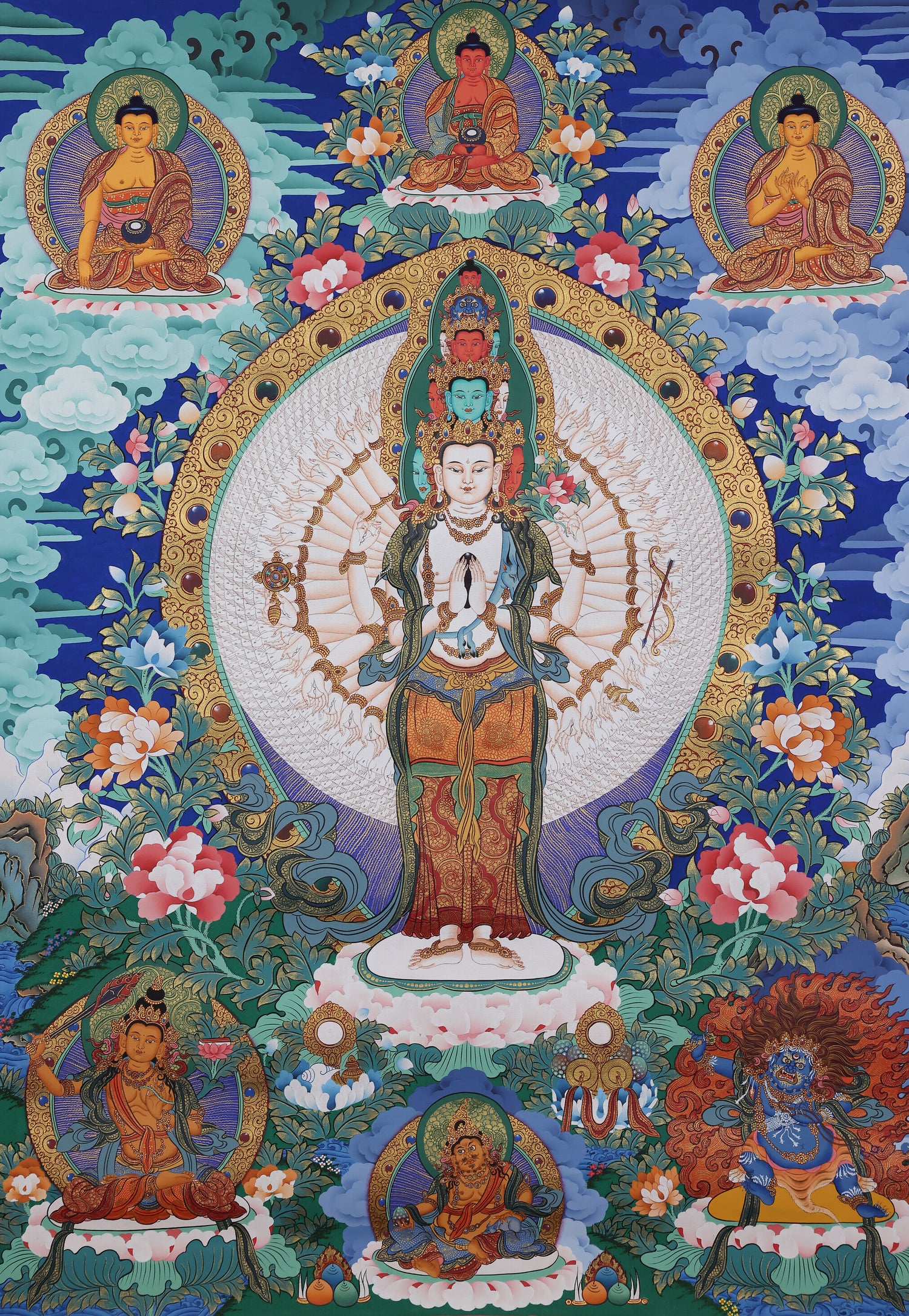
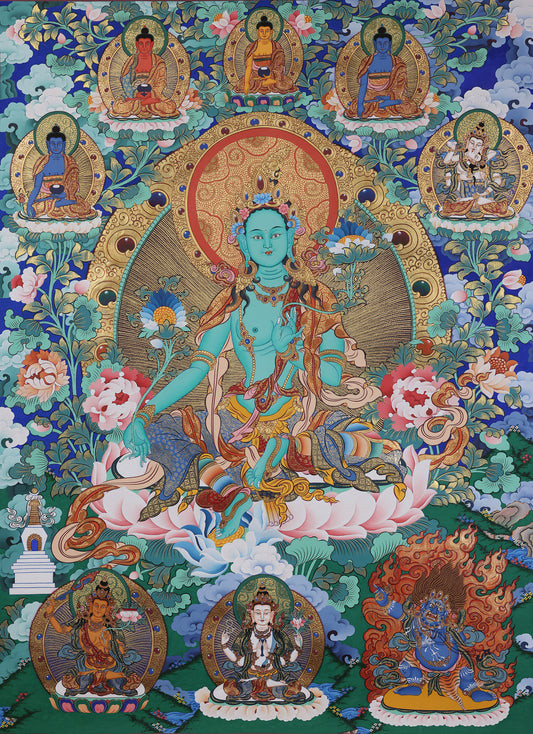
Hand-painted Tibetan Thangka of Vajrasattva, the Vajrayana deity of purification in Tibetan Buddhism.
Nepalese Hand-Painted Thangka: The Esoteric Core, Deity System, and Traditional Craft of the Vajrasattva Thangka
$599.00 USD

What Is a Nepalese Vajrasattva Thangka? A Visual Tool for Esoteric Tibetan Buddhist Purification Practice

When a vividly colored Nepalese hand-painted thangka unfolds, what you see is not just a painting—it is a practice mandala for "confessing karmic obstacles and returning to original purity" in esoteric Tibetan Buddhism.

This 45×60cm hand-painted thangka centers on the esoteric practice of Vajrasattva purification. In the esoteric Tibetan Buddhist system, Vajrasattva (Sanskrit: Vajrasattva) is regarded as the "synthesis of all yidams": his "vajra" nature represents the unshakable essence of bodhicitta, embodying both the dharmakaya of Samantabhadra Buddha and the inherent Buddha-nature of all sentient beings. By choosing Vajrasattva as the main deity, Nepalese thangkas align with Tibetan Buddhism’s core focus on "purification as practice" while resonating with local spiritual needs for "purity and protection."

Unlike ordinary decorative art, this thangka’s mandala-style layout (main deity centered, attendants surrounding) materializes esoteric rituals: during visualization, practitioners can enter a state of "one’s mind as the mandala" through the imagery, achieving the religious function of "dissolving karmic obstacles and purifying the mind." This is the core distinction of thangkas from other art forms: they are "visual texts for practice."

Main Deity Vajrasattva: Every Detail Is an Esoteric Symbol

The central deity in the painting is a standard sambhogakaya Vajrasattva in Tibetan thangkas, with each detail carrying deep esoteric meaning:

  • Body Color and Posture: His 通体 white form corresponds to "unstained mind"; he sits in the vajra cross-legged position (Vajrasana), symbolizing "transcending the extremes of samsara and nirvana"; he wears the "thirteen sambhogakaya adornments" (five-Buddha crown, jewelry, scarves, etc.), embodying both the compassion of a bodhisattva and the majesty of a vajra—this is a visual expression of "uniting compassion and wisdom."
  • Mudra and Implements: His right hand holds a five-pronged vajra at his heart (the five prongs represent the Five Buddhas; the vajra symbolizes "indestructible skillful means of the ultimate truth," capable of destroying ten afflictions); his left hand holds a vajra bell at his waist (the bell represents "prajna wisdom," rousing sentient beings with its dharma sound). The "combined vajra and bell" is Vajrasattva’s iconic symbol, signifying the esoteric core of "non-duality of wisdom and skillful means."
  • Aura and Lotus Seat: The nimbus (circular head halo) and body aura (radiating light) represent "original wisdom illuminating all directions"; the double lotus seat (pink lotus symbolizes freedom from afflictions, white lotus platform symbolizes inherent purity) is a classic symbol of "a sacred deity untainted by the mundane."

Attendant Deities: A Functional Network in Hierarchical Layout

The attendant deities surrounding the main deity are not arranged randomly but form a functional hierarchy corresponding to different practice meanings:

  1. Upper Attendants: Source of the Dharma and Compassionate Protection

    The red-bodied deity at the top center is Shakyamuni Buddha (or Amitabha Buddha), representing the "root of the dharma"; the white and green-bodied deities on either side are White Tara (relieving suffering) and Green Tara (increasing merit and wisdom)—this combination reinforces the theme of "compassionate protection" while aligning with the folk tradition of "Tara veneration" in Nepalese thangkas.
  2. Lower Attendants: Balance of Serene and Wrathful Forms

    The four-armed white-bodied deity at the bottom left is Four-Armed Avalokiteshvara, holding a lotus and scripture scroll, corresponding to "liberating sentient beings from suffering"; the blue-bodied wrathful deity at the bottom right is Vajrapani, wreathed in flames (burning afflictions) and holding implements (subduing obstacles). The "serene + wrathful" combination reflects esoteric Tibetan Buddhism’s approach of "using both gentleness and subjugation," echoing the doctrine that "afflictions are Buddha-nature."
  3. Bottom Symbols: The Ultimate Goal of Practice

    The "dharma wheel" (eight spokes represent the Eightfold Path) and "lotus" beneath the main deity’s lotus seat unify the thangka’s meaning: the dharma wheel symbolizes the spread of the dharma, and the lotus symbolizes a pure mind—these are the ultimate states practitioners strive to attain.

Nepalese Thangka Craft: Millennia of Tradition in Natural Materials

The "texture" of this thangka stems from the combination of traditional Nepalese craftsmanship and natural materials:

  • Canvas Base: Fine white cotton cloth is treated through three steps—"applying plant glue → smearing lime paste → repeated polishing"—to create a smooth, seamless surface. This is a typical Nepalese thangka practice of "light base, heavy color," distinct from the thick bases of Tibetan thangkas.
  • Mineral Pigment System: White comes from white clay or mica; red from cinnabar or red earth; blue from lapis lazuli; green from malachite; yellow from realgar or Rohitaka grass. These pigments require "grinding with an agate pestle → mixing with bone glue," a process that takes months but results in colors that endure (e.g., the deep blue of lapis lazuli and vibrant green of malachite cannot be replicated by synthetic pigments).
  • Painting Process: Strictly follows the steps: "marking positioning lines → sketching with charcoal → outlining with ink → layering colors → gilding with 24K gold powder → opening the face (painting facial features) on an auspicious day." "Opening the face" is the core step: the artist uses a fine brush to paint the main deity’s half-open eyes, symbolizing "watching over sentient beings"—this is a Nepalese artist’s "master skill," directly determining the thangka’s "spiritual essence."

Nepalese Style: Fusion of Tibetan Norms and Regional Aesthetics

The "distinctiveness" of this thangka comes from the softening of Tibetan thangka conventions by Nepalese regional style:

  • Color Aesthetics: Characterized by "high saturation and strong contrast"—the white of the main deity, gold of the aura, blue of the background, and pink of the lotus create a striking visual impact, aligning with Nepalese folk preference for "bright hues" and differing from the subdued tones of Tibetan thangkas.
  • Lines and Form: Lines are soft and fluid, with decorative curves for scarves and lotus petals; figures have slender proportions and rounded faces (large eyes, prominent noses)—unlike the strict proportions of Tibetan thangkas (governed by the Iconometry Sutra), this style has the vitality of folk art.
  • Gilding Craft: 24K gold powder is used to decorate auras and implements through a combination of "flat gilding and line outlining." While less intricate than the "hairline gilding" of Tibetan thangkas, the 厚重感 (heaviness) of the gold powder (which shines after polishing with an agate brush) lends the thangka a magnificent appearance.

Conclusion: More Than a Thangka—A Microcosm of Himalayan Culture

This Nepalese Vajrasattva thangka is a synthesis of "esoteric meaning, craftsmanship, and regional aesthetics": it is both a Tibetan Buddhist practice tool (for visualization and confession) and an expression of Nepalese culture (fusing traditional craft with folk aesthetics). Its 45×60cm size makes it suitable for household shrine worship and easy for practitioners to carry— it is a product of cross-regional exchange in the Himalayan cultural sphere, and a vivid example of "visualized faith."

# Nepalese Hand-Painted Thangka #Vajrasattva Thangka #Esoteric Tibetan Buddhist Art #Natural Mineral Pigment Thangka #Thangka Deity Analysis #Nepalese Thangka Craft #Tibetan Thangka Style #Purification Esoteric Thangka #Himalayan Cultural Art #Handmade Thangka Collection
Entdecken Sie das perfekte tibetisch-buddhistische Thangka, das zu Ihren Wünschen, Ihrem Lebensstil und Ihrem Raum passt. Jedes Thangka hat eine spirituelle Bedeutung und bringt Segen, wenn es richtig platziert wird.

1. Definieren Sie Ihre Absicht

Reichtum & Erfolg → Gelber Dzambhala (Gottheit des Reichtums)

Mitgefühl und Frieden → Avalokiteshvara, Grüne Tara

Weisheit & Lernen → Manjushri

Gesundheit & Heilung → Medizinbuddha

Langlebigkeit und Familienschutz → Weiße Tara

2. Wählen Sie nach Identität

Unternehmer und Geschäftsinhaber → Reichtumsgottheiten für Wohlstand.

Studenten und Gelehrte → Weisheitsgottheiten für Konzentration und Klarheit.

Heiler und Yoga-Praktizierende → Medizinbuddha für Energie und Gleichgewicht.

Familien und Hausfrauen → Tara-Gottheiten für Harmonie und Sicherheit.

Sammler und Kunstliebhaber → Seltene Mandalas oder Meisterwerk-Thangkas.

3. Passen Sie Ihren Raum an

Heimschrein / Meditationsraum → Mittlere Thangkas (60–80 cm).

Büro / Geschäftshalle → Große Thangkas für Wohlstand und Autorität.

Wohnzimmer / Arbeitszimmer → Dekorative Thangkas für Frieden und Schönheit.

4. Authentische Handwerkskunst

Jedes Thangka ist mit natürlichen Mineralpigmenten und feiner Leinwand handbemalt und spiegelt tibetische Kunstfertigkeit und spirituelle Kraft wider. Überprüfte Quellen gewährleisten Qualität und Respekt für die Tradition.

✨ Wählen Sie Ihr Thangka mit Herz – es ist nicht nur Kunst, sondern ein Segen für Ihr Leben.

Jeder Mensch hat unterschiedliche Bedürfnisse. Die Wahl des richtigen Thangkas kann spirituelle Unterstützung, Schutz, Glück und Segen bieten. Nachfolgend finden Sie Thangka-Empfehlungen für verschiedene Rollen:

1. Unternehmer

  • Bedürfnisse : Weisheit, Reichtum, Gesundheit, beruflicher Erfolg.
  • Empfohlene Thangkas :
    Manjushri : Verbessert die Entscheidungsfindung und Geschäftsweisheit.
    Gottheit des Reichtums : Bringt Reichtum und Wohlstand.
    Medizinbuddha : Unterstützt die Gesundheit und reduziert Stress.
    Mahakala : Schützt Unternehmen vor Konkurrenz und Herausforderungen.

2. Erfolgreiche Einzelpersonen

  • Bedürfnisse : Innerer Frieden, Familienharmonie, Langlebigkeit.
  • Empfohlene Thangkas :
    Amitabha Buddha : Bringt inneren Frieden und Ruhe.
    Avalokiteshvara (Guanyin) : Fördert Harmonie und Glück in der Familie.
    Amitayus (Langlebens-Buddha) : Betet für gute Gesundheit und ein langes Leben.
    Manjushri : Stärkt weiterhin die Weisheit.

3. Hausfrauen/Ehemänner

  • Bedürfnisse : Familienharmonie, Schutz, Gesundheit.
  • Empfohlene Thangkas :
    Avalokiteshvara : Steigert das Familienglück und die Harmonie.
    Schutzgottheiten : Beschützen die Familie vor äußeren Störungen.
    Weiße Tara : Segnet die Familie mit Gesundheit.

4. Studierende und Wissenschaftler

  • Bedürfnisse : Weisheit, Konzentration, akademischer Erfolg.
  • Empfohlene Thangkas :
    Manjushri : Fördert Lernfähigkeit, Gedächtnis und Weisheit.
    Shakyamuni Buddha : Hilft bei der Konzentration und spirituellen Praxis.
    Jixiang Tianmu : Bringt akademisches Glück und Prüfungserfolg.

5. Künstler und Kreativprofis

  • Bedürfnisse : Inspiration, Kreativität, künstlerische Leistung.
  • Empfohlene Thangkas :
    Manjushri : Regt kreatives Denken und Inspiration an.
    Vajrapani : Hilft, kreative Blockaden zu überwinden.
    Maitreya : Sorgt für eine entspannte und optimistische Einstellung und baut Stress ab.

6. Reisende und Abenteurer

  • Bedürfnisse : Schutz, Glück, Erfolg bei Abenteuern.
  • Empfohlene Thangkas :
    Hayagriva : Bietet starken Schutz auf Reisen und beseitigt Hindernisse.
    Mahakala : Bringt Glück und Schutz, insbesondere für Abenteurer.
    Vajrasattva : Hilft, Schwierigkeiten und Herausforderungen während der Reise zu überwinden.

7. Ältere Menschen

  • Bedürfnisse : Gesundheit, Langlebigkeit, spiritueller Frieden.
  • Empfohlene Thangkas :
    Amitayus : Betet für ein langes Leben und gute Gesundheit.
    Medizinbuddha : Fördert Heilung und körperliches Wohlbefinden.
    Avalokiteshvara : Bringt Mitgefühl und inneren Frieden in späteren Jahren.

8. Führungskräfte

  • Bedürfnisse : Führung, Weisheit, Teamarbeit und geschäftlicher Erfolg.
  • Empfohlene Thangkas :
    Manjushri : Verbessert Führungsqualitäten und Entscheidungsfindung.
    Gottheit des Reichtums : Bringt dem Unternehmen und dem Team Erfolg und Wohlstand.
    Avalokiteshvara : Fördert Harmonie und Gleichgewicht innerhalb des Teams.

9. Gesundheits- und Fitnessbegeisterte

  • Bedürfnisse : Gute Gesundheit, Vitalität, Energie.
  • Empfohlene Thangkas :
    Medizinbuddha : Verbessert die körperliche Gesundheit und Vitalität.
    Weiße Tara : Bringt Gesundheit und Verjüngung.
    Vajrasattva : Beseitigt gesundheitliche Probleme und steigert die Energie.

10. Politiker

  • Bedürfnisse : Führung, Weisheit, Frieden.
  • Empfohlene Thangkas :
    Manjushri : Verbessert Führungsqualitäten und Entscheidungsfindung.
    Vairocana Buddha : Hilft, inneren Frieden und Weisheit zu bewahren.
    Avalokiteshvara : Fördert den gesellschaftlichen Frieden und die Harmonie in der Familie.

Für alle Bestellungen über 100 USD ist der Versand kostenlos.

Rücksendungen werden bis zu 10 Tage nach Erhalt des Kaufbelegs bzw. der Sendungsnummer (bei ungetragenen Artikeln) akzeptiert. Sie als Kunde sind verpflichtet, uns vor der Rücksendung des Artikels per E-Mail zu informieren.

Andernfalls fallen die Standardversandkosten an. Weitere Informationen finden Sie in unseren Lieferbedingungen .

Rücksendungen werden bis zu 10 Tage nach Erhalt des Kaufbelegs oder der Sendungsnummer (bei ungetragenen Artikeln) akzeptiert. Sie als Kunde sind verpflichtet, uns vor der Rücksendung des Artikels per E-Mail zu informieren, nur in folgenden Fällen:

– Den falschen Artikel erhalten.
– Artikel kam nicht wie erwartet an (z. B. beschädigte Verpackung).
– Artikel hatte Mängel.
– Über die Lieferzeit hinaus.
– Der Spediteur gestattet keine Besichtigung der Ware vor der Bezahlung.

Die zurückgesendeten Produkte müssen in der Originalverpackung, sicher verpackt, unbeschädigt und ungetragen sein. Dies bedeutet, dass die Artikel zum Schutz während des Transports sicher in einem Karton verpackt sein müssen, möglichst im selben Karton, in dem sie an Sie als Kunde versendet wurden.

Kürzlich angesehen

Nicht vergessen! Die Produkte, die Sie angesehen haben, legen Sie jetzt in den Warenkorb.

Passt gut zu

Erweitern Sie Ihre Auswahl mit perfekt abgestimmtem Zubehör und ergänzenden Produkten.

Leute kauften auch

Hier sind einige unserer ähnlichsten Produkte, die die Leute kaufen. Klicken Sie hier, um den Trendstil zu entdecken.