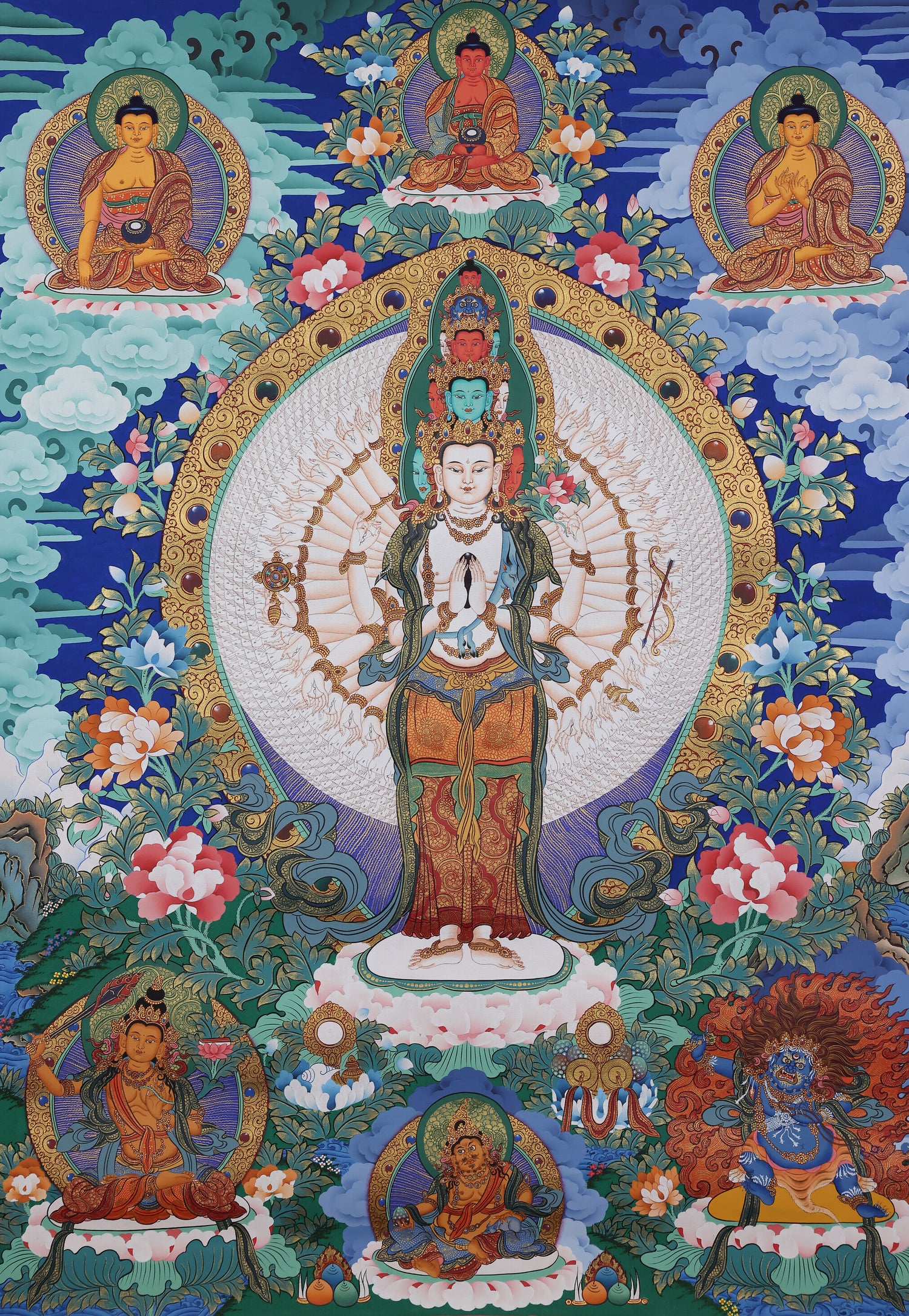
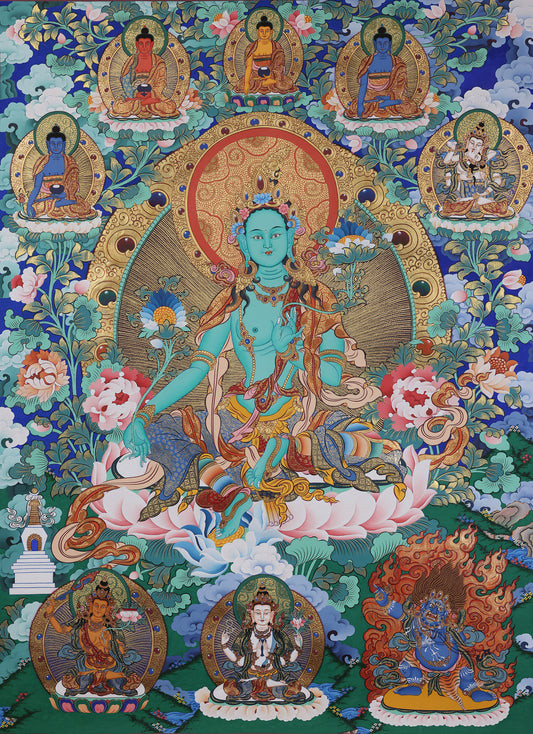
This hand-painted Four-Armed Avalokiteshvara Thangka is a sacred masterpiece that unites profound Tibetan Buddhist doctrine with the refined craftsmanship of the Rebgong (Regong) painting tradition. Centered on Four-Armed Avalokiteshvara (Chenrezig) as the principal deity, and surrounded by attendant deities, protectors, and auspicious symbols, the composition presents a complete visual system of Tibetan Vajrayana practice.
More than a devotional image, this thangka functions as a spiritual mandala—a sacred field where compassion, wisdom, merit, and protection converge. It serves simultaneously as an object of veneration, a contemplative aid, and a timeless work of sacred art.
I. Spiritual Core: Compassion as the Heart of Vajrayana Practice
The central theme of this thangka is the boundless compassionate vow of Four-Armed Avalokiteshvara and the protective spiritual network that emanates from it.
In Tibetan Buddhism, Avalokiteshvara is revered as the “Lord of Compassion” and the spiritual protector of the Himalayan region. Placing Four-Armed Avalokiteshvara at the center of a mandala-like composition reflects a complete path of practice:
Compassion as the axis, wisdom as guidance, merit as support, and protectors as guardians.
From a doctrinal perspective, the composition conveys three essential layers of meaning:
-
The Four Arms represent the Four Enlightened Activities:
Pacifying suffering, Increasing merit and wisdom, Magnetizing beings through compassion, and Subduing inner and outer obstacles.
-
The mandala structure illustrates the path of realization:
With compassion at the center, supported by wisdom and protective forces, practitioners advance steadily on the spiritual path.
-
The thangka itself functions as a meditation support:
In Vajrayana, sacred images are not symbolic decorations but living visual teachings—“the Dharma expressed through form.”
II. The Principal Deity: Four-Armed Avalokiteshvara in Sacred Iconography
The central figure of Four-Armed Avalokiteshvara (Chenrezig) is rendered in strict accordance with traditional iconographic canons and ritual measurements. Every detail carries precise spiritual meaning.
Physical Attributes
-
Pure white body: Symbolizes the immaculate nature of awakened compassion, free from all defilements.
-
Five-jeweled crown: Represents the wisdom of the Five Dhyani Buddhas, showing that compassion is inseparable from wisdom.
-
Amitabha Buddha on the crown: Indicates Avalokiteshvara’s spiritual lineage and connection to the Pure Land tradition.
Hand Gestures and Sacred Objects
-
Central hands joined at the heart holding a wish-fulfilling jewel: Symbolize the unity of wisdom and skillful means, compassion and insight as one.
-
Upper right hand holding a crystal mala: Each bead represents a vow to liberate beings, signifying ceaseless compassionate activity.
-
Upper left hand holding a white lotus: Symbolizes purity and transcendence—remaining unstained while manifesting in the world.
Posture and Throne
Seated in full lotus posture upon a thousand-petaled lotus and moon disc, Avalokiteshvara embodies unwavering meditative stability and cool, soothing compassion—actively liberating beings amid the suffering of samsara.
III. Attendant Deities and Auspicious Elements: A Complete Network of Compassionate Protection
Surrounding the principal deity is a carefully structured spiritual ecosystem of compassion and protection.
Upper Deities: Lineage and Blessings
-
Amitabha Buddha (center): The root guru and source of Avalokiteshvara’s compassionate activity.
-
White Tara (left): Bestows longevity, healing, and serenity—gentle, nurturing compassion.
-
Green Tara (right): Grants swift protection and successful activity—dynamic, responsive compassion.
Together, these three form a triangular field of blessings that supports practitioners physically, mentally, and spiritually.
Lower Protectors: Merit and Obstacle Removal
-
Yellow Jambhala (Wealth Deity): Represents spiritual and material resources needed to sustain the path—not worldly greed, but virtuous abundance.
-
Wrathful Dharma Protectors: Subdue inner afflictions and external obstacles, balancing Avalokiteshvara’s peaceful compassion with powerful protective force.
Decorative Motifs
Flowing lotus vines, lush foliage, and auspicious cloud patterns fill the background, symbolizing infinite compassion, continuous vitality, and the all-pervading presence of enlightened activity.
IV. Artistic Craftsmanship: The Sacred Discipline of Rebgong Hand Painting
This thangka is created using traditional Rebgong (Regong) hand-painting techniques, a UNESCO-recognized intangible cultural heritage. Every stage of creation is itself a form of spiritual practice.
-
Canvas Preparation: Aged cotton cloth is stretched, sized, coated, and polished to form a pure and stable foundation.
-
Precise Sacred Drafting: Iconographic proportions follow canonical measurements, with deviations measured in millimeters.
-
Natural Mineral Pigments: Over 100 traditional materials—including cinnabar, malachite, azurite, lapis lazuli, and gold—are layered to achieve depth, luminosity, and longevity.
-
Gold Line Detailing: 24K gold is used to outline ornaments and sacred symbols, representing the radiance of awakened wisdom.
-
Final Eye-Opening Ritual: The completion phase, performed with meditative focus, symbolically “awakens” the image and aligns it with its sacred purpose.
Conclusion: One Thangka, One Mandala of Compassion
This hand-painted Four-Armed Avalokiteshvara Mandala Thangka is far more than a religious artwork.
It is a spiritual guide, a source of inner refuge, and a timeless embodiment of Tibetan Buddhist wisdom.
To contemplate this thangka is to encounter the essence of the Dharma itself:
Facing suffering with compassion, transcending confusion with wisdom, and finding peace through faith.
#FourArmedAvalokiteshvara
#ChenrezigThangka
#AvalokiteshvaraThangka
#TibetanBuddhistThangka
#BodhisattvaThangka
#HandPaintedThangka
#RebgongThangka
#TraditionalThangkaArt
#TibetanSacredArt
#CompassionPractice
#MeditationThangka
#SpiritualMandala
#VajrayanaBuddhism
#MindfulnessArt
#HomeShrine
#MeditationSpace
#YogaAndHealing
#SpiritualDecor
#SacredWallArt