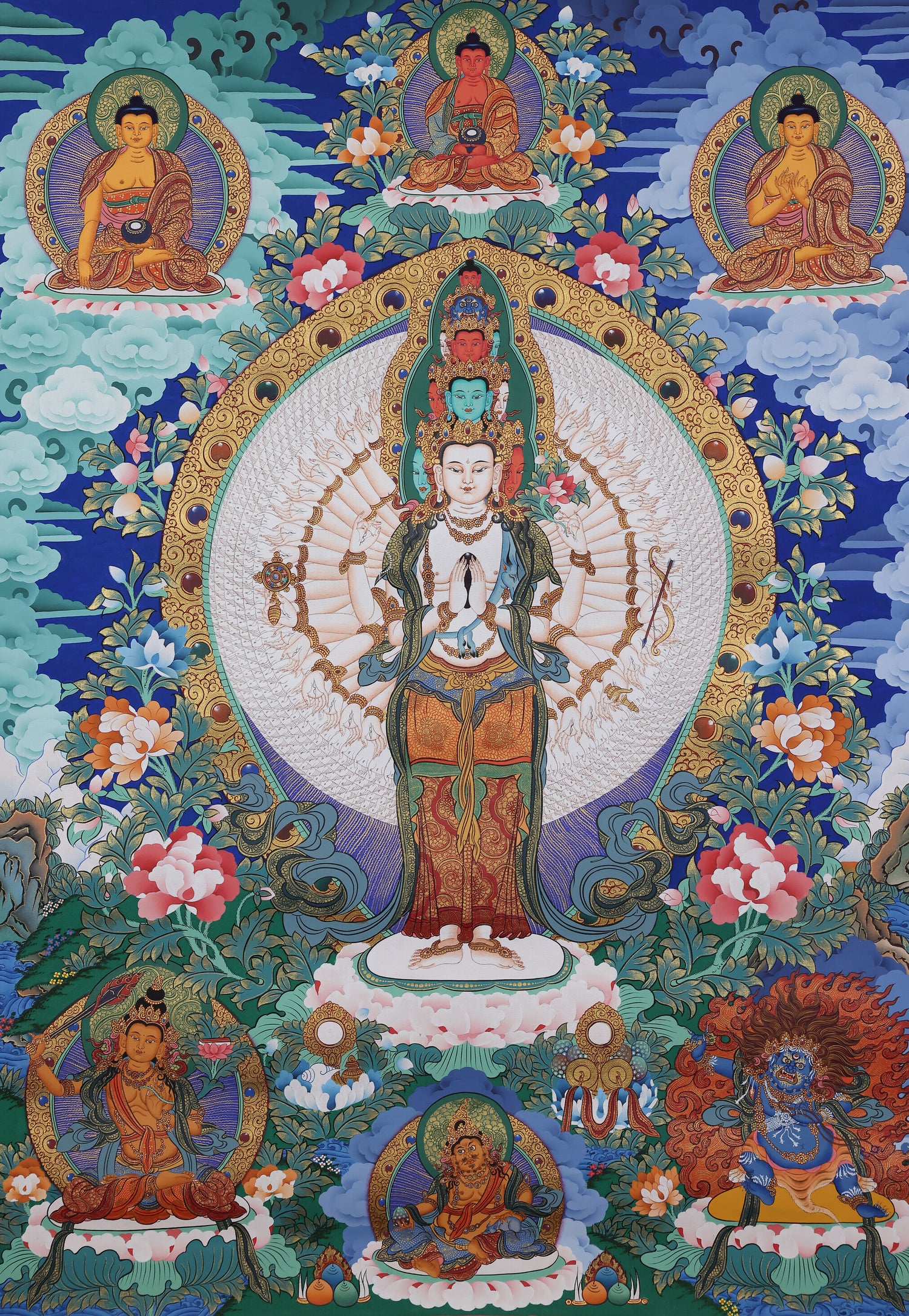
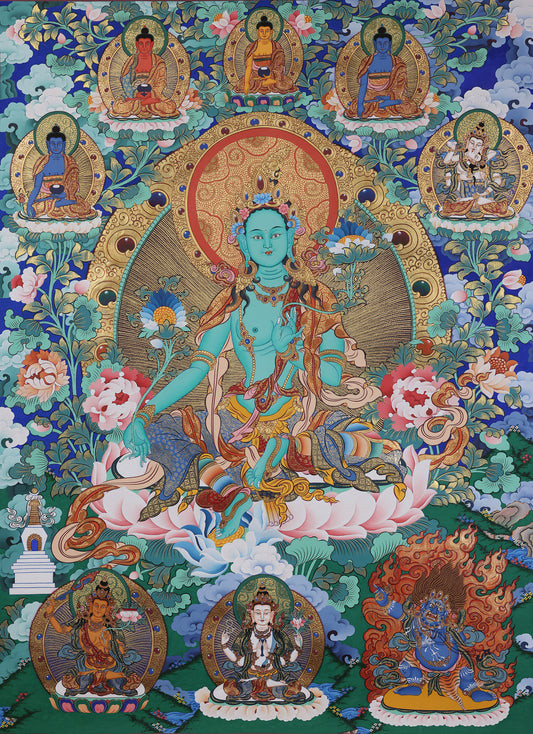
When a Samantabhadra thangka painted with mineral pigments unfurls, the deep blues of azurite, emerald greens of malachite, and crimson reds of cinnabar are more than just color—they are the symbiosis of Tibetan Buddhist doctrine and Nepalese millennial craftsmanship. This 42×60cm hand-painted thangka, crafted by a Nepalese Newari school artisan, centers on the "Avatamsaka Trinity," weaving religious ritual, natural gifts, and artistic precision into a single cloth.
In Tibetan Buddhist context, Samantabhadra embodies the "perfection of practice"—in the Avatamsaka Sutra, he and Manjushri (perfection of wisdom) attend Vairocana Buddha, forming the core of the "Avatamsaka Trinity." This thangka’s choice of Samantabhadra as the main deity is a visual expression of the "unimpeded vows" spiritual philosophy: for Tibetan devotees, Samantabhadra’s form is an anchor for "manifesting principle through practice"; for Nepalese artisans, this theme is a classic vessel for Sino-Nepalese Buddhist cultural exchange.
Every detail aligns with doctrine: the main deity’s six-tusked white elephant mount corresponds to the "Six Perfections" (generosity, discipline, patience, diligence, meditation, wisdom); the ruyi scepter (or vase) he holds symbolizes "vows fulfilled"; even the pink peonies (not native to Tibet, but a Gandhara-influenced motif in Newari art) metaphorize "majestic merit."
The central Samantabhadra blends Tibetan Iconometric Canon and Newari style:
-
Form: A soft, rounded face (Newari "infant-like" feature) with high brow bones and curved eyes; milky white skin symbolizes purity. His celestial robes, layered with mineral pigments in blue and red, are edged with 24K gold leaf for pearls and coral ornaments—honoring the "adorned bodhisattva" ritual while showcasing the Newari school’s opulent "color-rich adornment."
-
Symbols: His right hand forms the gesture of granting wishes; his left holds a vase. The six-tusked white elephant mount rests in a reclining pose—its curled trunk is a Newari symbol of "auspicious tameness," and the emerald pendant on its body reflects the Newari artisan’s unique take on "jeweled majesty."
-
Aura and Lotus Seat: A reddish-orange flame nimbus (wisdom light) surrounds his head; a boat-shaped aura of blue and gold (a classic Tibetan form) frames his body. The multi-layered pink lotus seat, set against green grass and flowing water patterns, merges the doctrine of "lotus-born purity" with the Newari compositional logic of "nature enclosing the main deity."
The attendant deities at the thangka’s corners form a complete sacred system:
-
Two Buddhas Above: The red-bodied Shakyamuni (Saha World ruler) at the top left, and the blue-bodied Akshobhya (Eastern Pure Land ruler) at the top right—simplified with Newari "small form, round aura" to complement the main deity without overshadowing it.
-
Two Attendants Below: Manjushri (sword in hand) at the bottom left, and Avalokiteshvara (lotus in hand) at the bottom right—extensions of the Avatamsaka Trinity and core figures of the "Four Great Bodhisattvas," their "willow-like gentle postures" embody Newari art’s vitality.
-
Border Ornaments: Blue cloud patterns and pink peony motifs, influenced by Indian art in Newari painting, symbolize "auspicious majesty."
This thangka uses pure mineral and earth pigments, adhering to Nepal’s highest standards of manual craftsmanship:
-
Core Mineral Colors: Azurite (blue) and malachite (green) are sourced from northern Nepalese mountains, processed through four steps (crush, soak, grind, settle) to layer hues (first blue, second blue), ensuring rich, fade-resistant color. Cinnabar (red) and realgar (yellow) come from Himalayan veins; white clay is local kaolin—mixed with 牛皮胶 (cowhide glue) in "weather-dependent ratios" (1:3 at 50% humidity) to balance adhesion and transparency.
-
Special Materials: 24K gold leaf is ground into powder, applied via "glue, sprinkle, polish with agate knife" to create a mirror-like luster. Coral and pearl powder detail small features (e.g., the elephant’s eyes), aligning with the religious belief that "jewels in art equal blessing."
As a first-grade Nepalese thangka, its creation takes 40–70 days:
-
Cloth Preparation: Thick cotton cloth is coated 5–6 times with cowhide glue and white clay, then polished smooth with pebbles (a key Newari step: "canvas quality defines detail precision").
-
Sketching and Outlining: After charcoal positioning, wolf hair brushes dip ink to outline with "nail-head rat-tail" and "orchid leaf" strokes—slender and fluid.
-
Coloring and Gradation: "Background first, main deity last," using "dot-dyeing" to layer 3–5 coats (e.g., Samantabhadra’s skin tone transition) for three-dimensional gradation.
-
Gold Outlining and Consecration: Gold powder outlines details; after monk-led chanting blessings, the seed syllables "Om Ah Hum" (symbolizing Buddha’s body, speech, mind) are written on the back—transforming the artwork into a ritual object.
This thangka is a quintessential fusion of Newari and Tibetan thangka styles:
-
Composition: The main deity occupies 60% of the space, with attendants at the corners—upholding the Tibetan "main deity supremacy" religious logic while using Newari "balanced density" aesthetics to avoid clutter.
-
Color: High-contrast "blue-red-yellow" hues, with the natural luster of minerals (e.g., azurite’s gem-like blue) enhancing sacredness—aligning with Tibetan tradition of "colors as doctrinal metaphors."
-
Form: Strictly following the Iconometric Canon proportions, yet softened by Newari "curved forms" to balance divinity and humanity, moving beyond the rigidity of Tibetan thangkas.
This Nepalese Samantabhadra thangka is both a visual carrier of Tibetan Buddhism’s Avatamsaka doctrine and a living heritage of Newari craftsmanship. The eternal colors of mineral pigments connect the Himalayan earth to devotees’ spiritual worlds; the fused iconography witnesses millennia of Sino-Nepalese Buddhist art exchange. It is both a "mobile temple" and a cross-cultural artistic treasure.
# Nepalese Thangka #Samantabhadra Thangka #Tibetan Buddhist Art #Newari Painting School #Mineral Pigment Thangka #Avatamsaka Trinity #Hand-Painted Thangka #Buddhist Iconography Art #Thangka Craft Analysis #Religious Art Collection