Analysis of a Hand-Painted Nepalese Thangka of Shakyamuni Buddha: Worldly Enlightenment and Three-Age Lineage in Tibetan Buddhist Art

$599.00 USD
Thangka name: Cai Tang Shakyamuni
size: 45cm×65cm
origin: Nepal
Eine Frage stellen

Beeil dich! Nur noch [Anzahl] auf Lager!

Geschätzte Lieferzeiten: 12–26 Tage (International), 3–6 Tage (USA).

Rückgabe innerhalb von 45 Tagen nach dem Kauf. Zölle und Steuern werden nicht erstattet.

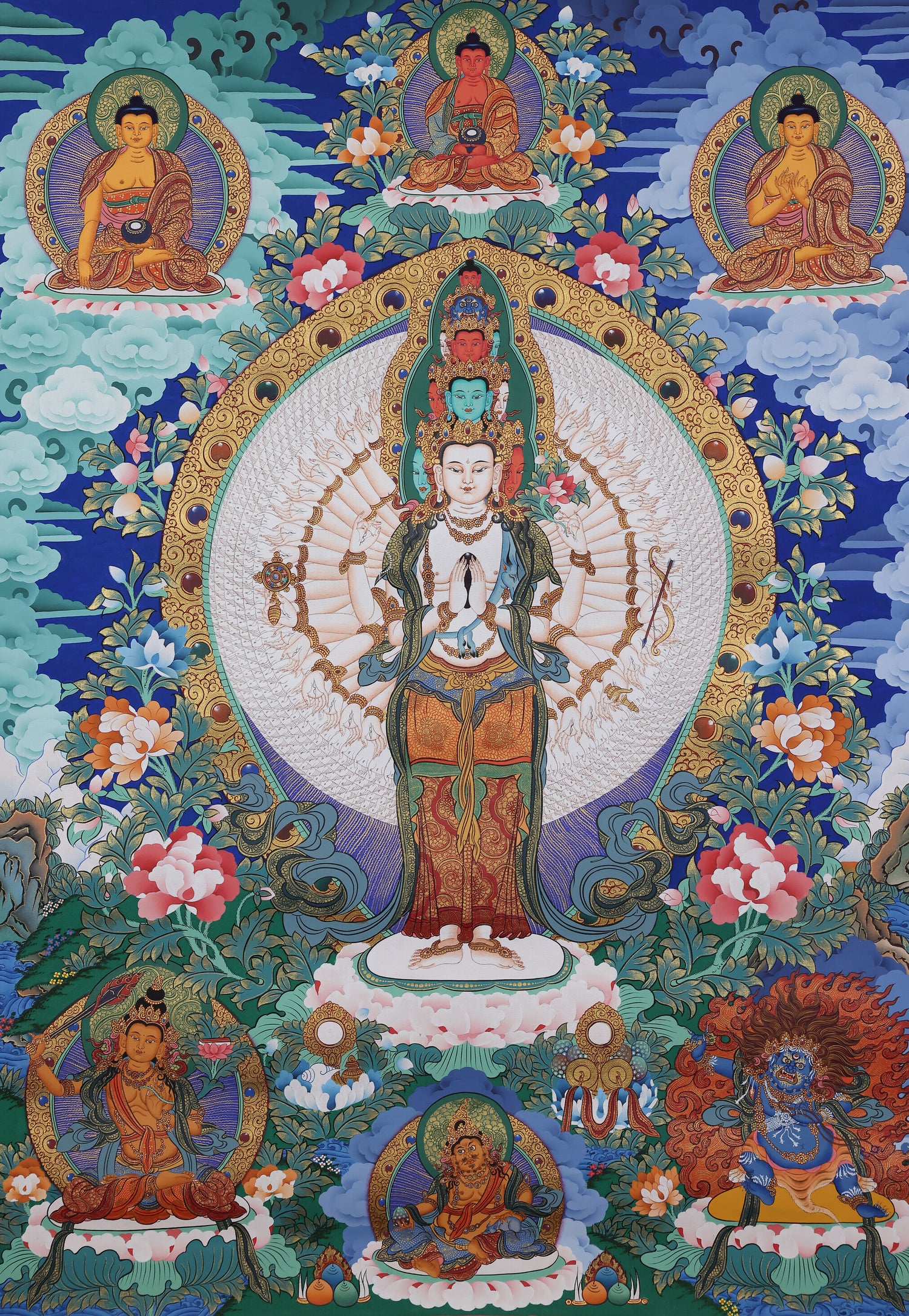
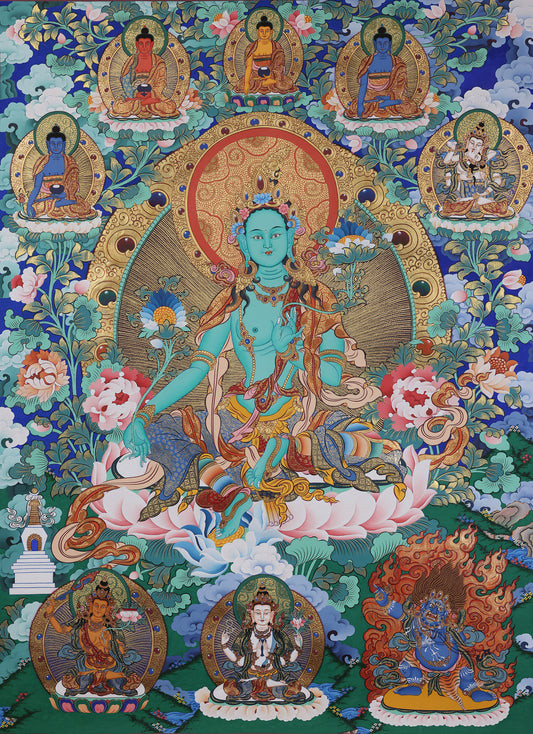
Hand-painted Tibetan Buddhist color thangka depicting Shakyamuni Buddha in meditation posture, symbolizing enlightenment and wisdom.
Analysis of a Hand-Painted Nepalese Thangka of Shakyamuni Buddha: Worldly Enlightenment and Three-Age Lineage in Tibetan Buddhist Art
$599.00 USD

A Hand-Painted Nepalese Color Thangka: The "Portable Sacred Space" in Tibetan Buddhist Art

When a 46×65cm hand-painted Nepalese color thangka unfurls, what you see is not just a canvas of layered colors, but a tangible embodiment of Tibetan Buddhism’s cosmology and spiritual practice. As a "portable mural" in Himalayan art, this thangka centered on Shakyamuni Buddha is a product of deep fusion between Nepal’s Newari painting school and Tibetan Buddhist ritual traditions. Every line, color, and icon holds the belief logic of Tibetan Buddhism.

Theme: The Perfection of Worldly Enlightenment, Encoded in the "Main Deity-Attendants-Crest" Order

In Tibetan Buddhism, Shakyamuni Buddha is the "Worldly Buddha"—representing the ultimate spiritual goal of transcending suffering to achieve perfection. However, this thangka’s theme is not an isolated image of the Buddha; instead, it constructs a complete "sacred field" through a composition of "main deity at the center, crest deities above, attendants below":

  • Shakyamuni (the main deity) symbolizes "present enlightenment"—the core of a practitioner’s visualization, signifying that "ordinary beings can attain bodhi through practice";
  • The three Buddhas above represent the "Three-Age Buddhas"—connecting the temporal dimensions of past, present, and future, embodying Buddhism’s worldview of "continuous cause and effect";
  • The disciples below serve as "bridges of the Dharma"—transmitters from the Buddha to worldly believers, implying that "enlightenment is not for self-benefit alone, but for universal salvation."

This composition is not an artistic whim but a requirement of Tibetan Buddhist ritual: the thangka is a tool for practitioners to "enter samadhi through visualization," and the position of each deity corresponds to the spiritual order of that visualization.

Main Deity and Attendants: The Tibetan Buddhist Code in Iconographic Symbols

1. Shakyamuni (Main Deity): The "Language of Enlightenment" in the Enlightenment Form

Shakyamuni at the center of the painting follows the Iconometric Canon of Tibetan Buddhism in his "Enlightenment Form":

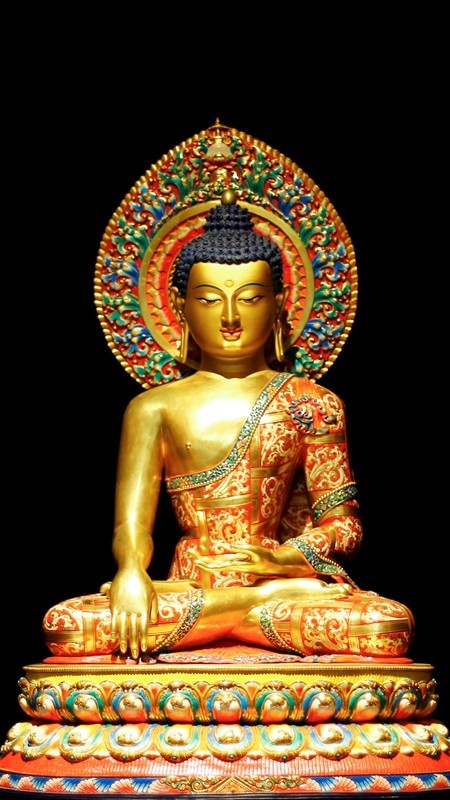
  • Body Color and Head Adornments: The warm yellow body symbolizes "the Middle Way and compassion"; the spiral curls and the cranial protuberance (ushnisha) are markers of the "Thirty-Two Marks of a Buddha"—the former represents the Buddha’s transcendence of mundane impurity, while the latter symbolizes wisdom that dispels ignorance;
  • Mudra and Ritual Implements: The left hand holds a alms bowl (signifying "nourishing sentient beings with the Dharma"), and the right hand performs the Bhumisparsha Mudra (Earth-Touching Mudra)—the iconic gesture of the Buddha’s enlightenment, meaning "subduing inner and outer demons to attain ultimate awakening";
  • Lotus Throne and Robes: The double lotus throne (with closed and blooming petals) corresponds to "the unity of worldly afflictions and transcendental enlightenment"; the "field-pattern" on the red kasaya (monastic robe) is a visual metaphor that "offering to the Buddha accumulates karmic merit (merit fields)."

The main deity’s multi-layered auras hold further details: the inner pink nimbus represents compassion, while the outer golden mandorla (body aura) adorned with scrollwork symbolizes "perfect wholeness." Tibetan Buddhism uses color to distinguish the sacred from the profane, and the depth of the auras and their patterns form the visual boundary of "sacredness."

2. Attendant Deities: The Ritual Significance of Crest and Retinue

The "attendants" in the thangka are not decorations, but extensions of the belief system:

  • Crest Deities (Three Buddhas Above): The Temporal Dimension of the Three-Age Buddhas

    The three Buddhas above the main deity’s head are the "Three-Age Buddhas" of Tibetan Buddhism:
    • The central red-bodied Buddha (Amitabha): The Future Buddha/Enjoyment Body Buddha, symbolizing guidance to the Pure Land;
    • The left yellow-bodied Buddha (Dipamkara): The Past Buddha/Dharma Body Buddha, the prognostic teacher of Shakyamuni;
    • The right blue-bodied Buddha (Bhaisajyaguru): The Worldly Buddha/Manifestation Body Buddha, signifying worldly merit of healing and dispelling disasters.

      These three Buddhas ensure that "worldly enlightenment" is not isolated—it is a continuation of past Dharma and the starting point of future liberation.
  • Retinue Disciples (Two Below): The Materialization of Dharma Transmission

    Ananda and Mahakasyapa, flanking the main deity, are representatives of the Buddha’s Ten Great Disciples:
    • Mahakasyapa (holding a khakkhara, "foremost in asceticism"): Symbolizes "ascetic practice and precepts," the foundation of spiritual cultivation;
    • Ananda (holding an alms bowl, "foremost in hearing"): Symbolizes "listening to the Dharma and memory," the transmitter of the teachings.

      Together, their "practice" and "learning" align with Tibetan Buddhism’s principle of "balancing understanding and practice."

Techniques and Style: The Persistence and Fusion of Nepal’s Newari Painting School

The "hand-painted" nature and "mineral pigments" of this thangka are the secrets to Himalayan art’s "enduring vitality," while its style epitomizes Sino-Nepalese Buddhist art exchange.

1. Mineral Pigments: The "Sacred Colors" That Do Not Fade for Centuries

All pigments are natural minerals and earth materials from the Kathmandu Valley in Nepal:

  • Red comes from cinnabar, yellow from realgar, blue from lapis lazuli (which requires 3–5 days of grinding to separate shades), and white from Rinpoche white earth;
  • Pigments are mixed with cowhide glue and applied in layers (e.g., 3–5 layers for skin tones), gradually integrating with the cotton fabric—centuries later, the colors become richer and more mellow, which is why thangkas can serve as "transmissible ritual objects."

Every brushstroke of color is not "decoration" but "the materialization of belief": the "eternity" of minerals corresponds to Buddhism’s philosophy of "the permanence of all dharmas."

2. Newari Painting School: The Fusion Gene of Sino-Nepalese Art

This thangka is a classic work of Nepal’s Newari school, incorporating elements of Tibetan ritual traditions:

  • Composition: The "symmetrical order" of Tibetan thangkas + the "balanced density" of the Newari school—the main deity occupies 60% of the space, attendants are placed above and below, and the background is filled with pink peonies (symbolizing perfection) and clouds, avoiding the "crowded fullness" of Tibetan thangkas;
  • Form: Icons follow the Iconometric Canon, but faces feature the Newari school’s "infant-like softness," while robes inherit the "lightness" of Indian Pala art, differing from the "solemn heaviness" of Tibetan thangkas;
  • Color: Warm tones (red, yellow) reflect the Newari school’s "warm opulence," while cool accents (blue, green) correspond to Tibetan Buddhism’s symbolic system of "five colors matching the Five Dhyani Buddhas."

Conclusion: The Thangka Is More Than Art—It Is a "Portable Temple" of Tibetan Buddhism

This 46×65cm Nepalese color thangka unites the roles of religious ritual object and artistic work: it carries belief through the eternity of mineral pigments, continues Sino-Nepalese art exchange through Newari school style, and constructs the sacred space of Tibetan Buddhism through the "main deity-attendant" composition.

For Tibetan Buddhist believers, it is a tool for visualization; for art enthusiasts, it is a living fossil of Himalayan culture—every line and color is a concrete expression of Tibetan Buddhism’s "enlightenment" and "transmission."

#NepaleseThangka #TibetanBuddhistArt #ShakyamuniThangka #NewariPaintingSchool #MineralPigmentThangka
Entdecken Sie das perfekte tibetisch-buddhistische Thangka, das zu Ihren Wünschen, Ihrem Lebensstil und Ihrem Raum passt. Jedes Thangka hat eine spirituelle Bedeutung und bringt Segen, wenn es richtig platziert wird.

1. Definieren Sie Ihre Absicht

Reichtum & Erfolg → Gelber Dzambhala (Gottheit des Reichtums)

Mitgefühl und Frieden → Avalokiteshvara, Grüne Tara

Weisheit & Lernen → Manjushri

Gesundheit & Heilung → Medizinbuddha

Langlebigkeit und Familienschutz → Weiße Tara

2. Wählen Sie nach Identität

Unternehmer und Geschäftsinhaber → Reichtumsgottheiten für Wohlstand.

Studenten und Gelehrte → Weisheitsgottheiten für Konzentration und Klarheit.

Heiler und Yoga-Praktizierende → Medizinbuddha für Energie und Gleichgewicht.

Familien und Hausfrauen → Tara-Gottheiten für Harmonie und Sicherheit.

Sammler und Kunstliebhaber → Seltene Mandalas oder Meisterwerk-Thangkas.

3. Passen Sie Ihren Raum an

Heimschrein / Meditationsraum → Mittlere Thangkas (60–80 cm).

Büro / Geschäftshalle → Große Thangkas für Wohlstand und Autorität.

Wohnzimmer / Arbeitszimmer → Dekorative Thangkas für Frieden und Schönheit.

4. Authentische Handwerkskunst

Jedes Thangka ist mit natürlichen Mineralpigmenten und feiner Leinwand handbemalt und spiegelt tibetische Kunstfertigkeit und spirituelle Kraft wider. Überprüfte Quellen gewährleisten Qualität und Respekt für die Tradition.

✨ Wählen Sie Ihr Thangka mit Herz – es ist nicht nur Kunst, sondern ein Segen für Ihr Leben.

Jeder Mensch hat unterschiedliche Bedürfnisse. Die Wahl des richtigen Thangkas kann spirituelle Unterstützung, Schutz, Glück und Segen bieten. Nachfolgend finden Sie Thangka-Empfehlungen für verschiedene Rollen:

1. Unternehmer

  • Bedürfnisse : Weisheit, Reichtum, Gesundheit, beruflicher Erfolg.
  • Empfohlene Thangkas :
    Manjushri : Verbessert die Entscheidungsfindung und Geschäftsweisheit.
    Gottheit des Reichtums : Bringt Reichtum und Wohlstand.
    Medizinbuddha : Unterstützt die Gesundheit und reduziert Stress.
    Mahakala : Schützt Unternehmen vor Konkurrenz und Herausforderungen.

2. Erfolgreiche Einzelpersonen

  • Bedürfnisse : Innerer Frieden, Familienharmonie, Langlebigkeit.
  • Empfohlene Thangkas :
    Amitabha Buddha : Bringt inneren Frieden und Ruhe.
    Avalokiteshvara (Guanyin) : Fördert Harmonie und Glück in der Familie.
    Amitayus (Langlebens-Buddha) : Betet für gute Gesundheit und ein langes Leben.
    Manjushri : Stärkt weiterhin die Weisheit.

3. Hausfrauen/Ehemänner

  • Bedürfnisse : Familienharmonie, Schutz, Gesundheit.
  • Empfohlene Thangkas :
    Avalokiteshvara : Steigert das Familienglück und die Harmonie.
    Schutzgottheiten : Beschützen die Familie vor äußeren Störungen.
    Weiße Tara : Segnet die Familie mit Gesundheit.

4. Studierende und Wissenschaftler

  • Bedürfnisse : Weisheit, Konzentration, akademischer Erfolg.
  • Empfohlene Thangkas :
    Manjushri : Fördert Lernfähigkeit, Gedächtnis und Weisheit.
    Shakyamuni Buddha : Hilft bei der Konzentration und spirituellen Praxis.
    Jixiang Tianmu : Bringt akademisches Glück und Prüfungserfolg.

5. Künstler und Kreativprofis

  • Bedürfnisse : Inspiration, Kreativität, künstlerische Leistung.
  • Empfohlene Thangkas :
    Manjushri : Regt kreatives Denken und Inspiration an.
    Vajrapani : Hilft, kreative Blockaden zu überwinden.
    Maitreya : Sorgt für eine entspannte und optimistische Einstellung und baut Stress ab.

6. Reisende und Abenteurer

  • Bedürfnisse : Schutz, Glück, Erfolg bei Abenteuern.
  • Empfohlene Thangkas :
    Hayagriva : Bietet starken Schutz auf Reisen und beseitigt Hindernisse.
    Mahakala : Bringt Glück und Schutz, insbesondere für Abenteurer.
    Vajrasattva : Hilft, Schwierigkeiten und Herausforderungen während der Reise zu überwinden.

7. Ältere Menschen

  • Bedürfnisse : Gesundheit, Langlebigkeit, spiritueller Frieden.
  • Empfohlene Thangkas :
    Amitayus : Betet für ein langes Leben und gute Gesundheit.
    Medizinbuddha : Fördert Heilung und körperliches Wohlbefinden.
    Avalokiteshvara : Bringt Mitgefühl und inneren Frieden in späteren Jahren.

8. Führungskräfte

  • Bedürfnisse : Führung, Weisheit, Teamarbeit und geschäftlicher Erfolg.
  • Empfohlene Thangkas :
    Manjushri : Verbessert Führungsqualitäten und Entscheidungsfindung.
    Gottheit des Reichtums : Bringt dem Unternehmen und dem Team Erfolg und Wohlstand.
    Avalokiteshvara : Fördert Harmonie und Gleichgewicht innerhalb des Teams.

9. Gesundheits- und Fitnessbegeisterte

  • Bedürfnisse : Gute Gesundheit, Vitalität, Energie.
  • Empfohlene Thangkas :
    Medizinbuddha : Verbessert die körperliche Gesundheit und Vitalität.
    Weiße Tara : Bringt Gesundheit und Verjüngung.
    Vajrasattva : Beseitigt gesundheitliche Probleme und steigert die Energie.

10. Politiker

  • Bedürfnisse : Führung, Weisheit, Frieden.
  • Empfohlene Thangkas :
    Manjushri : Verbessert Führungsqualitäten und Entscheidungsfindung.
    Vairocana Buddha : Hilft, inneren Frieden und Weisheit zu bewahren.
    Avalokiteshvara : Fördert den gesellschaftlichen Frieden und die Harmonie in der Familie.

Für alle Bestellungen über 100 USD ist der Versand kostenlos.

Rücksendungen werden bis zu 10 Tage nach Erhalt des Kaufbelegs bzw. der Sendungsnummer (bei ungetragenen Artikeln) akzeptiert. Sie als Kunde sind verpflichtet, uns vor der Rücksendung des Artikels per E-Mail zu informieren.

Andernfalls fallen die Standardversandkosten an. Weitere Informationen finden Sie in unseren Lieferbedingungen .

Rücksendungen werden bis zu 10 Tage nach Erhalt des Kaufbelegs oder der Sendungsnummer (bei ungetragenen Artikeln) akzeptiert. Sie als Kunde sind verpflichtet, uns vor der Rücksendung des Artikels per E-Mail zu informieren, nur in folgenden Fällen:

– Den falschen Artikel erhalten.
– Artikel kam nicht wie erwartet an (z. B. beschädigte Verpackung).
– Artikel hatte Mängel.
– Über die Lieferzeit hinaus.
– Der Spediteur gestattet keine Besichtigung der Ware vor der Bezahlung.

Die zurückgesendeten Produkte müssen in der Originalverpackung, sicher verpackt, unbeschädigt und ungetragen sein. Dies bedeutet, dass die Artikel zum Schutz während des Transports sicher in einem Karton verpackt sein müssen, möglichst im selben Karton, in dem sie an Sie als Kunde versendet wurden.

Kürzlich angesehen

Nicht vergessen! Die Produkte, die Sie angesehen haben, legen Sie jetzt in den Warenkorb.

Passt gut zu

Erweitern Sie Ihre Auswahl mit perfekt abgestimmtem Zubehör und ergänzenden Produkten.

Leute kauften auch

Hier sind einige unserer ähnlichsten Produkte, die die Leute kaufen. Klicken Sie hier, um den Trendstil zu entdecken.