Nepalese Hand-Painted Vaishravana Thangka (20x30cm): Unveiling Tibetan Buddhist Symbolism, Nuwari Artistry, and Mineral Pigment Craftsmanship

$499.00 USD
Thangka name: Cai Tang Cai Bao Tian Wang
size: 20cm×30cm
origin: Nepal
Eine Frage stellen

Beeil dich! Nur noch [Anzahl] auf Lager!

Geschätzte Lieferzeiten: 12–26 Tage (International), 3–6 Tage (USA).

Rückgabe innerhalb von 45 Tagen nach dem Kauf. Zölle und Steuern werden nicht erstattet.

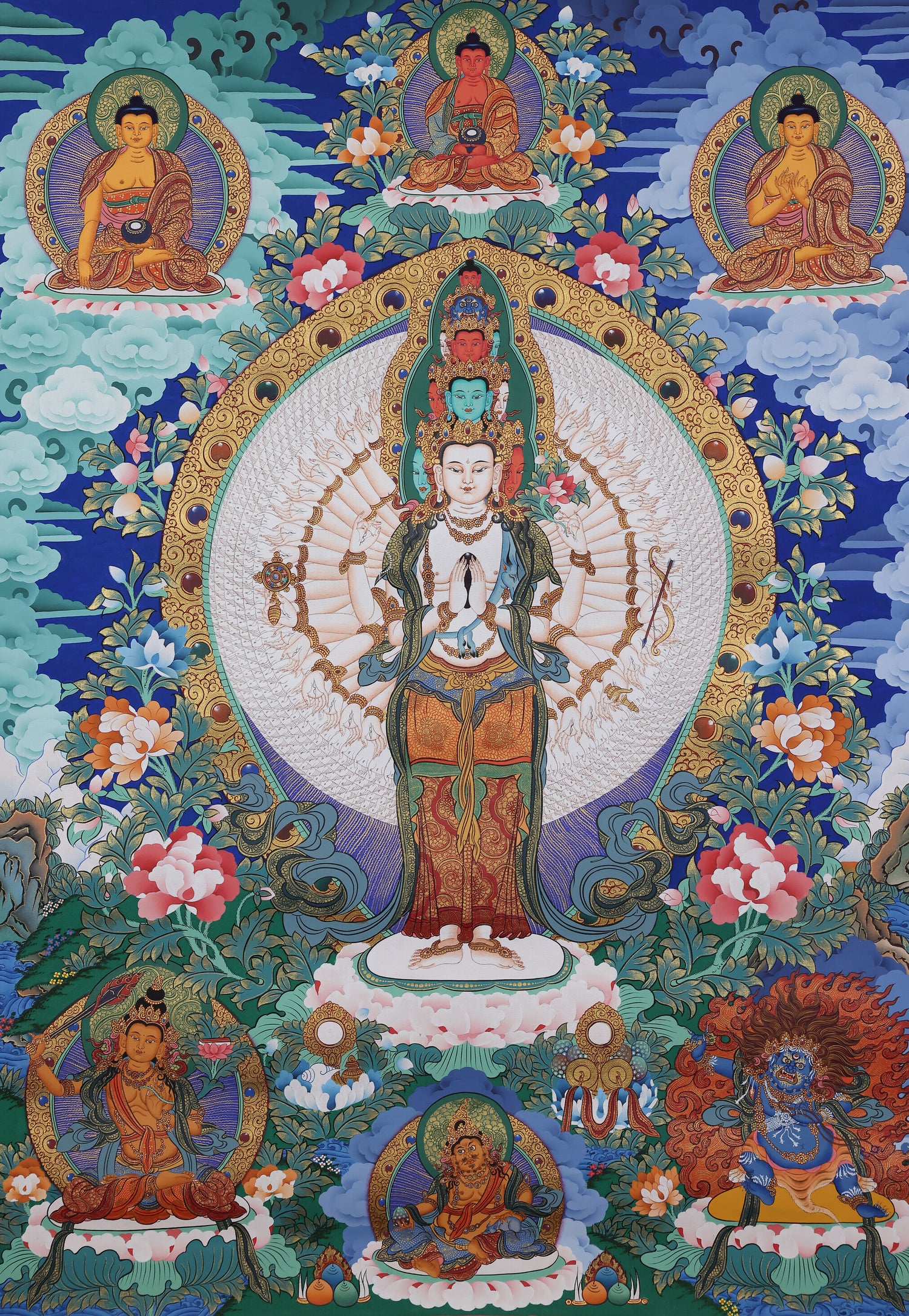
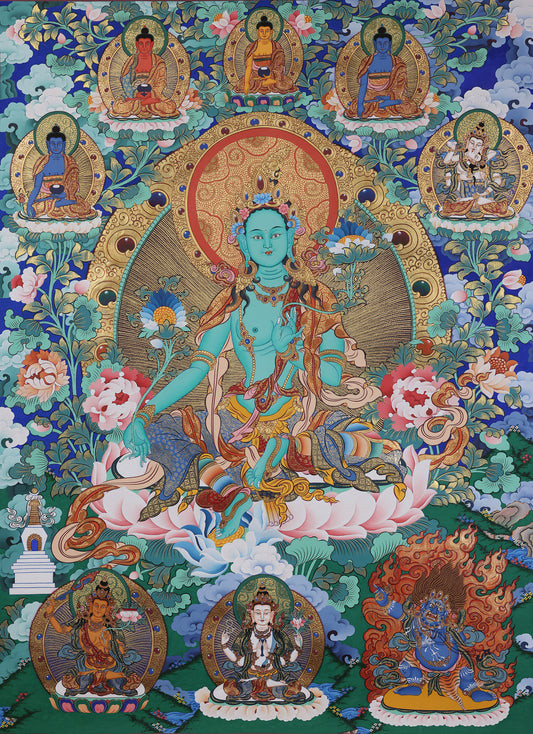
A colorful Tibetan Buddhist thangka depicting Vaishravana, the wealth deity, hand-painted in traditional Himalayan style.
Nepalese Hand-Painted Vaishravana Thangka (20x30cm): Unveiling Tibetan Buddhist Symbolism, Nuwari Artistry, and Mineral Pigment Craftsmanship
$499.00 USD
When you hold a 20x30cm Nepalese hand-painted Vaishravana Thangka—its surfaces glowing with layered mineral pigments, its details condensed but precise—you’re not just holding art: you’re holding a portable vessel of Tibetan Buddhist wealth philosophy and Nuwari (Newari) artistic legacy. This “color thangka” (tsheri thangka in Tibetan) is a microcosm of two cultural worlds: it adheres to Tibetan Buddhist iconographic rules while leaning into Nepal’s centuries-old tradition of intricate, ornament-driven thangka painting. For devout practitioners, it’s a personal talisman for prosperity; for art lovers, it’s a masterclass in miniature craftsmanship. Let’s unpack its layers.

1. The Theme: Dual Divinity of Wealth and Protection

At its core, this thangka centers on Vaishravana—a deity with dual roles in Tibetan Buddhism:
  • First, he is the Northern Guardian King (one of the Four Heavenly Kings), tasked with protecting the northern quadrant of Mount Meru (the cosmic center in Buddhist cosmology).
  • Second, he is an emanation of Ratnasambhava (the Jewel-born Buddha), the Buddha of abundance, who governs material and spiritual prosperity.
This dual identity shapes the thangka’s theme: “worldly prosperity as a tool for spiritual practice.” Unlike grand temple thangkas that depict vast sutra narratives, this 20x30cm miniature is tailored for personal devotion: it lets practitioners carry a symbol of “sustained wealth (to support family and dharma) and protection (from misfortune)” in small spaces (home altars, travel shrines). Its compact size is not a compromise—it’s a deliberate choice to make divine prosperity accessible.

2. The Main Deity: Vaishravana’s Iconography (Nuwari-Style)

Every line of Vaishravana’s form follows the Iconometric Canon of Tibetan Buddhism (the Tshon-khyi), but Nuwari artists infuse their signature ornamental softness:
  • Body & Complexion: Vaishravana’s golden-yellow skin (symbolizing Ratnasambhava’s “jewel light”) is layered with orpiment (a mineral pigment) ground to 5μm particles—applied in 3–5 thin coats (each sealed with diluted cowhide glue) to create a warm, luminous finish that mimics gilding without metal leaf.
  • Implements:
    • His right hand raises a victory banner (dhvajra): Woven with scrollwork (a Nuwari touch), the banner represents “authority over cosmic wealth” (its canopy is said to hold treasures from gods, nagas, and humans).
    • His left hand cradles a treasure-vomiting mongoose (nakchhya): The mongoose (its fur rendered with fine blue-green brushstrokes) spits jewels—a symbol of “inexhaustible abundance.”
  • Attire & Adornment: He wears a five-buddha crown (set with tiny painted gemstones, their facets defined by 24K gold ink) and a green silk sash (its folds shaded with malachite pigment). Unlike Tibetan thangkas’ stark, regal attire, Nuwari artists add delicate floral embroidery to his sash—echoing Nepal’s folk textile traditions.
  • Mount: He sits in lalita asana (relaxed pose) atop a white snow lion. The lion (its mane curled into Nuwari scrollwork) glares backward—symbolizing Vaishravana’s ability to “ward off obstacles to wealth.”

3. Attendant Deities: The Eight Horse Wealth Gods & Symbolic Retinue

Due to its 20x30cm size, the thangka condenses Vaishravana’s retinue (the Eight Horse Wealth Gods, or Ashtalakshmi in Hindu-Buddhist syncretism) into symbolic details:
  • The Eight Wealth Gods: These eight yaksha generals (who govern eight directions of wealth) appear as simplified figures around Vaishravana’s aura. Some are hinted at via their implements: a jewel (eastern wealth), a vase (southern wealth), and a sword (northern protection) peek through the cloud motifs.
  • Support Symbols: At the thangka’s base, a treasure vase (kalasha) (filled with nectar and jewels) sits atop a pile of colored gemstones. The vase—painted with lapis lazuli blue and gilded edges—is one of Tibetan Buddhism’s Eight Auspicious Symbols, representing “wholeness and abundance.” A small blue yaksha figure (Vaishravana’s chief attendant) huddles near his knee, emphasizing the deity’s role as a leader of wealth-bearing spirits.

4. Craftsmanship: Nuwari Techniques & Mineral Pigment Mastery

Nepalese thangka artists follow 12 traditional steps to create this miniature work—each tailored to the 20x30cm canvas:
  1. Canvas Preparation: White cotton is soaked in cowhide glue 3 times, then coated with 2 layers of chalk paste (ground to 10μm) and sanded smooth. For small thangkas, the canvas must be thinner (to fit portable altars) but reinforced with extra glue to prevent tearing.
  2. Mineral Pigment Layering:
    • Blue (background clouds): Lapis lazuli is ground to 20μm (coarse particles for dark blue, fine for light blue) and mixed with glue to avoid fading (mineral pigments resist discoloration for 50+ years).
    • Green (sashes & foliage): Malachite is blended with a tiny amount of yellow ochre to create a “lush, earthy green” (synthetic pigments cannot replicate this depth).
  3. Gold Ink Detailing: 24K gold foil is ground into a paste (mixed with glue) and applied with a weasel-hair brush (0.1mm tip) to outline crowns, gemstones, and the victory banner. For small thangkas, gold lines must be 0.1mm wide (no breaks) to maintain clarity.
  4. Consecration: After painting, a Nepalese monk writes the Om Ah Hum seed syllables (Tibetan Buddhist blessing) on the thangka’s reverse—turning the artwork into a sacred object, not just a decoration.

5. Artistic Style: Nuwari Ornamentation Meets Tibetan Symbolism

This thangka embodies the Nuwari Thangka Style—a fusion of Nepalese folk art and Tibetan religious iconography:
  • Dense Ornamentation (Miti Style): Nuwari artists fill every empty space with scrollwork, floral motifs, and gemstone details (even the cloud edges have tiny painted petals). To avoid clutter, they use radial headlight (around Vaishravana) and gradient sky (orange to blue) to create visual breathing room.
  • Color Palette: Contrasting warm gold (Vaishravana) with cool blue-green (clouds) follows Tibetan Buddhism’s “five-element color system” (gold = earth, blue = water) while leaning into Nepal’s love of vibrant, saturated hues.
  • Spatial Depth: Unlike Tibetan thangkas’ flat, cosmic layout, Nuwari artists add subtle perspective: distant snow-capped mountains (left) and grassy plains (bottom) use lighter pigments to create “near-far” depth—rooting the divine figure in a recognizable, earthly landscape.

Why This 20x30cm Thangka Matters

In a world of mass-produced spiritual art, this miniature Vaishravana Thangka is a reminder of tradition: it takes 2–3 weeks to paint (vs. 1–2 days for machine-made thangkas), uses pigments mined from Nepal’s Himalayan foothills, and carries the hand of a Nuwari artist trained in family-run workshops. It’s not just a “wealth charm”—it’s a bridge between Tibetan Buddhism’s spiritual goals and Nepal’s artistic ingenuity: prosperity, for this thangka, is both material and cultural.


#VaishravanaThangka #NepaleseHandPaintedThangka #TibetanBuddhistThangka #NuwariArtStyle #MineralPigmentThangka #WealthDeityThangka #MiniatureThangka20x30cm #TraditionalThangkaCraftsmanship #TibetanBuddhistSymbolism #NepaleseThangkaArt
Entdecken Sie das perfekte tibetisch-buddhistische Thangka, das zu Ihren Wünschen, Ihrem Lebensstil und Ihrem Raum passt. Jedes Thangka hat eine spirituelle Bedeutung und bringt Segen, wenn es richtig platziert wird.

1. Definieren Sie Ihre Absicht

Reichtum & Erfolg → Gelber Dzambhala (Gottheit des Reichtums)

Mitgefühl und Frieden → Avalokiteshvara, Grüne Tara

Weisheit & Lernen → Manjushri

Gesundheit & Heilung → Medizinbuddha

Langlebigkeit und Familienschutz → Weiße Tara

2. Wählen Sie nach Identität

Unternehmer und Geschäftsinhaber → Reichtumsgottheiten für Wohlstand.

Studenten und Gelehrte → Weisheitsgottheiten für Konzentration und Klarheit.

Heiler und Yoga-Praktizierende → Medizinbuddha für Energie und Gleichgewicht.

Familien und Hausfrauen → Tara-Gottheiten für Harmonie und Sicherheit.

Sammler und Kunstliebhaber → Seltene Mandalas oder Meisterwerk-Thangkas.

3. Passen Sie Ihren Raum an

Heimschrein / Meditationsraum → Mittlere Thangkas (60–80 cm).

Büro / Geschäftshalle → Große Thangkas für Wohlstand und Autorität.

Wohnzimmer / Arbeitszimmer → Dekorative Thangkas für Frieden und Schönheit.

4. Authentische Handwerkskunst

Jedes Thangka ist mit natürlichen Mineralpigmenten und feiner Leinwand handbemalt und spiegelt tibetische Kunstfertigkeit und spirituelle Kraft wider. Überprüfte Quellen gewährleisten Qualität und Respekt für die Tradition.

✨ Wählen Sie Ihr Thangka mit Herz – es ist nicht nur Kunst, sondern ein Segen für Ihr Leben.

Jeder Mensch hat unterschiedliche Bedürfnisse. Die Wahl des richtigen Thangkas kann spirituelle Unterstützung, Schutz, Glück und Segen bieten. Nachfolgend finden Sie Thangka-Empfehlungen für verschiedene Rollen:

1. Unternehmer

  • Bedürfnisse : Weisheit, Reichtum, Gesundheit, beruflicher Erfolg.
  • Empfohlene Thangkas :
    Manjushri : Verbessert die Entscheidungsfindung und Geschäftsweisheit.
    Gottheit des Reichtums : Bringt Reichtum und Wohlstand.
    Medizinbuddha : Unterstützt die Gesundheit und reduziert Stress.
    Mahakala : Schützt Unternehmen vor Konkurrenz und Herausforderungen.

2. Erfolgreiche Einzelpersonen

  • Bedürfnisse : Innerer Frieden, Familienharmonie, Langlebigkeit.
  • Empfohlene Thangkas :
    Amitabha Buddha : Bringt inneren Frieden und Ruhe.
    Avalokiteshvara (Guanyin) : Fördert Harmonie und Glück in der Familie.
    Amitayus (Langlebens-Buddha) : Betet für gute Gesundheit und ein langes Leben.
    Manjushri : Stärkt weiterhin die Weisheit.

3. Hausfrauen/Ehemänner

  • Bedürfnisse : Familienharmonie, Schutz, Gesundheit.
  • Empfohlene Thangkas :
    Avalokiteshvara : Steigert das Familienglück und die Harmonie.
    Schutzgottheiten : Beschützen die Familie vor äußeren Störungen.
    Weiße Tara : Segnet die Familie mit Gesundheit.

4. Studierende und Wissenschaftler

  • Bedürfnisse : Weisheit, Konzentration, akademischer Erfolg.
  • Empfohlene Thangkas :
    Manjushri : Fördert Lernfähigkeit, Gedächtnis und Weisheit.
    Shakyamuni Buddha : Hilft bei der Konzentration und spirituellen Praxis.
    Jixiang Tianmu : Bringt akademisches Glück und Prüfungserfolg.

5. Künstler und Kreativprofis

  • Bedürfnisse : Inspiration, Kreativität, künstlerische Leistung.
  • Empfohlene Thangkas :
    Manjushri : Regt kreatives Denken und Inspiration an.
    Vajrapani : Hilft, kreative Blockaden zu überwinden.
    Maitreya : Sorgt für eine entspannte und optimistische Einstellung und baut Stress ab.

6. Reisende und Abenteurer

  • Bedürfnisse : Schutz, Glück, Erfolg bei Abenteuern.
  • Empfohlene Thangkas :
    Hayagriva : Bietet starken Schutz auf Reisen und beseitigt Hindernisse.
    Mahakala : Bringt Glück und Schutz, insbesondere für Abenteurer.
    Vajrasattva : Hilft, Schwierigkeiten und Herausforderungen während der Reise zu überwinden.

7. Ältere Menschen

  • Bedürfnisse : Gesundheit, Langlebigkeit, spiritueller Frieden.
  • Empfohlene Thangkas :
    Amitayus : Betet für ein langes Leben und gute Gesundheit.
    Medizinbuddha : Fördert Heilung und körperliches Wohlbefinden.
    Avalokiteshvara : Bringt Mitgefühl und inneren Frieden in späteren Jahren.

8. Führungskräfte

  • Bedürfnisse : Führung, Weisheit, Teamarbeit und geschäftlicher Erfolg.
  • Empfohlene Thangkas :
    Manjushri : Verbessert Führungsqualitäten und Entscheidungsfindung.
    Gottheit des Reichtums : Bringt dem Unternehmen und dem Team Erfolg und Wohlstand.
    Avalokiteshvara : Fördert Harmonie und Gleichgewicht innerhalb des Teams.

9. Gesundheits- und Fitnessbegeisterte

  • Bedürfnisse : Gute Gesundheit, Vitalität, Energie.
  • Empfohlene Thangkas :
    Medizinbuddha : Verbessert die körperliche Gesundheit und Vitalität.
    Weiße Tara : Bringt Gesundheit und Verjüngung.
    Vajrasattva : Beseitigt gesundheitliche Probleme und steigert die Energie.

10. Politiker

  • Bedürfnisse : Führung, Weisheit, Frieden.
  • Empfohlene Thangkas :
    Manjushri : Verbessert Führungsqualitäten und Entscheidungsfindung.
    Vairocana Buddha : Hilft, inneren Frieden und Weisheit zu bewahren.
    Avalokiteshvara : Fördert den gesellschaftlichen Frieden und die Harmonie in der Familie.

Für alle Bestellungen über 100 USD ist der Versand kostenlos.

Rücksendungen werden bis zu 10 Tage nach Erhalt des Kaufbelegs bzw. der Sendungsnummer (bei ungetragenen Artikeln) akzeptiert. Sie als Kunde sind verpflichtet, uns vor der Rücksendung des Artikels per E-Mail zu informieren.

Andernfalls fallen die Standardversandkosten an. Weitere Informationen finden Sie in unseren Lieferbedingungen .

Rücksendungen werden bis zu 10 Tage nach Erhalt des Kaufbelegs oder der Sendungsnummer (bei ungetragenen Artikeln) akzeptiert. Sie als Kunde sind verpflichtet, uns vor der Rücksendung des Artikels per E-Mail zu informieren, nur in folgenden Fällen:

– Den falschen Artikel erhalten.
– Artikel kam nicht wie erwartet an (z. B. beschädigte Verpackung).
– Artikel hatte Mängel.
– Über die Lieferzeit hinaus.
– Der Spediteur gestattet keine Besichtigung der Ware vor der Bezahlung.

Die zurückgesendeten Produkte müssen in der Originalverpackung, sicher verpackt, unbeschädigt und ungetragen sein. Dies bedeutet, dass die Artikel zum Schutz während des Transports sicher in einem Karton verpackt sein müssen, möglichst im selben Karton, in dem sie an Sie als Kunde versendet wurden.

Kürzlich angesehen

Nicht vergessen! Die Produkte, die Sie angesehen haben, legen Sie jetzt in den Warenkorb.

Passt gut zu

Erweitern Sie Ihre Auswahl mit perfekt abgestimmtem Zubehör und ergänzenden Produkten.

Leute kauften auch

Hier sind einige unserer ähnlichsten Produkte, die die Leute kaufen. Klicken Sie hier, um den Trendstil zu entdecken.