Hand-Painted Yellow Jambhala Five Wealth Deities Thangka A Dual Reflection of Tibetan Buddhist Wealth Philosophy and Regong Art

$599.00 USD
Thangka Name: Five Wealth Gods
Size: 43*62
Orgin: Nepal
Eine Frage stellen

Beeil dich! Nur noch [Anzahl] auf Lager!

Geschätzte Lieferzeiten: 12–26 Tage (International), 3–6 Tage (USA).

Rückgabe innerhalb von 45 Tagen nach dem Kauf. Zölle und Steuern werden nicht erstattet.

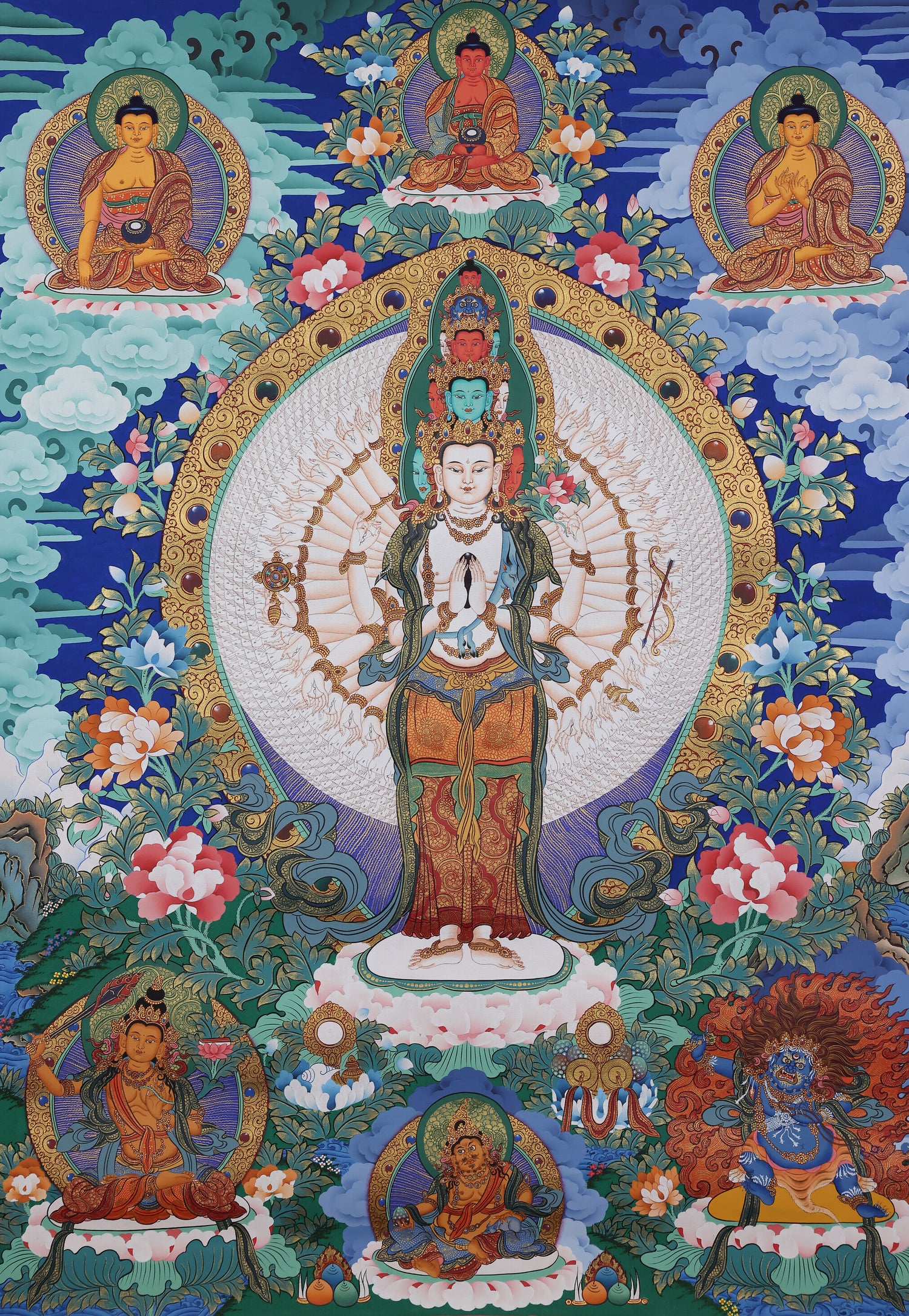
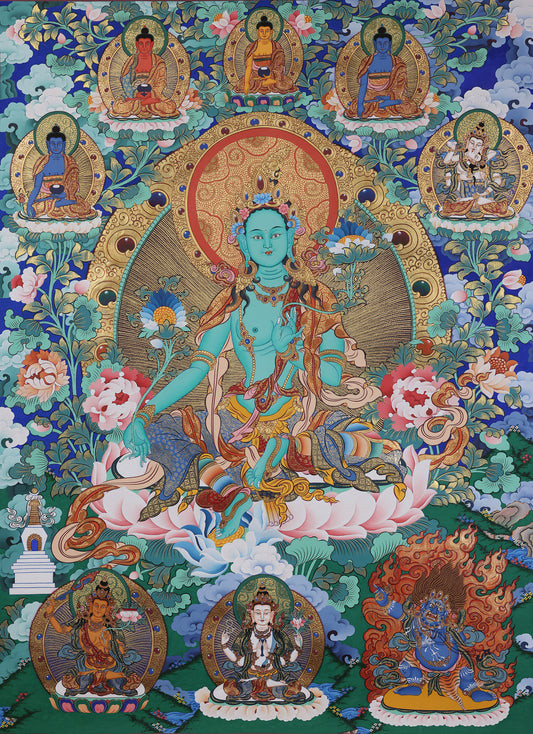
Sacred Tibetan thangka of the Five Wealth Kings united, symbolizing prosperity and spiritual wealth
Hand-Painted Yellow Jambhala Five Wealth Deities Thangka A Dual Reflection of Tibetan Buddhist Wealth Philosophy and Regong Art
$599.00 USD

In the visual and spiritual system of Tibetan Buddhism, a Thangka is never merely a painting. It is a sacred field of contemplation, a portable mandala, and a living support for practice.
This hand-painted Yellow Jambhala Five Wealth Deities Thangka represents a masterwork of the Regong (Rebkong) painting tradition, uniting profound Vajrayana wealth teachings with centuries-old artisanal discipline.

Centered on Yellow Jambhala, the principal deity of wealth and merit, this composition integrates the complete Five Wealth Deities (Five-Family Jambhala) system, rendered strictly according to tantric iconography and canonical measurement texts. It serves both as a contemplative aid for practitioners and as a visual embodiment of Tibetan Buddhist wisdom regarding wealth, generosity, and spiritual prosperity.


I. Core Theme: The Vajrayana View of Wealth as a Path

In Tibetan Buddhism, wealth is not regarded as a purely material pursuit. Instead, it is understood as a form of merit (punya)—a supportive condition that enables ethical living, spiritual practice, and compassionate action.

The Five Wealth Deities tradition reflects this philosophy. Their purpose is not to fuel greed, but to relieve poverty, remove anxiety, and stabilize the conditions necessary for spiritual cultivation. From a Vajrayana perspective, scarcity often gives rise to fear and attachment, which obstruct the path. Wealth, when guided by wisdom, becomes a skillful means.

Historically, this system traces back to the Indian deity Kubera, later assimilated into Buddhism as an aspect of Vaishravana (Vaiśravaṇa). Through centuries of transmission and localization in Tibet, it evolved into the Five-Family Wealth Deities system. By the Yuan dynasty, this belief had become deeply embedded in both monastic and lay communities as a protector of prosperity and continuity.

In this Thangka, the Five Deities are arranged according to the five directions and five elements, forming a complete cosmological order:

  • Yellow Jambhala (Center · Earth) – Merit, stability, and foundational wealth

  • Red Jambhala (South · Fire) – Relationships, attraction, and benefactors

  • Green Jambhala (East · Wood) – Health, vitality, and career growth

  • White Jambhala (West · Metal) – Wisdom, purification, and removal of obstacles

  • Black Jambhala (North · Water) – Authority, protection, and subjugation of negativity

Together, they symbolize the fulfillment of the Five Blessings, harmonizing material sufficiency with inner balance.


II. Yellow Jambhala: The Union of Compassion and Wealth

At the heart of the composition sits Yellow Jambhala (Dzambhala Serpo), the foremost deity among the Five Wealth Deities. His iconography follows the Iconometric Scriptures and tantric ritual manuals with meticulous precision.

Physical Form and Expression
His radiant golden body represents the Earth element, symbolizing abundance that is stable, grounded, and inclusive. His exposed belly and rounded form are not signs of indulgence, but expressions of boundless generosity and compassion, capable of embracing the suffering of impoverished beings. The five-Buddha crown signifies the blessings of the Five Wisdom Buddhas.

Attributes and Sacred Symbols
In his right hand, he holds a wish-fulfilling jewel, representing the granting of legitimate material and spiritual needs. His left arm cradles a jewel-spitting mongoose, from whose mouth treasures continuously flow—an unmistakable teaching that generosity is the true source of wealth. His foot rests upon a white conch, symbolizing “entering the ocean to retrieve treasures,” or mastering the principles of wealth through wisdom.

Posture and Aura
Seated in a relaxed royal posture upon a lotus throne, Yellow Jambhala embodies both authority and accessibility. Behind him, a double halo appears: an inner ring of flames representing the destruction of obstacles, and an outer aureole symbolizing awakened radiance. Auspicious clouds and jeweled blossoms complete the sacred realm.


III. The Five Wealth Deities: A Complete Protective Network

Surrounding the central deity are the four directional Jambhalas, forming a fully integrated Vajrayana wealth mandala. This reflects the Tibetan Buddhist principle of “main deity with retinue”, where enlightened activity operates as a system rather than an isolated force.

  • Red Jambhala supports harmonious relationships and social success

  • Green Jambhala safeguards health, action, and professional advancement

  • White Jambhala dissolves obstacles and enhances clarity and wisdom

  • Black Jambhala protects authority, resources, and subdues negative forces

Additional protective figures, sacred animals, and offering elements appear throughout the composition. Dragons and guardian figures symbolize the safeguarding of wealth from harmful influences; offering heaps of jewels, fruits, and treasure vases express the practitioner’s attitude of cultivating merit. Mythical birds signify the subjugation of inner afflictions through insight—teaching that wealth must be guided by awareness.


IV. Regong Hand-Painting: The Discipline of Sacred Craft

This Thangka is a pure hand-painted Regong work, created through a six-stage process that integrates ritual discipline with extraordinary craftsmanship.

From the preparation of aged cotton canvas and repeated applications of hide glue and shell polishing, to the precise drafting based on canonical measurements; from the use of 108 natural mineral pigments—including cinnabar, lapis lazuli, malachite, and genuine gold—to multi-layer shading and traditional iron-line drawing; from extensive gilding with 24K gold to the final eye-opening (consecration) ritual, every stage reflects devotion and mastery.

In the Regong tradition, painting is itself a form of practice. Each stroke is a prayer, and each completed Thangka is regarded as a living vessel of spiritual intention—something no printed reproduction can replicate.


Conclusion: More Than a Wealth Thangka

This hand-painted Yellow Jambhala Five Wealth Deities Thangka is not a decorative symbol of fortune. It is a visual teaching on how wealth should be understood, cultivated, and transformed.

It reminds us that wealth should circulate, not stagnate;
that prosperity arises from generosity, not hoarding;
and that true abundance is grounded in inner stability and wisdom.

When placed within a space, this Thangka becomes more than art—it becomes a field of merit, a source of reflection, and a living expression of Tibetan Buddhist insight into wealth and life itself.


#YellowJambhala
#FiveWealthDeities
#FiveJambhala
#WealthDeityThangka
#TibetanBuddhistThangka

#VajrayanaBuddhism
#TibetanBuddhism
#BuddhistArt
#SacredThangka
#MeritAndGenerosity

#HandPaintedThangka
#RegongThangka
#TraditionalThangka
#MineralPigmentArt
#24KGoldThangka

#SpiritualWealth
#ProsperityWithWisdom
#BuddhistWealthPhilosophy
#AbundanceAndMerit
#SacredArtForMeditation

Entdecken Sie das perfekte tibetisch-buddhistische Thangka, das zu Ihren Wünschen, Ihrem Lebensstil und Ihrem Raum passt. Jedes Thangka hat eine spirituelle Bedeutung und bringt Segen, wenn es richtig platziert wird.

1. Definieren Sie Ihre Absicht

Reichtum & Erfolg → Gelber Dzambhala (Gottheit des Reichtums)

Mitgefühl und Frieden → Avalokiteshvara, Grüne Tara

Weisheit & Lernen → Manjushri

Gesundheit & Heilung → Medizinbuddha

Langlebigkeit und Familienschutz → Weiße Tara

2. Wählen Sie nach Identität

Unternehmer und Geschäftsinhaber → Reichtumsgottheiten für Wohlstand.

Studenten und Gelehrte → Weisheitsgottheiten für Konzentration und Klarheit.

Heiler und Yoga-Praktizierende → Medizinbuddha für Energie und Gleichgewicht.

Familien und Hausfrauen → Tara-Gottheiten für Harmonie und Sicherheit.

Sammler und Kunstliebhaber → Seltene Mandalas oder Meisterwerk-Thangkas.

3. Passen Sie Ihren Raum an

Heimschrein / Meditationsraum → Mittlere Thangkas (60–80 cm).

Büro / Geschäftshalle → Große Thangkas für Wohlstand und Autorität.

Wohnzimmer / Arbeitszimmer → Dekorative Thangkas für Frieden und Schönheit.

4. Authentische Handwerkskunst

Jedes Thangka ist mit natürlichen Mineralpigmenten und feiner Leinwand handbemalt und spiegelt tibetische Kunstfertigkeit und spirituelle Kraft wider. Überprüfte Quellen gewährleisten Qualität und Respekt für die Tradition.

✨ Wählen Sie Ihr Thangka mit Herz – es ist nicht nur Kunst, sondern ein Segen für Ihr Leben.

Jeder Mensch hat unterschiedliche Bedürfnisse. Die Wahl des richtigen Thangkas kann spirituelle Unterstützung, Schutz, Glück und Segen bieten. Nachfolgend finden Sie Thangka-Empfehlungen für verschiedene Rollen:

1. Unternehmer

  • Bedürfnisse : Weisheit, Reichtum, Gesundheit, beruflicher Erfolg.
  • Empfohlene Thangkas :
    Manjushri : Verbessert die Entscheidungsfindung und Geschäftsweisheit.
    Gottheit des Reichtums : Bringt Reichtum und Wohlstand.
    Medizinbuddha : Unterstützt die Gesundheit und reduziert Stress.
    Mahakala : Schützt Unternehmen vor Konkurrenz und Herausforderungen.

2. Erfolgreiche Einzelpersonen

  • Bedürfnisse : Innerer Frieden, Familienharmonie, Langlebigkeit.
  • Empfohlene Thangkas :
    Amitabha Buddha : Bringt inneren Frieden und Ruhe.
    Avalokiteshvara (Guanyin) : Fördert Harmonie und Glück in der Familie.
    Amitayus (Langlebens-Buddha) : Betet für gute Gesundheit und ein langes Leben.
    Manjushri : Stärkt weiterhin die Weisheit.

3. Hausfrauen/Ehemänner

  • Bedürfnisse : Familienharmonie, Schutz, Gesundheit.
  • Empfohlene Thangkas :
    Avalokiteshvara : Steigert das Familienglück und die Harmonie.
    Schutzgottheiten : Beschützen die Familie vor äußeren Störungen.
    Weiße Tara : Segnet die Familie mit Gesundheit.

4. Studierende und Wissenschaftler

  • Bedürfnisse : Weisheit, Konzentration, akademischer Erfolg.
  • Empfohlene Thangkas :
    Manjushri : Fördert Lernfähigkeit, Gedächtnis und Weisheit.
    Shakyamuni Buddha : Hilft bei der Konzentration und spirituellen Praxis.
    Jixiang Tianmu : Bringt akademisches Glück und Prüfungserfolg.

5. Künstler und Kreativprofis

  • Bedürfnisse : Inspiration, Kreativität, künstlerische Leistung.
  • Empfohlene Thangkas :
    Manjushri : Regt kreatives Denken und Inspiration an.
    Vajrapani : Hilft, kreative Blockaden zu überwinden.
    Maitreya : Sorgt für eine entspannte und optimistische Einstellung und baut Stress ab.

6. Reisende und Abenteurer

  • Bedürfnisse : Schutz, Glück, Erfolg bei Abenteuern.
  • Empfohlene Thangkas :
    Hayagriva : Bietet starken Schutz auf Reisen und beseitigt Hindernisse.
    Mahakala : Bringt Glück und Schutz, insbesondere für Abenteurer.
    Vajrasattva : Hilft, Schwierigkeiten und Herausforderungen während der Reise zu überwinden.

7. Ältere Menschen

  • Bedürfnisse : Gesundheit, Langlebigkeit, spiritueller Frieden.
  • Empfohlene Thangkas :
    Amitayus : Betet für ein langes Leben und gute Gesundheit.
    Medizinbuddha : Fördert Heilung und körperliches Wohlbefinden.
    Avalokiteshvara : Bringt Mitgefühl und inneren Frieden in späteren Jahren.

8. Führungskräfte

  • Bedürfnisse : Führung, Weisheit, Teamarbeit und geschäftlicher Erfolg.
  • Empfohlene Thangkas :
    Manjushri : Verbessert Führungsqualitäten und Entscheidungsfindung.
    Gottheit des Reichtums : Bringt dem Unternehmen und dem Team Erfolg und Wohlstand.
    Avalokiteshvara : Fördert Harmonie und Gleichgewicht innerhalb des Teams.

9. Gesundheits- und Fitnessbegeisterte

  • Bedürfnisse : Gute Gesundheit, Vitalität, Energie.
  • Empfohlene Thangkas :
    Medizinbuddha : Verbessert die körperliche Gesundheit und Vitalität.
    Weiße Tara : Bringt Gesundheit und Verjüngung.
    Vajrasattva : Beseitigt gesundheitliche Probleme und steigert die Energie.

10. Politiker

  • Bedürfnisse : Führung, Weisheit, Frieden.
  • Empfohlene Thangkas :
    Manjushri : Verbessert Führungsqualitäten und Entscheidungsfindung.
    Vairocana Buddha : Hilft, inneren Frieden und Weisheit zu bewahren.
    Avalokiteshvara : Fördert den gesellschaftlichen Frieden und die Harmonie in der Familie.

Für alle Bestellungen über 100 USD ist der Versand kostenlos.

Rücksendungen werden bis zu 10 Tage nach Erhalt des Kaufbelegs bzw. der Sendungsnummer (bei ungetragenen Artikeln) akzeptiert. Sie als Kunde sind verpflichtet, uns vor der Rücksendung des Artikels per E-Mail zu informieren.

Andernfalls fallen die Standardversandkosten an. Weitere Informationen finden Sie in unseren Lieferbedingungen .

Rücksendungen werden bis zu 10 Tage nach Erhalt des Kaufbelegs oder der Sendungsnummer (bei ungetragenen Artikeln) akzeptiert. Sie als Kunde sind verpflichtet, uns vor der Rücksendung des Artikels per E-Mail zu informieren, nur in folgenden Fällen:

– Den falschen Artikel erhalten.
– Artikel kam nicht wie erwartet an (z. B. beschädigte Verpackung).
– Artikel hatte Mängel.
– Über die Lieferzeit hinaus.
– Der Spediteur gestattet keine Besichtigung der Ware vor der Bezahlung.

Die zurückgesendeten Produkte müssen in der Originalverpackung, sicher verpackt, unbeschädigt und ungetragen sein. Dies bedeutet, dass die Artikel zum Schutz während des Transports sicher in einem Karton verpackt sein müssen, möglichst im selben Karton, in dem sie an Sie als Kunde versendet wurden.

Kürzlich angesehen

Nicht vergessen! Die Produkte, die Sie angesehen haben, legen Sie jetzt in den Warenkorb.

Passt gut zu

Erweitern Sie Ihre Auswahl mit perfekt abgestimmtem Zubehör und ergänzenden Produkten.

Leute kauften auch

Hier sind einige unserer ähnlichsten Produkte, die die Leute kaufen. Klicken Sie hier, um den Trendstil zu entdecken.