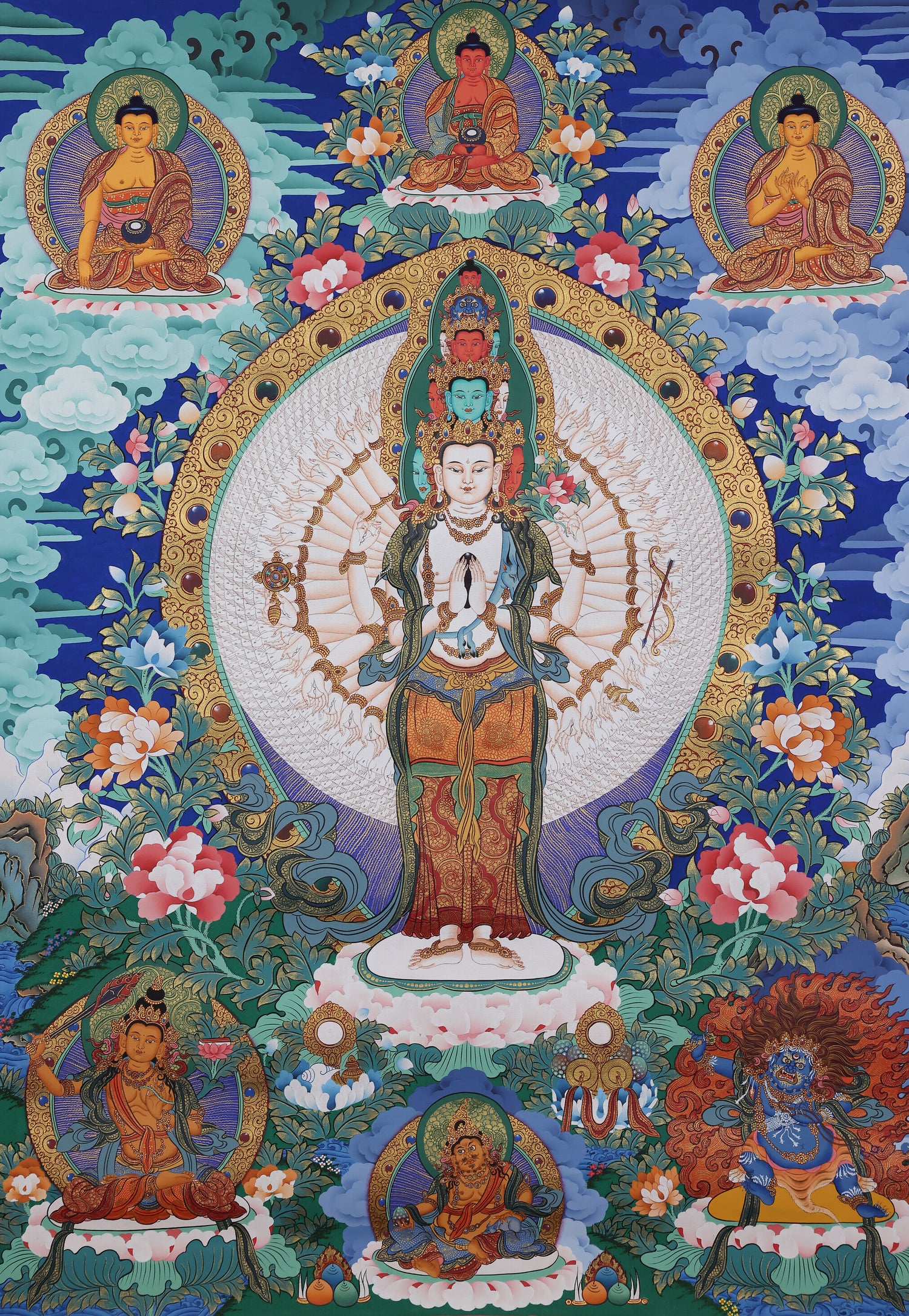
When a 44×64cm hand-painted Nepalese thangka unfolds before you, it is more than a vivid religious painting: it is a fusion of Tibetan Buddhism’s “harmony of fortune and wisdom” spirituality and Nepal’s millennial artistic heritage. This thangka, centered on Vaishravana (the Wealth King), uses the rich texture of mineral pigments and ritualized iconography to tell the deeper logic of Tibetan Buddhist wealth philosophy—and hides the unique code of Nepalese thangka art.
Tibetan Buddhism’s Vaishravana devotion is not secular “财神崇拜” (caishen worship); its core lies in balancing “worldly resources” and “transcendent wisdom”: wealth is a tool to escape material scarcity, ultimately enabling dedicated Dharma practice to achieve “harmony of fortune and wisdom.”
This Nepalese thangka’s theme is the visual translation of this spirituality: as the “steward of all worldly wealth,” Vaishravana leads his attendants to bestow treasures and protect devotees. It responds to people’s wishes for worldly abundance while implying the religious wisdom that “wealth serves spiritual practice.” Nepalese artists chose this subject to align with local culture, where thangkas bridge the secular and the sacred—serving as both objects of worship at altars and spiritual companions in daily life.
The central Vaishravana is a fusion of Tibetan Buddhism’s Iconometric Sutras and Nepalese artistic style; every detail is a precise religious symbol:
-
Form and Adornment: Divinity Behind Opulence
His golden body (an emanation of Ratnasambhava Buddha, symbolizing wealth and light) and “mildly wrathful” visage (wide eyes, stubbly beard) convey both the authority of a protector and compassion for sentient beings. A five-leaf crown, beaded ornaments, and flowing green silk (rendered with the soft curves characteristic of Nepalese art) are not just markers of a “wealth deity”—they affirm his divine status as a “bodhisattva of the tenth stage manifesting as a protector.”
-
Implements and Mount: Dual Metaphors of Wealth and Protection
His right hand holds a victory banner (adorned with streamers and jewels), symbolizing “stable endeavors and overcoming adversity”; his left hand supports a treasure-spitting mongoose, whose gem-strewn mouth directly represents “endless wealth bestowed on all.” His mount, a white snow lion (with layered green-brown mane, a signature Nepalese technique), roars backward: it symbolizes “subduing obstacles,” and its four paws correspond to the Four Immeasurables (loving-kindness, compassion, joy, equanimity)—embodying the symbiosis of wealth and virtuous intent.
-
Aura and Background: Anchoring His Celestial Identity
The golden-red nimbus (with lotus vines softening its solemnity) and golden cloud backdrop firmly anchor Vaishravana as a “celestial wealth deity,” infusing the work with dynamism amid its religious gravity.
The thangka’s layered composition reflects the belief that Vaishravana commands the Eight Wealth Gods. Nepalese artists use a “dense-yet-balanced” arrangement to honor ritual traditions while maintaining artistic grace:
-
Upper Deity: The Source Connection to Ratnasambhava Buddha
The small crimson Buddha above Vaishravana is Ratnasambhava Buddha (Vaishravana’s dharmakaya origin), seated in meditation on a lotus throne. This clarifies Vaishravana’s identity as a “Buddha-emanated protector,” grounding the wealth devotion in the Buddhist system.
-
Side Attendants: Complementing Wisdom and Protection
The golden deity on the left (holding a sword and lotus) is a wisdom wealth god emanated from Manjushri—Nepalese thangkas often use bodhisattva forms as attendants to emphasize “seeking wealth with wisdom.” The blue wrathful deity on the lower right (wreathed in flames, holding ritual tools) clears “obstacles to wealth.” The treasure-bearing deities (partially visible) correspond to the Eight Wealth Gods: each holds a treasure-spitting mongoose, and their colors (yellow, white, blue) align with their directional attributes—wealth acquisition requires both wisdom and obstacle-clearing.
This 44×64cm thangka is a prime example of Nepalese “hand-painted color thangkas”; its techniques and style carry millennial traditions:
-
Materials: The Timeless Texture of Mineral Pigments
The canvas is Nepalese cotton, treated with “clay glue” (animal glue mixed with chalk, polished repeatedly) to create a smooth, mirror-like surface. Pigments are minerals and earth-based: gold from ground gold leaf, red from cinnabar and red earth, blue from lapis lazuli, green from malachite. These require grinding, glue mixing, and layered glazing: Vaishravana’s golden body, for example, starts with a yellow base, layered with gold paste, and finished with pale red lines for muscle texture. Clouds use “dry-brush strokes” to create depth.
-
Style: Balancing Ritual and Aesthetics
Lines are rooted in “iron-wire outlines” but softened with Nepalese curves for drapery and flowers, avoiding the rigidity of Tibetan thangkas. Colors follow the “five-color symbolism” (yellow = light, red = authority) but use warm “earthy gold” and pink flowers to balance solemnity. The “centrally symmetric, layered composition” is filled with landscapes and flowers, blending ritual rigor with secular warmth—reflecting Nepalese thangkas’ dual role as worship objects and decorative art.
-
Heritage: Thangkas as “Living Faith”
Artists purify themselves and chant sutras before painting, draft strictly to Iconometric Sutras (Vaishravana’s height follows the “nine-finger measure”), and “open the eyes” (the final detail) with a lama’s blessing. In Nepal, thangkas are not mere art—they are “living faith.”
This Vaishravana thangka expresses Tibetan Buddhist wealth philosophy and epitomizes Nepalese artistic tradition: it carries the wisdom of “harmony of fortune and wisdom” through heavy mineral pigments, balances ritual rigor with soft lines, and uses its 44×64cm size to weave sacred faith into daily life. When you gaze at it, you see more than a painting—you feel the warmth of the symbiosis between Tibetan Buddhism and Nepalese culture.
#NepaleseThangka #Vaishravana #TibetanBuddhistArt #MineralPigmentThangka #HandPaintedThangka #WealthProtectorSpirituality #ThangkaAnalysis #Vaisravana #ReligiousArt #NepaleseHandmadeArt