Brief Introduction to Nepalese Hand-Painted Padmasambhava Thangka
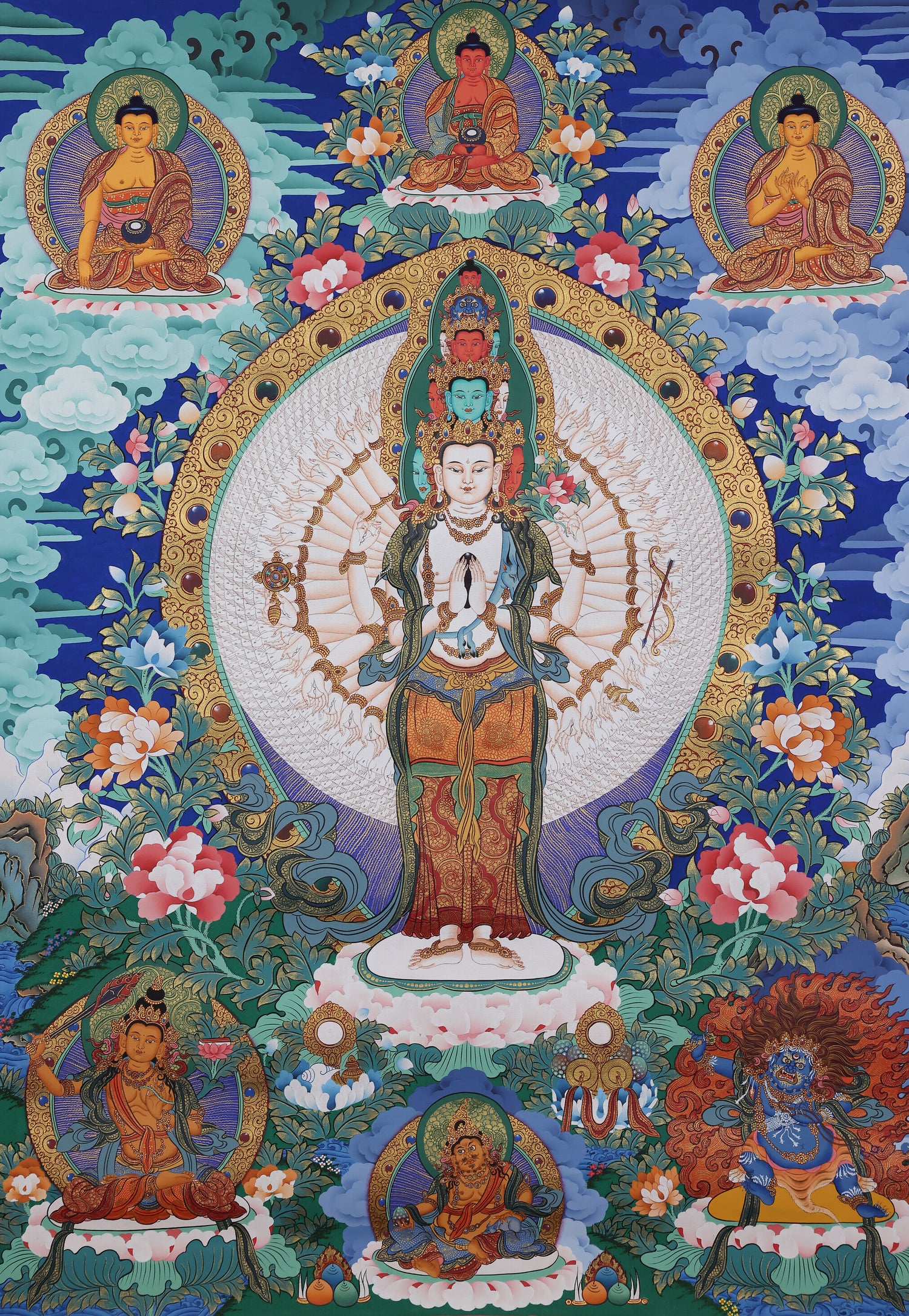
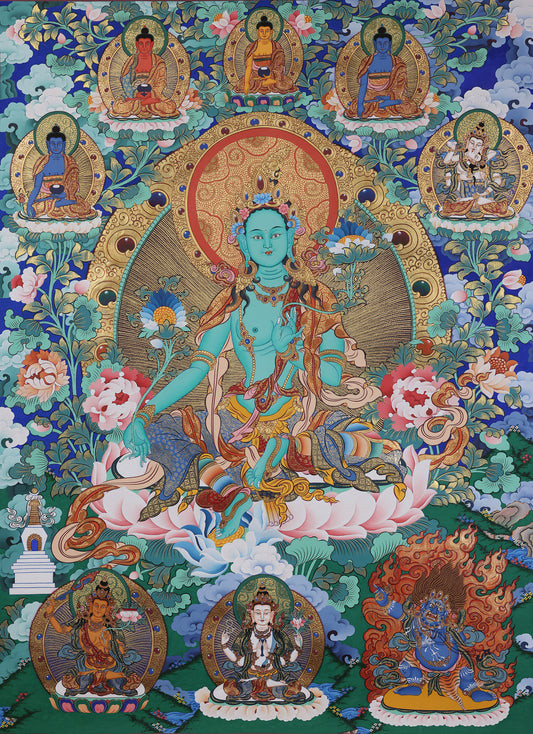
Today, we focus on a 46×65cm hand-painted Padmasambhava thangka from Nepal. Crafted with natural mineral and earth pigments, it adheres to Tibetan Vajrayana rituals while integrating Newari aesthetic traits, embodying the seamless fusion of Tibetan Buddhist faith and Nepalese traditional craftsmanship.
I. Theme: Manifestation of Oddiyana Pure Land – A Visual Vessel of Padmasambhava Faith
The core theme of this thangka is "The Serene Manifestation of Padmasambhava & His Attendant Protectors," corresponding to the Oddiyana Pure Land belief system of Tibetan Buddhism’s Nyingma school. Revered as the "Second Buddha of Oddiyana," Padmasambhava’s lotus-born origin and deeds (subduing Tibetan Bonpo demons, founding Samye Monastery, laying the foundation of Tibetan Vajrayana) establish him as a dual deity of "enlightener" and "demon-subduer."
Through the layout of "central main deity + surrounding attendants + pure land background," the thangka showcases Padmasambhava’s sacredness as a "Buddha incarnation" (the Buddha above his head symbolizes lineage origin) and his adaptability to sentient beings (half-lotus posture, secular-style adornments). Meanwhile, the attendants construct a complete "guru-disciple-dakini" lineage system, fulfilling a core function of Tibetan thangkas: communicating doctrine visually.
II. Main Deity: Padmasambhava’s Form – Materialization of Vajrayana Meanings
As the visual core, every detail of Padmasambhava strictly follows the Iconographic Measurement Sutra and tantric rituals, while incorporating the ornate aesthetics of Newari art:
1. Form & Attire: Fusion of Dual Identities
Padmasambhava appears in a "serene middle-aged form" with fair skin and faint facial hair, echoing his dual identity as a prince of Uddiyana and an ordained monk. His headdress is a jewel-and-feather-adorned variant of the blue pandita hat—symbolizing Indian scholarship, enhancing Vajrayana acharya majesty, and aligning with Newari ornamentation preferences.
His attire adopts a "three-layer nesting" design: an inner white monk’s robe (symbolizing monastic purity), a middle blue-based Tibetan waistcoat with gold Eight Auspicious Symbols patterns (symbolizing complete merit), and an outer dark brown brocade kasaya (with gold cloud patterns on edges, echoing the background). The blue-brown-gold color scheme, a classic Newari combination for "honored gurus," denotes emptiness wisdom, worldly steadiness, and perfect virtue respectively.
2. Ritual Tools: Symbols of Vajrayana Merit
Padmasambhava’s ritual tools embody clear tantric symbolism:
-
Khatvanga (skull staff): Leaned on his left arm, it features a trident (cutting greed, anger, delusion), three skulls (past-present-future wisdom; dharma-sambhoga-nirmana bodies), a five-pronged vajra (sum of Buddha-nature), a lotus (pure essence), and a bell-drum (wisdom and skillful means). Adhering to Padmasambhava Tantras rituals, Newari artists’ delicate carving amplifies its visual impact.
-
Kapala (skull bowl) & vase: His left hand holds a kapala containing a nectar vase—the kapala symbolizes "attaining wisdom through affliction," while the vase represents "blessing sentient beings and achieving siddhis," a core symbol of Vajrayana empowerment rituals.
-
Half-lotus posture: Unlike Buddhas’ full lotus posture, this "lifestyle posture" symbolizes adaptability to sentient beings’ capacities (not bound by monastic rules), typical of Newari thangkas’ "free deities."
3. Aura: Visual Reinforcement of Sacredness
Padmasambhava’s head aura is an orange circular halo (symbolizing wisdom light), and his body aura is a "multi-layer nested great aura": an outer golden scrollwork halo and an inner blue-black jewel-inlaid halo. The aura’s layers and ornamentation follow "Buddha-level deity" rituals while reflecting Newari art’s "vibrant and ornate" style.
III. Attendant Deities: Visual Expression of Lineage Transmission & Protective Power
The attendants are not decorative but materialize Tibetan Buddhism’s "lineage system" and "protective power":
-
Upper Deity: Amitabha Buddha (red, on a lotus throne above Padmasambhava) symbolizes his lineage origin—tantras regard Padmasambhava as the "body, speech, mind incarnation of Amitabha, Avalokiteshvara, and Shakyamuni," representing dharma source and pure land aspiration.
-
Lower Left Attendant: Vairotsana (Tibet’s First Translator), in ordained monk form holding a vase, symbolizes Padmasambhava’s core Tibetan disciple and "dharma transmission and blessing sustenance."
-
Lower Right Attendant: Yeshe Tsogyal Dakini (Padmasambhava’s consort and female acharya), in serene palms-together posture, symbolizes "dakini dharma protection" and embodies Tibetan Vajrayana’s "male-female union" trait.
-
Lower Central: Nectar Vase (on a thousand-petal lotus under Padmasambhava’s throne) is an auspicious offering vessel symbolizing "blessing all sentient beings," representing his pervasive blessings.
IV. Craftsmanship & Style: The Uniqueness of Newari Art
This thangka’s techniques and style are typical of Nepal’s Newari school:
1. Natural Mineral Pigment Craftsmanship
Artists use natural mineral/earth pigments (lapis lazuli for blue, cinnabar for red, realgar for yellow) processed via crushing → grinding to 5-20μm → aging → mixing with 5+ year-old cow glue (3:1 ratio). This pigment boasts strong adhesion and centuries-long fade resistance, the core reason traditional thangkas "endure with timeless beauty."
2. Newari Artistic Style
Distinct from Tibetan local thangkas (e.g., Regong school), its stylistic traits include:
-
Colors: Saturated & Layered—3-5 pigment layers create lotus’ light pink-to-deep rose transition; warm hues evoke a sacred, serene atmosphere.
-
Ornamentation: Intricate & Detailed—"Newari scroll clouds" for cloud patterns; fine-brush outlining for garment patterns and aura jewels, reflecting Newari artists’ meticulous family-transmitted craftsmanship.
-
Composition: Dynamic Symmetry & Regional Background—incorporates "snow-capped mountains, green fields, rivers" (Nepal-Tibet border landscape), breaking Tibetan thangkas’ "abstract background" limitation and enhancing spatial depth and lifelikeness.
V. Cultural Value: Dual Identity as Religious Relic & Art Collection
Classified as a "medium worship thangka" (46×65cm), it suits both home shrine worship and monastery hall display. It is both a material vessel for Tibetan Buddhism’s "Padmasambhava faith" (meeting practitioners’ visual meditation needs) and a Newari art masterpiece (exquisite craftsmanship, unique style).
Its value lies in balancing "ritual rigor" and "artistic aesthetics": preserving Tibetan Vajrayana’s core meanings while transforming the "dharma-through-imagery" tradition into a more visually compelling form via Newari art.
#NepalesePaintedThangka #PadmasambhavaThangka #NewariThangkaCraftsmanship #TibetanBuddhistThangkaGuide #MineralPigmentHandpaintedThangka #NewariArtThangka #TibetanVajrayanaThangka #HandpaintedReligiousArt #MineralPigmentArt #OddiyanaPureLandThangka