Nepalese Painted Thangka of Vaishravana (Wealth King): The Symbiosis of Tibetan Buddhist Wealth Beliefs and Millennia-Old Art

$599.00 USD
Thangka name: Caitang treasure king
size: 45cm×65cm
origin: Nepal
Eine Frage stellen

Beeil dich! Nur noch [Anzahl] auf Lager!

Geschätzte Lieferzeiten: 12–26 Tage (International), 3–6 Tage (USA).

Rückgabe innerhalb von 45 Tagen nach dem Kauf. Zölle und Steuern werden nicht erstattet.

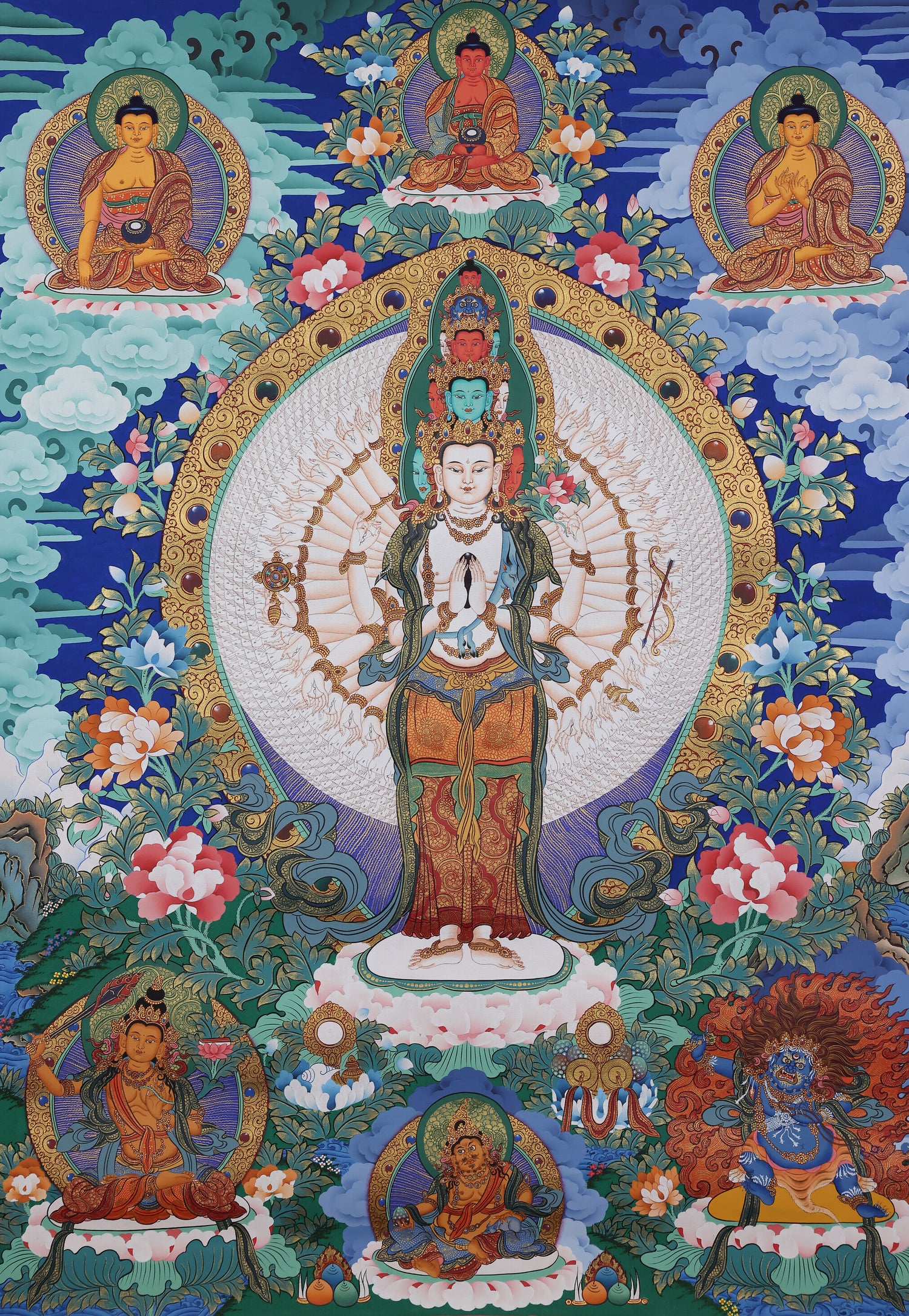
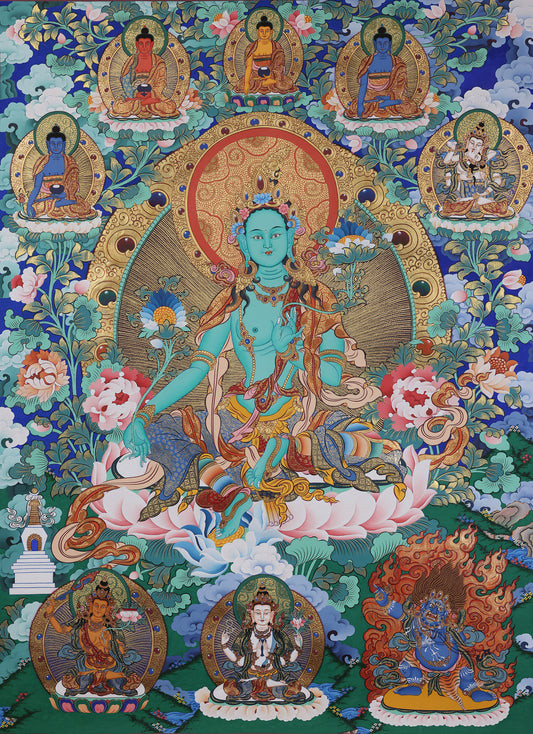
Traditional Tibetan Thangka showing Vaishravana in golden armor, symbolizing power and abundance
Nepalese Painted Thangka of Vaishravana (Wealth King): The Symbiosis of Tibetan Buddhist Wealth Beliefs and Millennia-Old Art
$599.00 USD
When a 45×65cm Nepalese painted thangka unfurls in a shrine, the glow of gold leaf and mineral pigments holds more than just the majestic form of Vaishravana; it embodies the profound Tibetan Buddhist doctrine of "using worldly desires to lead beings to Buddhist wisdom." This is the allure of the hand-painted Nepalese Vaishravana thangka: it is both a vessel for secular wealth aspirations and a visual manifestation of religious wisdom.

I. Core Theme: Wealth as a Resource for Practice, Not an End

The central theme of this thangka is the dual guardianship of Vaishravana (also known as Vaisravana in Sanskrit). As the only deity in Tibetan Buddhism who holds both the roles of "Northern Dharma Protector" and "Chief God of Wealth," Vaishravana’s very existence balances worldly needs and transcendental wisdom.

For devotees in Tibet and the Himalayan cultural sphere, worshipping Vaishravana is not merely "seeking prosperity." The doctrine behind the thangka clarifies: wealth is a "resource for spiritual practice," to be guarded by virtuous deeds and used with compassion. The thangka’s composition and imagery concretize this idea: the main deity’s authority, the attendants’ gentleness, the permanence of mineral pigments, and the fluidity of lines together construct the logic that "wealth originates from the Dharma and ultimately returns to virtuous karma."

II. The Main Deity: Divinity and Symbolism in Golden Form

The central Vaishravana in the painting is a model of fusion between Tibetan Buddhist iconometric rules and Nepalese aesthetics:

  • Form and Ritual Implements: His golden body (corresponding to Ratnasambhava Buddha, symbolizing the perfection of merit) is crowned with a five-Buddha crown that unifies the wisdom of the five directional Buddhas. His right hand holds a victory banner, which represents both "stable undertakings" and the "vanquishing of greed." His left hand supports a nüli (treasure-spitting mongoose), whose mouth overflowing with jewels is a symbol of "boundless generosity"—the direct embodiment of his identity as a god of wealth.
  • Mount and Posture: His mount, a red-maned white snow lion, roars proudly; its four paws correspond to the "Four Immeasurables" (loving-kindness, compassion, joy, equanimity), embodying both the authority of a Dharma protector and the core of compassion. Vaishravana assumes a "lalita asana" (relaxed seated posture), which balances ease and dignity, hinting at "mastering wealth freely rather than being bound by it."

III. Attendant Deities: A Complete System of Wealth Protection

The attendants surrounding the main deity are not mere decorations; they visualize the doctrine of the "Eight Treasuries":

  • Three Deities Above: The central top deity (Buddha/Ratnasambhava Buddha) establishes that "wealth originates from the Dharma." The White Tara (holding a lotus, symbolizing purity) and Green Tara (making the gesture of granting wishes) flanking him symbolize the union of "virtuous aspirations and wealth."
  • Two Deities Below: The Yellow God of Wealth (holding a treasure vase) acts as the "executor of wealth," tasked with directly bestowing material resources. The blue-bodied protector (wreathed in flames) is the "guardian of wealth," vanquishing the karmic obstacles of poverty.
  • Implicit System: Though the Eight Wealth Gods are not depicted, the main deity’s treasure-spitting mongoose and the attendants’ treasure-bearing implements implicitly represent the "Eight Treasuries answering to Vaishravana," completing the thangka’s function of wealth protection.

IV. Craftsmanship: Millennia of Heritage in Mineral Pigments

Half the value of this thangka lies in its doctrine, the other in its craftsmanship—the handcrafted techniques of the Nepalese Newari school are a living cultural heritage:

  • Base and Pigments: The cotton-linen canvas is treated repeatedly with glue-alum water and ground white stone powder to ensure it is smooth and opaque. All pigments are natural minerals and earth-based: yellow from realgar and ochre, blue-green from lapis lazuli and malachite, red from cinnabar and saffron, and gold from ground 24K gold leaf (processed through "gold kneading" and "gold dyeing" to create tonal layers). These pigments require weeks of soaking, stone grinding, and mixing with cowhide glue; their resistance to fading aligns with the religious need for thangkas to be "permanent manifestations of the Dharma."
  • Technical Details: Wolf-hair brushes outline lines (double gold lines enhance opulence), wet blending is used for shading (the main deity’s golden body requires three layers of overlapping dyeing), and facial features follow "three sections and five eyes" iconometry while incorporating the Newari style of "handsome neutrality"—gentle yet heroic brows, a slight smile hinting at compassion, exemplifying the principle of "expressing spirit through form."

V. Style: The Beauty of Cultural Fusion in the Newari School

This thangka is a classic example of the Nepalese Newari school, balancing religious solemnity with regional softness:

  • Composition: It adopts a mandala-like structure but abandons strict symmetry; the background, filled with scrollwork and Han-style peony patterns (symbolizing prosperity), embodies flexibility.
  • Color Palette: High-contrast saturated colors (the main deity’s gold, the orange-red nimbus, the blue-green attendants) are unified by gold outlines, achieving opulence without gaudiness.
  • Details: Gemstones on the crown use "highlight dotting" to convey texture, while flowing ribbons employ "curved fluidity" to express dynamism; the snow lion’s softened features balance solemnity and approachability—this is the result of merging Indo-Nepalese artistic roots with Tibetan and Han aesthetics.

Conclusion: A Thangka Is More Than a "Painting"—It Is Living Wisdom

This 45×65cm Nepalese painted thangka was never meant to be a "lucky charm for wealth." It is a vessel for the Tibetan Buddhist ideal of "cultivating both merit and wisdom": the permanence of mineral pigments symbolizes the continuity of merit; the main deity’s dual divinity explains the essence of wealth; the Newari school’s softness makes doctrine accessible in daily life. When we gaze at this thangka, we see not just art, but a life wisdom of "governing wealth with good intentions."
#NepaleseThangka #Vaishravana #TibetanBuddhistArt #NewariSchool #MineralPigmentThangka #WealthBeliefs #PaintedThangkaCraft #ShrineWorshipThangka #HimalayanCulture #ThangkaAnalysis

Entdecken Sie das perfekte tibetisch-buddhistische Thangka, das zu Ihren Wünschen, Ihrem Lebensstil und Ihrem Raum passt. Jedes Thangka hat eine spirituelle Bedeutung und bringt Segen, wenn es richtig platziert wird.

1. Definieren Sie Ihre Absicht

Reichtum & Erfolg → Gelber Dzambhala (Gottheit des Reichtums)

Mitgefühl und Frieden → Avalokiteshvara, Grüne Tara

Weisheit & Lernen → Manjushri

Gesundheit & Heilung → Medizinbuddha

Langlebigkeit und Familienschutz → Weiße Tara

2. Wählen Sie nach Identität

Unternehmer und Geschäftsinhaber → Reichtumsgottheiten für Wohlstand.

Studenten und Gelehrte → Weisheitsgottheiten für Konzentration und Klarheit.

Heiler und Yoga-Praktizierende → Medizinbuddha für Energie und Gleichgewicht.

Familien und Hausfrauen → Tara-Gottheiten für Harmonie und Sicherheit.

Sammler und Kunstliebhaber → Seltene Mandalas oder Meisterwerk-Thangkas.

3. Passen Sie Ihren Raum an

Heimschrein / Meditationsraum → Mittlere Thangkas (60–80 cm).

Büro / Geschäftshalle → Große Thangkas für Wohlstand und Autorität.

Wohnzimmer / Arbeitszimmer → Dekorative Thangkas für Frieden und Schönheit.

4. Authentische Handwerkskunst

Jedes Thangka ist mit natürlichen Mineralpigmenten und feiner Leinwand handbemalt und spiegelt tibetische Kunstfertigkeit und spirituelle Kraft wider. Überprüfte Quellen gewährleisten Qualität und Respekt für die Tradition.

✨ Wählen Sie Ihr Thangka mit Herz – es ist nicht nur Kunst, sondern ein Segen für Ihr Leben.

Jeder Mensch hat unterschiedliche Bedürfnisse. Die Wahl des richtigen Thangkas kann spirituelle Unterstützung, Schutz, Glück und Segen bieten. Nachfolgend finden Sie Thangka-Empfehlungen für verschiedene Rollen:

1. Unternehmer

  • Bedürfnisse : Weisheit, Reichtum, Gesundheit, beruflicher Erfolg.
  • Empfohlene Thangkas :
    Manjushri : Verbessert die Entscheidungsfindung und Geschäftsweisheit.
    Gottheit des Reichtums : Bringt Reichtum und Wohlstand.
    Medizinbuddha : Unterstützt die Gesundheit und reduziert Stress.
    Mahakala : Schützt Unternehmen vor Konkurrenz und Herausforderungen.

2. Erfolgreiche Einzelpersonen

  • Bedürfnisse : Innerer Frieden, Familienharmonie, Langlebigkeit.
  • Empfohlene Thangkas :
    Amitabha Buddha : Bringt inneren Frieden und Ruhe.
    Avalokiteshvara (Guanyin) : Fördert Harmonie und Glück in der Familie.
    Amitayus (Langlebens-Buddha) : Betet für gute Gesundheit und ein langes Leben.
    Manjushri : Stärkt weiterhin die Weisheit.

3. Hausfrauen/Ehemänner

  • Bedürfnisse : Familienharmonie, Schutz, Gesundheit.
  • Empfohlene Thangkas :
    Avalokiteshvara : Steigert das Familienglück und die Harmonie.
    Schutzgottheiten : Beschützen die Familie vor äußeren Störungen.
    Weiße Tara : Segnet die Familie mit Gesundheit.

4. Studierende und Wissenschaftler

  • Bedürfnisse : Weisheit, Konzentration, akademischer Erfolg.
  • Empfohlene Thangkas :
    Manjushri : Fördert Lernfähigkeit, Gedächtnis und Weisheit.
    Shakyamuni Buddha : Hilft bei der Konzentration und spirituellen Praxis.
    Jixiang Tianmu : Bringt akademisches Glück und Prüfungserfolg.

5. Künstler und Kreativprofis

  • Bedürfnisse : Inspiration, Kreativität, künstlerische Leistung.
  • Empfohlene Thangkas :
    Manjushri : Regt kreatives Denken und Inspiration an.
    Vajrapani : Hilft, kreative Blockaden zu überwinden.
    Maitreya : Sorgt für eine entspannte und optimistische Einstellung und baut Stress ab.

6. Reisende und Abenteurer

  • Bedürfnisse : Schutz, Glück, Erfolg bei Abenteuern.
  • Empfohlene Thangkas :
    Hayagriva : Bietet starken Schutz auf Reisen und beseitigt Hindernisse.
    Mahakala : Bringt Glück und Schutz, insbesondere für Abenteurer.
    Vajrasattva : Hilft, Schwierigkeiten und Herausforderungen während der Reise zu überwinden.

7. Ältere Menschen

  • Bedürfnisse : Gesundheit, Langlebigkeit, spiritueller Frieden.
  • Empfohlene Thangkas :
    Amitayus : Betet für ein langes Leben und gute Gesundheit.
    Medizinbuddha : Fördert Heilung und körperliches Wohlbefinden.
    Avalokiteshvara : Bringt Mitgefühl und inneren Frieden in späteren Jahren.

8. Führungskräfte

  • Bedürfnisse : Führung, Weisheit, Teamarbeit und geschäftlicher Erfolg.
  • Empfohlene Thangkas :
    Manjushri : Verbessert Führungsqualitäten und Entscheidungsfindung.
    Gottheit des Reichtums : Bringt dem Unternehmen und dem Team Erfolg und Wohlstand.
    Avalokiteshvara : Fördert Harmonie und Gleichgewicht innerhalb des Teams.

9. Gesundheits- und Fitnessbegeisterte

  • Bedürfnisse : Gute Gesundheit, Vitalität, Energie.
  • Empfohlene Thangkas :
    Medizinbuddha : Verbessert die körperliche Gesundheit und Vitalität.
    Weiße Tara : Bringt Gesundheit und Verjüngung.
    Vajrasattva : Beseitigt gesundheitliche Probleme und steigert die Energie.

10. Politiker

  • Bedürfnisse : Führung, Weisheit, Frieden.
  • Empfohlene Thangkas :
    Manjushri : Verbessert Führungsqualitäten und Entscheidungsfindung.
    Vairocana Buddha : Hilft, inneren Frieden und Weisheit zu bewahren.
    Avalokiteshvara : Fördert den gesellschaftlichen Frieden und die Harmonie in der Familie.

Für alle Bestellungen über 100 USD ist der Versand kostenlos.

Rücksendungen werden bis zu 10 Tage nach Erhalt des Kaufbelegs bzw. der Sendungsnummer (bei ungetragenen Artikeln) akzeptiert. Sie als Kunde sind verpflichtet, uns vor der Rücksendung des Artikels per E-Mail zu informieren.

Andernfalls fallen die Standardversandkosten an. Weitere Informationen finden Sie in unseren Lieferbedingungen .

Rücksendungen werden bis zu 10 Tage nach Erhalt des Kaufbelegs oder der Sendungsnummer (bei ungetragenen Artikeln) akzeptiert. Sie als Kunde sind verpflichtet, uns vor der Rücksendung des Artikels per E-Mail zu informieren, nur in folgenden Fällen:

– Den falschen Artikel erhalten.
– Artikel kam nicht wie erwartet an (z. B. beschädigte Verpackung).
– Artikel hatte Mängel.
– Über die Lieferzeit hinaus.
– Der Spediteur gestattet keine Besichtigung der Ware vor der Bezahlung.

Die zurückgesendeten Produkte müssen in der Originalverpackung, sicher verpackt, unbeschädigt und ungetragen sein. Dies bedeutet, dass die Artikel zum Schutz während des Transports sicher in einem Karton verpackt sein müssen, möglichst im selben Karton, in dem sie an Sie als Kunde versendet wurden.

Kürzlich angesehen

Nicht vergessen! Die Produkte, die Sie angesehen haben, legen Sie jetzt in den Warenkorb.

Passt gut zu

Erweitern Sie Ihre Auswahl mit perfekt abgestimmtem Zubehör und ergänzenden Produkten.

Leute kauften auch

Hier sind einige unserer ähnlichsten Produkte, die die Leute kaufen. Klicken Sie hier, um den Trendstil zu entdecken.