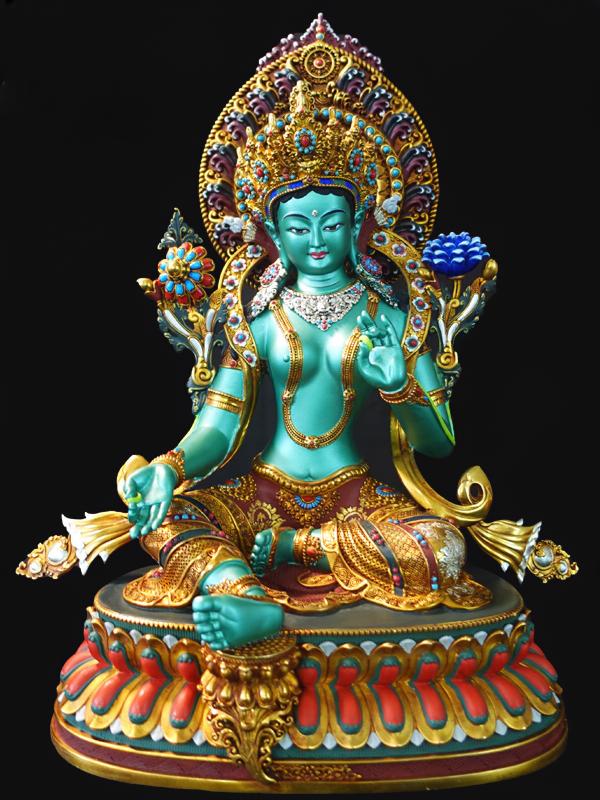
This statue is the Green Tara statue—a highly representative figure in Tibetan Buddhism, serving not only as an artistic treasure but also as a tangible embodiment of the compassion and cultural symbols of Tibetan Buddhist culture. Below is an analysis from four dimensions: cultural identity, iconographic symbolism, spiritual connotations, and artistic craftsmanship:
1. Cultural Identity: The Incarnation of Guanyin’s Compassionate Tears, the "Mother of Salvation" in Tibet
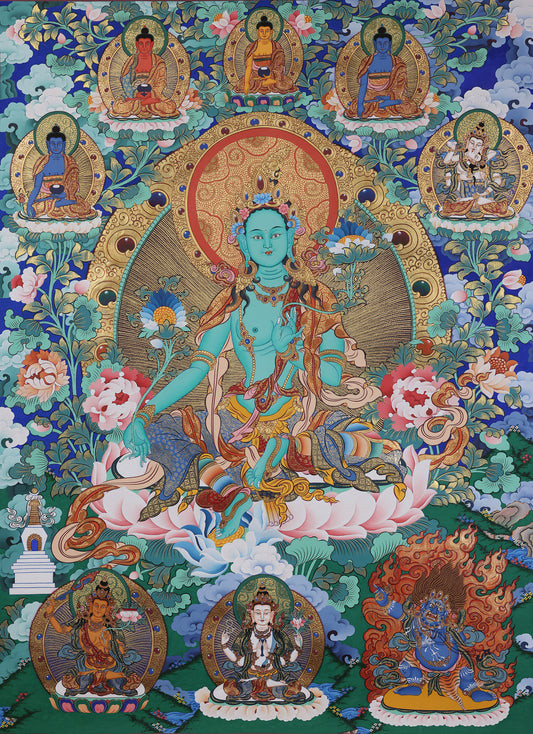
In the Tibetan Buddhist system, Green Tara is the manifestation of the right-eye tear of Avalokiteshvara (Guan Yin), the leader of the "21 Taras," and is revered as the "Mother of All Buddhas" and "Buddha Activity Mother." Her worship was introduced to Tibet as early as the 7th century: Princess Bhrikuti of Nepal brought the first Tara statue to Tibet when she married Songtsen Gampo, while Princess Wencheng of the Tang Dynasty was regarded in Tibet as the earthly incarnation of Green Tara—legend has it that before Songtsen Gampo’s passing, Princess Wencheng transformed into a 16-petaled green lotus, from which Green Tara’s dharma form appeared.
This identity positions Green Tara as a symbol of "compassionate action": Avalokiteshvara grieved over the unending suffering of sentient beings despite his mercy, and his tear manifested as Green Tara, who vowed to "share the responsibility of salvation on Avalokiteshvara’s behalf." Thus, she is also called the "Tara Who Saves from Eight Perils"—capable of rescuing from lion, elephant, water, and other worldly terrors, while transforming "doubt" (one of the five poisons: greed, anger, delusion, pride, doubt). She protects women and children, making her the most trusted "worldly savior" among Tibetan believers.
2. Iconographic Symbolism: Every Detail is a Code of Doctrine
This statue strictly follows the specifications of the Tibetan Buddhist Iconometry Sutras, with each element carrying specific symbolic meaning:
-
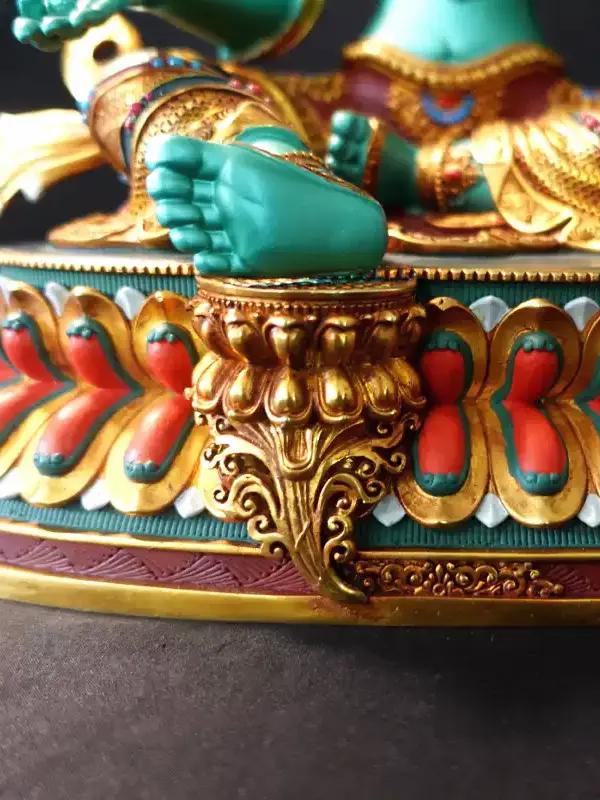
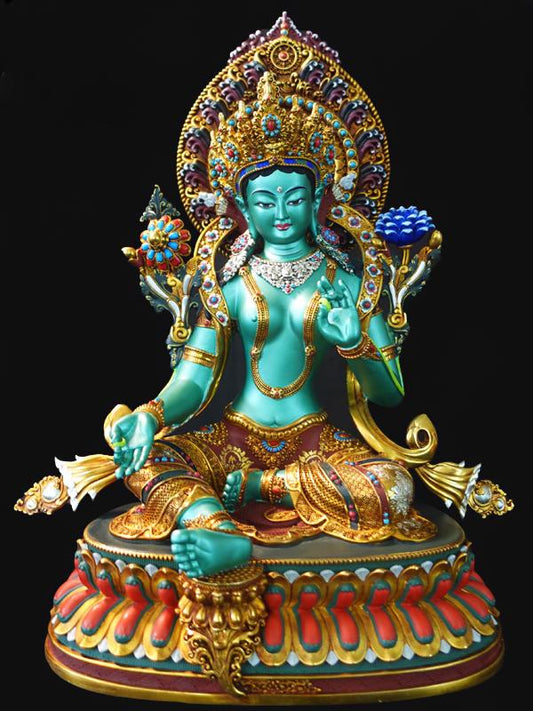
Body Color & Posture: The entire body is emerald green, corresponding to the color of the "Activity Buddha Family" (the body color of Amoghasiddhi Buddha), symbolizing "the ever-renewing power of salvation." The posture is the "half-lotus position" (left leg crossed, right leg extended forward resting on a lotus), embodying both the stillness of meditation and the readiness to rise and save sentient beings—an expression of "the union of compassion and wisdom."
-
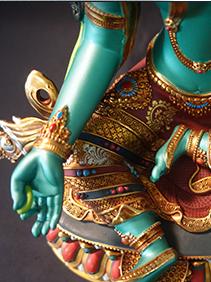
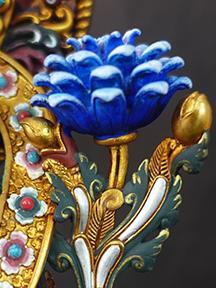
Mudra & Implements: The right hand forms the "Granting Wishes Mudra" (palm outward), representing "bestowing fearlessness and fulfilling wishes to sentient beings." The left hand holds a blue utpala lotus (water lily), with the stem extending to the ear; the lotus bears a "fruit, a blooming flower, and a bud"—the fruit represents past Buddhas (e.g., Kasyapa Buddha), the blooming flower represents the present Buddha (Sakyamuni), and the bud represents the future Buddha (Maitreya), signifying that Green Tara is "the manifestation of the activities of the Buddhas of the three times."
-
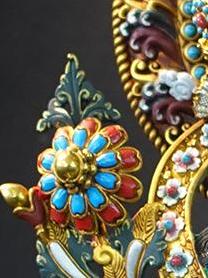
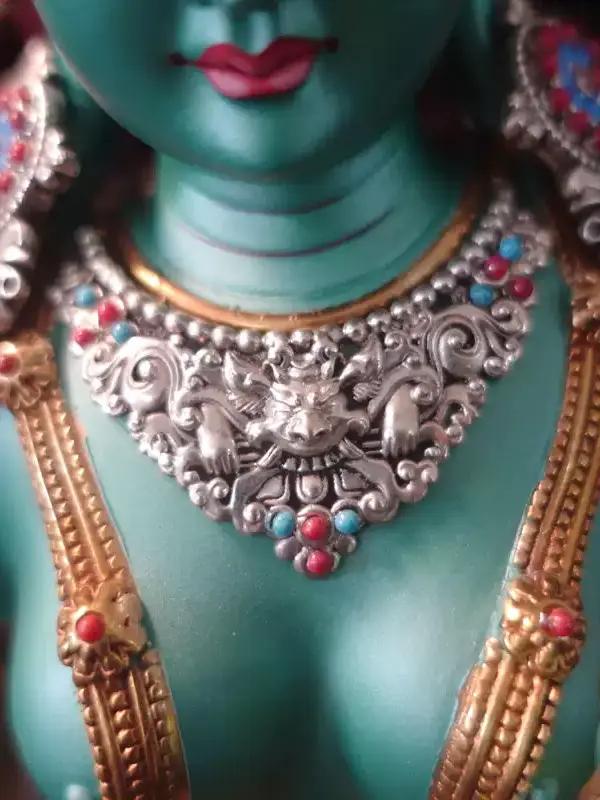
Ornaments & Aura: She wears a "Five-Buddha Crown," with the five Buddhas (Vairocana, Akshobhya, Ratnasambhava, Amitabha, Amoghasiddhi) symbolizing her mastery of the virtues of the five directional Buddhas. Adorned with necklaces, bracelets, and armbands, these are not only the solemn decorations of a "young maiden form" but also metaphors for "perfect merit." The ornate aura behind her, composed of scrollwork and jewel patterns, forms a "rainbow light 结界 (energy field)," representing her dharma body pervading the universe.
3. Spiritual Connotations: Extending from "Salvation" to a Philosophy of Life
The worship of Green Tara is not merely "prayer" but an embodiment of the Tibetan Buddhist view of life:
-
The Esoteric Meaning of "Green": Green is the color of growing plants, symbolizing "vitality and perfection"—just as fertile green land nourishes all living things, Green Tara’s compassion nurtures the good roots of sentient beings, freeing them from suffering and fostering wisdom.
-
The Deep Meaning of "Tara": "Tara" means "liberation (self-liberation and liberation of others)," and "Mother" means "origin and 包容 (containment)." Tibetan Buddhism holds that Green Tara’s "motherhood" is not secular reproduction but "rooted in compassion, embracing all sentient beings"—she is the "mother of prajna wisdom." Her dharma body is "Prajnaparamita (Mother of Wisdom)," her sambhogakaya (enjoyment body) is "Vajravarahi," and her nirmanakaya (manifestation body) takes various forms to save sentient beings. Thus, she is both a "protector who saves from suffering" and the "fundamental refuge for attaining Buddhahood."
In Tibetan spiritual traditions, the Green Tara practice is renowned for "swift accomplishment": Atisha Dipankara Srijnana entered Tibet to spread the dharma after receiving a prophecy from Tara; the Gelugpa master Drukpa Rinpoche survived a hunger strike in prison through the Green Tara practice; ordinary believers recite her mantra ("Om Tare Tuttare Ture Soha") to eliminate obstacles and seek protection.
4. Artistic Craftsmanship: A Model of Nepalese-Tibetan Style Fusion
This statue is a painted copper Nepalese-style sculpture, a representative work of "exquisite craftsmanship" in Tibetan Buddhist art:
-
Materials & Techniques: Cast from pure copper using the "lost-wax method," the surface undergoes processes such as "chasing, gilding, and painting"—the chased patterns are intricate, the gilding layer is full and luminous, and mineral pigments (e.g., malachite, cinnabar) are used for painting, ensuring vivid colors while meeting the religious requirement that "ritual objects must be durable and pure."
-
Stylistic Features: It blends the "softness" of Nepalese sculpture with the "solemnity" of Tibetan sculpture—the facial lines are rounded and gentle, the eyes are lowered with compassion (reflecting Nepalese art’s portrayal of "female softness"), while the ornate crown, aura, and precise proportions embody the "accurate iconometry and solemnity" of Tibetan sculpture.
This craftsmanship is not only an artistic expression but also a "carrier of faith": Every detail of the statue must conform to "ritual rules," otherwise it loses its "blessings." Thus, such statues are both works of art and "living ritual objects"—Tibetan believers infuse them with "spirituality" through ceremonies like "consecration and enshrinement," turning them into a bridge between the mundane and the sacred.
This Green Tara statue is, in essence, an epitome of Tibetan Buddhism’s "compassion and wisdom": It transforms abstract doctrine into visible symbols through art, allowing believers to perceive "the power of salvation" in admiration and comprehend "the perfection of life" in practice. From the first statue brought by Princess Bhrikuti to the countless statues across Tibet today, Green Tara has always been a symbol of "hope" in Tibetan culture—just as her right leg extends forward, she is always ready to reach out to sentient beings in suffering.