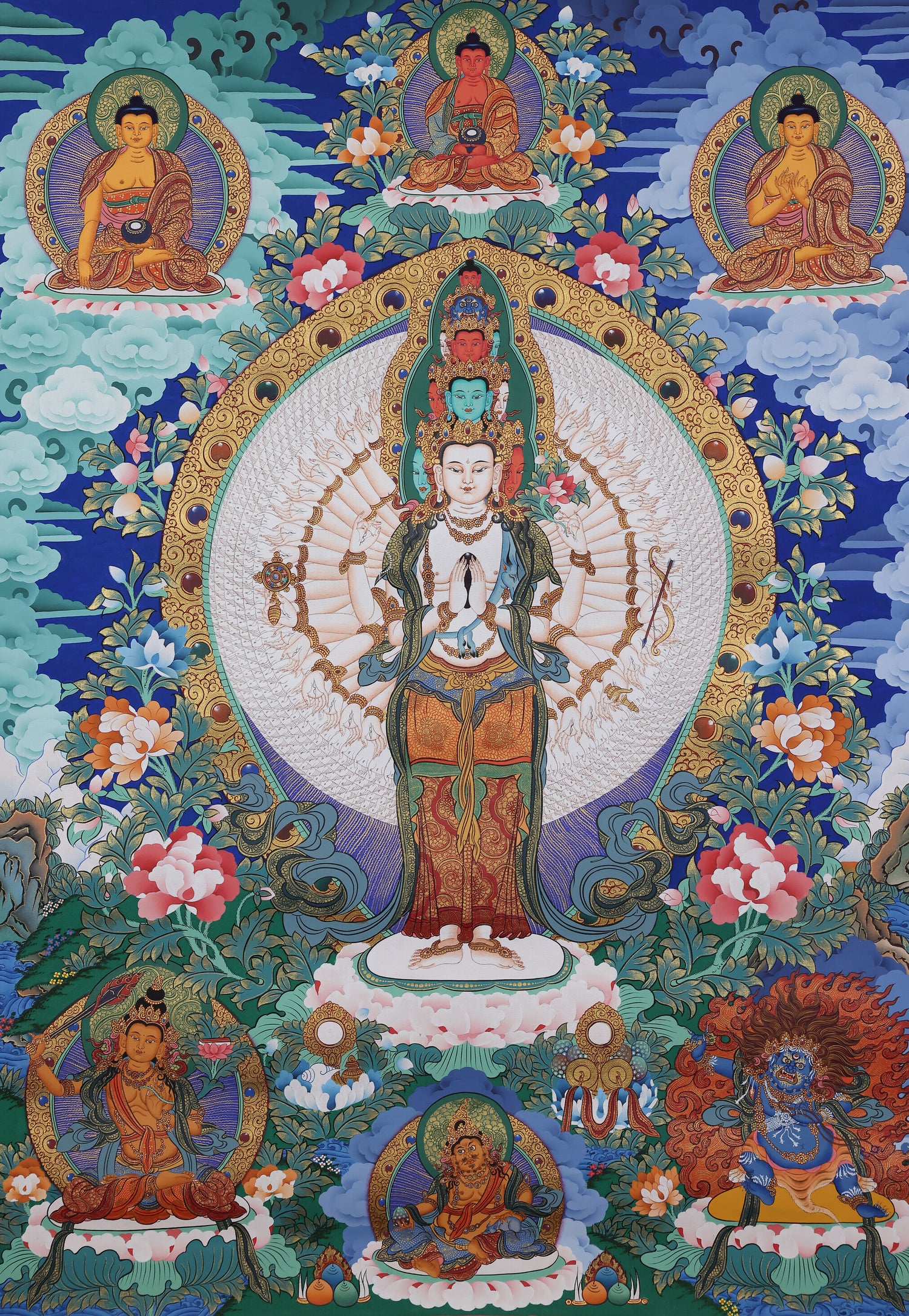
In Tibetan temples and homes, thangkas are never just "decorative paintings"—they are visual scriptures of faith, tangible embodiments of compassion. The 48×65cm hand-painted Tibetan color thangka of the Four-Armed Avalokiteshvara we dissect today is precisely such a 雪域 treasure ("snowland treasure") that "embodies dharma through imagery": every detail, from the rich texture of mineral pigments to the ritual iconography, holds the thousand-year spiritual lineage of Tibetan Buddhism.
I. Theme: The Visual Scripture of "Compassionate Redemption" in Tibetan Buddhism
To Tibetans, the Four-Armed Avalokiteshvara is the "Protector of the Snowlands"—an incarnation of the Bodhisattva Avalokiteshvara, manifest to liberate beings in Tibet, and the bearer of the core doctrine of the Six-Syllable Mantra (
Om Mani Padme Hum). The theme of this thangka is not merely to depict a deity, but to construct a sacred realm of "all-encompassing compassion":
It connects Tibetans’ daily wishes for "worldly peace" and carries their spiritual longing for "rebirth in the Pure Land in the next life," making it a symbiosis of religious doctrine and secular emotion. The 48×65cm size is perfectly suited for hanging in household Buddhist shrines (common in Tibetan homes), integrating "compassionate gaze" into daily life.
II. The Main Deity: Every Ritual Detail is a "Code of Compassion"
Iconography in Tibetan thangkas is never arbitrary—this Four-Armed Avalokiteshvara strictly adheres to the Iconometric Sutra, with every element serving as a symbol of doctrine:
-
Form: The moon-white body corresponds to "innate purity, untainted by afflictions"; the four arms symbolize the Four Immeasurables (loving-kindness, compassion, joy, equanimity), embodying Avalokiteshvara’s ability to "liberate all beings"; the cranial protuberance (urna) between the brows and the gently downward-gazing, smiling face are hallmarks of the "peaceful form," conveying the tenderness of "gazing upon the suffering of beings."
-
Implements and Mudras: The Cintāmaṇi (wish-fulfilling jewel) held in the palms (joined in anjali mudra) symbolizes "the union of wisdom and skillful means" (compassion guided by wisdom); the crystal prayer beads in the right hand, each bead representing a sentient being, signify "cyclical liberation from samsara"; the blue lotus held in the left hand is a metaphor for "purity unsoiled by worldly defilement."
-
Decorative Details: The Five-Buddha Crown corresponds to "the wisdom of the Five Dhyani Buddhas"; the deer skin draped over the left shoulder is a symbol of "compassionate non-harm"; coral, turquoise, and other jewels are vessels of "sacred wealth" in Tibetan culture—these elements are not "ornate decorations," but visual language of faith.
III. Attendants and Background: The Narrative Logic of "Main Deity + Sacred Realm" in Tibetan Thangkas
The background of a thangka is never "filler"—it extends the "sacred realm":
-
Implicit Attendants: The golden flaming halo above the main deity subtly aligns with the dharma lineage of "Amitabha as the crown" (the Four-Armed Avalokiteshvara is an incarnation of Amitabha), symbolizing "buddha-light pervading the three realms";
-
Explicit Elements: The peacock in the background symbolizes "the dispelling of afflictions," the auspicious clouds correspond to "all-encompassing good fortune," and the intertwined lotus vines are a metaphor for "the pure dharma realm"—these elements surround the main deity, constructing a spiritual space of "protection by the deity and fulfillment of good wishes."
This "main deity as core, attendants as context" composition is a classic order of Tibetan thangkas, designed to serve doctrine.
IV. Craftsmanship: Mineral Pigments and the Menri School—A Millennium of Tibetan Artisanal Heritage
Half the value of this thangka lies in faith; the other half lies in craftsmanship:
-
The Warmth of Mineral Pigments: Natural materials such as lapis lazuli (for blue), malachite (for green), cinnabar (for red), and 24K gold leaf (for gold) undergo crushing, grinding (to 5–20μm particles), and mixing with yak bone glue (3:1 glue-to-pigment ratio), resulting in lightfastness lasting over a century—the speckled texture of lapis lazuli and the luminous sheen of gold powder make the thangka appear to "flow with buddha-light" as light shifts.
-
The Rigor of 12 Processes: From canvas soaked in cowhide glue and stretched taut, to drafting strictly to the Iconometric Sutra’s "37:25 golden ratio," to 3–5 layers of gradient coloring (the moon-white of the deity’s face requires multiple thin coats to achieve a "gentle lunar glow"), and finally the ritual "eye-opening" (conducted at a specific time to symbolize the deity "gaining spiritual essence")—every step is an act of reverence for tradition.
-
The Aesthetics of the Menri School: The main deity’s "large eyes, full lips, high nose, and broad forehead," paired with bold yet flowing garment lines, are hallmarks of the Tibetan Menri School—it balances religious rigor with artistic expression, remaining faithful to ritual while incorporating Tibetan aesthetic sensibilities.
V. Size: 48×65cm—"Compassionate Suitability" in Tibetan Life
The thangka’s size holds Tibetan lifestyle aesthetics:
48×65cm is a classic specification for "household worship thangkas" in Tibet—it fits the space of home Buddhist shrines, allowing Tibetans to worship daily and wish at any time; the vertical rectangular composition also aligns with the Tibetan cosmological view of "heaven-earth-human": the main deity connects heaven and earth, and when worshippers gaze upon it, they naturally feel "enveloped by compassion."
To Tibetans, this thangka is "living faith"; to the world, it is a dual heritage of Tibetan craftsmanship and spirit— the weight of mineral pigments, the rigor of ritual iconography, and the aesthetics of the Menri School together give "compassion" a tangible warmth.
#FourArmedAvalokiteshvaraThangka
#HandPaintedTibetanThangka
#TibetanBuddhistThangkaCraft
#MenriSchoolThangka
#MineralPigmentThangka
#TibetanFaithArt
#48x65cmThangkaSize
#ThangkaSymbolism
#TraditionalTibetanCraft
#ThangkaCulturalValue