1. Theme: The Compassion and Wisdom of the “Three Longevity Deities”
The core theme of this Thangka is White Tara’s “longevity and salvation” as well as the “perfection of merit and wisdom,” belonging to the classic “Three Longevity Deities” system in Tibetan Buddhist deity paintings. In Vajrayana rituals, White Tara, together with the “Buddha of Infinite Life (Amitayus)” and “Vajra Mother (Yeshe Tsogyal variant),” forms the “Three Longevity Deities.” Its thematic significance can be divided into two dimensions:
-
Worldly Salvation: Dispelling Obstacles and Extending Life
White Tara is known as the “Seven-Eyed Mother Buddha,” with seven eyes (three on her face and one on each hand and foot) symbolizing her ability to perceive the sufferings of sentient beings across the six realms. The practice’s core is to alleviate illnesses, extend lifespan, and remove obstacles. Devotees who visualize this image can pray for protection from disease, premature death, and other life obstacles, while also seeking worldly blessings such as fertility and prosperity. This theme aligns with the Tibetan people’s fundamental wish for “physical and mental well-being.”
-
Ultimate Liberation: Unity of Emptiness and Compassion
White Tara, as the embodiment of Avalokiteshvara’s “left-eye tears of compassion,” conveys a profound message of “simultaneous cultivation of wisdom and compassion.” Her white body represents the emptiness of the Dharma realm, while the seven eyes symbolize compassionate perception. Together, they illustrate the Vajrayana principle of “using compassion as the function of emptiness,” making longevity not only a matter of lifespan but also the pursuit of liberation and the perfection of merit and wisdom.
2. Principal Deity: Iconography and Symbolism of White Tara
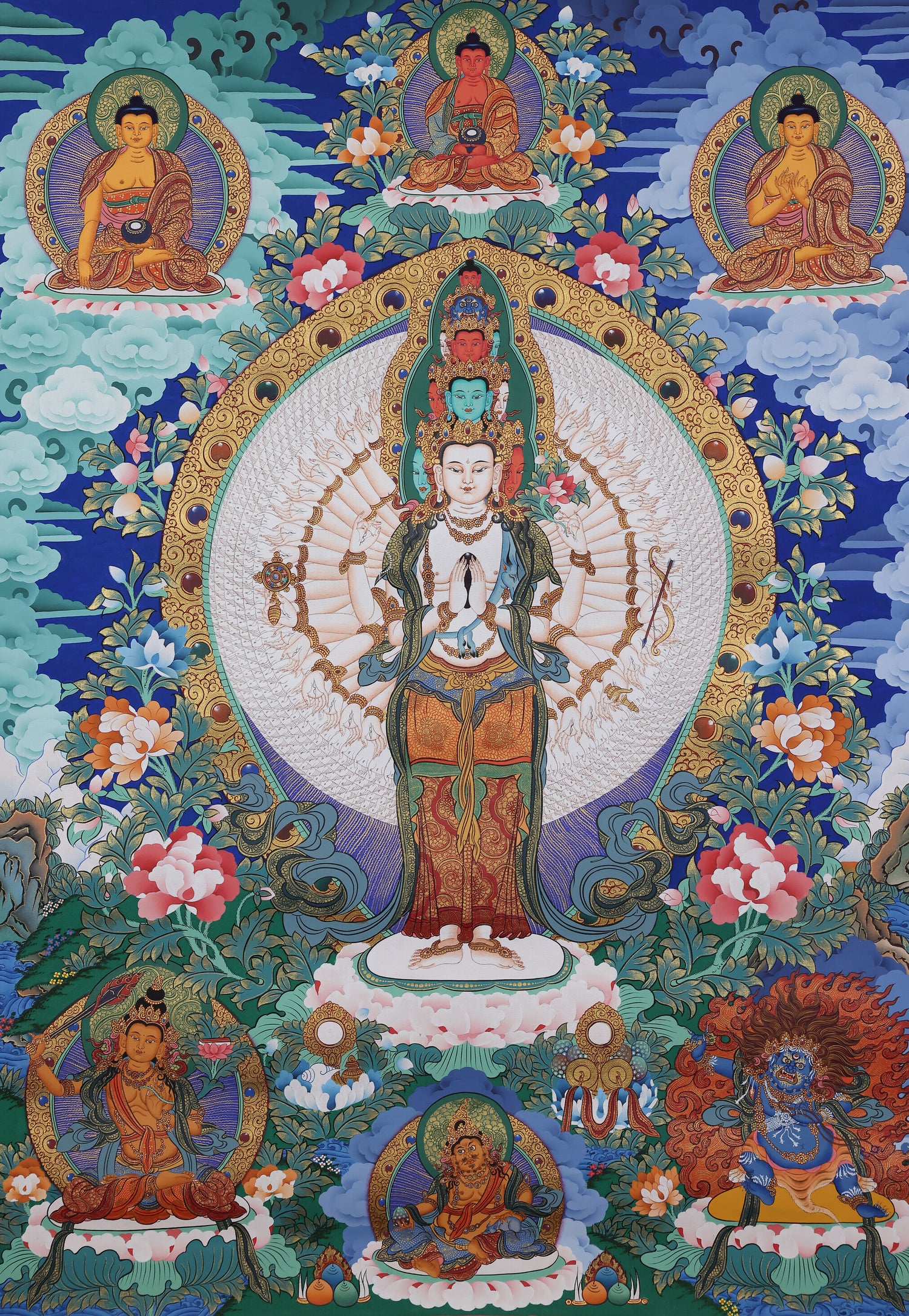
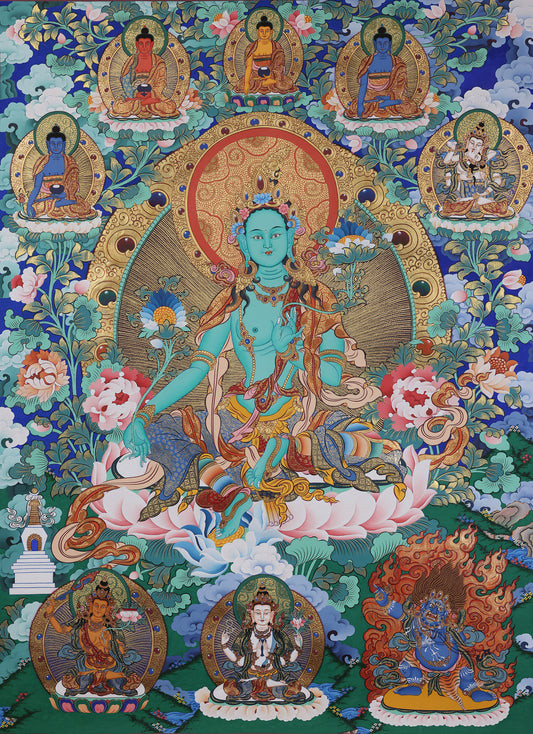
The central figure is White Tara in her serene form, strictly following the ritual proportions in the Sutra of Measurement of Deities (Zangzao Liangdu Jing). Every detail carries religious meaning.
-
Color and Facial Features
Her body is “pure white like the bright moon,” corresponding to Amitabha Buddha in the Five Dhyani Buddhas, symbolizing purity, emptiness, and longevity wisdom. The face depicts a “sixteen-year-old maiden,” full and lotus-like, with crescent-shaped eyebrows and smiling lips, reflecting feminine grace and timeless compassion. This youthful form is not a secular aesthetic, but a visual manifestation of the perfected form of the Buddha-body.
-
Posture and Mudras
She sits in the “vajra full-lotus posture” on a double-layered inverted and upright lotus seat, symbolizing liberation from defilements without regression. Her right hand forms the Varada Mudra (gesture of granting wishes), and her left hand forms the Triratna Mudra (thumb and forefinger holding the stem of the Utpala lotus). The white lotus in her hands appears in three stages—bud, half-bloom, full bloom—representing the perfection of the Three Jewels (Buddha, Dharma, Sangha), and the curling lotus stem reaching her ears symbolizes nourishing all beings with the Dharma.
-
Ornaments and Ritual Implements
She wears the “Five-Buddha Crown” (adorned with Amitabha at the top), symbolizing mastery over the five wisdoms. She is adorned with eight layers of sacred ornaments (necklaces, earrings, armlets, etc.), and her celestial robes feature the “U-shaped folds” characteristic of the Rebgong school, fulfilling the “dignified proportions” in ritual texts while highlighting the perfect attributes of the Buddha-body. Background ritual implements such as mani jewels and banners symbolize the completeness of merit and wisdom.
3. Retinue Deities: Structured Protection and Offerings
The retinue of deities follows the traditional “Three Longevity Deities” model, forming a closed-loop of “principal deity – Dharmakaya – protectors.”
-
Top Dharmakaya: Amitabha Buddha
As an emanation of Avalokiteshvara, White Tara Thangkas often depict Amitabha Buddha at the top, representing “compassion originating from Buddha-nature.” Amitabha is also the central deity of the longevity Buddha, forming the “Dharmakaya – Nirmanakaya” sequence, reinforcing the legitimacy of the longevity theme.
-
Attendant Deities: Vajra Mother and Protectors
In the background among flowers and clouds, the “three-headed, eight-armed deity” represents Vajra Mother (one of the Three Longevity Deities), holding the “nectar vase” and “dharmachakra,” symbolizing removal of obstacles and life extension, complementing White Tara’s theme of longevity and wisdom. Any blue wrathful figures may represent Vaishravana or other protective deities, symbolizing external protection of Dharma and resources.
-
Offering Elements: Lotus and Nature Imagery
The double-layered lotus seat symbolizes liberation without defilement. Background motifs such as peonies, auspicious clouds, and flowing water represent worldly offerings—the peony symbolizes abundance, clouds indicate protection by divine beings, and water symbolizes the nourishment of compassion. Together, these elements create a harmonious prayerful environment for body and mind.
4. Painting Craftsmanship: Rebgong School Color Thangka Expertise
This Thangka belongs to the Rebgong school color Thangka tradition, where painting itself is a meditative practice.
-
Base Preparation: Purifying Canvas
High-quality cotton canvas is stretched, coated with a mixture of yak glue and white chalk, and polished with shells until smooth like a mirror, symbolizing the removal of worldly distractions.
The background colors are layered with mineral pigments. Warm orange is prepared from ochre and realgar, applied 3–5 thin layers to achieve a stable yet bright base. Each layer requires the painter to recite mantras, embodying the principle of “work as practice.”
-
Color and Spirituality
The pristine white of the principal deity is created using pearl powder and white chalk, finely ground to achieve a jade-like texture, ensuring centuries-long durability while symbolizing White Tara’s pure nature.
Background elements like peonies and clouds employ the Rebgong 32-color gradient technique, blending mineral pigments to create natural transitions over 3–5 layers. This achieves vivid Rebgong-style colors while reflecting the Buddhist principle of equality of all phenomena.
-
Gold Line Work and Detailing
Gold lines are made from 24K gold leaf ground into a fine paste and applied with soft cat-hair brushes to highlight ornaments and clothing patterns. The interplay of bright and dark gold creates a radiant effect, symbolizing “light dispelling ignorance,” while showcasing Rebgong craftsmanship precision.
-
“Eye-Opening” Ritual
The eyes of the deity are painted last. The painter, after retreat and mantra recitation, uses cinnabar to dot the pupils, considered the key step in imbuing the Thangka with spiritual vitality. Masterpieces of this tradition often require six months of focused retreat, reflecting both artistic rigor and meditative practice.
Conclusion: Thangka as a “Living Ritual”
This White Tara Color Thangka is not merely an artwork but a living spiritual instrument. It embodies both worldly longevity and ultimate liberation, following strict ritual proportions and employing colors and gold to express the Vajrayana principle of “compassion arising within emptiness.” For Tibetan practitioners, this Thangka is a dynamic presence—manifesting during visualization and responding during prayer. It transforms abstract teachings into perceivable visual symbols, making the pursuit of longevity a tangible path to perfected merit and wisdom.
#WhiteTara #TibetanBuddhistThangka #ColorThangka #RebgongArt #LongevityDeities #BuddhistArt #SpiritualArt #MeditationArt #TibetanArt #HandPaintedThangka #Vajrayana #BuddhistDeities #ThangkaCollectors #HomeShrine #Mindfulness