1. Core Theme: The Four-Armed Avalokiteshvara as a Carrier of Universal Compassion
The central theme of this Thangka is the Four-Armed Avalokiteshvara (Tibetan: “Sharchupa”), a supreme symbol of compassion in Tibetan Buddhism and a key representation of Sino-Tibetan Buddhist cultural integration. Originally one of the “Six Avalokiteshvaras” in Indian Esoteric Buddhism, the Four-Armed Avalokiteshvara was later revered in Tibet by major schools such as the Gelug and Kagyu as a “root deity” and considered an incarnation of Avalokiteshvara. Its image embodies the fundamental teaching of “relieving the suffering of all sentient beings.”
This Thangka is executed in the Gold Thangka style (using gold leaf or gold powder as the base), enhancing its sacred significance. In Tibetan Buddhist symbolism, gold represents light, perfection, and indestructibility. Creating a Gold Thangka is itself a profound act of respect for Avalokiteshvara’s compassion, symbolizing the deity’s mercy shining like gold throughout the world, unhindered and all-encompassing.
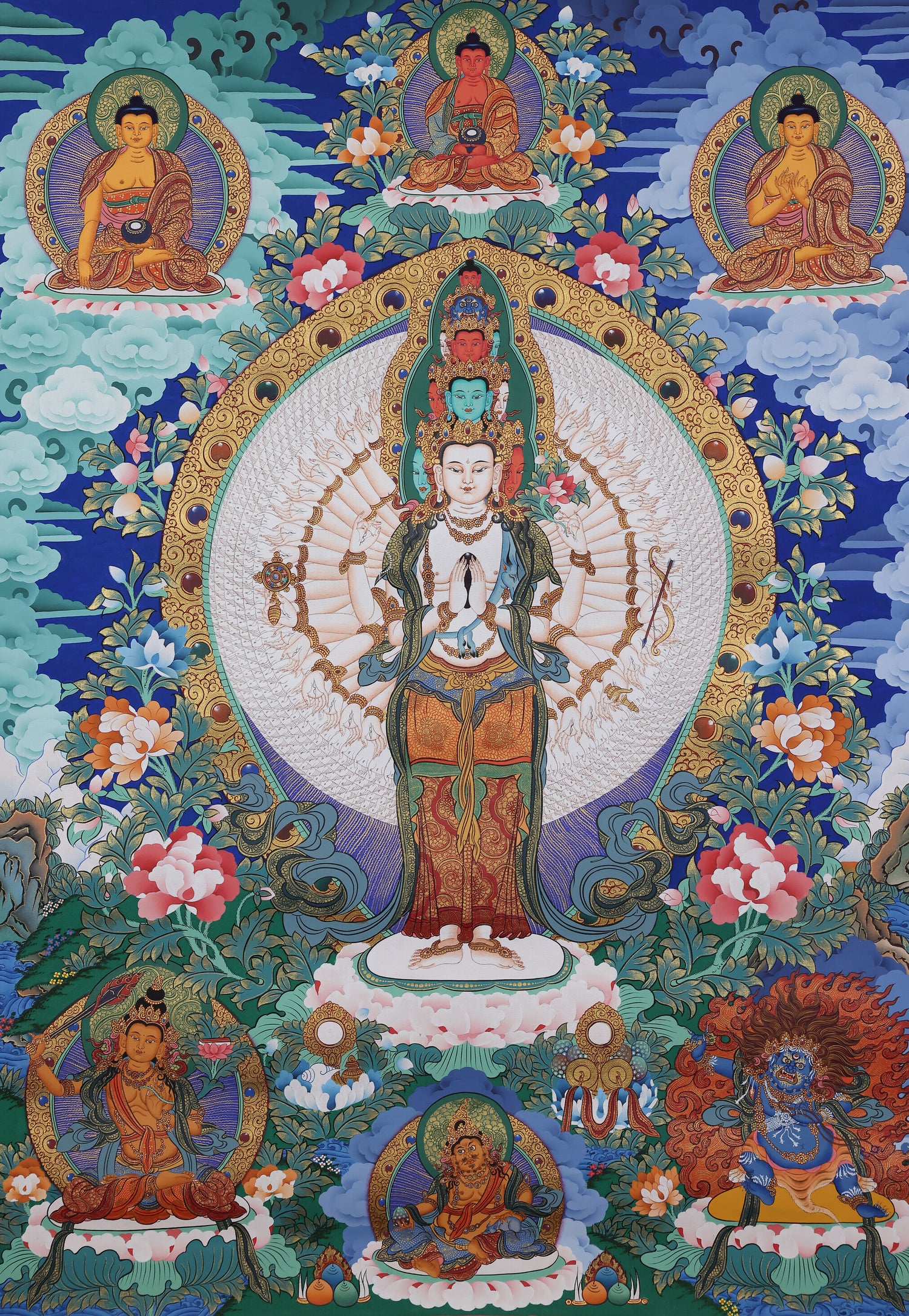
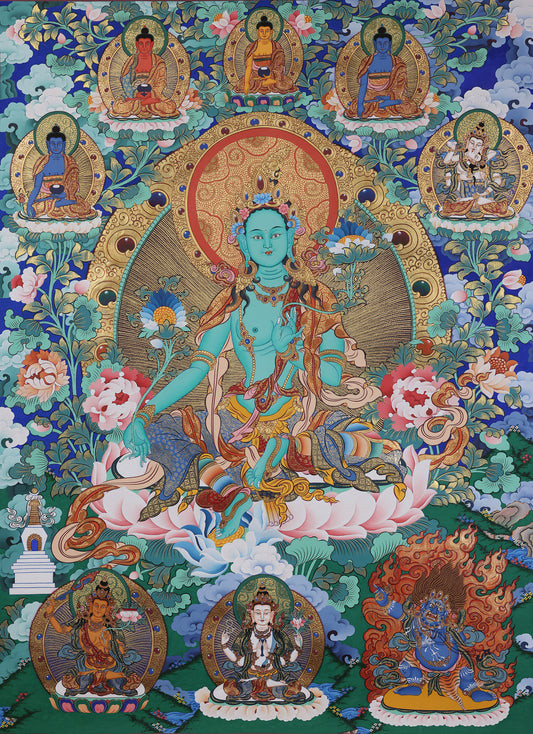
The composition follows a “Deity–Attendants–Environment” three-tiered layout, visually demonstrating Avalokiteshvara’s boundless compassion and providing spiritual support for practitioners’ visualization and prayer.
2. The Central Deity: Iconography and Symbolic Meaning of the Four-Armed Avalokiteshvara
The central figure strictly adheres to the iconometric standards of the “Sutra on the Measurement of Images”, with each detail carrying specific religious symbolism.
Physical Attributes and Mudras:
-
The body is milky white, symbolizing pure compassion.
-
Four arms represent Avalokiteshvara’s compassion reaching all directions:
-
The first pair of arms are joined at the chest, holding a cintamani (wish-fulfilling jewel). The joined palms signify the union of wisdom and compassion, while the jewel represents the fulfillment of all sentient beings’ virtuous wishes.
-
The second pair of arms: the right hand holds a crystal mala, symbolizing continual mindfulness in saving beings; the left hand holds a blue lotus, often bearing a sutra scroll, symbolizing “pure compassion arising unstained from the world’s suffering.”
Attire and Ornamentation:
-
The deity wears the Five Buddha Crown, symbolizing the wisdom of the five Buddhas.
-
Draped in flowing celestial robes, adorned with necklaces, armlets, and jewels. These elaborate ornaments are not secular symbols of wealth; instead, they signify that Avalokiteshvara, in perfect form, draws beings toward the Dharma through delight in the deity’s appearance.
Posture and Lotus Base:
-
Seated in full lotus posture on a thousand-petal lotus throne, representing transcendence over worldly suffering.
-
The thousand petals symbolize Avalokiteshvara’s compassion extending to all sentient beings.
3. Attendant Deities: The Divine Network of Compassionate Support
The attendant deities are arranged in a radiating structure, forming a complete system from “Dharmic teachers” to “worldly protectors,” emphasizing Avalokiteshvara’s theme of compassionate rescue.
Upper Attendants:
-
In the small upper register, Shakyamuni Buddha sits centrally, in lotus posture, with the Bhumisparsha mudra, indicating that Avalokiteshvara’s compassion derives from the Buddha’s teachings.
-
Flanked by Manjushri Bodhisattva and Vajrapani Bodhisattva (or Green and White Tara), where:
-
Manjushri holds a lotus, symbolizing wisdom supporting compassion.
-
Vajrapani holds a vajra, representing protective power for compassionate action.
Together, these three form a trinity of compassion, wisdom, and power, illustrating that Avalokiteshvara’s mercy is guided by wisdom and protected by strength.
Lower Attendants:
-
On the left, offering Bodhisattvas hold ritual offerings, representing devotees’ respect and prayers.
-
On the right, worldly protectors (such as Hayagriva or Mahakala) appear fierce yet reverent, symbolizing protection of Avalokiteshvara’s teachings and practitioners’ worldly safety.
Symbolic Details:
-
The cintamani offering plate at the bottom represents Avalokiteshvara’s ability to fulfill all virtuous wishes.
-
Surrounding clouds and floral motifs symbolize auspiciousness and purity, reinforcing the theme that compassion brings fulfillment.
4. Painting Technique: Gold Thangka as a Fusion of Material and Faith
This Thangka is a pure hand-painted Gold Thangka, one of the most intricate and revered forms of Tibetan Thangka art, demonstrating a profound connection between materials and spiritual belief.
Base Preparation and Gold Application:
-
The base consists of double-layered pure cotton cloth, meticulously hammered, bleached, and mounted to ensure a smooth, crack-resistant surface.
-
Gold layer is the centerpiece of Gold Thangka: 24K gold leaf or gold powder mixed with gelatin is applied across the painting.
-
Gold application requires a clean environment; polishing with agate stone produces a mirror-like sheen, symbolizing Avalokiteshvara’s illuminating mercy.
Detailing and Techniques:
-
Line Work: Painted with wolf-hair fine brushes, lines are hair-thin yet strong. Robe folds use “cloud-line” technique, symbolizing flowing compassion. Faces follow the “full moon visage” rules in iconometry, with an allowable deviation of ≤0.2 mm.
-
Coloring: Low-saturation mineral pigments (light blue, pale green, cinnabar red) accentuate garments and ornaments, highlighting the gold without overshadowing it.
-
Decorative Patterns: Clouds and vine motifs form continuous patterns, symbolizing endless compassion. The Eight Auspicious Symbols (Dharma wheel, treasure vase, etc.) are incorporated to reinforce completeness.
Stylistic Origin:
-
The Thangka aligns with the Central Tibet “Gold Thangka School”, known for gold base with muted colors, fine lines, and strict adherence to iconometric rules.
-
Traditionally, these are created by strictly disciplined, devout artists, each stroke accompanied by recitation of Avalokiteshvara’s mantra, ensuring both artistic excellence and spiritual blessing.
5. Conclusion: Dual Value of the Gold Four-Armed Avalokiteshvara Thangka
This Gold Four-Armed Avalokiteshvara Thangka serves both as a work of art and a carrier of faith.
-
Artistic Value: Exhibits the pinnacle of Tibetan Gold Thangka craftsmanship, with shimmering gold, fine lines, and restrained colors, creating a solemn yet compassionate visual experience.
-
Spiritual Value: Functions as a central medium for devotees to pray for Avalokiteshvara’s protection. Through devotion and visualization, worshippers resonate with the deity’s compassion, attaining inner peace and worldly blessing.
This “art as practice” feature distinguishes Tibetan Thangka from secular art: it is not merely for appreciation, but a bridge connecting sentient beings with boundless compassion, embodying the profound wisdom and spiritual power of Tibetan Buddhism.
#TibetanBuddhism #Avalokiteshvara #FourArmedAvalokiteshvara #GoldThangka #HandPaintedThangka #TibetanArt #SacredArt #BuddhistArt #SpiritualArt #MeditationArt #Compassion #TibetanCulture #ReligiousArt #BuddhistDeity #ArtAndFaith