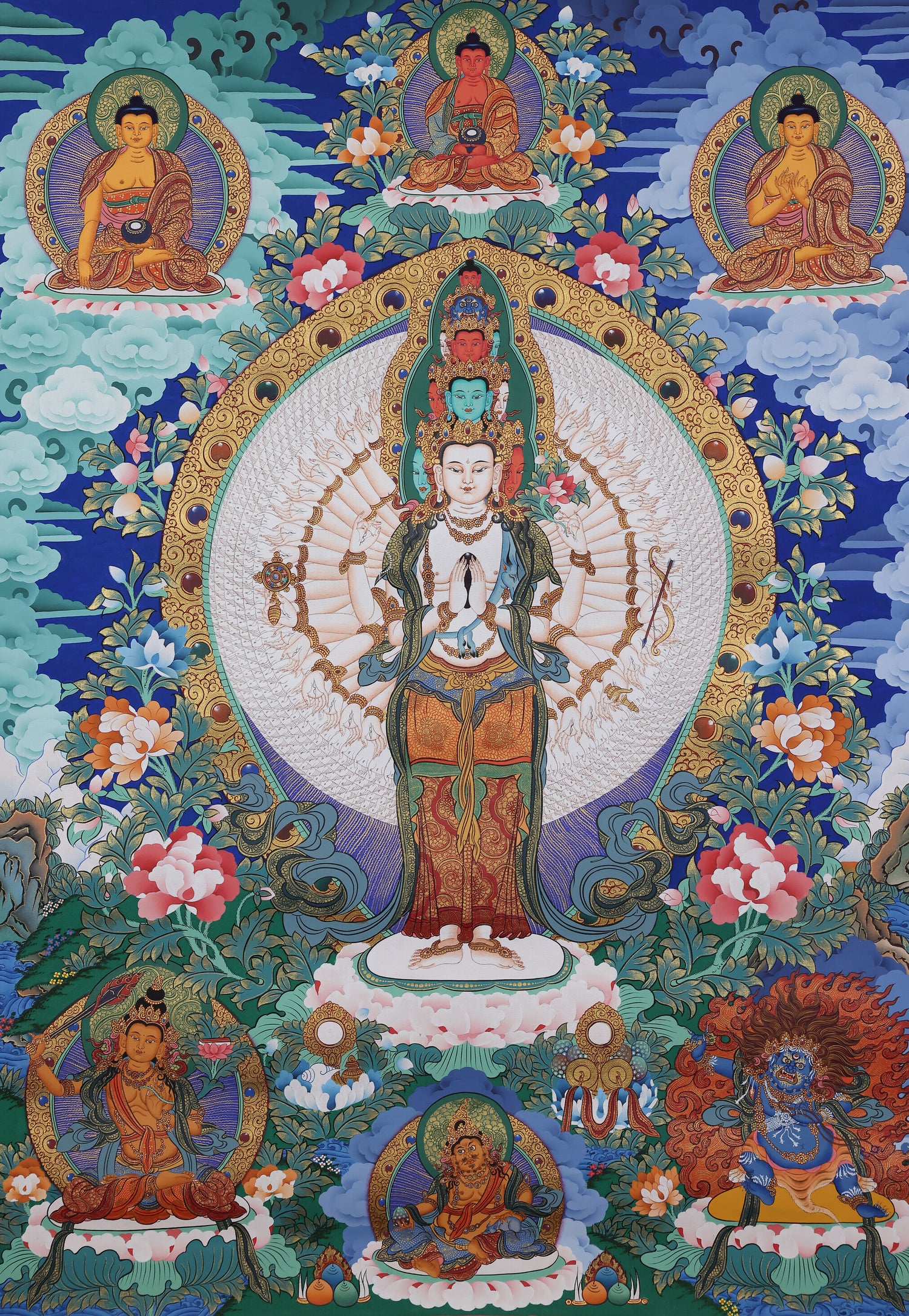
When a black-gold thangka, colored with lapis lazuli blue and gilded with gold leaf, unfolds before you, you are looking not just at the brushstrokes of a Nepalese Newari painter, but at a millennium of Tibetan Buddhist tradition of "visualizing dharma meaning."
This 50×50cm hand-painted thangka is a signature work of Nepal’s Newar ethnic group: the Medicine Buddha Six-Syllable Mantra Black-Gold Thangka. Framed by mineral pigments and animated by Tantric ritual, it condenses the Medicine Buddha’s healing vows and the compassionate purifying power of the Six-Syllable Mantra onto a black backdrop—an embodiment of Tibetan Buddhism’s pacification practice (zhi-khro) and Newari artistry.
I. Theme: Dual Blessings of Healing and Purification—The Tantric Core of "Pacification"
Tibetan thangkas are never "decorative art"; they are "venerable carriers of dharma meaning." The core of this thangka lies in the fusion of the Medicine Buddha’s healing vows and the Six-Syllable Mantra’s purifying esotericism, aligning with Tibetan Buddhism’s zhi-khro (pacifying afflictions and obstacles) aspirations.
The Medicine Buddha: Healing Sovereign of the Eastern Pure Land of Lapis Lazuli
Bhaisajyaguru (called Menla in Tibetan) is the ruler of the "Eastern Pure Land of Lapis Lazuli" in Tibetan Buddhism. The Sutra of the Merit and Virtue of the Vows of Bhaisajyaguru records his twelve great vows—from "freeing sentient beings from want" to "curing all illnesses"—each centered on "physical and mental well-being." In Tibetan and Nepalese folk practice, enshrining the Medicine Buddha’s icon is a core way to pray for healing and protection from misfortune.
The Six-Syllable Mantra: Avalokiteshvara’s Compassionate Mantra Wheel
The Om Mani Padme Hum mantra surrounding the main deity is Avalokiteshvara’s fundamental heart mantra. In Tibetan Tantra, these six syllables embody the wisdom of four Buddhist families: Om (Buddha Family), Mani (Jewel Family, merit), Padme (Lotus Family, purity), and Hum (Vajra Family, breaking obstacles).
Their union combines "tangible healing" and "root purification": the Medicine Buddha addresses "physical suffering," while the Six-Syllable Mantra dissolves the "karmic afflictions behind suffering." The concentric arrangement of the sutra text forms a mantra wheel—a miniature mandala (cosmic palace): the main deity is the center of the dharma realm, and the sutra is a field of vows; when practitioners visualize this, they "abide in dual protection."
II. The Main Deity: Medicine Buddha Iconography—Ritual as Framework, Newari Style as Soul
The main deity of this thangka adheres strictly to the Iconographic Measurements of Buddhas and Bodhisattvas while integrating Newari artistic traits; every detail carries symbolism.
Body Color and Identity: "Lapis Lazuli Light" in Mineral Pigment
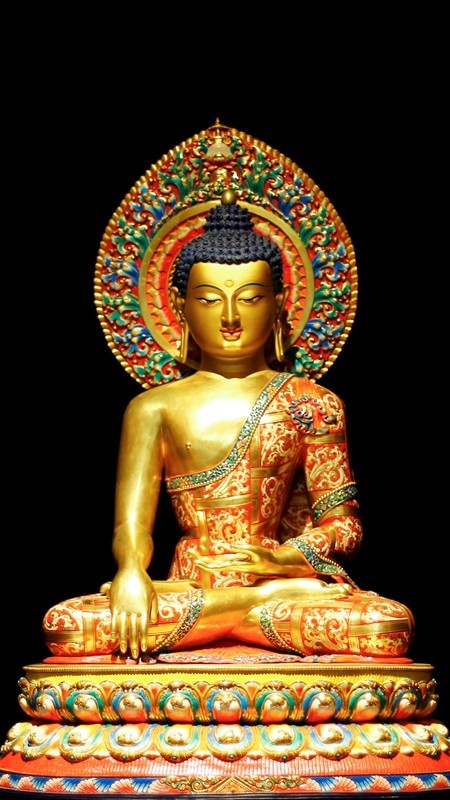
The main deity’s body is "lapis lazuli blue"—the signature hue of the Medicine Buddha, as recorded in the Ritual Manual of the Medicine Buddha’s Lapis Lazuli Light ("blue body, Hum seed syllable on the chest"), symbolizing "unstained purity." This blue is made by grinding Nepalese (or Tibetan) lapis lazuli into powder, bound with ox bone glue; the mineral pigment’s weight perfectly replicates the clarity and solemnity of "lapis lazuli."
Iconographic Details: Balancing Ritual and Style
-
Posture and Throne: The deity sits in vajra cross-legged posture (full lotus) on an eight-petaled lotus throne—the lotus symbolizes "enlightenment beyond samsara," and the eight petals correspond to the Medicine Buddha’s Noble Eightfold Path; the plump lotus petals, edged with Newari scrollwork, are a hallmark of Newar traditional ornamentation.
-
Mudra and Ritual Object: The right hand forms the varada mudra (gesture of granting wishes, palm outward), while the left hand holds a vase of ambrosia—the Medicine Buddha’s signature ritual object, containing "immortal nectar" symbolizing "healing all suffering." The proportions follow the Iconographic Measurements, softened by Newari curvilinear lines.
-
Attire and Features: Clad in a Buddhist monk’s robe (right shoulder bare, in accordance with monastic precepts), the robe is adorned with Newari-style interwoven lotus patterns; the face is square, full, and centered in features—a "childlike visage" typical of Newar iconography, expressing both the Buddha’s compassion and local ethnic facial traits.
-
Aureole: A nimbus (head halo) depicts a dharma wheel (symbolizing the turning of the dharma), and a mandorla (body halo) shows radiating lines (symbolizing the Buddha’s all-pervading light); the curved cloud patterns on the aureole’s edge are distinctively Newari—unlike the linear geometric patterns of Tibetan thangkas, they feel more dynamic.
III. Retinue Deities: Tantric Expression of "Dharma as Retinue"
In Tibetan thangkas, "retinues" are not limited to attendant bodhisattvas—they also include "sutras that carry dharma meaning." This single-deity thangka does not depict the Medicine Buddha’s traditional attendants (Suryaprabha and Chandraprabha); instead, the Six-Syllable Mantra sutra serves as the "dharma retinue"—a classic Tantric expression of "dharma as companions."
The sutra is no mere decoration; it is the material carrier of Avalokiteshvara’s vows. In Tantric visualization rituals, practitioners imagine "each syllable emitting light that merges with themselves"; the sutra then replaces attendants as the "dharma link between the main deity and the practitioner." The concentric mantra wheel aligns with the mandala cosmology: the main deity is the dharma realm’s center, the sutra its cosmic order, and the visualizing practitioner "abides in dual protection."
IV. Craftsmanship and Style: The Millennium Craftsmanship of Newari Black-Gold Thangkas
The thangka’s black-gold form and mineral pigments are both vessels of religious meaning and epitomes of Newari craftsmanship.
Style Identity: Newar Family Lineage
It belongs to the Newari style—the Newar, descendants of the Shakya clan, were early inheritors of Tibetan thangka art; their thangkas, once royal ritual objects in Nepal, are known for "family secret transmission, strict ritual compliance, and exquisite craftsmanship." This thangka’s traits are distinct: the deity’s S-curved body (influenced by Gandhara art), curved cloud patterns on the aureole, and intricate ornamentation—differing from the linear, flat style of Tibetan thangkas.
Black-Gold Craftsmanship: Tantric Philosophy of "Light Emerging from Darkness"
The "black-gold thangka" (called na-tang in Tibetan) uses a black background and gold patterns, visualizing the Tantric idea of "wisdom arising from ignorance":
-
Black Background: Made from 32 types of black herbs or mineral black earth, it symbolizes "primordial cosmic ignorance" and "the power to devour afflictions";
-
Gold Patterns: Ground gold leaf, bound with ox glue, symbolizes "the Buddha’s eternal light"—the stark black-gold contrast embodies the Tantric core of "light piercing darkness."
Mineral Pigments and Creation: Infusing Faith into Brushstrokes
This thangka uses mineral and earth pigments, crafted through a rigorous process:
-
Stretching and Priming: Cotton is stretched over a wooden frame, coated with ox bone glue and chalk, air-dried, and polished—ensuring the 50×50cm surface endures over time;
-
Coloring and Gilding: The black background is laid first, then the blue body with lapis lazuli (3–5 layers of glazing to achieve "lapis lazuli radiance"), followed by gold sutra inscriptions;
-
Eye-Opening Ritual: Gilding and "opening the eyes" (painting the deity’s eyes) are done on Buddhist auspicious days; the painter chants sutras before brushing—this is a religious ritual to "animate the icon."
The 50×50cm size balances "home enshrinement" and "portable practice," making it a carrier of daily faith.
Conclusion: More Than Art—A Living Carrier of Tibetan Buddhism
This thangka is a fusion of Tibetan Buddhist belief, Nepalese craftsmanship, and Tantric ritual: it answers the longing for "well-being" through the Medicine Buddha, dissolves afflictions through the Six-Syllable Mantra, interprets wisdom through black-gold art, and preserves the cultural exchange between Nepal and Tibet via Newari style.
When you gaze at it, you see not just brushstrokes—but the warmth of a millennium of faith.
#NepaleseThangka #NewariStyle #MedicineBuddhaThangka #TibetanBuddhistArt #BlackGoldThangka #ThangkaArt #BuddhistThangka #TraditionalNepaleseArt #Bhaisajyaguru #OmManiPadmeHum #TantricArt #HandpaintedThangka #MineralPigmentArt