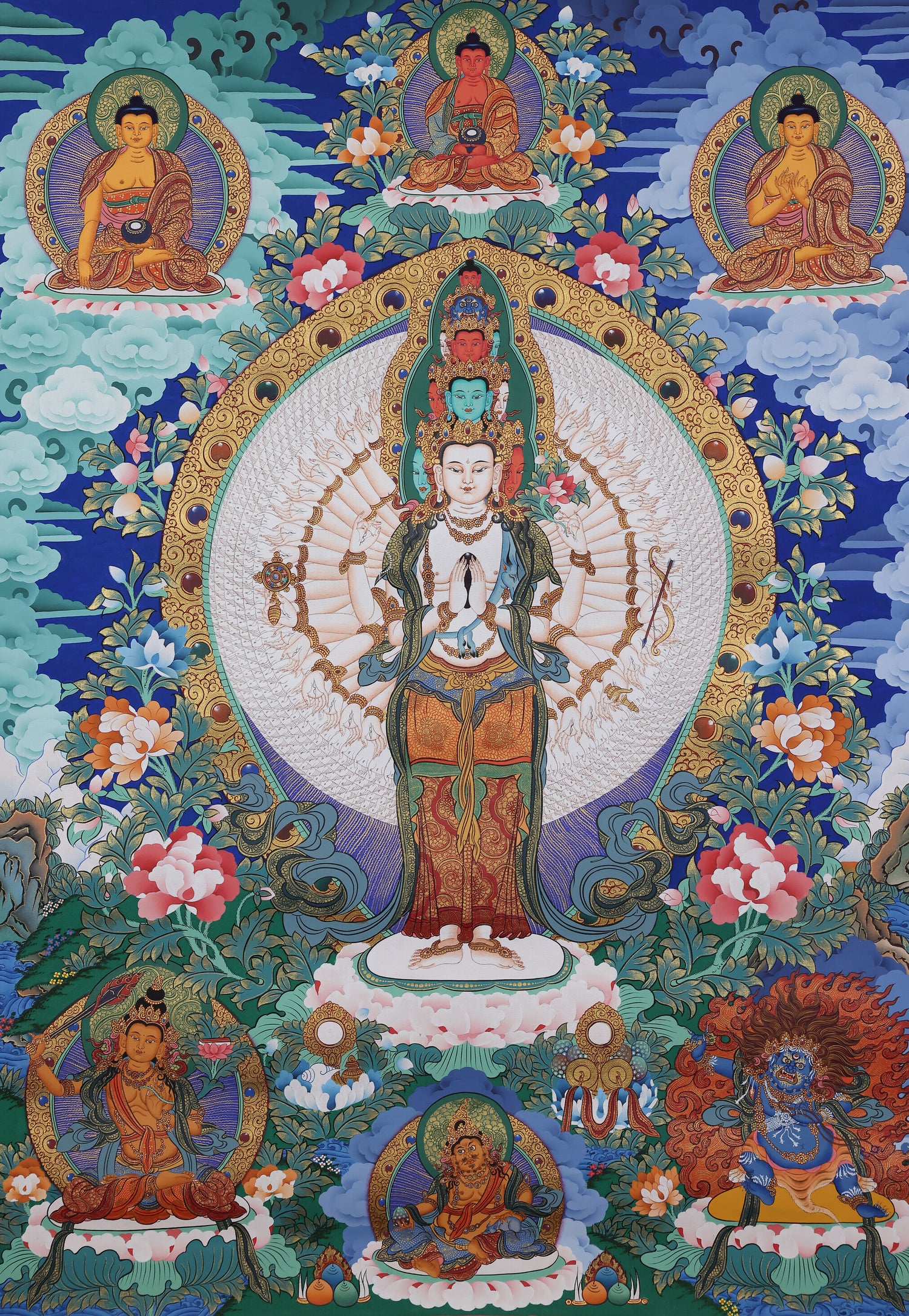
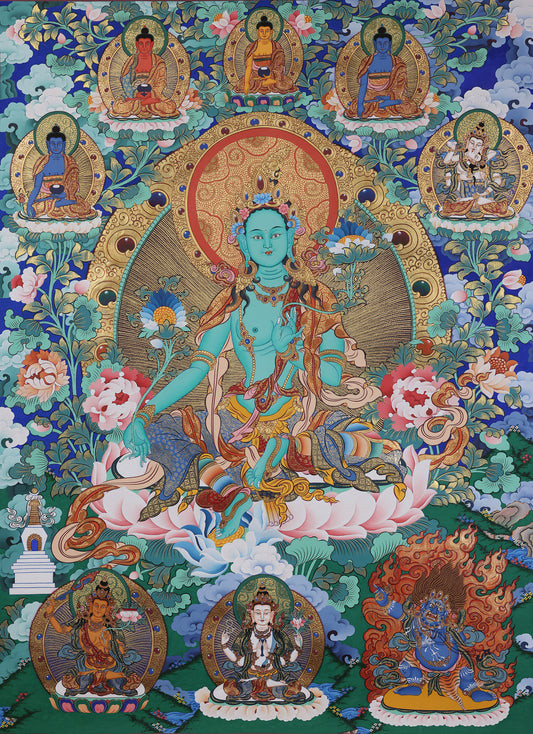
When a 47×64cm hand-painted Nepalese colored thangka unfolds before you, what you see is not just a vividly colored painting, but a symbiosis of Tibetan Buddhism’s compassionate faith and the millennial heritage of Newari art. Centered on White Tara, this thangka uses the rich texture of mineral pigments and ritualized iconographic details to construct a spiritual space that is both sacred and imbued with regional aesthetic traits—it is a "portable temple" and a microcosm of the intersection of art and faith in the Himalayan cultural sphere.
As one of the most central manifestations among Tibetan Buddhism’s "Twenty-One Taras," White Tara (said to emanate from the left tear of Avalokiteshvara) is depicted in this thangka as the standard "Seven-Eyed Buddha-Mother" form, adhering strictly to the Iconographic Measurement Sutra. Every detail embodies spiritual meaning:
-
The Seven Eyes: Compassion Without Blind Spots
The deity’s all-white form symbolizes "the purity of untainted compassion." One eye on the forehead and one on each hand and foot (seven total) correspond to the doctrine of "watching over all Buddha-fields and sentient beings in the six realms"—this is not ornamentation, but a religious promise that "no suffering goes unseen."
-
Posture and Implements: The Tangibility of Salvation
She sits cross-legged on a double lotus throne: the lower red lotus represents "transcendence of the mundane (rising unsoiled from mud)," while the upper white lotus mirrors her "intrinsic purity." Her right hand forms the
Varada Mudra (palm outward), promising to "fulfill sentient beings’ virtuous wishes"; her left hand holds an utpala flower (with a stem extending to her ear) via the
Tri-Ratna Mudra, with a nectar vase resting in the flower’s bloom. The vase’s nectar symbolizes "purifying afflictions and bestowing longevity," aligning with White Tara’s core merits of "alleviating disasters and rescuing from the eight hardships."
-
Ornamentation: Blending Ritual and Regional Aesthetic
She wears a Newari-style floral wreath crown (distinct from the metal crowns of Tibetan thangkas), adorned with a red coral necklace and golden armlets, draped in a blue-and-gold celestial robe. These ornaments adhere to the religious norms of "bodhisattva attire" while incorporating the opulence of Nepalese art, balancing sacredness and aesthetic appeal.
The thangka’s background and attendants are not "supporting roles"—they use spatial narrative to fully embody White Tara’s spiritual system:
-
Attendants: Complementary Salvation Functions
The golden "Vase-Bearing Goddess" on the left, holding a nectar vase, echoes White Tara’s merit of "bestowing peace"; the blue "Blue Tara" (one of the Twenty-One Taras) on the right, whose blue form symbolizes "subduing demons"—together, they form the two wings of White Tara’s salvific system: one for "comfort" and one for "protection."
-
Mythical Beasts and Nature: Extending Spiritual Symbols
The red dragon in the upper left is both the mount of the
Vairocana Buddha (associated with the East in Tibetan Buddhism) and a metaphor for "compassion as life-giving rain" (dragons govern precipitation). The blue peacock in the upper right symbolizes "purifying afflictions" (via the image of peacock feathers sweeping dust) and is linked to the
Ratnasambhava Buddha lineage. The background’s swirling clouds (gold-orange gradient), peonies (a Nepalese native flower), and lotuses (the Buddhist symbol of purity) fuse regional aesthetics with religious symbolism naturally.
-
Dharma Wheel at the Base: Closing the Loop Between Doctrine and Practice
The eight-spoked Dharma Wheel (a symbol of the Buddha’s teachings) beneath the lotus throne reinforces White Tara’s identity as a "Buddha emanation" and completes the spiritual logic: from doctrine (the Dharma Wheel) to salvific practice (White Tara).
Half the value of this thangka lies in faith, the other in craftsmanship—it is a living example of the Nepalese Newari school tradition:
The artist uses natural minerals and earth pigments from the Himalayas:
- White comes from "Rinbung white clay" (from Tibet’s Rinbung County, prized for its fineness);
- Blue is ground from Afghan lapis lazuli, layered to create the robe’s gradient;
- Red blends cinnabar and red coral powder, giving the lotus throne a solemn, rich texture;
- Gold is made from ground pure gold leaf mixed with glue, used for linework and ornaments (the Dharma Wheel, crown)—this is not just an aesthetic choice, but a religious tradition of "offering the most precious substance."
These pigments require four steps: crushing, water-grinding, drying, and layering, taking up to 15 days—their stability ensures the thangka’s colors remain vibrant for centuries.
This thangka belongs to the Nepalese Newari colored thangka style, with clear differences from Tibet’s Menri and Karma Gadri schools:
-
Color: Harmony in High-Saturation Contrast
Warm tones dominate, with stark contrasts between the deity’s white, the lotus throne’s red, and the robe’s blue—balanced by golden linework, unlike the "low-saturation, coordinated" aesthetic of Tibetan thangkas.
-
Form: Soft, Concrete Regional Temperament
The deity’s facial lines lean toward a "youthful, rounded softness," and attendants/mythical beasts (e.g., peacock feathers, dragon scales) are rendered more concretely—distinct from the "solemn grandeur" and "symbolic forms" of Tibetan thangkas.
-
Composition: Opulent Yet Uncluttered Full-Scene Aesthetics
It retains the Newari tradition of "decorative clouds and flora" while incorporating the Tibetan "full-scene composition," resulting in a rich yet orderly image—a model of regional artistic fusion.
This 47×64cm White Tara thangka is never "just a painting": to believers, it is a spiritual medium for meditation; to art lovers, it is a treasure where Newari craftsmanship meets Tibetan faith. With the weight of mineral pigments, the rigor of ritual iconography, and the vitality of regional style, it proves that thangkas are the most unique spiritual and artistic vessels in the Himalayan cultural sphere.
When you gaze at its seven eyes, you see not just artistic details, but the warm faith of Tibetan Buddhism’s "all-pervading compassion."
# Nepalese White Tara Thangka #Tibetan Buddhist Thangka Analysis #Newari Art School #Mineral Pigment Thangka #Hand-Painted Colored Thangka #White Tara Iconographic Symbolism #Thangka Art Craftsmanship #Himalayan Cultural Art #Thangka Attendant Deities #Buddhist Art Collection