Hand-Painted Tibetan Buddhist Four-Armed Avalokiteshvara Thangka Decoding Theme, Deity, and Craftsmanship

$599.00 USD
Thangka Name: Four-armed Avalokiteshvara
Eine Frage stellen

Beeil dich! Nur noch [Anzahl] auf Lager!

Geschätzte Lieferzeiten: 12–26 Tage (International), 3–6 Tage (USA).

Rückgabe innerhalb von 45 Tagen nach dem Kauf. Zölle und Steuern werden nicht erstattet.

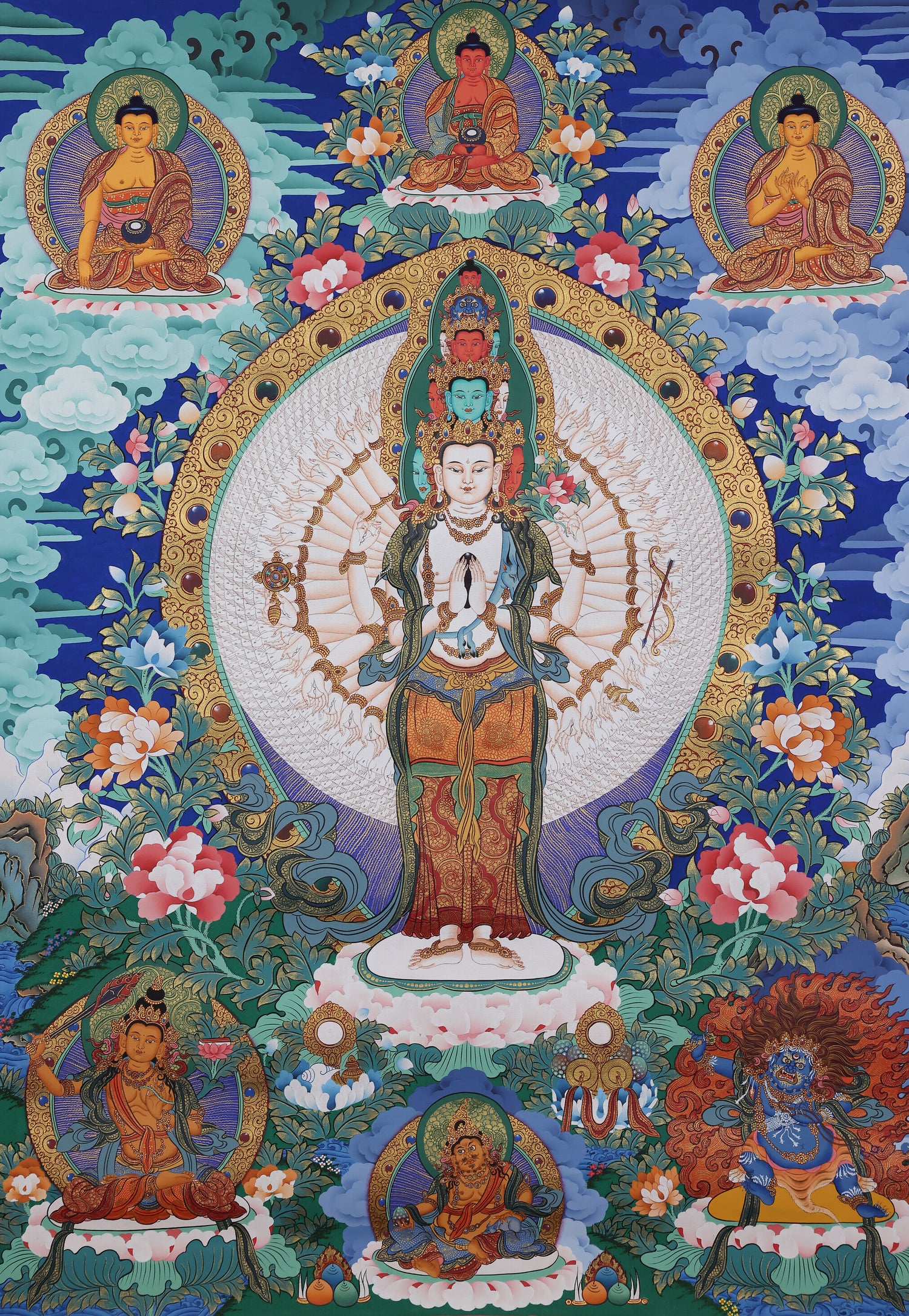
Hand-painted Tibetan Buddhist thangka depicting Four-Armed Avalokiteshvara, symbol of infinite compassion and mercy
Hand-Painted Tibetan Buddhist Four-Armed Avalokiteshvara Thangka Decoding Theme, Deity, and Craftsmanship
$599.00 USD

In the visual tradition of Tibetan Buddhism, a thangka is far more than a painting—it is a “map of compassion” guiding the practitioner through the spiritual realm. This hand-painted Four-Armed Avalokiteshvara Thangka is rooted in strict tantric rituals and rendered in the non-heritage craftsmanship of the Hotog (Rebgong) painting style. It transforms the core beliefs of Avalokiteshvara devotion into a sacred visual form suitable for meditation, cultural display, and spiritual practice, blending religious function, cultural symbolism, and artistic value in a single masterpiece.


I. Core Theme: The Snowy Realm’s Totem of Compassionate Protection

At the heart of this thangka lies the theme of “Four-Armed Avalokiteshvara’s Compassionate Protection.” In Tibetan Buddhism, Avalokiteshvara is revered as the protector of the Snowy Land (Tibet) and a central figure in the spiritual life of Tibetan communities.

According to Tibetan origin legends, the Tibetan people are considered descendants of a divine union between Avalokiteshvara’s enlightened influence, a sacred monkey, and a rakshasi. Thus, the Four-Armed Avalokiteshvara Thangka not only serves as a religious object but also as a symbol of ethnic and spiritual identity. Displaying or consecrating such a thangka is viewed as reconnecting with the ancestral compassion that shapes Tibetan culture.

Structurally, the thangka follows the Tibetan Buddhist Three Realms and Five Directions cosmology:

  • Upper Realm depicts the pure and holy abode of Buddhas and Bodhisattvas

  • Middle Realm presents the central deity and protective figures

  • Lower Realm symbolizes the compassionate guardianship over sentient beings in the human world

This top-to-bottom spatial hierarchy embodies the descending path of compassion, symbolizing Avalokiteshvara’s boundless vow to relieve the suffering of beings across the three realms.


II. Central Deity: Symbolism and Ritual Significance of the Four-Armed Avalokiteshvara

At the center of the painting sits the serene Four-Armed Avalokiteshvara (Chenrezig / Avalokiteshvara), meticulously drawn according to the canonical proportions outlined in the Sutra of Proportions for Sacred Images (37:25 ratio). Every detail is designed according to ritual law, ensuring the thangka functions as a legitimate tool for spiritual practice.

1. Body Features and Color

The deity’s body is pure white like the moon, symbolizing innate purity, free from defilements and afflictive obstacles. The four arms represent the Four Immeasurables—loving-kindness, compassion, joy, and equanimity—demonstrating Avalokiteshvara’s ability to save beings through multiple skillful means.

2. Mudras and Sacred Implements

  • Central hands in prayer hold a wish-fulfilling jewel, signifying the integration of wisdom and skillful means

  • Right hand holds a crystal mala, symbolizing that each recitation rescues countless beings from the cycle of suffering

  • Left hand holds an eight-petaled white lotus, representing purity and non-attachment amid worldly existence

3. Crown and Lotus Pedestal

The deity’s crown features Amitabha Buddha, signifying Avalokiteshvara as the embodiment of Amitabha’s compassion. Seated on a double-layered lotus pedestal, the lower red lotus represents liberation from defilements, while the upper moon lotus conveys cooling compassion. This design embodies the Bodhisattva ideal of “remaining in samsara without attachment, yet not detached from nirvana.”

This portrayal is not artistic improvisation but a ritually precise rendering. Deviations in proportions or implements are considered “improper” and would diminish its religious efficacy as a meditation support.


III. Attendant Deities: The Sacred Network of Protection Across Three Realms

Surrounding the central Avalokiteshvara, a carefully arranged ensemble of attendant deities creates a complete protective network, reflecting the Tibetan Buddhist hierarchy of Guru, Yidam, Dakini, and Dharma Protector.

Upper Realm Deities

At the top, Green Tara (left) and White Tara (right) manifest Avalokiteshvara’s compassion:

  • Green Tara eliminates obstacles and calamities

  • White Tara promotes longevity and health

A central Vajrasattva figure represents karmic purification, forming the core of tantric practices focused on confession and purification.

Lower Realm Guardians

  • Yellow Jambhala (Wealth Deity) on the left symbolizes worldly prosperity and abundance

  • Blue Mahakala (Protector) on the right represents the subjugation of obstacles and protection of spiritual practice

Together, the combination of “Compassion” (Avalokiteshvara), “Mercy” (Tara), “Blessing” (Jambhala), and “Protection” (Mahakala) creates a holistic spiritual safeguard, balancing wisdom, compassion, material support, and defense in a single visual schema.


IV. Artistic Craftsmanship: Non-Heritage Techniques and Sacred Reverence

This thangka is executed in the Rebgong (Hotog) school, entirely hand-painted with meticulous attention to ritual and artistry. Its production process is itself a spiritual practice:

  • Canvas Preparation: Pure cotton cloth treated with multiple layers of aged cowhide glue and polished with crushed shells, creating a mirror-like, durable surface

  • Mineral Pigments: Lapis lazuli (blue, wisdom), malachite (green, vitality), cinnabar (red, compassion), and 24K gold powder are layered to achieve vivid, lasting colors, with lapis lazuli applied in 3–5 layers, finely ground to 5–20 μm

  • Linework and Gilding: Squirrel-hair brushes trace flowing lines with “thick center, thin ends” patterns for robes, while S-shaped arcs convey protector flames; 24K gold paint highlights divine radiance, applied with <0.3% line break rate

  • Face Opening Ritual: The final step involves drawing the deity’s face during a state of meditation and mantra recitation, infusing the painting with living spiritual energy

The Rebgong tradition emphasizes patience, precision, and devotion, where even the smallest jewelry or lotus petal may require multiple layers of shading and separate gold outlining, transforming the act of painting into a ritualized expression of faith.


V. Cultural Significance: A Living Encyclopedia of Tibetan Buddhism

This Four-Armed Avalokiteshvara Thangka is not merely an artwork—it is a microcosm of Tibetan Buddhist culture. It functions simultaneously as:

  • A spiritual tool, for visualization and meditation to receive Avalokiteshvara’s blessings

  • An educational medium, illustrating the doctrinal framework of the three realms and the interconnectedness of protective deities

  • A cultural memory, preserving Tibetan origin legends and collective spiritual identity

In contemporary terms, its use of precious mineral pigments (including scarce lapis lazuli) underscores both the heritage value and the urgency of preserving traditional techniques. The balance of ritual precision and artistic creativity demonstrates the Tibetan Buddhist principle of “expressing dharma through beauty”—faith made tangible, art made sacred.

Every brushstroke, pigment layer, and gilded line in this thangka embodies “faith realized in form”, making it a unique masterpiece that integrates spiritual practice, cultural heritage, and artistic excellence.


  • #TibetanBuddhism

  • #Avalokiteshvara

  • #FourArmedChenrezig

  • #BuddhistThangka

  • HandPaintedArt

  • #HotogArt

  • #RebgongThangka

  • #MeditationArt

  • #SpiritualArtwork

  • #TibetanHeritage

  • #SacredArt

  • #MineralPigmentArt

  • #Bodhisattva

  • #CompassionArt

  • #CulturalPreservation
Entdecken Sie das perfekte tibetisch-buddhistische Thangka, das zu Ihren Wünschen, Ihrem Lebensstil und Ihrem Raum passt. Jedes Thangka hat eine spirituelle Bedeutung und bringt Segen, wenn es richtig platziert wird.

1. Definieren Sie Ihre Absicht

Reichtum & Erfolg → Gelber Dzambhala (Gottheit des Reichtums)

Mitgefühl und Frieden → Avalokiteshvara, Grüne Tara

Weisheit & Lernen → Manjushri

Gesundheit & Heilung → Medizinbuddha

Langlebigkeit und Familienschutz → Weiße Tara

2. Wählen Sie nach Identität

Unternehmer und Geschäftsinhaber → Reichtumsgottheiten für Wohlstand.

Studenten und Gelehrte → Weisheitsgottheiten für Konzentration und Klarheit.

Heiler und Yoga-Praktizierende → Medizinbuddha für Energie und Gleichgewicht.

Familien und Hausfrauen → Tara-Gottheiten für Harmonie und Sicherheit.

Sammler und Kunstliebhaber → Seltene Mandalas oder Meisterwerk-Thangkas.

3. Passen Sie Ihren Raum an

Heimschrein / Meditationsraum → Mittlere Thangkas (60–80 cm).

Büro / Geschäftshalle → Große Thangkas für Wohlstand und Autorität.

Wohnzimmer / Arbeitszimmer → Dekorative Thangkas für Frieden und Schönheit.

4. Authentische Handwerkskunst

Jedes Thangka ist mit natürlichen Mineralpigmenten und feiner Leinwand handbemalt und spiegelt tibetische Kunstfertigkeit und spirituelle Kraft wider. Überprüfte Quellen gewährleisten Qualität und Respekt für die Tradition.

✨ Wählen Sie Ihr Thangka mit Herz – es ist nicht nur Kunst, sondern ein Segen für Ihr Leben.

Jeder Mensch hat unterschiedliche Bedürfnisse. Die Wahl des richtigen Thangkas kann spirituelle Unterstützung, Schutz, Glück und Segen bieten. Nachfolgend finden Sie Thangka-Empfehlungen für verschiedene Rollen:

1. Unternehmer

  • Bedürfnisse : Weisheit, Reichtum, Gesundheit, beruflicher Erfolg.
  • Empfohlene Thangkas :
    Manjushri : Verbessert die Entscheidungsfindung und Geschäftsweisheit.
    Gottheit des Reichtums : Bringt Reichtum und Wohlstand.
    Medizinbuddha : Unterstützt die Gesundheit und reduziert Stress.
    Mahakala : Schützt Unternehmen vor Konkurrenz und Herausforderungen.

2. Erfolgreiche Einzelpersonen

  • Bedürfnisse : Innerer Frieden, Familienharmonie, Langlebigkeit.
  • Empfohlene Thangkas :
    Amitabha Buddha : Bringt inneren Frieden und Ruhe.
    Avalokiteshvara (Guanyin) : Fördert Harmonie und Glück in der Familie.
    Amitayus (Langlebens-Buddha) : Betet für gute Gesundheit und ein langes Leben.
    Manjushri : Stärkt weiterhin die Weisheit.

3. Hausfrauen/Ehemänner

  • Bedürfnisse : Familienharmonie, Schutz, Gesundheit.
  • Empfohlene Thangkas :
    Avalokiteshvara : Steigert das Familienglück und die Harmonie.
    Schutzgottheiten : Beschützen die Familie vor äußeren Störungen.
    Weiße Tara : Segnet die Familie mit Gesundheit.

4. Studierende und Wissenschaftler

  • Bedürfnisse : Weisheit, Konzentration, akademischer Erfolg.
  • Empfohlene Thangkas :
    Manjushri : Fördert Lernfähigkeit, Gedächtnis und Weisheit.
    Shakyamuni Buddha : Hilft bei der Konzentration und spirituellen Praxis.
    Jixiang Tianmu : Bringt akademisches Glück und Prüfungserfolg.

5. Künstler und Kreativprofis

  • Bedürfnisse : Inspiration, Kreativität, künstlerische Leistung.
  • Empfohlene Thangkas :
    Manjushri : Regt kreatives Denken und Inspiration an.
    Vajrapani : Hilft, kreative Blockaden zu überwinden.
    Maitreya : Sorgt für eine entspannte und optimistische Einstellung und baut Stress ab.

6. Reisende und Abenteurer

  • Bedürfnisse : Schutz, Glück, Erfolg bei Abenteuern.
  • Empfohlene Thangkas :
    Hayagriva : Bietet starken Schutz auf Reisen und beseitigt Hindernisse.
    Mahakala : Bringt Glück und Schutz, insbesondere für Abenteurer.
    Vajrasattva : Hilft, Schwierigkeiten und Herausforderungen während der Reise zu überwinden.

7. Ältere Menschen

  • Bedürfnisse : Gesundheit, Langlebigkeit, spiritueller Frieden.
  • Empfohlene Thangkas :
    Amitayus : Betet für ein langes Leben und gute Gesundheit.
    Medizinbuddha : Fördert Heilung und körperliches Wohlbefinden.
    Avalokiteshvara : Bringt Mitgefühl und inneren Frieden in späteren Jahren.

8. Führungskräfte

  • Bedürfnisse : Führung, Weisheit, Teamarbeit und geschäftlicher Erfolg.
  • Empfohlene Thangkas :
    Manjushri : Verbessert Führungsqualitäten und Entscheidungsfindung.
    Gottheit des Reichtums : Bringt dem Unternehmen und dem Team Erfolg und Wohlstand.
    Avalokiteshvara : Fördert Harmonie und Gleichgewicht innerhalb des Teams.

9. Gesundheits- und Fitnessbegeisterte

  • Bedürfnisse : Gute Gesundheit, Vitalität, Energie.
  • Empfohlene Thangkas :
    Medizinbuddha : Verbessert die körperliche Gesundheit und Vitalität.
    Weiße Tara : Bringt Gesundheit und Verjüngung.
    Vajrasattva : Beseitigt gesundheitliche Probleme und steigert die Energie.

10. Politiker

  • Bedürfnisse : Führung, Weisheit, Frieden.
  • Empfohlene Thangkas :
    Manjushri : Verbessert Führungsqualitäten und Entscheidungsfindung.
    Vairocana Buddha : Hilft, inneren Frieden und Weisheit zu bewahren.
    Avalokiteshvara : Fördert den gesellschaftlichen Frieden und die Harmonie in der Familie.

Für alle Bestellungen über 100 USD ist der Versand kostenlos.

Rücksendungen werden bis zu 10 Tage nach Erhalt des Kaufbelegs bzw. der Sendungsnummer (bei ungetragenen Artikeln) akzeptiert. Sie als Kunde sind verpflichtet, uns vor der Rücksendung des Artikels per E-Mail zu informieren.

Andernfalls fallen die Standardversandkosten an. Weitere Informationen finden Sie in unseren Lieferbedingungen .

Rücksendungen werden bis zu 10 Tage nach Erhalt des Kaufbelegs oder der Sendungsnummer (bei ungetragenen Artikeln) akzeptiert. Sie als Kunde sind verpflichtet, uns vor der Rücksendung des Artikels per E-Mail zu informieren, nur in folgenden Fällen:

– Den falschen Artikel erhalten.
– Artikel kam nicht wie erwartet an (z. B. beschädigte Verpackung).
– Artikel hatte Mängel.
– Über die Lieferzeit hinaus.
– Der Spediteur gestattet keine Besichtigung der Ware vor der Bezahlung.

Die zurückgesendeten Produkte müssen in der Originalverpackung, sicher verpackt, unbeschädigt und ungetragen sein. Dies bedeutet, dass die Artikel zum Schutz während des Transports sicher in einem Karton verpackt sein müssen, möglichst im selben Karton, in dem sie an Sie als Kunde versendet wurden.

Kürzlich angesehen

Nicht vergessen! Die Produkte, die Sie angesehen haben, legen Sie jetzt in den Warenkorb.

Passt gut zu

Erweitern Sie Ihre Auswahl mit perfekt abgestimmtem Zubehör und ergänzenden Produkten.

Leute kauften auch

Hier sind einige unserer ähnlichsten Produkte, die die Leute kaufen. Klicken Sie hier, um den Trendstil zu entdecken.