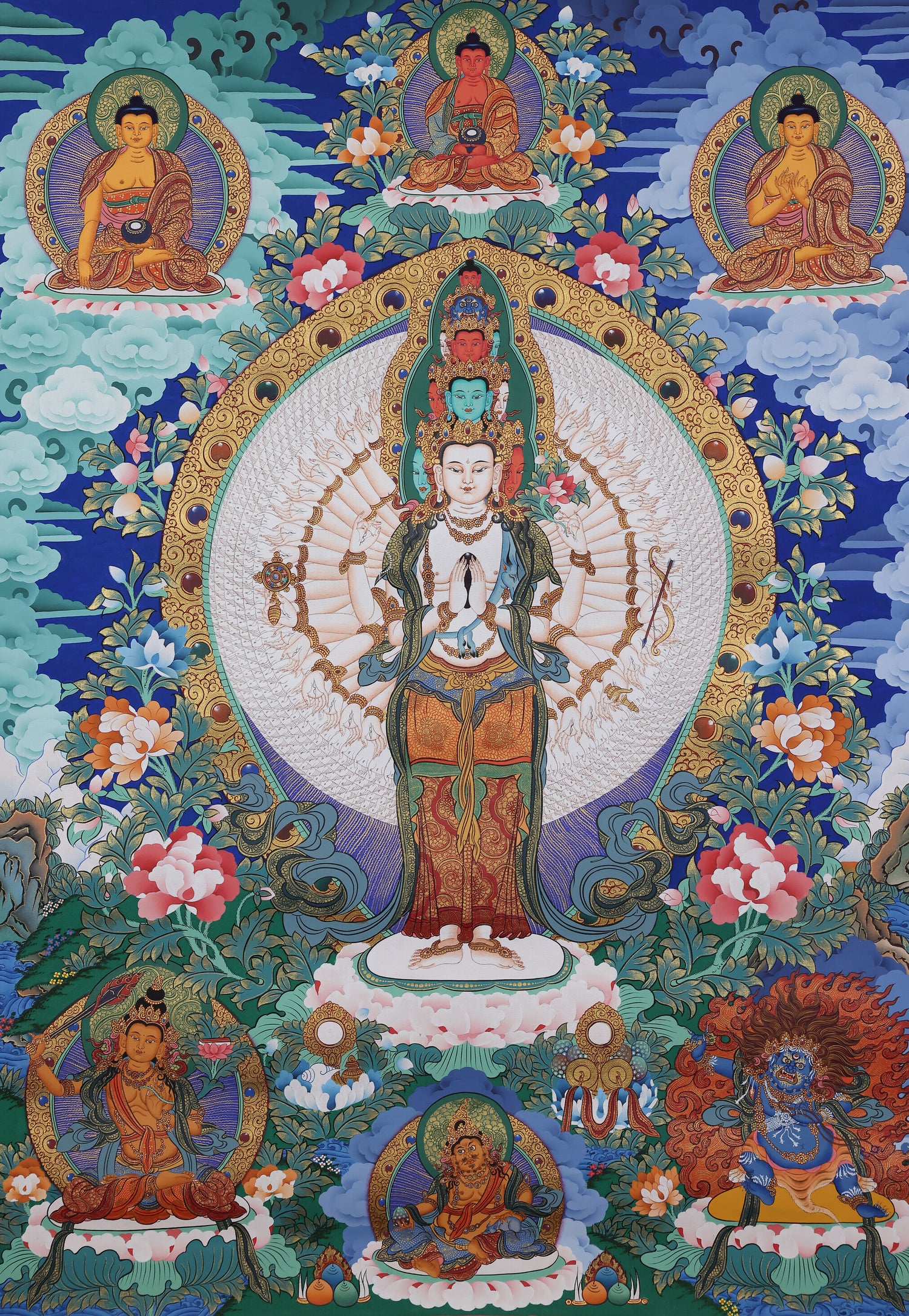
When a 44×61cm Nepalese thangka unfurls on a desk, the lapis lazuli blue, cinnabar red, and malachite green blend into a solemn order on the fabric—not just a painting, but a visual vessel of the Tibetan Tantric Vajra Realm Mandala, a "Dharma cosmos" written in mineral pigments by a Nepalese Newari artist.
Tibetan Tantric Buddhism embodies cosmic truth as the mandala (sacred circle), and the core of this thangka is the Vairocana Abhisambodhi Mandala (Vajra Realm Mandala)—one of the "Two Mandalas" (Vajra Realm and Womb Realm) representing "wisdom essence" in Tantra. Centered on Vairocana Buddha, with attendant deities surrounding him, it constructs a spiritual order where "all phenomena are manifestations of Buddha’s wisdom."
The 44×61cm size is typical of Nepal’s "portable meditation thangkas": portable for daily practice, yet its compact composition condenses the mandala’s sacred structure. Every hue and deity is a visual translation of Tantric doctrine, making the "Dharma body" tangible within a small space.
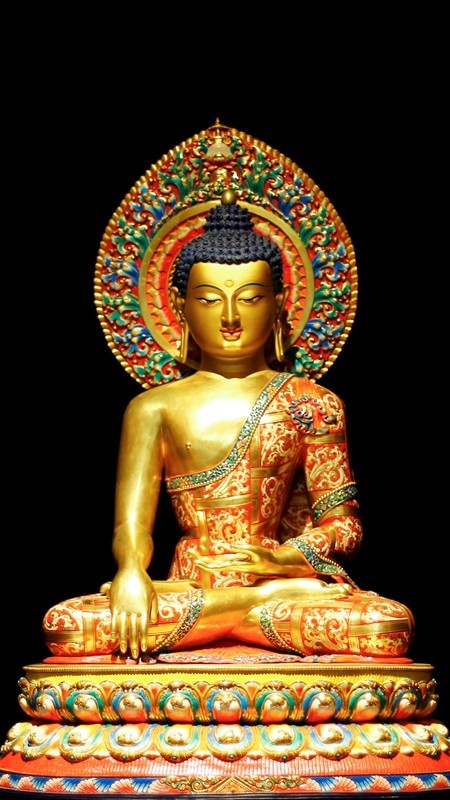
The central figure is the four-faced, two-armed Vairocana Buddha, whose iconography strictly follows the Vajraśekhara Sūtra and Iconometric Canon—every detail carries Tantric philosophy:
-
Form and Symbolism: The white body represents "the inherent purity of the Dharma realm"; the four faces (facing the four directions) correspond to the "Four Wisdoms" (Dharmadhātu-prakṛti-jñāna, Mahādarśa-jñāna, Samatā-jñāna, Pratyavekṣaṇā-jñāna); the cranial protuberance (urna) glows like a thread of light, symbolizing "wisdom dispelling ignorance."
-
Mudrā and Ritual Implement: Hands form the dhyāna mudrā (meditation gesture), holding an eight-spoked vajra wheel—the former is the signature mudrā of Vairocana in the Abhisambodhi Mandala, while the latter symbolizes "the Dharma pervading all directions, shattering afflictions."
-
Attire and Lotus Seat: The Five-Buddha Crown unites the Five Directional Buddhas; the green silk saṃghāti (monastic robe) symbolizes liberation from suffering; the red tight skirt corresponds to "compassionate embrace"; seated cross-legged on a thousand-petaled red lotus, the lotus (unsoiled by mud) embodies the Tantric metaphor of "enlightenment arising from afflictions."
-
Three-Layered Aura: The circular nimbus (head halo) represents perfect wisdom; the flaming body halo symbolizes burning afflictions; the outer golden scrollwork mandala signifies "the solemnity of the Dharma realm"—layers that expand from "individual wisdom" to "universal sacredness."
The four attendants surrounding the central deity are core figures of the 37 Vajra Realm Deities, each a branch manifestation of "wisdom essence":
-
Two Buddhas Above: Top-left: the Eastern Akṣobhya Buddha (red body, bhumisparśa mudrā), corresponding to "Mahādarśa-jñāna" (mirror-like wisdom), subduing anger with a wrathful form; Top-right: the Western Amitābha Buddha (blue body, dhyāna mudrā), corresponding to "Pratyavekṣaṇā-jñāna" (discriminating wisdom), purifying greed with a serene form.
-
Two Bodhisattvas Below: Bottom-left: Vajra 波罗蜜 Bodhisattva (holding a vajra), symbolizing "unshakable wisdom"; Bottom-right: Ratna 波罗蜜 Bodhisattva (holding a wish-fulfilling jewel), symbolizing "fulfilling sentient beings’ good aspirations."
Arranged in fourfold symmetry, these deities translate the Tantric logic of "Four Wisdoms governing all phenomena" into visual balance—even with simplified details (due to size constraints), their religious meaning remains clear.
Half the value of this thangka lies in "doctrine," half in "art"—it is a crystallization of Nepalese traditional craft and mineral pigments:
-
Canvas and Pigments: The base is white 府绸 cotton, polished repeatedly with cowhide glue and Rinpoche white clay; pigments are sourced from natural minerals (cinnabar, lapis lazuli, malachite), sorted by color depth via "crushing-grinding-sedimentation"—lapis lazuli’s "first, second, third blues" take half a month to separate.
-
Creation Process: Charcoal sketches adhere strictly to the Iconometric Canon; "light-to-dark" layering creates soft skin texture; wolf-hair brushes draw "iron-thread" garment lines; 24K gold powder (mixed with cowhide glue) adorns the aura. The final "face-painting" is a ritual: eyes are added on an auspicious day, as "painting a Buddha is practicing the Buddha."
-
Newari Style: The central deity occupies over 60% of the frame (a signature focus on sacredness); colors contrast sharply yet harmoniously (red/white warm and pure, blue/green cool and vibrant); soft forms and heavy ornaments carry echoes of ancient Indian Pala art, distinct from the light elegance of Tibetan thangkas.
This 44×61cm thangka exemplifies "great vision in a small format": it is a "spiritual map" for practitioners, a "faith vessel" for Newari artists, and a testament to Tibetan Tantra-Nepalese cultural fusion. As mineral pigments mellow with time, the "wisdom essence" behind the colors and lines remains bright—this is the enduring charm of thangkas: a boundless Dharma realm, contained in a small space.
#NepaleseThangka #VairocanaBuddhaThangka #TibetanTantricMandala #NewariArtSchool #MineralPigmentThangka #VajraRealmMandala #HandPaintedThangka #ThangkaCraftAnalysis #TibetanBuddhistArt #MicrocosmicDharmaRealmThangka