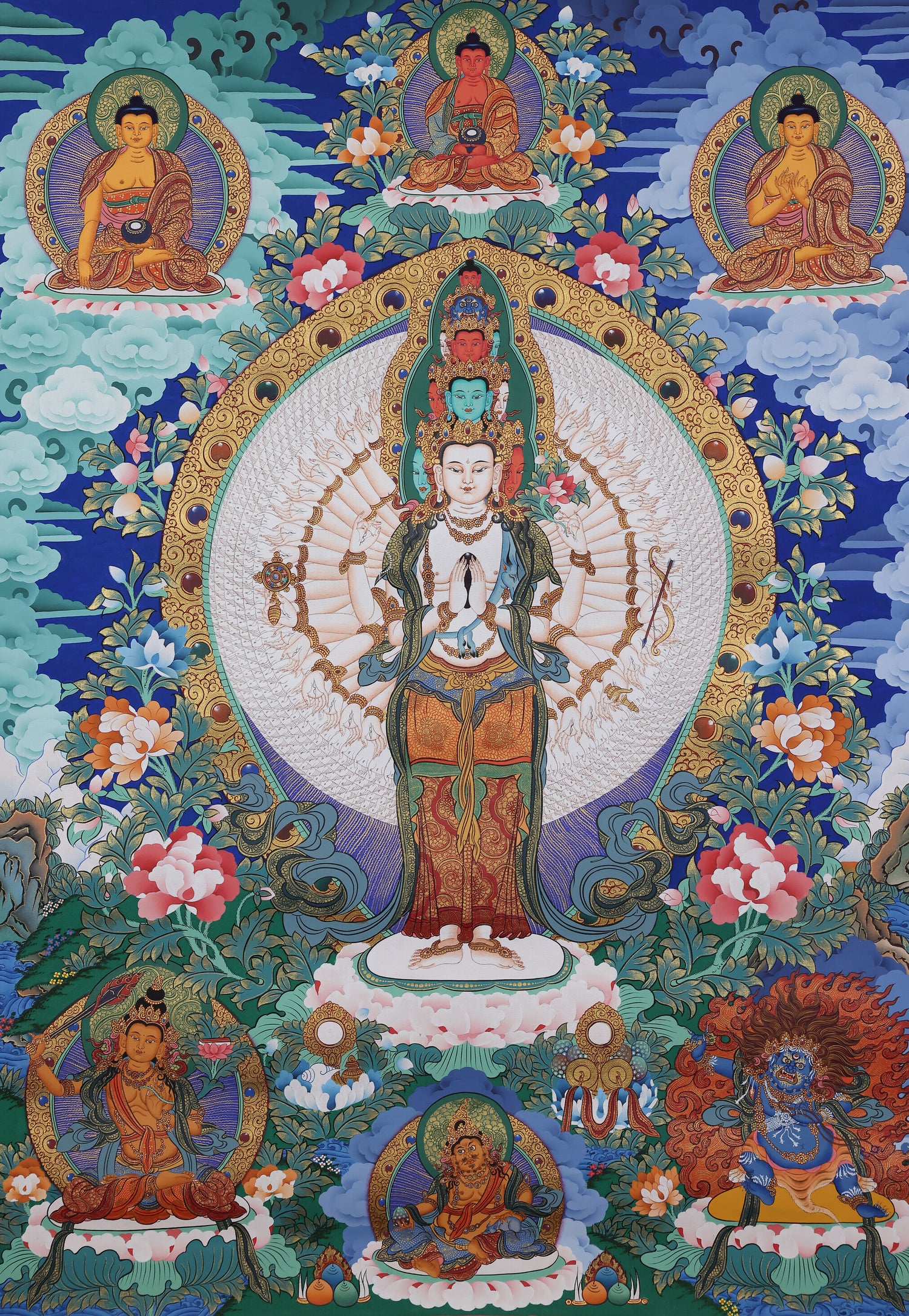
When a softly hued, detail-rich hand-painted Nepalese White Tara thangka unfolds before you, it is far more than a work of art—it is a Tibetan Buddhist ritual implement (capable of "liberation upon sight"), a showcase of Nepal’s Newari painting techniques, and a vivid example of the symbiosis of faith and aesthetics in the Himalayan cultural sphere. Today, we use a 47×64cm mineral-pigment thangka to decode the Tibetan Buddhist logic and Nepalese cultural DNA behind its theme, iconography, and craftsmanship.
In Tibetan Buddhism, White Tara (Tibetan: Drolma Karpo) is the emanation of the left tear of Avalokiteshvara, the most prominent of the "Twenty-One Taras." Together with Amitayus (the Longevity Buddha) and Ushnisha Vijaya (the Victorious Crown Buddha), she forms the "Three Longevity Deities." This thangka’s core theme is the visualization of White Tara’s spiritual essence: "liberating beings from the six realms, fulfilling wishes, enhancing wisdom, and healing illness to extend life."
For Nepalese devotees, such thangkas are not mere decorations but "carriers of spiritual blessing": Meditating on White Tara’s seven eyes (one on the forehead to see all buddha-fields, six on the palms and feet to see all sentient beings in the six realms) evokes the promise of "omniscience and liberation from suffering." The auspicious elements surrounding her translate the wish for "protection" into tangible visual symbols—epitomizing Tibetan Buddhism’s ethos of "conveying the Dharma through imagery" and the Nepalese thangka’s priority of faith over art.
As the core deity, White Tara’s iconography adheres strictly to the Iconometric Sutras while incorporating local Nepalese aesthetics:
-
Physical Features & Adornments: Her pure white body symbolizes purity and compassion; her face, resembling a 16-year-old maiden, embodies youthful vitality. She wears a Newari-style floral wreath crown (distinct from the five-buddha crown of Tibetan thangkas), and her gold-and-red necklaces, armlets, and bracelets balance the orthodoxy of "divine 庄严" with Nepalese preferences for opulence and vibrancy.
-
Seven Eyes & Mudras: Her seven eyes (the hallmark of "the Seven-Eyed Buddha-Mother") include one on the forehead and six on the palms/feet. Her left hand holds a blue-and-white utpala lotus (its stem curling around her shoulder, signifying "enlightenment emerging from affliction"), while her right hand forms the varada mudra (palm outward, representing "granting sentient beings’ wishes"). She sits cross-legged on a double lotus throne (the red lower lotus symbolizes "transcending suffering"; the white upper lotus, "pure enlightenment").
-
Auras & Robes: Her pink nimbus softens her 庄严 presence, while her body aura uses the Nepalese signature "black background with gold patterns" (contrasting the colorful auras of Tibetan thangkas). Her brown-and-sky-blue celestial robes feature fluid, graceful lines—a hallmark of the Newari school’s "softness complementing solemnity."
Unlike Tibetan White Tara thangkas (which typically surround her with five Taras), this work’s attendants bear distinct Nepalese cultural marks:
-
Left Naga Dragon: The pink-patterned green dragon is not a traditional Tibetan Buddhist protector but a Nepalese local deity of "rain and harvest." As an attendant, it both guards the Dharma and aligns with the secular wish for "abundant sustenance."
-
Right Garuda Variant: The blue-feathered bird is an artistic adaptation of the Nepalese Garuda, paired with a small attendant below to create an asymmetrically balanced composition ("auspicious bird above, attendant below")—a defining feature that sets Nepalese thangkas apart from Tibet’s strictly symmetrical works.
-
Background Symbols: Stylized trees with clustered leaves (a traditional Nepalese "tree motif"), plus lotus flowers and auspicious clouds at the bottom, fill the space while echoing White Tara’s core themes of "purity" and "good fortune."
This thangka uses traditional Nepalese mineral and earth pigments, with craft details that hold unique aesthetic codes:
-
Pigment Selection: White Tara’s white comes from a mix of white earth and mica (softening the harshness of pure mineral colors); blue is ground from lapis lazuli; red blends cinnabar and red earth. Natural minerals ensure colorfastness, while earth pigments lend a warmer tone (distinct from the vivid hues of Tibetan thangkas).
-
Canvas Preparation: White cotton cloth (replacing Tibetan linen) undergoes a simplified "gluing-sizing-sanding" process—retaining traditional texture while suiting the "efficient creation" of Nepalese thangkas.
-
Painting Techniques: Lines are 勾勒 with lynx-tail brushes (ideal for thick mineral pigments), with flat application as the primary coloring method (supplemented by subtle blending, unlike the bold shading of Regong thangkas). Finally, 24K gold powder is used for gilding, and the "opening of the eyes" (painting the eyebrows and eyes) is done on an auspicious day—its soft, rounded features reflect the Nepalese thangka’s emphasis on "benevolent expression."
This White Tara thangka’s rarity lies in its dual identity: it upholds Tibetan Buddhist iconographic orthodoxy while reimagining artistic expression through Nepalese pigments, techniques, and local faith elements. It is not a "copy" of Tibetan thangkas but a living sample of "pluralistic symbiosis" in the Himalayan cultural sphere—faith as its core, local aesthetics as its form, and mineral pigments as its carrier, culminating in a ritual implement and art treasure that embodies "liberation upon sight."
#NepaleseWhiteTaraThangka #TibetanBuddhistArt #HandPaintedThangka #MineralPigmentThangka #NewariPaintingSchool #ThangkaIconography #ThreeLongevityDeities #HimalayanCulture #ThangkaCraftsmanship #BuddhistRitualImplements