Nepalese Hand-Painted Green Tara Thangka: A Millennium of Fusion Between Tibetan Buddhism and Newari Art

$699.00 USD
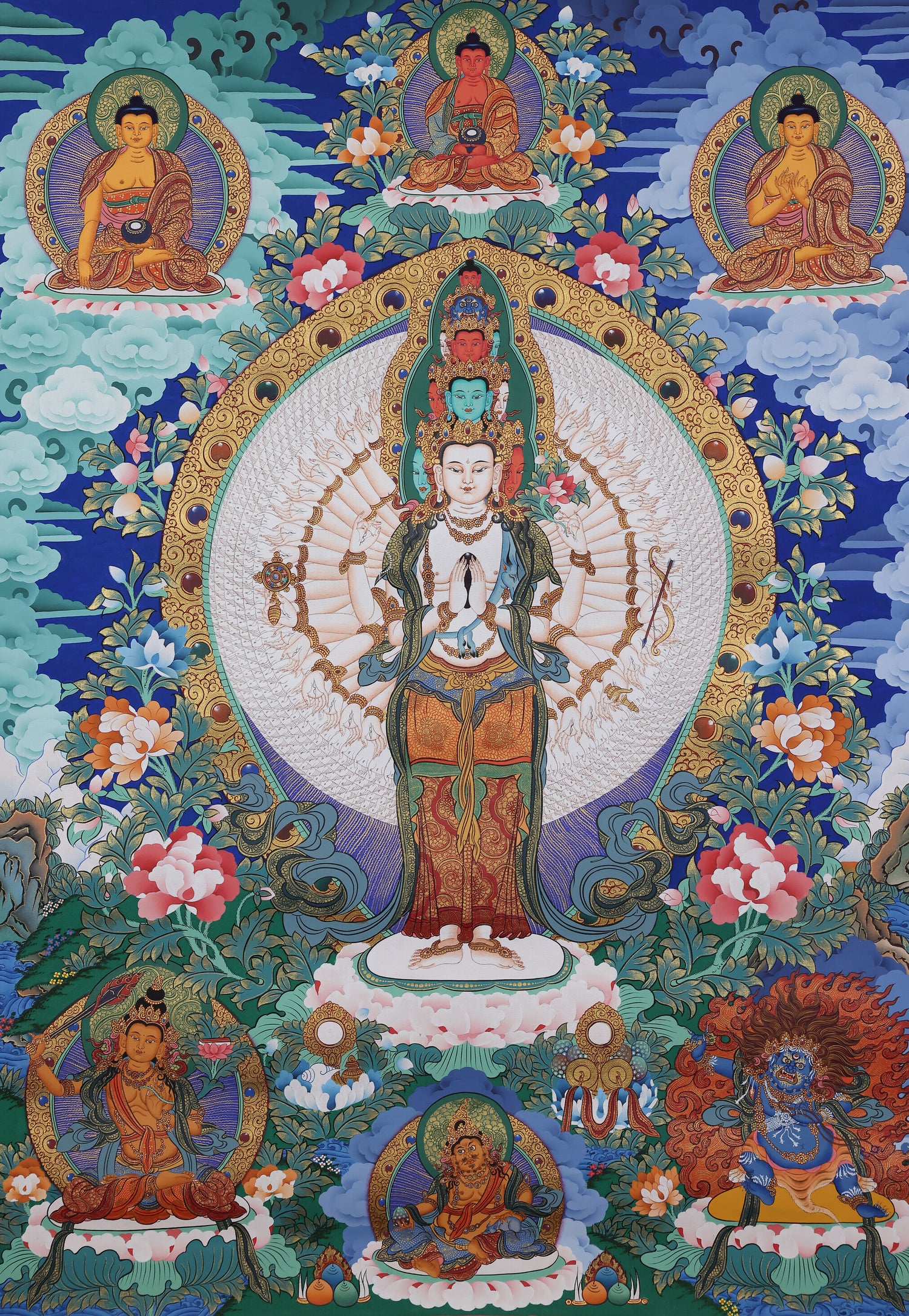
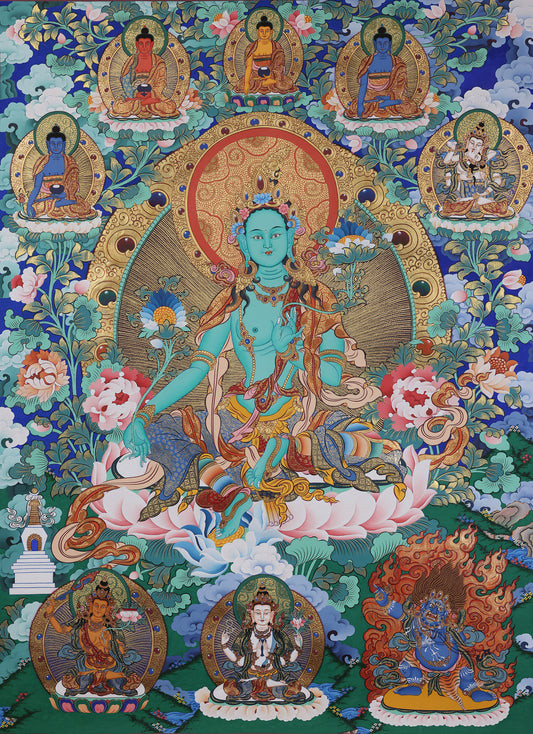
Thangka name: Colorful Tang Green Tara
size: 45cm×60cm
origin: Nepal
Eine Frage stellen

Beeil dich! Nur noch [Anzahl] auf Lager!

Geschätzte Lieferzeiten: 12–26 Tage (International), 3–6 Tage (USA).

Rückgabe innerhalb von 45 Tagen nach dem Kauf. Zölle und Steuern werden nicht erstattet.

Nepalese Hand-Painted Green Tara Thangka: A Millennium of Fusion Between Tibetan Buddhism and Newari Art
$699.00 USD
In the visual system of Tibetan Buddhism, thangkas are "mobile temples"; hand-painted thangkas of Nepal’s Newari school, meanwhile, are living specimens of a millennium of Sino-Nepalese cultural exchange. The 45×60cm hand-painted Green Tara thangka we dissect today is precisely such a work—one where spirituality and art coexist. It carries eternity in mineral pigments, defines sacredness through Tibetan ritual norms, and conveys beauty via Newari techniques, condensing the cultural codes of the Tibetan Plateau and the southern Himalayas within its compact frame.

I. Theme: The "Redemptive Narrative" in Avalokiteshvara’s Tear


Tibetan Buddhist scriptures record that Green Tara is the incarnation of Avalokiteshvara’s "right-eye tear of compassion": when Avalokiteshvara gazed upon the suffering of the six realms with his wisdom eye, a tear fell to the earth and manifested as Green Tara, who vowed to "liberate sentient beings in a female form."

The core theme of this thangka is "Compassion Overcomes the Eight Calamities; Female Form Embodies Universal Salvation". It not only presents Green Tara’s divine role in rescuing beings from the eight calamities (e.g., lion, elephant, water disasters) but also echoes the temporal dimension of "past, present, and future buddhas relying on the Dharma"—from the "fruit-bloom-bud" of the utpala flower in the painting to the Five Buddha Crown atop the main deity, all align with this spiritual core.

II. Main Deity: Esoteric Symbols in Green Tara’s Iconography


Every detail of the central Green Tara in the painting is a visual translation of Tibetan ritual norms:

  • Body Color & Posture: Her entire form is emerald green (derived from malachite), corresponding to the "vitalizing energy" of Amoghasiddhi Buddha; her half-lotus posture (left leg crossed, right leg resting on a lotus) is the "responsive form" of being "ready to rise and liberate," distinguishing it from the Buddha’s "meditative stillness."
  • Implements & Mudras: She holds utpala flowers (blue lotuses) in both hands, with stems bearing "fruit, full bloom, and bud"—symbolizing "past, present, and future buddhas relying on Tara’s vow of compassion"; her right hand forms the varada mudra (gesture of granting wishes) to "bestow fearlessness," while her left hand forms the triratna mudra (three fingers raised) to signify "purity of body, speech, and mind."
  • Ornaments & Aura: The Five Buddha Crown unites the merits of the Five Dhyani Buddhas; three layers of ornaments correspond to "body, speech, and mind"; the orange-yellow circular nimbus and radiant body aura are a warm-toned tradition of the Newari school, also symbolizing the divine nature of "light dispelling darkness."

III. Attendant Deities: The "Redemptive System" in Composition


The attendant deities in the thangka extend the logical framework of Tibetan spirituality:

  • Yellow Deity (Left): Likely White/Yellow Tara (incarnation of Avalokiteshvara’s left-eye tear), holding a lotus to represent "extending life and purifying obstacles," forming a "compassion-wisdom duality" with Green Tara.
  • Dark Blue Deity (Right): Corresponding to Black Tara (a protective goddess), holding a vajra to subdue demons, echoing Green Tara’s role in "overcoming non-human calamities."
  • Background Symbols: Dragons and fish—rooted in Nepalese folk imagery of "water and vitality"—are reimagined as symbols of "Green Tara rescuing from water disasters"; the treasure flowers and golden clouds merge the Newari tradition of "offering flowers to the Buddha" with the Tibetan concept of "pure land imagery."

IV. Craftsmanship: The "Timeless Techniques" of the Newari School


Half the value of this thangka lies in spirituality, the other half in craftsmanship:

  • Mastery of Mineral Pigments: Emerald green comes from malachite, blue from lapis lazuli, red from cinnabar, and gold from ground 24K gold leaf—bound with 牛皮胶 (cowhide glue). This "nine-category pigment" tradition ensures colors "remain vivid for centuries."
  • Canvas & Painting Process: Coarse cotton cloth is coated and polished 5-6 times with cowhide glue and stone powder, creating a "smooth, silk-like base"; the painting follows ancient methods: line positioning (per the Iconometric Sutras)layered coloring (3-5 layers of malachite powder for gradient)face-painting on an auspicious day. The "wheat-awn brush gradient technique" is the core feature distinguishing the Newari school from the "flat application" of Tibetan thangkas.
  • Stylistic Traits: The "dominant composition" (the main deity occupies 60% of the frame), the contrast between warm tones and mineral hues, and the fluid, dynamic lines of the robes are all inheritances of the Newari "court school"—it adheres to Tibetan ritual sacredness while preserving the aesthetic warmth of Nepalese art.

Conclusion: Cultural Fusion in a Compact Frame


This 45×60cm Green Tara thangka is never just a "decorative object": it is a spiritual vessel of Tibetan Buddhism’s "union of compassion and wisdom," an artistic specimen of the Nepalese Newari school, and a millennium of cross-Himalayan cultural dialogue between China and Nepal. In the rich hues of mineral pigments, the precise iconography of Tibetan rituals, and the delicate gradients of Newari painting, we see not just a thangka, but a living slice of civilizational fusion.

 #NepaleseGreenTaraThangka #TibetanBuddhismThangkaAnalysis #NewariArtSchool #MineralPigmentThangka #GreenTaraIconography #HandPaintedThangkaCraft #SinoNepaleseCulturalFusion #ThangkaArt #TibetanSpiritualAesthetics #45x60cmThangka
Entdecken Sie das perfekte tibetisch-buddhistische Thangka, das zu Ihren Wünschen, Ihrem Lebensstil und Ihrem Raum passt. Jedes Thangka hat eine spirituelle Bedeutung und bringt Segen, wenn es richtig platziert wird.

1. Definieren Sie Ihre Absicht

Reichtum & Erfolg → Gelber Dzambhala (Gottheit des Reichtums)

Mitgefühl und Frieden → Avalokiteshvara, Grüne Tara

Weisheit & Lernen → Manjushri

Gesundheit & Heilung → Medizinbuddha

Langlebigkeit und Familienschutz → Weiße Tara

2. Wählen Sie nach Identität

Unternehmer und Geschäftsinhaber → Reichtumsgottheiten für Wohlstand.

Studenten und Gelehrte → Weisheitsgottheiten für Konzentration und Klarheit.

Heiler und Yoga-Praktizierende → Medizinbuddha für Energie und Gleichgewicht.

Familien und Hausfrauen → Tara-Gottheiten für Harmonie und Sicherheit.

Sammler und Kunstliebhaber → Seltene Mandalas oder Meisterwerk-Thangkas.

3. Passen Sie Ihren Raum an

Heimschrein / Meditationsraum → Mittlere Thangkas (60–80 cm).

Büro / Geschäftshalle → Große Thangkas für Wohlstand und Autorität.

Wohnzimmer / Arbeitszimmer → Dekorative Thangkas für Frieden und Schönheit.

4. Authentische Handwerkskunst

Jedes Thangka ist mit natürlichen Mineralpigmenten und feiner Leinwand handbemalt und spiegelt tibetische Kunstfertigkeit und spirituelle Kraft wider. Überprüfte Quellen gewährleisten Qualität und Respekt für die Tradition.

✨ Wählen Sie Ihr Thangka mit Herz – es ist nicht nur Kunst, sondern ein Segen für Ihr Leben.

Jeder Mensch hat unterschiedliche Bedürfnisse. Die Wahl des richtigen Thangkas kann spirituelle Unterstützung, Schutz, Glück und Segen bieten. Nachfolgend finden Sie Thangka-Empfehlungen für verschiedene Rollen:

1. Unternehmer

  • Bedürfnisse : Weisheit, Reichtum, Gesundheit, beruflicher Erfolg.
  • Empfohlene Thangkas :
    Manjushri : Verbessert die Entscheidungsfindung und Geschäftsweisheit.
    Gottheit des Reichtums : Bringt Reichtum und Wohlstand.
    Medizinbuddha : Unterstützt die Gesundheit und reduziert Stress.
    Mahakala : Schützt Unternehmen vor Konkurrenz und Herausforderungen.

2. Erfolgreiche Einzelpersonen

  • Bedürfnisse : Innerer Frieden, Familienharmonie, Langlebigkeit.
  • Empfohlene Thangkas :
    Amitabha Buddha : Bringt inneren Frieden und Ruhe.
    Avalokiteshvara (Guanyin) : Fördert Harmonie und Glück in der Familie.
    Amitayus (Langlebens-Buddha) : Betet für gute Gesundheit und ein langes Leben.
    Manjushri : Stärkt weiterhin die Weisheit.

3. Hausfrauen/Ehemänner

  • Bedürfnisse : Familienharmonie, Schutz, Gesundheit.
  • Empfohlene Thangkas :
    Avalokiteshvara : Steigert das Familienglück und die Harmonie.
    Schutzgottheiten : Beschützen die Familie vor äußeren Störungen.
    Weiße Tara : Segnet die Familie mit Gesundheit.

4. Studierende und Wissenschaftler

  • Bedürfnisse : Weisheit, Konzentration, akademischer Erfolg.
  • Empfohlene Thangkas :
    Manjushri : Fördert Lernfähigkeit, Gedächtnis und Weisheit.
    Shakyamuni Buddha : Hilft bei der Konzentration und spirituellen Praxis.
    Jixiang Tianmu : Bringt akademisches Glück und Prüfungserfolg.

5. Künstler und Kreativprofis

  • Bedürfnisse : Inspiration, Kreativität, künstlerische Leistung.
  • Empfohlene Thangkas :
    Manjushri : Regt kreatives Denken und Inspiration an.
    Vajrapani : Hilft, kreative Blockaden zu überwinden.
    Maitreya : Sorgt für eine entspannte und optimistische Einstellung und baut Stress ab.

6. Reisende und Abenteurer

  • Bedürfnisse : Schutz, Glück, Erfolg bei Abenteuern.
  • Empfohlene Thangkas :
    Hayagriva : Bietet starken Schutz auf Reisen und beseitigt Hindernisse.
    Mahakala : Bringt Glück und Schutz, insbesondere für Abenteurer.
    Vajrasattva : Hilft, Schwierigkeiten und Herausforderungen während der Reise zu überwinden.

7. Ältere Menschen

  • Bedürfnisse : Gesundheit, Langlebigkeit, spiritueller Frieden.
  • Empfohlene Thangkas :
    Amitayus : Betet für ein langes Leben und gute Gesundheit.
    Medizinbuddha : Fördert Heilung und körperliches Wohlbefinden.
    Avalokiteshvara : Bringt Mitgefühl und inneren Frieden in späteren Jahren.

8. Führungskräfte

  • Bedürfnisse : Führung, Weisheit, Teamarbeit und geschäftlicher Erfolg.
  • Empfohlene Thangkas :
    Manjushri : Verbessert Führungsqualitäten und Entscheidungsfindung.
    Gottheit des Reichtums : Bringt dem Unternehmen und dem Team Erfolg und Wohlstand.
    Avalokiteshvara : Fördert Harmonie und Gleichgewicht innerhalb des Teams.

9. Gesundheits- und Fitnessbegeisterte

  • Bedürfnisse : Gute Gesundheit, Vitalität, Energie.
  • Empfohlene Thangkas :
    Medizinbuddha : Verbessert die körperliche Gesundheit und Vitalität.
    Weiße Tara : Bringt Gesundheit und Verjüngung.
    Vajrasattva : Beseitigt gesundheitliche Probleme und steigert die Energie.

10. Politiker

  • Bedürfnisse : Führung, Weisheit, Frieden.
  • Empfohlene Thangkas :
    Manjushri : Verbessert Führungsqualitäten und Entscheidungsfindung.
    Vairocana Buddha : Hilft, inneren Frieden und Weisheit zu bewahren.
    Avalokiteshvara : Fördert den gesellschaftlichen Frieden und die Harmonie in der Familie.

Für alle Bestellungen über 100 USD ist der Versand kostenlos.

Rücksendungen werden bis zu 10 Tage nach Erhalt des Kaufbelegs bzw. der Sendungsnummer (bei ungetragenen Artikeln) akzeptiert. Sie als Kunde sind verpflichtet, uns vor der Rücksendung des Artikels per E-Mail zu informieren.

Andernfalls fallen die Standardversandkosten an. Weitere Informationen finden Sie in unseren Lieferbedingungen .

Rücksendungen werden bis zu 10 Tage nach Erhalt des Kaufbelegs oder der Sendungsnummer (bei ungetragenen Artikeln) akzeptiert. Sie als Kunde sind verpflichtet, uns vor der Rücksendung des Artikels per E-Mail zu informieren, nur in folgenden Fällen:

– Den falschen Artikel erhalten.
– Artikel kam nicht wie erwartet an (z. B. beschädigte Verpackung).
– Artikel hatte Mängel.
– Über die Lieferzeit hinaus.
– Der Spediteur gestattet keine Besichtigung der Ware vor der Bezahlung.

Die zurückgesendeten Produkte müssen in der Originalverpackung, sicher verpackt, unbeschädigt und ungetragen sein. Dies bedeutet, dass die Artikel zum Schutz während des Transports sicher in einem Karton verpackt sein müssen, möglichst im selben Karton, in dem sie an Sie als Kunde versendet wurden.

Kürzlich angesehen

Nicht vergessen! Die Produkte, die Sie angesehen haben, legen Sie jetzt in den Warenkorb.

Passt gut zu

Erweitern Sie Ihre Auswahl mit perfekt abgestimmtem Zubehör und ergänzenden Produkten.

Leute kauften auch

Hier sind einige unserer ähnlichsten Produkte, die die Leute kaufen. Klicken Sie hier, um den Trendstil zu entdecken.