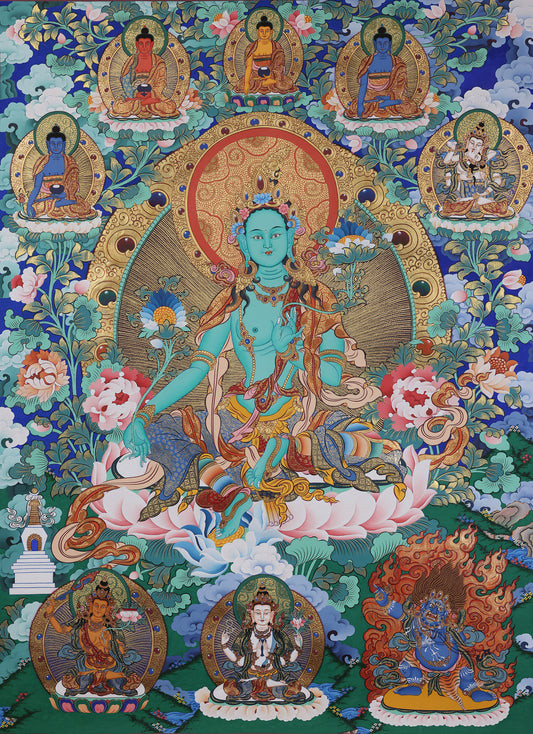
Nepalese 20×20cm Hand-Painted Auspicious Vase Mandala Thangka: The Microcosmic Sacred Realm of Tibetan Buddhist Cosmology

$299.00 USD
Thangka name: Mandala
size: 20cm×20cm
origin: Nepal
Eine Frage stellen

Beeil dich! Nur noch [Anzahl] auf Lager!

Geschätzte Lieferzeiten: 12–26 Tage (International), 3–6 Tage (USA).

Rückgabe innerhalb von 45 Tagen nach dem Kauf. Zölle und Steuern werden nicht erstattet.

Sacred Tibetan Buddhist mandala thangka depicting a symbolic cosmic universe for meditation
Nepalese 20×20cm Hand-Painted Auspicious Vase Mandala Thangka: The Microcosmic Sacred Realm of Tibetan Buddhist Cosmology
$299.00 USD
When you hold a 20×20cm hand-painted Nepalese Thangka in your palm, you’re not just grasping a decorative artwork—you’re holding the "microcosmic sacred realm" of Tibetan Buddhist cosmology. This is the Auspicious Vase Mandala Thangka we’ll dissect today: rendered in natural mineral pigments, it embodies the spiritual aspirations of Tibetan Buddhism and stands as a quintessential example of Nepal’s "exquisite micro-painting" Thangka tradition.

I. What Is a Tibetan Buddhist Mandala?


In Tibetan Buddhist culture, a mandala is far more than a pattern—it is a "gathering place of Buddhas and sacred beings." Its nested circle-square geometric structure symbolizes the cosmic order of "transcending secular suffering to reach the enlightened realm of the Buddha’s pure land":

  • The outer circle represents the "all-pervading, unobstructed nature of the Dharma Realm";
  • The middle square fortress (called the vijaya) symbolizes the "solid boundary of the Buddha’s pure land";
  • The inner circle embodies the "pure essence of the principal deity."

Mandala Thangkas function both as "spiritual maps" for practitioners (who meditate on the patterns to merge with the Buddha’s realm) and visual carriers of Tibetan Buddhism’s "sacred space." As a key birthplace of Tibetan Thangkas, Nepal’s hand-painted mandalas balance rigorous ritual norms with a soft, artistic sensibility.

II. The Core of the Auspicious Vase Mandala: Amitayus Buddha’s Longevity Aspirations


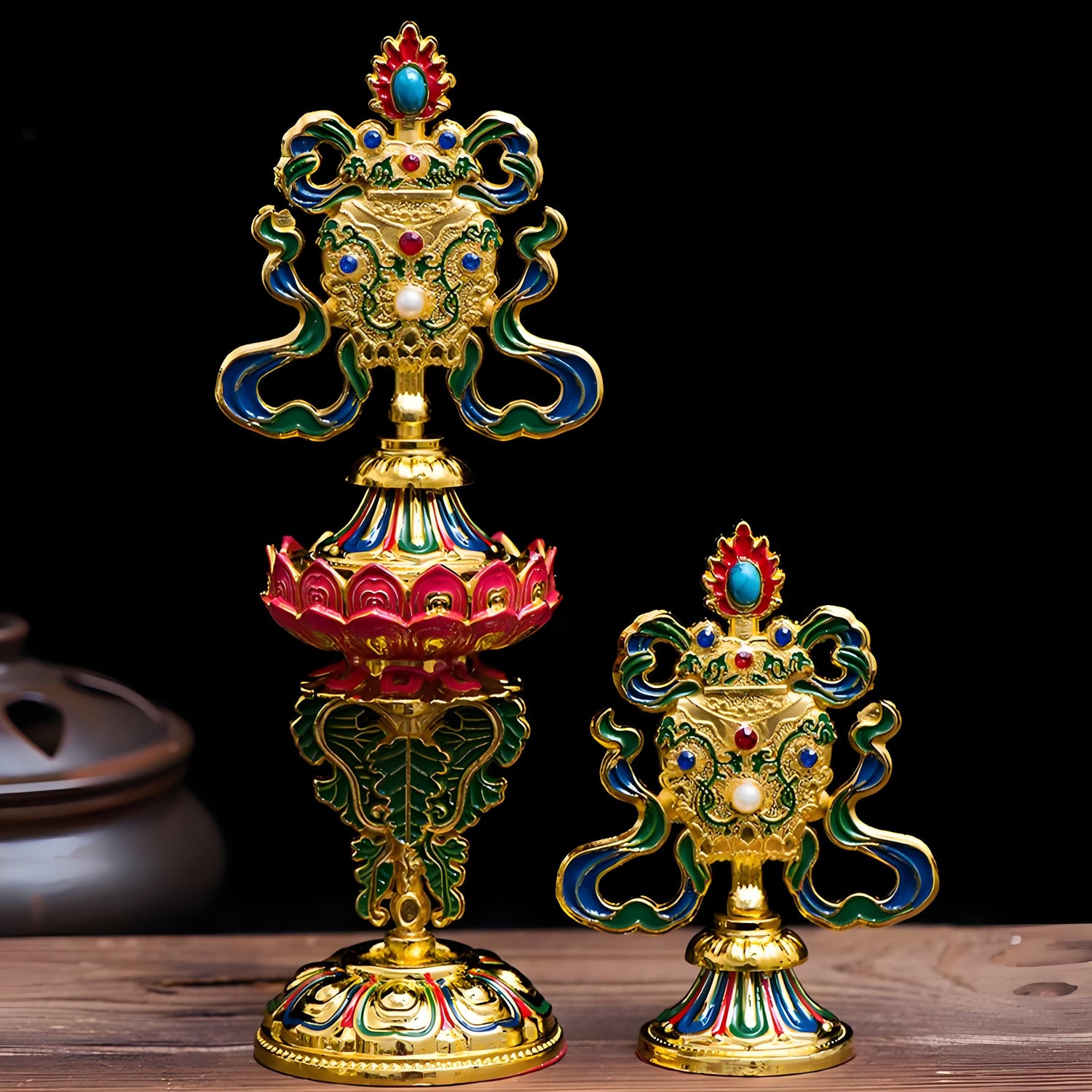
This 20×20cm Thangka centers on the theme of the "Amitayus Buddha Longevity Vase Mandala"—a ritual implement symbolic mandala (using the principal deity’s iconic ritual tool instead of a 具象 statue). The core element, the "auspicious vase," is the signature implement of Amitayus Buddha (the sambhogakaya form of Amitabha in Tibetan Buddhism).

In Tibetan Buddhism, the auspicious vase carries layered meanings:

  • Filled with nectar and jewels, it symbolizes the "untainted merit and wisdom inherent in Buddha-nature";
  • The red lotus surrounding the vase corresponds to Amitayus Buddha’s "enlightened realm of pure, unblemished clarity";
  • The vase itself embodies Amitayus Buddha’s vow: "to free sentient beings from the fear of death and grant them ultimate peace."

For practitioners, the meditation logic of this mandala is: by focusing on the vase’s details, one gradually dissolves attachment to "birth, old age, sickness, and death," and aligns with Amitayus Buddha’s vows of longevity and the dual accumulation of merit and wisdom. This explains the popularity of small "portable mandalas" in Tibetan Buddhism: they allow practitioners to construct a "pure Buddha-land" anytime, anywhere.

III. Hidden Sacred Beings in the Mandala’s Geometry: Symbols of Attendant Deities


The mandala’s square fortress and decorative elements are not mere aesthetic flourishes—they are the symbolic gathering of attendant deities, with each motif corresponding to beings that uphold the principal deity’s vows:

  1. Protection of the Three Longevity Deities: White Tara and Ushnisha Vijaya

    Amitayus Buddha’s core attendants form the "Three Longevity Deities," echoed in this mandala through symbols:

    • The seven-petaled lotus patterns (red petals, blue outlines) at the four fortress gates represent White Tara—her "seven eyes that see sentient beings’ suffering" correspond to the vow of "healing illness and extending life";
    • The triangular "victory banner symbols" in the fortress’s geometric patterns signify Ushnisha Vijaya—she dispels all obstacles to practice, granting sentient beings a peaceful death and abundant merit.

  2. Worldly Blessings: Vaishravana and the Eight Auspicious Symbols

    Nepalese mandalas often balance "enlightened spiritual goals" with "worldly blessings":

    • The curved fold patterns in the outer circle symbolize the "umbrella" of Vaishravana (the wealth-protecting guardian deity), representing "protection of the devotee’s resources and safety";
    • The vase itself, lotus motifs, and scrollwork correspond to the "vase," "lotus," and "endless knot" among Tibetan Buddhism’s Eight Auspicious Symbols—combining secular and sacred blessings of "completeness, purity, and unobstructed Buddha-wisdom."


IV. Nepalese Hand-Painting Techniques: The Eternity in Mineral Pigments


The value of this Thangka lies in its traditional craftsmanship—and the 20×20cm size showcases the precision of Nepal’s "exquisite micro-painting" tradition:

  1. Carrier and Pigments: Sacred Metaphors in Natural Materials

    • The base is cotton cloth treated with four steps: washing, sun-drying, stretching, and coating with a yak-glue and gypsum layer. Its fine, smooth texture suits micro-painting and symbolizes the "stability of the Buddha’s pure land";
    • All pigments are natural mineral and earth materials:
      • Red (lotus petals): Sourced from local cinnabar ore in Nepal, its rich, oxidation-resistant hue symbolizes "the warmth of life and the Buddha’s compassion";
      • Blue (lotus outlines): Ground from Afghan lapis lazuli, representing the "profound clarity of the Dharma Realm";
      • Green (fortress patterns): Derived from malachite ore, corresponding to "the growth and continuity of merit";
      • Gold (lines): Made from 24K gold powder mixed with yak glue, symbolizing "the unchanging, indestructible nature of Buddha-nature."


  2. Stylistic Traits: Fusion of Tibetan Rituals and Nepalese Art

    Unlike the bold lines of Tibetan Thangkas, this mandala’s scrollwork and geometric patterns feature "rounded curves"—a reflection of Nepal’s "soft aesthetic." At the same time, its proportions strictly follow the Iconometry Sutra (the square fortress’s side length equals 1/12 of the "Buddha-body measurement"), ensuring ritual accuracy.


The 20×20cm size makes it a "portable mandala": suitable for meditation on a practitioner’s altar, or for framing and hanging in a home (in Tibetan custom, mandalas are believed to "ward off negative energy and gather blessings").

V. The Contemporary Significance of the Auspicious Vase Mandala: Value of the Microcosmic Sacred Realm


Today, this small mandala Thangka transcends its role as a "meditation tool": it is an artistic specimen of Tibetan-Nepalese cultural fusion (Tibetan ritual norms + Nepalese hand-painting techniques) and a "living heritage of traditional craftsmanship" (mineral pigments, hand-painting skills).

For collectors, it is a "tangible expression of Tibetan Buddhist cosmology"; for cultural enthusiasts, it is a visual textbook for understanding "suffering as enlightenment"—every line and pigment embodies the Tibetan wisdom of "integrating the sacred into daily life."
#NepaleseHandPaintedMandalaThangka

#AuspiciousVaseMandalaThangka

#TibetanBuddhistMandalaExplained

#AmitayusBuddhaMandala

#NepaleseThangkaMineralPigmentTechnique

#20cmPortableMandalaThangka

#TibetanBuddhistAttendantDeitySymbols

#TibetanNepaleseCulturalFusionThangka

#ThangkaCosmologyMetaphor

#HandPaintedThangkaCollection
Entdecken Sie das perfekte tibetisch-buddhistische Thangka, das zu Ihren Wünschen, Ihrem Lebensstil und Ihrem Raum passt. Jedes Thangka hat eine spirituelle Bedeutung und bringt Segen, wenn es richtig platziert wird.

1. Definieren Sie Ihre Absicht

Reichtum & Erfolg → Gelber Dzambhala (Gottheit des Reichtums)

Mitgefühl und Frieden → Avalokiteshvara, Grüne Tara

Weisheit & Lernen → Manjushri

Gesundheit & Heilung → Medizinbuddha

Langlebigkeit und Familienschutz → Weiße Tara

2. Wählen Sie nach Identität

Unternehmer und Geschäftsinhaber → Reichtumsgottheiten für Wohlstand.

Studenten und Gelehrte → Weisheitsgottheiten für Konzentration und Klarheit.

Heiler und Yoga-Praktizierende → Medizinbuddha für Energie und Gleichgewicht.

Familien und Hausfrauen → Tara-Gottheiten für Harmonie und Sicherheit.

Sammler und Kunstliebhaber → Seltene Mandalas oder Meisterwerk-Thangkas.

3. Passen Sie Ihren Raum an

Heimschrein / Meditationsraum → Mittlere Thangkas (60–80 cm).

Büro / Geschäftshalle → Große Thangkas für Wohlstand und Autorität.

Wohnzimmer / Arbeitszimmer → Dekorative Thangkas für Frieden und Schönheit.

4. Authentische Handwerkskunst

Jedes Thangka ist mit natürlichen Mineralpigmenten und feiner Leinwand handbemalt und spiegelt tibetische Kunstfertigkeit und spirituelle Kraft wider. Überprüfte Quellen gewährleisten Qualität und Respekt für die Tradition.

✨ Wählen Sie Ihr Thangka mit Herz – es ist nicht nur Kunst, sondern ein Segen für Ihr Leben.

Jeder Mensch hat unterschiedliche Bedürfnisse. Die Wahl des richtigen Thangkas kann spirituelle Unterstützung, Schutz, Glück und Segen bieten. Nachfolgend finden Sie Thangka-Empfehlungen für verschiedene Rollen:

1. Unternehmer

  • Bedürfnisse : Weisheit, Reichtum, Gesundheit, beruflicher Erfolg.
  • Empfohlene Thangkas :
    Manjushri : Verbessert die Entscheidungsfindung und Geschäftsweisheit.
    Gottheit des Reichtums : Bringt Reichtum und Wohlstand.
    Medizinbuddha : Unterstützt die Gesundheit und reduziert Stress.
    Mahakala : Schützt Unternehmen vor Konkurrenz und Herausforderungen.

2. Erfolgreiche Einzelpersonen

  • Bedürfnisse : Innerer Frieden, Familienharmonie, Langlebigkeit.
  • Empfohlene Thangkas :
    Amitabha Buddha : Bringt inneren Frieden und Ruhe.
    Avalokiteshvara (Guanyin) : Fördert Harmonie und Glück in der Familie.
    Amitayus (Langlebens-Buddha) : Betet für gute Gesundheit und ein langes Leben.
    Manjushri : Stärkt weiterhin die Weisheit.

3. Hausfrauen/Ehemänner

  • Bedürfnisse : Familienharmonie, Schutz, Gesundheit.
  • Empfohlene Thangkas :
    Avalokiteshvara : Steigert das Familienglück und die Harmonie.
    Schutzgottheiten : Beschützen die Familie vor äußeren Störungen.
    Weiße Tara : Segnet die Familie mit Gesundheit.

4. Studierende und Wissenschaftler

  • Bedürfnisse : Weisheit, Konzentration, akademischer Erfolg.
  • Empfohlene Thangkas :
    Manjushri : Fördert Lernfähigkeit, Gedächtnis und Weisheit.
    Shakyamuni Buddha : Hilft bei der Konzentration und spirituellen Praxis.
    Jixiang Tianmu : Bringt akademisches Glück und Prüfungserfolg.

5. Künstler und Kreativprofis

  • Bedürfnisse : Inspiration, Kreativität, künstlerische Leistung.
  • Empfohlene Thangkas :
    Manjushri : Regt kreatives Denken und Inspiration an.
    Vajrapani : Hilft, kreative Blockaden zu überwinden.
    Maitreya : Sorgt für eine entspannte und optimistische Einstellung und baut Stress ab.

6. Reisende und Abenteurer

  • Bedürfnisse : Schutz, Glück, Erfolg bei Abenteuern.
  • Empfohlene Thangkas :
    Hayagriva : Bietet starken Schutz auf Reisen und beseitigt Hindernisse.
    Mahakala : Bringt Glück und Schutz, insbesondere für Abenteurer.
    Vajrasattva : Hilft, Schwierigkeiten und Herausforderungen während der Reise zu überwinden.

7. Ältere Menschen

  • Bedürfnisse : Gesundheit, Langlebigkeit, spiritueller Frieden.
  • Empfohlene Thangkas :
    Amitayus : Betet für ein langes Leben und gute Gesundheit.
    Medizinbuddha : Fördert Heilung und körperliches Wohlbefinden.
    Avalokiteshvara : Bringt Mitgefühl und inneren Frieden in späteren Jahren.

8. Führungskräfte

  • Bedürfnisse : Führung, Weisheit, Teamarbeit und geschäftlicher Erfolg.
  • Empfohlene Thangkas :
    Manjushri : Verbessert Führungsqualitäten und Entscheidungsfindung.
    Gottheit des Reichtums : Bringt dem Unternehmen und dem Team Erfolg und Wohlstand.
    Avalokiteshvara : Fördert Harmonie und Gleichgewicht innerhalb des Teams.

9. Gesundheits- und Fitnessbegeisterte

  • Bedürfnisse : Gute Gesundheit, Vitalität, Energie.
  • Empfohlene Thangkas :
    Medizinbuddha : Verbessert die körperliche Gesundheit und Vitalität.
    Weiße Tara : Bringt Gesundheit und Verjüngung.
    Vajrasattva : Beseitigt gesundheitliche Probleme und steigert die Energie.

10. Politiker

  • Bedürfnisse : Führung, Weisheit, Frieden.
  • Empfohlene Thangkas :
    Manjushri : Verbessert Führungsqualitäten und Entscheidungsfindung.
    Vairocana Buddha : Hilft, inneren Frieden und Weisheit zu bewahren.
    Avalokiteshvara : Fördert den gesellschaftlichen Frieden und die Harmonie in der Familie.

Für alle Bestellungen über 100 USD ist der Versand kostenlos.

Rücksendungen werden bis zu 10 Tage nach Erhalt des Kaufbelegs bzw. der Sendungsnummer (bei ungetragenen Artikeln) akzeptiert. Sie als Kunde sind verpflichtet, uns vor der Rücksendung des Artikels per E-Mail zu informieren.

Andernfalls fallen die Standardversandkosten an. Weitere Informationen finden Sie in unseren Lieferbedingungen .

Rücksendungen werden bis zu 10 Tage nach Erhalt des Kaufbelegs oder der Sendungsnummer (bei ungetragenen Artikeln) akzeptiert. Sie als Kunde sind verpflichtet, uns vor der Rücksendung des Artikels per E-Mail zu informieren, nur in folgenden Fällen:

– Den falschen Artikel erhalten.
– Artikel kam nicht wie erwartet an (z. B. beschädigte Verpackung).
– Artikel hatte Mängel.
– Über die Lieferzeit hinaus.
– Der Spediteur gestattet keine Besichtigung der Ware vor der Bezahlung.

Die zurückgesendeten Produkte müssen in der Originalverpackung, sicher verpackt, unbeschädigt und ungetragen sein. Dies bedeutet, dass die Artikel zum Schutz während des Transports sicher in einem Karton verpackt sein müssen, möglichst im selben Karton, in dem sie an Sie als Kunde versendet wurden.

Kürzlich angesehen

Nicht vergessen! Die Produkte, die Sie angesehen haben, legen Sie jetzt in den Warenkorb.

Passt gut zu

Erweitern Sie Ihre Auswahl mit perfekt abgestimmtem Zubehör und ergänzenden Produkten.

Leute kauften auch

Hier sind einige unserer ähnlichsten Produkte, die die Leute kaufen. Klicken Sie hier, um den Trendstil zu entdecken.