1. Theme: The “Continuation of Lineage” in the Long Life Pure Land and Gelugpa Longevity Practice
The Amitayus Long Life Pure Land Thangka centers on the Long Life Pure Land presided over by Amitayus, reflecting the Tibetan Buddhist “longevity faith” system and the devotion to the “Three Longevity Deities.” In Tibetan Buddhist context, Amitayus is uniquely revered for his vow to extend life and preserve the Dharma in the world. According to the Sutra on Longevity, “Beings’ lifespans are immeasurable; by practicing longevity methods with a pure mind, they can remain in the world alongside the Dharma,” which concretely embodies the Tibetan Buddhist teaching of protecting the lineage and benefiting sentient beings.
This Thangka also incorporates the Gelugpa longevity practice framework: Amitayus’ characteristic of long life aligns with the Gelugpa aspiration to ensure the presence of highly realized masters for the propagation of Dharma. The layout of attendant deities and supporting figures mirrors the ritual structure of the Three Longevity Deities, making the Thangka both a symbol of Pure Land devotion and a practical visual guide for ritual practice.
2. Main Deity: Amitayus, the “Long-Life Buddha” – Iconography and Esoteric Symbolism
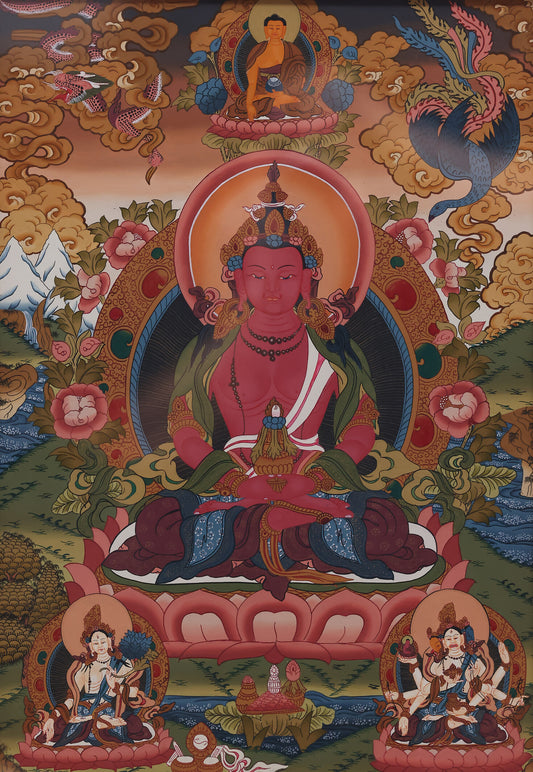
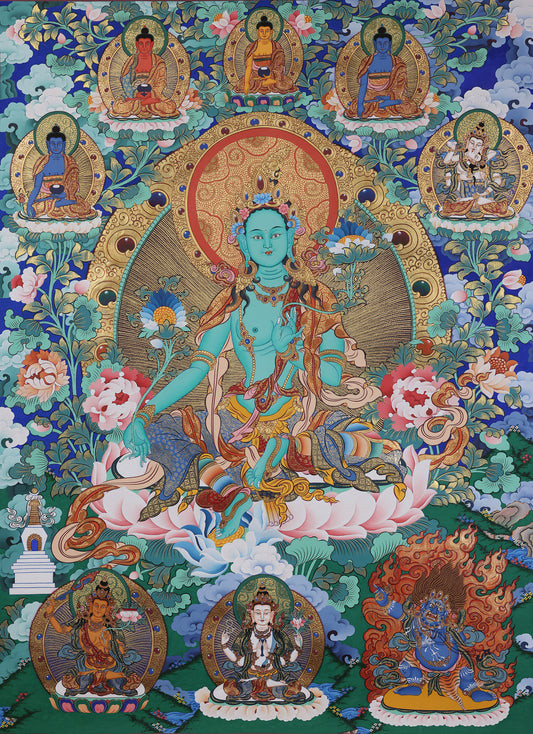
The central deity is Amitayus (Tibetan: Tsemo Linpa, “Buddha of Infinite Life”), depicted according to the strict iconometric guidelines of the Sutra on Image Measurement for Long-Life Buddhas. Every detail visually represents the teaching of life extension and Dharma preservation:
-
Physical Features: Amitayus wears the Five Buddha Crown, symbolizing mastery over the wisdom of the Five Dhyani Buddhas and the continuity of life and Dharma. His long earlobes signify past acts of generosity, cultivating longevity merit. His serene, compassionate face, with eyes slightly lowered and lips gently smiling, conveys the power of long life to protect sentient beings and the Dharma. His deep red body color, emblematic in Tibetan Thangkas, corresponds to the fire element, symbolizing lifespan as enduring as a flame and warming sentient beings with compassion while sustaining the Dharma.
-
Mudras and Ritual Implements: Both hands are in the meditation mudra, holding a longevity vase containing nectar and a longevity arrow. The vase represents the extension of life through the nectar of Dharma, while the arrow destroys obstacles to longevity. Amitayus also wears the Kapala (ritual skull cup) at the chest, reinforcing the theme of life extension. These elements collectively embody both the vow of long life and compassionate salvation.
-
Lotus Seat and Halo: Amitayus sits on a thousand-petal red lotus, representing the flourishing of longevity merit. Behind him is a double halo: an inner orange aura symbolizing the warmth of long-life power, and an outer golden wheel of Dharma representing the perpetuity of Dharma through the Buddha’s long life. The wheel’s curling vine motif signifies continuity of lineage.
3. Attendant Deities: Sacred Hierarchy and Functional Layers in the Long Life Pure Land
The attendants are arranged around Amitayus in a hierarchical order—Buddha, Bodhisattvas, and Longevity Deities—establishing a sacred system that embodies life extension and Dharma preservation:
-
Upper Deity: Directly above Amitayus is Shakyamuni Buddha, a classic element in Tibetan longevity Thangkas. This emphasizes that Amitayus’ longevity vow is anchored in the continuation of Shakyamuni Buddha’s Dharma, reflecting the doctrinal principle that longevity practices are based on the Buddha’s teachings.
-
Flanking Deities: Below Amitayus sit the White Tara (left) and Uṣṇīṣavijaya (right), representing the Three Longevity Deities. White Tara holds a lotus, granting longevity through compassion, while Uṣṇīṣavijaya holds a longevity vase, symbolizing the destruction of lifespan obstacles via mantra. These figures assist Amitayus in executing his vow and correspond to the ritual of combined practice of the Three Longevity Deities in the Gelugpa tradition.
-
Lower Sacred Objects and Attendants: Under the lotus base are longevity vases and the Eight Auspicious Symbols, representing continuous accumulation of longevity merit and protection of life and Dharma. Surrounding celestial maidens carrying musical instruments and offerings symbolize merit accumulation through devotion and ritual offerings.
These attendants are not mere decoration—they are a visualization of the ritual structure for longevity practice, from Shakyamuni Buddha as the foundation of the Dharma to the Three Longevity Deities executing the vow, and from sacred symbols representing merit to celestial maidens representing virtuous accumulation. Together, they illustrate the logic of relying on Amitayus’ vow to extend life and sustain the Dharma.
4. Painting Craftsmanship: Tibetan Thangka as Unity of Art and Longevity Vow
This Thangka is a hand-painted masterpiece of the Menri (Mensa) school, known for vivid colors and intricate details. The process not only demonstrates artistic skill but also reflects the spiritual practice of accumulating longevity merit through craftsmanship:
-
Canvas Preparation: Fine cotton cloth is treated through five rounds of animal glue soaking, stretched on a wooden frame, and polished with jade stone (approximately 15 days). The glue is infused with Tibetan longevity herbs, symbolizing the harmonization of life and spiritual practice.
-
Pigment Preparation: Natural mineral and plant pigments are used: red from cinnabar and safflower, gold from 24K gold leaf pulverized under 5μm, blue from lapis lazuli, and green from malachite. Pigments are mixed with glue in a 4:1 ratio. These natural materials ensure century-long durability and symbolize the eternal nature of longevity vows.
-
Painting Techniques:
-
Line Drawing: Fine wolf-hair brushes delineate intricate contours (e.g., Five Buddha Crown and longevity vase details), reflecting Menri school principle “lines as bones, intricacy as rhythm”, conveying meticulous accumulation of longevity merit.
-
Color Application: 4–5 layers of heavy-color blending are applied; deep red for Amitayus’ body uses a base of cinnabar, overlaid with safflower juice and gold powder for luminous, majestic effect.
-
Opening the Face (Kaixiang): The most sacred stage, painting facial features with a purple brush while holding the vow of longevity, results in eyes that are compassionate yet dignified, reflecting Amitayus’ protective power.
-
Composition Logic: The central deity with surrounding ritual layout mirrors the structure of the longevity practice. Warm tones (orange and red) evoke the sense of gathered merit and complete fulfillment, creating a visual representation of the concentrated energy of long-life vows.
5. Conclusion: The Thangka as a “Portable Longevity Mandala”
The Amitayus Long Life Pure Land Thangka unites artistic beauty with ritual functionality, serving as both a devotional object and a ritual vehicle for longevity practices. The theme embodies life extension and Dharma preservation, the main deity and attendants form a symbolic system of ritual practice, and the craftsmanship represents accumulated longevity merit through artisanal devotion. In Tibetan practice, such a Thangka is more than a display piece—it is a tool for visualizing Amitayus, practicing longevity rituals, and accumulating merit. Every brushstroke of mineral pigment and every line embodies the vow to extend life and sustain the Dharma, encapsulating the core cultural essence of Tibetan Thangka: unity of form, spirit, and function.
#AmitayusThangka #LongLifeBuddha #TibetanBuddhistArt #HandPaintedThangka #LongevityDeities #PureLandThangka #BuddhistArt #TibetanThangka #SpiritualArt #MeditationTools #DharmaPreservation #BuddhistCraftsmanship#LongevityPractice #ThreeLongevityDeities #BuddhistShrineDecor