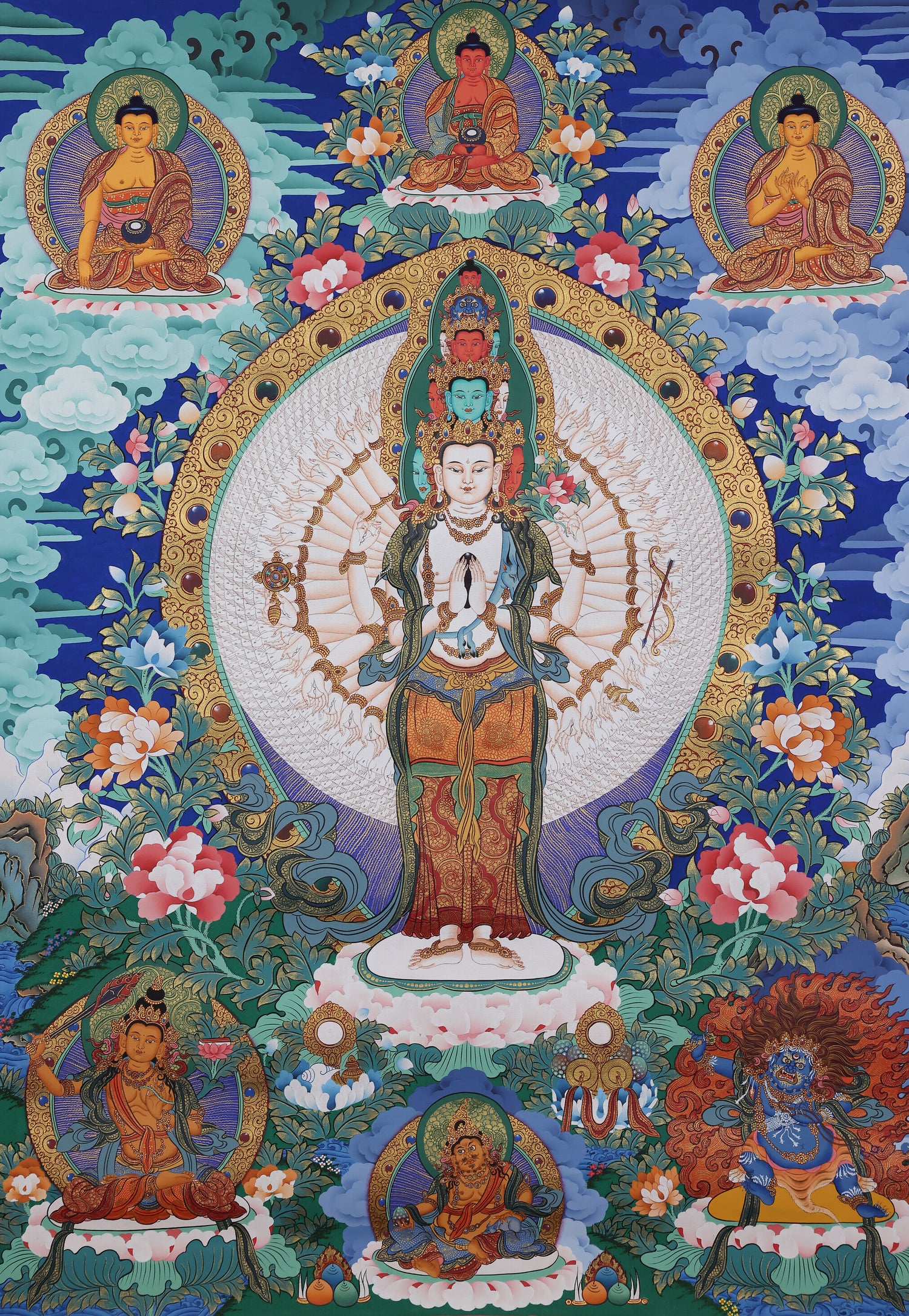
In the spiritual world of Tibetan Buddhism, a thangka is never just a painting—it is a "visible scripture" and a medium for practitioners to connect with Buddhas and Bodhisattvas. Today, we explore a 45×60cm hand-painted Tibetan black-gold Manjushri Thangka: its deep black background is etched with gilded lines forming the solemn form of Yellow Manjushri, and the rich texture of mineral pigments holds the wisdom codes of Tibetan culture.
1. Theme: "Wisdom Dispelling Ignorance" in Black-Gold Palette
The core of this thangka lies in the fundamental Tibetan Buddhist doctrine of "using prajna wisdom to cut through delusion."
In Vajrayana philosophy, the
black background is not a mere color choice: it corresponds to the "cosmic substrate of ignorance," representing the unawakened mental state of sentient beings. The
gilded lines and Yellow Manjushri’s form, by contrast, symbolize "wisdom’s light bursting forth from darkness"—their stark contrast visualizes the idea of "wisdom dispelling ignorance."
Its 45×60cm size is equally meaningful: this is a "portable thangka" commonly used by Tibetan practitioners, not a "grand thangka" enshrined in temples. Its theme thus focuses on personal practice: it is not a grand religious narrative, but a "wisdom artifact" that accompanies practitioners in daily visualization and blessings, embodying the spiritual aspiration to "use Manjushri’s wisdom to cut through one’s own delusions."
2. Main Deity: Rituals and Symbolism of Yellow Manjushri
The central Yellow Manjushri is the embodiment of "Mirror-like Wisdom" among the "Five Manjushris" in Tibetan Buddhism. Every detail adheres strictly to the Iconometric Canon of Buddhist Images:
-
Form and Crown: The honey-yellow body symbolizes "perfect wisdom"; the five topknots represent "uniting the wisdom of the Five Dhyani Buddhas"; the cranial protuberance (urna) between the brows marks "transcendent wisdom."
-
Posture and Lotus Throne: Seated in full lotus posture on a lotus throne, the lotus—"unsoiled by mud"—metaphorizes that the Bodhisattva’s wisdom remains unpolluted by worldly delusions.
-
Implements and Mudra: The right hand raises the Prajna Flame Sword (flames wrap the blade, symbolizing cutting through ignorance); the left hand forms the Dharmachakra Mudra (palm outward, representing teaching the Dharma of wisdom); the Dharma wheel motif at the base of the lotus throne signifies "the Dharma of wisdom spreading throughout the world."
3. Implicit Retinue: The Protector System Hidden in Ornamentation
Small portable thangkas often use "symbolic retinues" instead of 具象 figures. This work’s retinue is hidden in its background and patterns:
- The scroll cloud motifs surrounding the main deity correspond to the Gandharvas (celestial musicians)—"protectors who offer devotion to wisdom" in Tibetan Buddhism.
- The Bao Xiang flowers beside the lotus throne symbolize the "Eight Youthful Attendants of Manjushri," representing the retinue of wisdom surrounding and protecting the practitioner.
- It also implicitly connects to the "Three Protectors": as the "Protector of Wisdom," Yellow Manjushri aligns with Chenrezig (Compassion) and Vajrapani (Power), hinting at the unity of wisdom, compassion, and strength.
4. Craftsmanship: The Exquisite Art of Black-Gold Thangkas
This work belongs to the "Nathang (black-gold thangka)" category—one of the most technically demanding forms of Tibetan thangka. Its craftsmanship reflects the meticulous effort of Tibetan artisans:
-
Base Preparation: Local Tibetan "white woolen cotton cloth" is stretched over a frame, coated with a base of aged (5+ years) cow glue + gypsum powder, and polished repeatedly until mirror-smooth to ensure an even black background.
-
Black Background: Made from a mixture of magnetite powder (mineral pigment, sourced from Medog, Tibet) and deer antler ash (earthy pigment), it undergoes 50 layers of application + polishing per layer—each layer is only 0.02mm thick, ensuring deep blackness while preventing cracking.
-
Gold Techniques: The main deity’s form and lines use 24K gold leaf ground into powder, mixed with 3+ year-old cow glue (for reduced stickiness but enhanced malleability). The raised gold technique is used: artisans use specialized wolf-hair brushes to build up gilded lines into subtle reliefs, which shimmer three-dimensionally in light—making the main deity "emerge from the black background" and reinforcing the metaphor of "wisdom revealing itself."
-
Mineral Pigments: Yellow Manjushri’s honey-yellow hue is blended from realgar (mineral) + yellow earth (earthy pigment); the subtle dark green accents in the background use malachite (mineral) + turquoise powder (earthy pigment)—these align with ritual standards while adding depth to the black-gold palette.
5. Artistic Style: Fusion of the Men Tang School and Portable Thangka Functionality
This thangka exemplifies the Tibetan-native Men Tang School style:
-
Line as the Foundation: It uses "iron-wire line drawing" as its core—lines are bold, fluid, and sharply defined, adhering to the Men Tang School’s aesthetic of "lines as bones, colors as skin."
-
Simplified Background: Unlike the "dense ornamentation" of the Rebkong School, this work retains only core symbols (scroll clouds, Bao Xiang flowers) to highlight the main deity—a functional choice for portable thangkas, which need to facilitate easy visualization.
-
Solemn Facial Features: The rounded face, downward-gazing eyes (spaced one eye-width apart), and slightly upturned lips (the "compassionate expression") align with the Men Tang School’s standard for "serene forms"—dignified yet approachable.
Conclusion: A "Living Spiritual Artifact"
This black-gold Manjushri Thangka unites religion, craftsmanship, and art: its black-gold palette interprets "wisdom dispelling ignorance," its Yellow Manjushri form supports visualization practice, and its Men Tang School craftsmanship showcases the pinnacle of Tibetan artistry. It is not just wall decor, but a "living artifact"—a symbol of "wisdom awakening" in Tibetan Buddhism.
#TibetanBlackGoldThangka #ManjushriThangka #TibetanBuddhistArt #MenTangSchoolThangka #MineralPigmentThangka #PortableThangkaAnalysis #TibetanCulturalCode #ThangkaCraftsmanship #YellowManjushriSymbolism #WisdomDispelsIgnorance