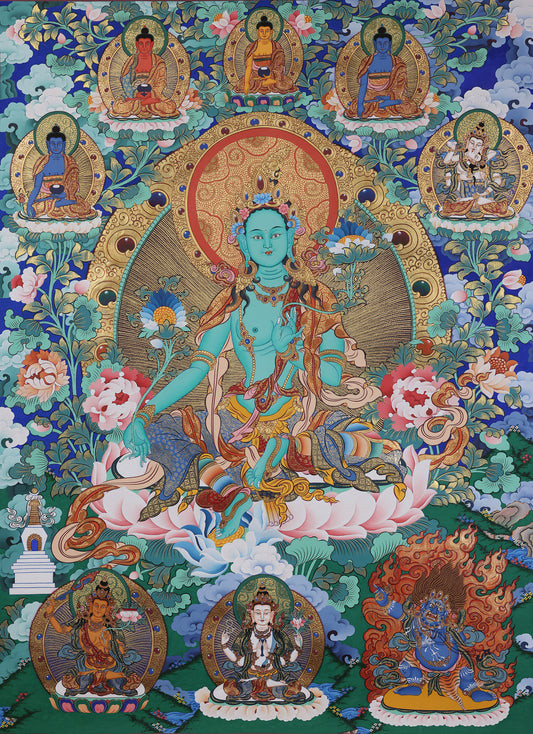
When the "Dharmadhatu wisdom" of Tibetan Esoteric Buddhism meets the millennium-old hand-painting skills of Nepalese Newari artisans, a 45×60cm pure mineral pigment color thangka becomes a "mobile mandala" that combines religious ritual functions and artistic collection value. In Tibetan Buddhist culture, a thangka is not a mere decorative painting but a spiritual practice tool that "embodies the Dharma"; as a key birthplace of Tibetan thangkas, Nepal infuses this "sacred object" with unique regional aesthetics through Newari art. Today, we fully unpack the deep connotations of this Vairocana Buddha thangka, from Tibetan Esoteric principles to craft details.
1. Core Theme: The Embodied Mandala of "Dharmadhatu Pervasion" in Tibetan Esotericism
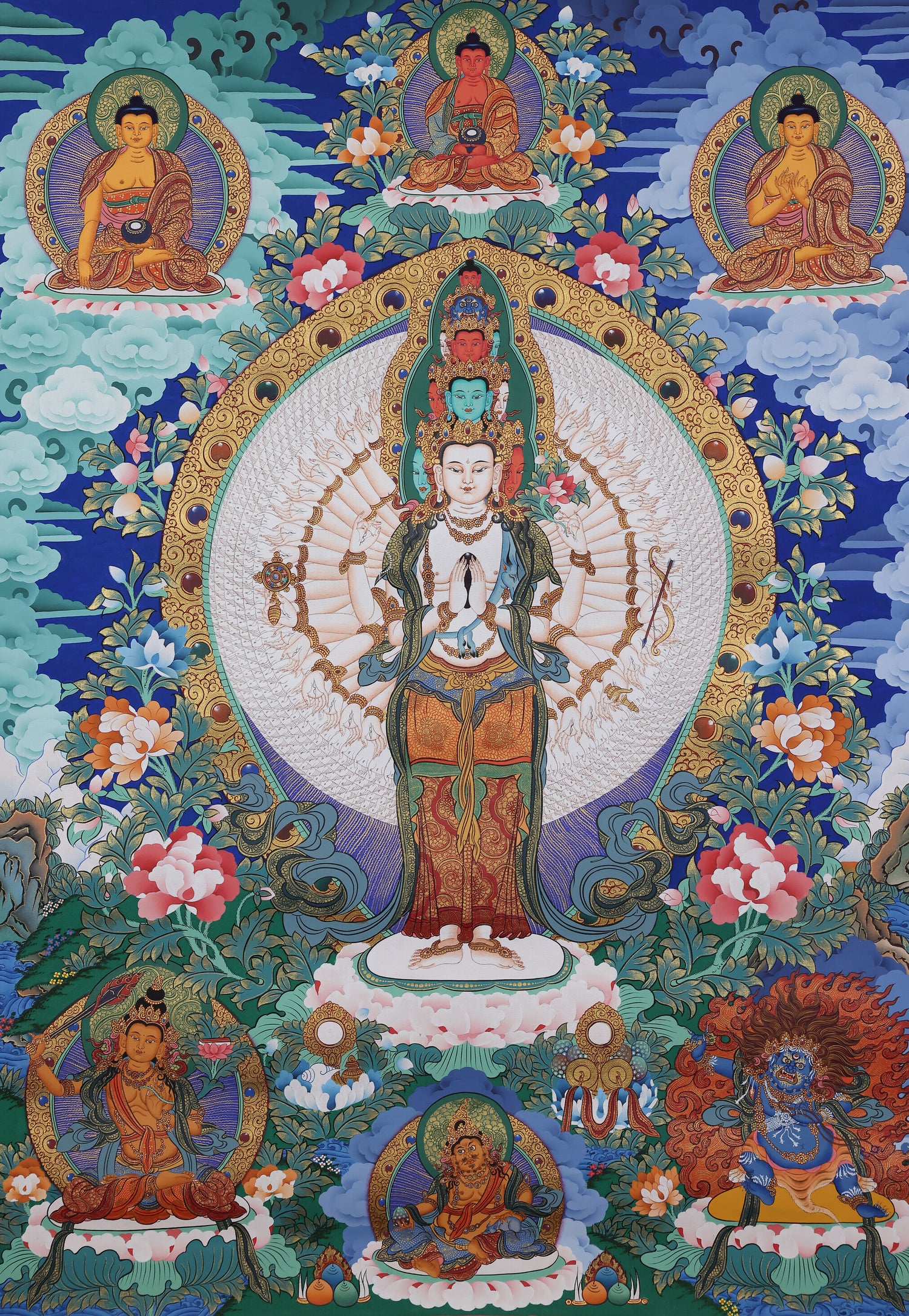
The core theme of this thangka is the combined Dharmakaya-Sambhogakaya mandala of Vairocana Buddha (the central Buddha in Tibetan Esoteric Buddhism). In the Tibetan Esoteric system, Vairocana Buddha is not a "sun god" but the personification of "Dharmakaya Wisdom," serving as the central core of both the Garbha Realm and Vajra Realm mandalas.
Tibetan Esoteric doctrine holds that all sentient beings inherently possess a "pure self-nature," which is essentially identical to Vairocana Buddha’s Dharmakaya Wisdom. The thangka’s iconography and attendant deity configuration are essentially visualization tools for practitioners: by gazing at the main deity’s features, chanting mantras, and aligning with the Dharma’s meaning, practitioners can realize the core Esoteric tenet that "sentient beings are inherently Buddhas." The value of this Nepalese color thangka lies in its translation of abstract "Dharmadhatu wisdom" into perceptible visual symbols through Newari art—adhering to the ritual norms of the Tibetan Iconographic Measurement Sutra while retaining the vivid traits of regional art.
2. Main Deity: Vairocana Buddha—The Code of Esoteric Meaning in Feature Details
The four-armed Vairocana Buddha at the center of the thangka is the standard samaya form of Vairocana in Tibetan Esotericism; every feature, ritual object, and mudra is a tangible expression of Esoteric doctrine:
1. Physical Form: The Invisibility of Dharmakaya and the 庄严 of Sambhogakaya
Vairocana Buddha is originally a "Dharmakaya Buddha" (formless, permeating the entire Dharmadhatu), but to accommodate ordinary beings’ ability to "connect with the Dharma through form," it appears in the form of a "Sambhogakaya Buddha" in the thangka:
-
Five-Buddha Crown and Ornaments: The five-buddha crown on the head symbolizes the convergence of wisdom from the Five Dhyani Buddhas; the pearl necklaces, armlets, and chest chains are not secular decorations—the diamond pendant on the chest chain corresponds to "Viryaparamita (Perfection of Vigor)," and the circular armlets symbolize "complete merit." Each jewel is a visual symbol of the Buddha’s virtues.
-
Skin Tone and Aura: The light golden skin tone is an extension of the Tibetan Esoteric "urna (cranial protuberance)," signifying the pervasion of Dharmadhatu light; the pure gold patterns in the inner halo represent "the inherent light of the Dharmadhatu," while the interwoven red and black patterns in the outer halo correspond to "compassionate embrace" and "subduing afflictions." The Newari scrollwork on the halo’s edge further implies "the endless vitality of the Dharmadhatu."
2. Ritual Objects and Mudras: Esoteric Alignment of Body, Speech, and Mind
The four arms correspond to the four Dharmadhatu attributes: body, speech, mind, and karma:
-
Dhyana Mudra with Dharmacakra: The hands, clasped at the abdomen, hold an eight-spoked Dharmacakra (the blue ritual object in the image). The Dhyana Mudra symbolizes stable meditation, while the eight-spoked Dharmacakra represents Vairocana Buddha turning the "Wheel of Dharmadhatu" to liberate sentient beings in the six realms.
-
Rosary in the Right Rear Hand: The 108-bead rosary corresponds to the 108 afflictions of sentient beings; holding the rosary signifies Vairocana Buddha’s guidance of sentient beings through wisdom to cut through afflictive obstacles.
-
Utpala Flower in the Left Rear Hand: The blue utpala (blue lotus) is the "flower of purity" in Tibetan Esotericism, symbolizing "a self-nature untainted by affliction," directly echoing the essence of Vairocana Buddha’s Dharmakaya Wisdom.
3. Sitting Pose and Lotus Throne: The Dialectic of Affliction and Purity
The main deity sits in the Vajra Lotus Pose (full lotus position), symbolizing "stable meditation, unshaken by afflictions." The thousand-petal lotus throne has two layers: the lower pink petals represent "sentient beings trapped in the cycle of afflictions, like lotuses growing from mud," while the upper white petals symbolize "revealing the pure self-nature through Vairocana Buddha’s wisdom." The green water patterns at the base of the throne are a direct expression of "pure lotuses growing from the sea of afflictions."
3. Attendant Deities: The Doctrinal Extension and Functional Network of the Mandala
The attendant deities in the thangka are not decorations but "doctrinal branches" of Vairocana Buddha’s mandala, forming a complete Esoteric practice context:
1. Retinue Bodhisattvas: The Union of Wisdom and Compassion
- The deity holding a scripture in the upper left corner is Manjushri (symbolizing "wisdom"), and the deity holding a vase in the upper right corner is Avalokiteshvara (symbolizing "compassion"). As Vairocana Buddha’s "left and right arms," they imply that Tibetan Esoteric practice requires the "union of wisdom and compassion"—neither can be absent.
- The golden deity in the lower left corner is Saraswati (Miaoyin Bodhisattva), holding a scripture and ritual object, symbolizing "the spread of Dharma teachings," meaning Vairocana Buddha’s Dharma spreads throughout the world through sacred sounds.
2. Protector Deity: Subduing Inner Afflictions and Outer Obstacles
The blue wrathful deity in the lower right corner is the wrathful form of Vajrapani (or an incarnation of Hayagriva): the blue body symbolizes "unchanging vajra nature," and the surrounding flames signify "burning afflictive and cognitive obstacles." Its wrathful form is not "hatred" but an "expedient manifestation" in Esotericism—using a fierce appearance to protect practitioners from inner afflictions (greed, anger, delusion) and outer obstacles (adverse circumstances).
3. Ritual Object Deities: Bestowing Merit and Wisdom
On the small lotus throne below the main deity’s throne, ritual objects from the Eight Auspicious Symbols (such as the Dharmacakra and vase) are enshrined: the repeated Dharmacakra reinforces the meaning of "turning the Dharma wheel," while the nectar in the vase symbolizes Vairocana Buddha’s "Dharmadhatu nectar abhisheka," bestowing merit and wisdom upon sentient beings.
4. Newari Art: The Craft Code of Mineral Pigments and Regional Style
This thangka is a typical representative of Nepalese "color thangkas"; its craft and style adhere to Tibetan ritual norms while showcasing the unique genes of Newari art:
1. Mineral/Earth Pigments: The Material Foundation of an "Eternal Sacred Object"
The pigments used are traditional Nepalese natural minerals and earth pigments (such as lapis lazuli blue, malachite green, cinnabar red, realgar yellow, and gold leaf), prepared through strict processes:
- Pigments undergo three steps: grinding, washing, and glue mixing. For example, lapis lazuli is ground into three powders of different coarseness, which are layered to create gradients (the blue layers of the sky and utpala flower in the image are formed by overlapping coarse, medium, and fine lapis lazuli powders).
- Ox bone glue (a traditional Nepalese material) is used for mixing, ensuring the pigments adhere firmly and do not fade for centuries—this is the core reason thangkas are called "eternal sacred objects." The matte texture of mineral pigments contrasts with the luster of gold leaf, enhancing the sacred aura.
2. Newari Style: The Regional Aesthetic of Delicacy and Richness
Unlike the ruggedness of Tibetan thangkas, this thangka’s Newari traits are distinct:
-
Lines: The "Iron Wire Line Technique" is used, with delicate and smooth lines—the folds of the main deity’s robes and the texture of the ornaments are precisely rendered, with no messy strokes, reflecting the millennium-old line-drawing skills of Newari artisans.
-
Colors: Centered on red, blue, and green (corresponding to "compassion," "purity," and "vitality" in Tibetan Esotericism), the high saturation is not harsh; harmony is achieved through color gradients (such as the pink-to-red transition of the lotus petals).
-
Patterns: The "Nepalese scroll clouds" in the background have rounded, curly shapes (different from the sharp clouds in Tibetan thangkas), and the scrollwork on the halo edge and gilded details of the lotus petals are all traditional Newari "Kalak patterns," embodying the aesthetic of "intricacy and refinement."
3. Size Adaptation: Practical Design for Worship and Visualization
The 45×60cm size belongs to a "medium worship thangka," suitable for Nepalese family shrines or small prayer halls. Newari thangka sizes are usually designed according to worship scenarios: this size is easy to carry (Nepalese believers often carry small thangkas) while clearly presenting the details of the main deity and attendants, meeting visualization needs.
Conclusion: A Symbiosis of Religious Ritual and Artistic Heritage
This Nepalese Vairocana Buddha color thangka is not a mere "work of art" but a symbiosis of Tibetan Esoteric doctrine and Newari artistic skills: it takes Vairocana Buddha’s Dharmadhatu wisdom as its soul, natural mineral pigments as its framework, and Newari delicate lines as its flesh and blood. It not only fulfills the religious function of "helping practitioners align with the Dharmadhatu" but also inherits the millennium-old hand-painting craft of Nepal.
- #Nepal Color Thangka
- #Vairocana Buddha Thangka
- #Tibetan Buddhism Thangka
- # Newari Hand-Painted Art
- #Mineral Pigment Thangka
- #Thangka Cultural Analysis
- #Esoteric Mandala Thangka
- #Traditional Nepalese Thangka Craft
- #45×60cm Thangka
- #Vairocana Buddha Mandala