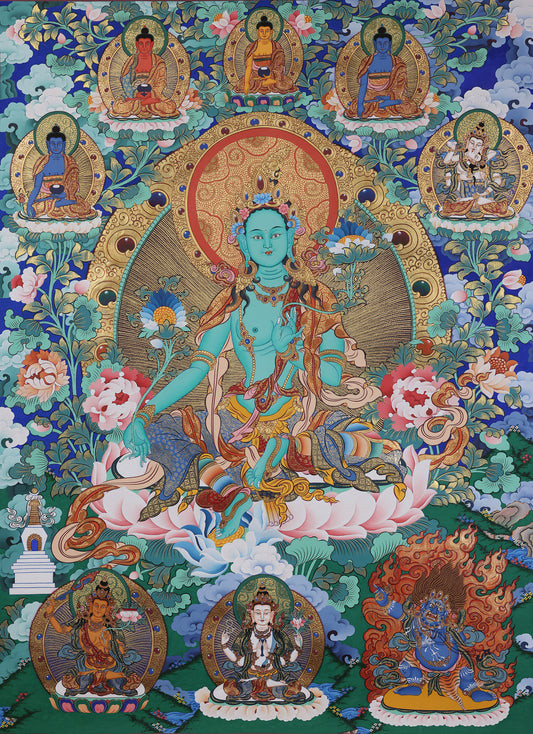
Hand-Painted Tibetan Buddhist Thangka: Guru Rinpoche Refuge Mandala – Faith and Artistic Mastery

$599.00 USD
Thangka Name: Padmasambhava
Size: 45*65
Orgin: Nepal
Eine Frage stellen

Beeil dich! Nur noch [Anzahl] auf Lager!

Geschätzte Lieferzeiten: 12–26 Tage (International), 3–6 Tage (USA).

Rückgabe innerhalb von 45 Tagen nach dem Kauf. Zölle und Steuern werden nicht erstattet.

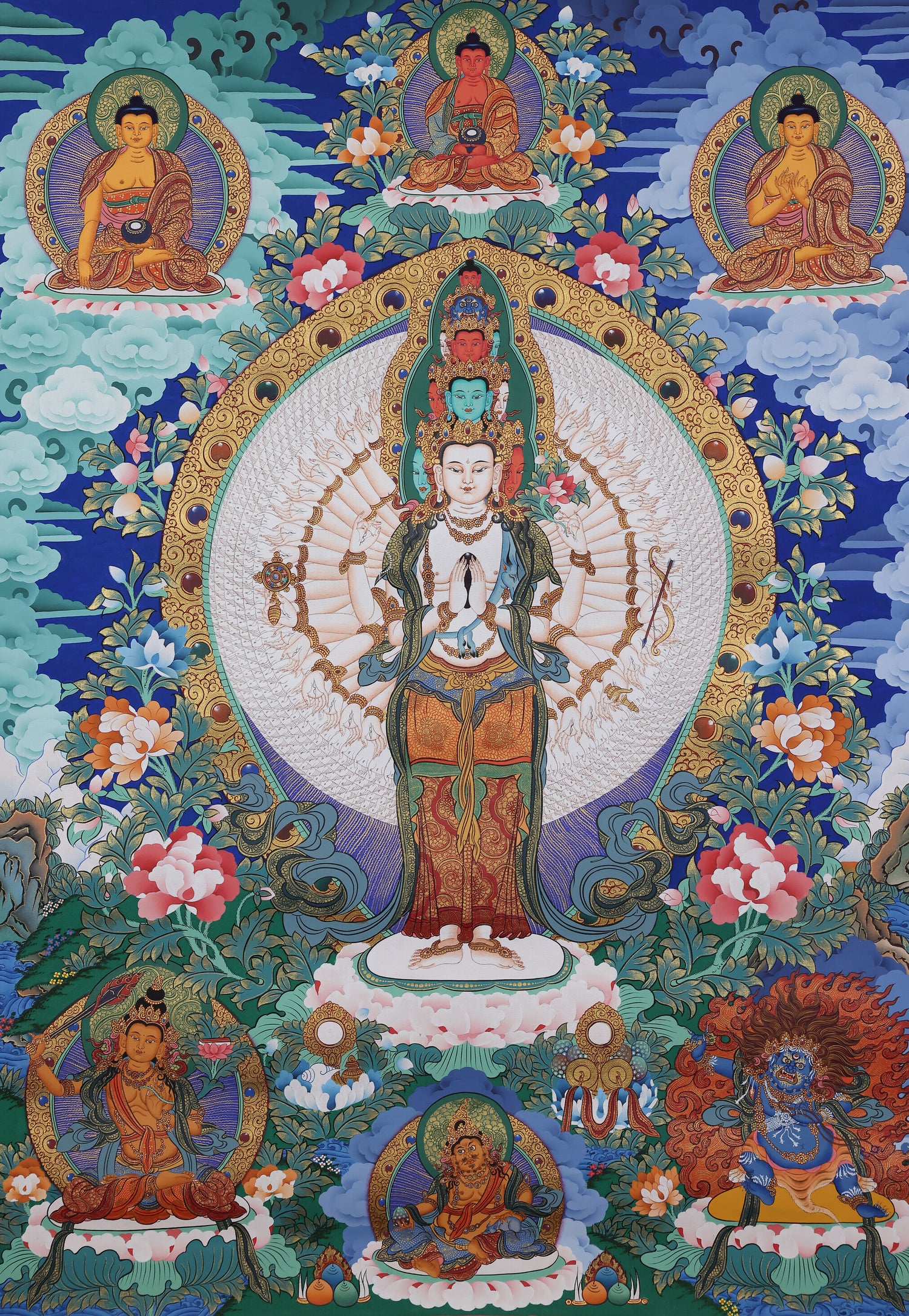
Hand-painted Tibetan thangka of Padmasambhava in the refuge mandala, illustrating spiritual connection and blessings."
Hand-Painted Tibetan Buddhist Thangka: Guru Rinpoche Refuge Mandala – Faith and Artistic Mastery
$599.00 USD

1. Core Theme: Nyingma “Main Refuge” as a Spiritual Convergence

This exquisite hand-painted Thangka features Guru Rinpoche (Padmasambhava) in the Refuge Mandala, one of the most iconic visual embodiments of faith in the Nyingma tradition (Red School) of Tibetan Buddhism. In the context of Tibetan Buddhism, a Refuge Mandala is not merely a portrait of a single deity but a condensed “field of merit” encompassing all the Buddhas of the three times, lineage masters, principal deities, dakas, dakinis, and protector deities. Through meditative visualization of this mandala, practitioners can seamlessly connect body, speech, and mind with the lineage system, receiving collective blessings and spiritual empowerment.

The depth of this theme lies in Guru Rinpoche’s role as a foundational figure. In the 8th century, he entered Tibet, subjugated indigenous Bön deities, and integrated exoteric and esoteric teachings, establishing Samye Monastery and ordaining the “Seven Mahasiddhas.” By blending Indian tantric teachings with indigenous Tibetan beliefs, he laid the foundation of Tibetan Buddhism. This Refuge Mandala visually expresses the threefold empowerment of body, speech, and mind conferred by Guru Rinpoche. Meditating on this mandala is equivalent to taking refuge simultaneously in the Three Jewels, the Guru, the principal deity, dakas, dakinis, and protector deities, forming a preparatory ritual for Dzogchen practice and embodying the wisdom of “encompassing all phenomena within one mandala.”


2. Principal Deity: Iconography and Symbolism of Guru Rinpoche

At the center of the Thangka is Guru Rinpoche, whose depiction strictly follows the Sutra of Measurements for Sacred Images and the Nyingma Guru Rinpoche iconographic guidelines. Every detail serves as a symbolic representation of tantric teachings:

  • Physical Appearance and Attire: Guru Rinpoche wears the Ushnisha Lotus Hat, with a lotus bud on top symbolizing enlightenment arising from the mundane world. He dons a cross-collared monk’s robe (representing Vinaya discipline) beneath a red-brown and sapphire blue brocade cloak—red representing wrathful activity to subdue obstacles, blue representing compassion and reception. His face, serene yet slightly furrowed, embodies the fusion of wisdom and compassion, illustrating the method of subduing obstacles with wrath and guiding beings with compassion.

  • Ritual Implements and Mudras: Left hand holds the Garbha Bowl filled with immortal nectar of wisdom, with Vajra patterns symbolizing liberation through emptiness and stability in bodhicitta; left elbow holds the Khatvanga Staff, the principal tantric implement featuring a cross-vajra, treasure vase, three heads (red, green, white), and triple flaming prongs, representing the five elements, complete nectar, and the union of the three bodies (Dharmakaya, Sambhogakaya, Nirmanakaya), as well as the power to destroy all obstacles; right hand forms the Varada Mudra, palm outward, symbolizing granting all sentient beings’ wishes. Together, the implements and mudra represent the union of compassion and wisdom.

  • Lotus Throne and Aura: Guru Rinpoche sits in Royal Dance Posture (semi-lotus) on a double lotus throne. The lower dark pink lotus represents pure mind untouched by defilements, while the upper white lotus symbolizes the purity of enlightenment. Below is a sun-moon cushion, with the sun illuminating ignorance and the moon cooling afflictions. Head and body halos, painted with gold leaf and mineral pigments, include inner red flames symbolizing wisdom burning away afflictions, outer rainbow clouds representing celestial realms, and gold borders highlighting sacredness.


3. Attendant Deities: Lineage and Protective Network

The surrounding deities form the “lineage chain” and protective net of the Nyingma Refuge Mandala:

  • Above: A miniature image of Amitabha Buddha (Infinite Light), representing Guru Rinpoche’s Dharmakaya source and illustrating the spiritual transmission from Dharmakaya to Nirmanakaya.

  • Sides: On the left, Jingming Master (Shikpu), representing exoteric lineage and showing Guru Rinpoche’s method of using exoteric teachings as foundation and esoteric teachings as practice; on the right, Yeshe Tsogyal, symbolizing the “Skillful Means” of tantric practice and the origin of the terma (hidden treasure) lineage, critical for the continuation of Nyingma teachings.

  • Below: Offerings and minor wrathful deities, such as Vajrakilaya, provide worldly and transcendent protection, ensuring uninterrupted practice and representing the functional guardians of the mandala.


4. Painting Techniques: Fusion of Newar and Men-Tang Styles

This Thangka exemplifies a high-level fusion of Newar (Nepalese) and Men-Tang (Tibetan) painting traditions, reflecting devotion and artistic mastery:

  • Canvas Preparation: A six-step process—washing, stretching, applying cowhide glue, coating with white clay, coarse polishing, and fine polishing. Each step requires drying between layers, with fine polishing repeated 3–5 times, resulting in a surface “as smooth as paper, with a leather-like resonance.” The process itself is a meditative accumulation of merit.

  • Pigments: Natural minerals including lapis lazuli, malachite, cinnabar, and gold leaf. Lapis lazuli and malachite are purified through triple washing and settling, cinnabar is wet-ground for days, and gold is ground into gold mud mixed with gum and saffron for painting deities and vestments. These pigments are considered spiritually potent, connecting the mundane with the divine.

  • Techniques: Iron-line (for bold outlines) and fine thread-line (for subtle details) are combined; dry and wet shading creates dimensionality in garments and skin, ensuring a vivid, solemn, and lifelike depiction.

  • Eye-Opening Ritual: Performed by the artist or a high lama, this final ceremony involves bathing, incense, and recitation, after which the deity’s eyes are marked in ink, transforming the Thangka from artwork into a living field of merit.


5. Cultural Value: A Living Codex of Faith and Art

This Thangka is not merely a painting but a visual codex of Nyingma lineage and practice:

  • From a Faith Perspective: Records the lineage, rituals, and teachings, allowing practitioners to meditate upon Guru Rinpoche and receive blessings.

  • From an Artistic Perspective: Balanced composition, mineral pigments, gold leaf, and line techniques exemplify the fusion of Newar and Men-Tang styles.

  • From a Cultural Perspective: Preserves centuries of iconographic tradition while conveying the core Nyingma teaching of “union of compassion and wisdom.”

Today, this Thangka is a testament to living cultural heritage, suitable for homes, temples, or cultural spaces, providing collectors, practitioners, and art lovers with a profound spiritual and aesthetic experience.


#TibetanBuddhistThangka #GuruRinpoche #Padmasambhava #HandPaintedThangka #RefugeMandala #NyingmaArt #NewarPainting #MenTangPainting #BuddhistArt #SpiritualEmpowerment #TibetanCulture #BuddhistCollectibles #MeditationTool #SacredArt #BuddhistMasterpiece
Entdecken Sie das perfekte tibetisch-buddhistische Thangka, das zu Ihren Wünschen, Ihrem Lebensstil und Ihrem Raum passt. Jedes Thangka hat eine spirituelle Bedeutung und bringt Segen, wenn es richtig platziert wird.

1. Definieren Sie Ihre Absicht

Reichtum & Erfolg → Gelber Dzambhala (Gottheit des Reichtums)

Mitgefühl und Frieden → Avalokiteshvara, Grüne Tara

Weisheit & Lernen → Manjushri

Gesundheit & Heilung → Medizinbuddha

Langlebigkeit und Familienschutz → Weiße Tara

2. Wählen Sie nach Identität

Unternehmer und Geschäftsinhaber → Reichtumsgottheiten für Wohlstand.

Studenten und Gelehrte → Weisheitsgottheiten für Konzentration und Klarheit.

Heiler und Yoga-Praktizierende → Medizinbuddha für Energie und Gleichgewicht.

Familien und Hausfrauen → Tara-Gottheiten für Harmonie und Sicherheit.

Sammler und Kunstliebhaber → Seltene Mandalas oder Meisterwerk-Thangkas.

3. Passen Sie Ihren Raum an

Heimschrein / Meditationsraum → Mittlere Thangkas (60–80 cm).

Büro / Geschäftshalle → Große Thangkas für Wohlstand und Autorität.

Wohnzimmer / Arbeitszimmer → Dekorative Thangkas für Frieden und Schönheit.

4. Authentische Handwerkskunst

Jedes Thangka ist mit natürlichen Mineralpigmenten und feiner Leinwand handbemalt und spiegelt tibetische Kunstfertigkeit und spirituelle Kraft wider. Überprüfte Quellen gewährleisten Qualität und Respekt für die Tradition.

✨ Wählen Sie Ihr Thangka mit Herz – es ist nicht nur Kunst, sondern ein Segen für Ihr Leben.

Jeder Mensch hat unterschiedliche Bedürfnisse. Die Wahl des richtigen Thangkas kann spirituelle Unterstützung, Schutz, Glück und Segen bieten. Nachfolgend finden Sie Thangka-Empfehlungen für verschiedene Rollen:

1. Unternehmer

  • Bedürfnisse : Weisheit, Reichtum, Gesundheit, beruflicher Erfolg.
  • Empfohlene Thangkas :
    Manjushri : Verbessert die Entscheidungsfindung und Geschäftsweisheit.
    Gottheit des Reichtums : Bringt Reichtum und Wohlstand.
    Medizinbuddha : Unterstützt die Gesundheit und reduziert Stress.
    Mahakala : Schützt Unternehmen vor Konkurrenz und Herausforderungen.

2. Erfolgreiche Einzelpersonen

  • Bedürfnisse : Innerer Frieden, Familienharmonie, Langlebigkeit.
  • Empfohlene Thangkas :
    Amitabha Buddha : Bringt inneren Frieden und Ruhe.
    Avalokiteshvara (Guanyin) : Fördert Harmonie und Glück in der Familie.
    Amitayus (Langlebens-Buddha) : Betet für gute Gesundheit und ein langes Leben.
    Manjushri : Stärkt weiterhin die Weisheit.

3. Hausfrauen/Ehemänner

  • Bedürfnisse : Familienharmonie, Schutz, Gesundheit.
  • Empfohlene Thangkas :
    Avalokiteshvara : Steigert das Familienglück und die Harmonie.
    Schutzgottheiten : Beschützen die Familie vor äußeren Störungen.
    Weiße Tara : Segnet die Familie mit Gesundheit.

4. Studierende und Wissenschaftler

  • Bedürfnisse : Weisheit, Konzentration, akademischer Erfolg.
  • Empfohlene Thangkas :
    Manjushri : Fördert Lernfähigkeit, Gedächtnis und Weisheit.
    Shakyamuni Buddha : Hilft bei der Konzentration und spirituellen Praxis.
    Jixiang Tianmu : Bringt akademisches Glück und Prüfungserfolg.

5. Künstler und Kreativprofis

  • Bedürfnisse : Inspiration, Kreativität, künstlerische Leistung.
  • Empfohlene Thangkas :
    Manjushri : Regt kreatives Denken und Inspiration an.
    Vajrapani : Hilft, kreative Blockaden zu überwinden.
    Maitreya : Sorgt für eine entspannte und optimistische Einstellung und baut Stress ab.

6. Reisende und Abenteurer

  • Bedürfnisse : Schutz, Glück, Erfolg bei Abenteuern.
  • Empfohlene Thangkas :
    Hayagriva : Bietet starken Schutz auf Reisen und beseitigt Hindernisse.
    Mahakala : Bringt Glück und Schutz, insbesondere für Abenteurer.
    Vajrasattva : Hilft, Schwierigkeiten und Herausforderungen während der Reise zu überwinden.

7. Ältere Menschen

  • Bedürfnisse : Gesundheit, Langlebigkeit, spiritueller Frieden.
  • Empfohlene Thangkas :
    Amitayus : Betet für ein langes Leben und gute Gesundheit.
    Medizinbuddha : Fördert Heilung und körperliches Wohlbefinden.
    Avalokiteshvara : Bringt Mitgefühl und inneren Frieden in späteren Jahren.

8. Führungskräfte

  • Bedürfnisse : Führung, Weisheit, Teamarbeit und geschäftlicher Erfolg.
  • Empfohlene Thangkas :
    Manjushri : Verbessert Führungsqualitäten und Entscheidungsfindung.
    Gottheit des Reichtums : Bringt dem Unternehmen und dem Team Erfolg und Wohlstand.
    Avalokiteshvara : Fördert Harmonie und Gleichgewicht innerhalb des Teams.

9. Gesundheits- und Fitnessbegeisterte

  • Bedürfnisse : Gute Gesundheit, Vitalität, Energie.
  • Empfohlene Thangkas :
    Medizinbuddha : Verbessert die körperliche Gesundheit und Vitalität.
    Weiße Tara : Bringt Gesundheit und Verjüngung.
    Vajrasattva : Beseitigt gesundheitliche Probleme und steigert die Energie.

10. Politiker

  • Bedürfnisse : Führung, Weisheit, Frieden.
  • Empfohlene Thangkas :
    Manjushri : Verbessert Führungsqualitäten und Entscheidungsfindung.
    Vairocana Buddha : Hilft, inneren Frieden und Weisheit zu bewahren.
    Avalokiteshvara : Fördert den gesellschaftlichen Frieden und die Harmonie in der Familie.

Für alle Bestellungen über 100 USD ist der Versand kostenlos.

Rücksendungen werden bis zu 10 Tage nach Erhalt des Kaufbelegs bzw. der Sendungsnummer (bei ungetragenen Artikeln) akzeptiert. Sie als Kunde sind verpflichtet, uns vor der Rücksendung des Artikels per E-Mail zu informieren.

Andernfalls fallen die Standardversandkosten an. Weitere Informationen finden Sie in unseren Lieferbedingungen .

Rücksendungen werden bis zu 10 Tage nach Erhalt des Kaufbelegs oder der Sendungsnummer (bei ungetragenen Artikeln) akzeptiert. Sie als Kunde sind verpflichtet, uns vor der Rücksendung des Artikels per E-Mail zu informieren, nur in folgenden Fällen:

– Den falschen Artikel erhalten.
– Artikel kam nicht wie erwartet an (z. B. beschädigte Verpackung).
– Artikel hatte Mängel.
– Über die Lieferzeit hinaus.
– Der Spediteur gestattet keine Besichtigung der Ware vor der Bezahlung.

Die zurückgesendeten Produkte müssen in der Originalverpackung, sicher verpackt, unbeschädigt und ungetragen sein. Dies bedeutet, dass die Artikel zum Schutz während des Transports sicher in einem Karton verpackt sein müssen, möglichst im selben Karton, in dem sie an Sie als Kunde versendet wurden.

Kürzlich angesehen

Nicht vergessen! Die Produkte, die Sie angesehen haben, legen Sie jetzt in den Warenkorb.

Passt gut zu

Erweitern Sie Ihre Auswahl mit perfekt abgestimmtem Zubehör und ergänzenden Produkten.

Leute kauften auch

Hier sind einige unserer ähnlichsten Produkte, die die Leute kaufen. Klicken Sie hier, um den Trendstil zu entdecken.