Tibetan Buddhist Four-Armed Avalokiteshvara Gold Thangka: In-Depth Analysis of Compassion, Deity System, and Gold Thangka Craftsmanship

$8,500.00 USD
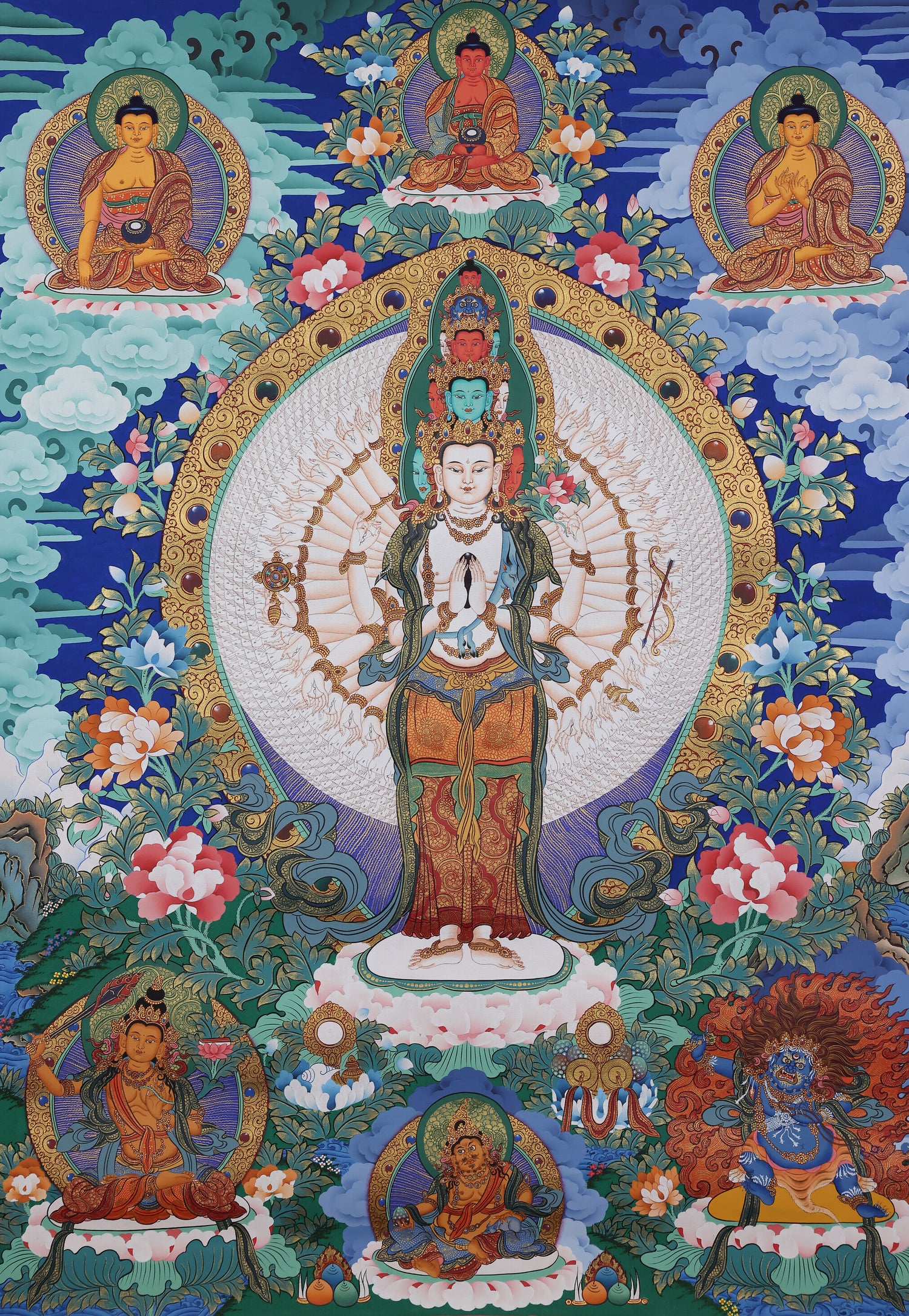
Thangka name: Golden Tang Dynasty Four-Armed Guanyin
Size: 70cm*100cm
Orgin: Tibet
Eine Frage stellen

Beeil dich! Nur noch [Anzahl] auf Lager!

Geschätzte Lieferzeiten: 12–26 Tage (International), 3–6 Tage (USA).

Rückgabe innerhalb von 45 Tagen nach dem Kauf. Zölle und Steuern werden nicht erstattet.

tibetan-buddhist-culture-golden-four-armed-avalokiteshvara-thangka-01.jpg
Tibetan Buddhist Four-Armed Avalokiteshvara Gold Thangka: In-Depth Analysis of Compassion, Deity System, and Gold Thangka Craftsmanship
$8,500.00 USD

1. Core Theme: The Four-Armed Avalokiteshvara as a Carrier of Universal Compassion

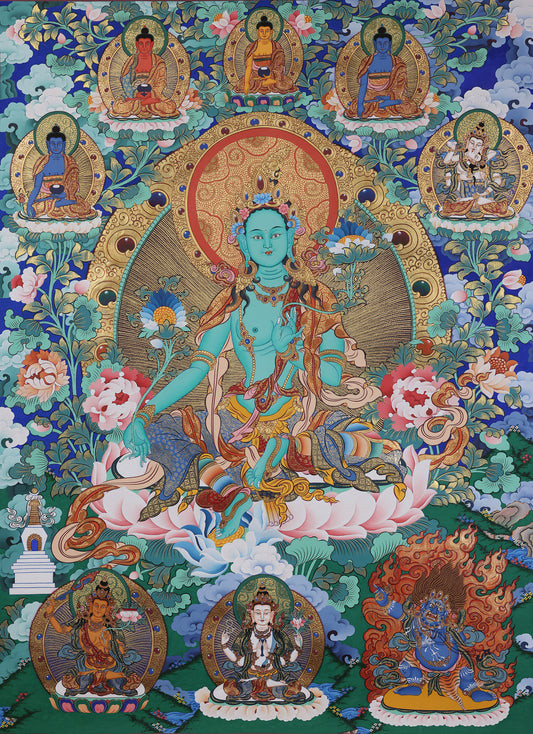
The central theme of this Thangka is the Four-Armed Avalokiteshvara (Tibetan: “Sharchupa”), a supreme symbol of compassion in Tibetan Buddhism and a key representation of Sino-Tibetan Buddhist cultural integration. Originally one of the “Six Avalokiteshvaras” in Indian Esoteric Buddhism, the Four-Armed Avalokiteshvara was later revered in Tibet by major schools such as the Gelug and Kagyu as a “root deity” and considered an incarnation of Avalokiteshvara. Its image embodies the fundamental teaching of “relieving the suffering of all sentient beings.”

This Thangka is executed in the Gold Thangka style (using gold leaf or gold powder as the base), enhancing its sacred significance. In Tibetan Buddhist symbolism, gold represents light, perfection, and indestructibility. Creating a Gold Thangka is itself a profound act of respect for Avalokiteshvara’s compassion, symbolizing the deity’s mercy shining like gold throughout the world, unhindered and all-encompassing.

The composition follows a “Deity–Attendants–Environment” three-tiered layout, visually demonstrating Avalokiteshvara’s boundless compassion and providing spiritual support for practitioners’ visualization and prayer.


2. The Central Deity: Iconography and Symbolic Meaning of the Four-Armed Avalokiteshvara

The central figure strictly adheres to the iconometric standards of the “Sutra on the Measurement of Images”, with each detail carrying specific religious symbolism.

Physical Attributes and Mudras:

  • The body is milky white, symbolizing pure compassion.

  • Four arms represent Avalokiteshvara’s compassion reaching all directions:

    • The first pair of arms are joined at the chest, holding a cintamani (wish-fulfilling jewel). The joined palms signify the union of wisdom and compassion, while the jewel represents the fulfillment of all sentient beings’ virtuous wishes.

    • The second pair of arms: the right hand holds a crystal mala, symbolizing continual mindfulness in saving beings; the left hand holds a blue lotus, often bearing a sutra scroll, symbolizing “pure compassion arising unstained from the world’s suffering.”

Attire and Ornamentation:

  • The deity wears the Five Buddha Crown, symbolizing the wisdom of the five Buddhas.

  • Draped in flowing celestial robes, adorned with necklaces, armlets, and jewels. These elaborate ornaments are not secular symbols of wealth; instead, they signify that Avalokiteshvara, in perfect form, draws beings toward the Dharma through delight in the deity’s appearance.

Posture and Lotus Base:

  • Seated in full lotus posture on a thousand-petal lotus throne, representing transcendence over worldly suffering.

  • The thousand petals symbolize Avalokiteshvara’s compassion extending to all sentient beings.


3. Attendant Deities: The Divine Network of Compassionate Support

The attendant deities are arranged in a radiating structure, forming a complete system from “Dharmic teachers” to “worldly protectors,” emphasizing Avalokiteshvara’s theme of compassionate rescue.

Upper Attendants:

  • In the small upper register, Shakyamuni Buddha sits centrally, in lotus posture, with the Bhumisparsha mudra, indicating that Avalokiteshvara’s compassion derives from the Buddha’s teachings.

  • Flanked by Manjushri Bodhisattva and Vajrapani Bodhisattva (or Green and White Tara), where:

    • Manjushri holds a lotus, symbolizing wisdom supporting compassion.

    • Vajrapani holds a vajra, representing protective power for compassionate action.
      Together, these three form a trinity of compassion, wisdom, and power, illustrating that Avalokiteshvara’s mercy is guided by wisdom and protected by strength.

Lower Attendants:

  • On the left, offering Bodhisattvas hold ritual offerings, representing devotees’ respect and prayers.

  • On the right, worldly protectors (such as Hayagriva or Mahakala) appear fierce yet reverent, symbolizing protection of Avalokiteshvara’s teachings and practitioners’ worldly safety.

Symbolic Details:

  • The cintamani offering plate at the bottom represents Avalokiteshvara’s ability to fulfill all virtuous wishes.

  • Surrounding clouds and floral motifs symbolize auspiciousness and purity, reinforcing the theme that compassion brings fulfillment.


4. Painting Technique: Gold Thangka as a Fusion of Material and Faith

This Thangka is a pure hand-painted Gold Thangka, one of the most intricate and revered forms of Tibetan Thangka art, demonstrating a profound connection between materials and spiritual belief.

Base Preparation and Gold Application:

  • The base consists of double-layered pure cotton cloth, meticulously hammered, bleached, and mounted to ensure a smooth, crack-resistant surface.

  • Gold layer is the centerpiece of Gold Thangka: 24K gold leaf or gold powder mixed with gelatin is applied across the painting.

  • Gold application requires a clean environment; polishing with agate stone produces a mirror-like sheen, symbolizing Avalokiteshvara’s illuminating mercy.

Detailing and Techniques:

  • Line Work: Painted with wolf-hair fine brushes, lines are hair-thin yet strong. Robe folds use “cloud-line” technique, symbolizing flowing compassion. Faces follow the “full moon visage” rules in iconometry, with an allowable deviation of ≤0.2 mm.

  • Coloring: Low-saturation mineral pigments (light blue, pale green, cinnabar red) accentuate garments and ornaments, highlighting the gold without overshadowing it.

  • Decorative Patterns: Clouds and vine motifs form continuous patterns, symbolizing endless compassion. The Eight Auspicious Symbols (Dharma wheel, treasure vase, etc.) are incorporated to reinforce completeness.

Stylistic Origin:

  • The Thangka aligns with the Central Tibet “Gold Thangka School”, known for gold base with muted colors, fine lines, and strict adherence to iconometric rules.

  • Traditionally, these are created by strictly disciplined, devout artists, each stroke accompanied by recitation of Avalokiteshvara’s mantra, ensuring both artistic excellence and spiritual blessing.


5. Conclusion: Dual Value of the Gold Four-Armed Avalokiteshvara Thangka

This Gold Four-Armed Avalokiteshvara Thangka serves both as a work of art and a carrier of faith.

  • Artistic Value: Exhibits the pinnacle of Tibetan Gold Thangka craftsmanship, with shimmering gold, fine lines, and restrained colors, creating a solemn yet compassionate visual experience.

  • Spiritual Value: Functions as a central medium for devotees to pray for Avalokiteshvara’s protection. Through devotion and visualization, worshippers resonate with the deity’s compassion, attaining inner peace and worldly blessing.

This “art as practice” feature distinguishes Tibetan Thangka from secular art: it is not merely for appreciation, but a bridge connecting sentient beings with boundless compassion, embodying the profound wisdom and spiritual power of Tibetan Buddhism.


#TibetanBuddhism #Avalokiteshvara #FourArmedAvalokiteshvara #GoldThangka #HandPaintedThangka #TibetanArt #SacredArt #BuddhistArt #SpiritualArt #MeditationArt #Compassion #TibetanCulture #ReligiousArt #BuddhistDeity #ArtAndFaith
Entdecken Sie das perfekte tibetisch-buddhistische Thangka, das zu Ihren Wünschen, Ihrem Lebensstil und Ihrem Raum passt. Jedes Thangka hat eine spirituelle Bedeutung und bringt Segen, wenn es richtig platziert wird.

1. Definieren Sie Ihre Absicht

Reichtum & Erfolg → Gelber Dzambhala (Gottheit des Reichtums)

Mitgefühl und Frieden → Avalokiteshvara, Grüne Tara

Weisheit & Lernen → Manjushri

Gesundheit & Heilung → Medizinbuddha

Langlebigkeit und Familienschutz → Weiße Tara

2. Wählen Sie nach Identität

Unternehmer und Geschäftsinhaber → Reichtumsgottheiten für Wohlstand.

Studenten und Gelehrte → Weisheitsgottheiten für Konzentration und Klarheit.

Heiler und Yoga-Praktizierende → Medizinbuddha für Energie und Gleichgewicht.

Familien und Hausfrauen → Tara-Gottheiten für Harmonie und Sicherheit.

Sammler und Kunstliebhaber → Seltene Mandalas oder Meisterwerk-Thangkas.

3. Passen Sie Ihren Raum an

Heimschrein / Meditationsraum → Mittlere Thangkas (60–80 cm).

Büro / Geschäftshalle → Große Thangkas für Wohlstand und Autorität.

Wohnzimmer / Arbeitszimmer → Dekorative Thangkas für Frieden und Schönheit.

4. Authentische Handwerkskunst

Jedes Thangka ist mit natürlichen Mineralpigmenten und feiner Leinwand handbemalt und spiegelt tibetische Kunstfertigkeit und spirituelle Kraft wider. Überprüfte Quellen gewährleisten Qualität und Respekt für die Tradition.

✨ Wählen Sie Ihr Thangka mit Herz – es ist nicht nur Kunst, sondern ein Segen für Ihr Leben.

Jeder Mensch hat unterschiedliche Bedürfnisse. Die Wahl des richtigen Thangkas kann spirituelle Unterstützung, Schutz, Glück und Segen bieten. Nachfolgend finden Sie Thangka-Empfehlungen für verschiedene Rollen:

1. Unternehmer

  • Bedürfnisse : Weisheit, Reichtum, Gesundheit, beruflicher Erfolg.
  • Empfohlene Thangkas :
    Manjushri : Verbessert die Entscheidungsfindung und Geschäftsweisheit.
    Gottheit des Reichtums : Bringt Reichtum und Wohlstand.
    Medizinbuddha : Unterstützt die Gesundheit und reduziert Stress.
    Mahakala : Schützt Unternehmen vor Konkurrenz und Herausforderungen.

2. Erfolgreiche Einzelpersonen

  • Bedürfnisse : Innerer Frieden, Familienharmonie, Langlebigkeit.
  • Empfohlene Thangkas :
    Amitabha Buddha : Bringt inneren Frieden und Ruhe.
    Avalokiteshvara (Guanyin) : Fördert Harmonie und Glück in der Familie.
    Amitayus (Langlebens-Buddha) : Betet für gute Gesundheit und ein langes Leben.
    Manjushri : Stärkt weiterhin die Weisheit.

3. Hausfrauen/Ehemänner

  • Bedürfnisse : Familienharmonie, Schutz, Gesundheit.
  • Empfohlene Thangkas :
    Avalokiteshvara : Steigert das Familienglück und die Harmonie.
    Schutzgottheiten : Beschützen die Familie vor äußeren Störungen.
    Weiße Tara : Segnet die Familie mit Gesundheit.

4. Studierende und Wissenschaftler

  • Bedürfnisse : Weisheit, Konzentration, akademischer Erfolg.
  • Empfohlene Thangkas :
    Manjushri : Fördert Lernfähigkeit, Gedächtnis und Weisheit.
    Shakyamuni Buddha : Hilft bei der Konzentration und spirituellen Praxis.
    Jixiang Tianmu : Bringt akademisches Glück und Prüfungserfolg.

5. Künstler und Kreativprofis

  • Bedürfnisse : Inspiration, Kreativität, künstlerische Leistung.
  • Empfohlene Thangkas :
    Manjushri : Regt kreatives Denken und Inspiration an.
    Vajrapani : Hilft, kreative Blockaden zu überwinden.
    Maitreya : Sorgt für eine entspannte und optimistische Einstellung und baut Stress ab.

6. Reisende und Abenteurer

  • Bedürfnisse : Schutz, Glück, Erfolg bei Abenteuern.
  • Empfohlene Thangkas :
    Hayagriva : Bietet starken Schutz auf Reisen und beseitigt Hindernisse.
    Mahakala : Bringt Glück und Schutz, insbesondere für Abenteurer.
    Vajrasattva : Hilft, Schwierigkeiten und Herausforderungen während der Reise zu überwinden.

7. Ältere Menschen

  • Bedürfnisse : Gesundheit, Langlebigkeit, spiritueller Frieden.
  • Empfohlene Thangkas :
    Amitayus : Betet für ein langes Leben und gute Gesundheit.
    Medizinbuddha : Fördert Heilung und körperliches Wohlbefinden.
    Avalokiteshvara : Bringt Mitgefühl und inneren Frieden in späteren Jahren.

8. Führungskräfte

  • Bedürfnisse : Führung, Weisheit, Teamarbeit und geschäftlicher Erfolg.
  • Empfohlene Thangkas :
    Manjushri : Verbessert Führungsqualitäten und Entscheidungsfindung.
    Gottheit des Reichtums : Bringt dem Unternehmen und dem Team Erfolg und Wohlstand.
    Avalokiteshvara : Fördert Harmonie und Gleichgewicht innerhalb des Teams.

9. Gesundheits- und Fitnessbegeisterte

  • Bedürfnisse : Gute Gesundheit, Vitalität, Energie.
  • Empfohlene Thangkas :
    Medizinbuddha : Verbessert die körperliche Gesundheit und Vitalität.
    Weiße Tara : Bringt Gesundheit und Verjüngung.
    Vajrasattva : Beseitigt gesundheitliche Probleme und steigert die Energie.

10. Politiker

  • Bedürfnisse : Führung, Weisheit, Frieden.
  • Empfohlene Thangkas :
    Manjushri : Verbessert Führungsqualitäten und Entscheidungsfindung.
    Vairocana Buddha : Hilft, inneren Frieden und Weisheit zu bewahren.
    Avalokiteshvara : Fördert den gesellschaftlichen Frieden und die Harmonie in der Familie.

Für alle Bestellungen über 100 USD ist der Versand kostenlos.

Rücksendungen werden bis zu 10 Tage nach Erhalt des Kaufbelegs bzw. der Sendungsnummer (bei ungetragenen Artikeln) akzeptiert. Sie als Kunde sind verpflichtet, uns vor der Rücksendung des Artikels per E-Mail zu informieren.

Andernfalls fallen die Standardversandkosten an. Weitere Informationen finden Sie in unseren Lieferbedingungen .

Rücksendungen werden bis zu 10 Tage nach Erhalt des Kaufbelegs oder der Sendungsnummer (bei ungetragenen Artikeln) akzeptiert. Sie als Kunde sind verpflichtet, uns vor der Rücksendung des Artikels per E-Mail zu informieren, nur in folgenden Fällen:

– Den falschen Artikel erhalten.
– Artikel kam nicht wie erwartet an (z. B. beschädigte Verpackung).
– Artikel hatte Mängel.
– Über die Lieferzeit hinaus.
– Der Spediteur gestattet keine Besichtigung der Ware vor der Bezahlung.

Die zurückgesendeten Produkte müssen in der Originalverpackung, sicher verpackt, unbeschädigt und ungetragen sein. Dies bedeutet, dass die Artikel zum Schutz während des Transports sicher in einem Karton verpackt sein müssen, möglichst im selben Karton, in dem sie an Sie als Kunde versendet wurden.

Kürzlich angesehen

Nicht vergessen! Die Produkte, die Sie angesehen haben, legen Sie jetzt in den Warenkorb.

Passt gut zu

Erweitern Sie Ihre Auswahl mit perfekt abgestimmtem Zubehör und ergänzenden Produkten.

Leute kauften auch

Hier sind einige unserer ähnlichsten Produkte, die die Leute kaufen. Klicken Sie hier, um den Trendstil zu entdecken.