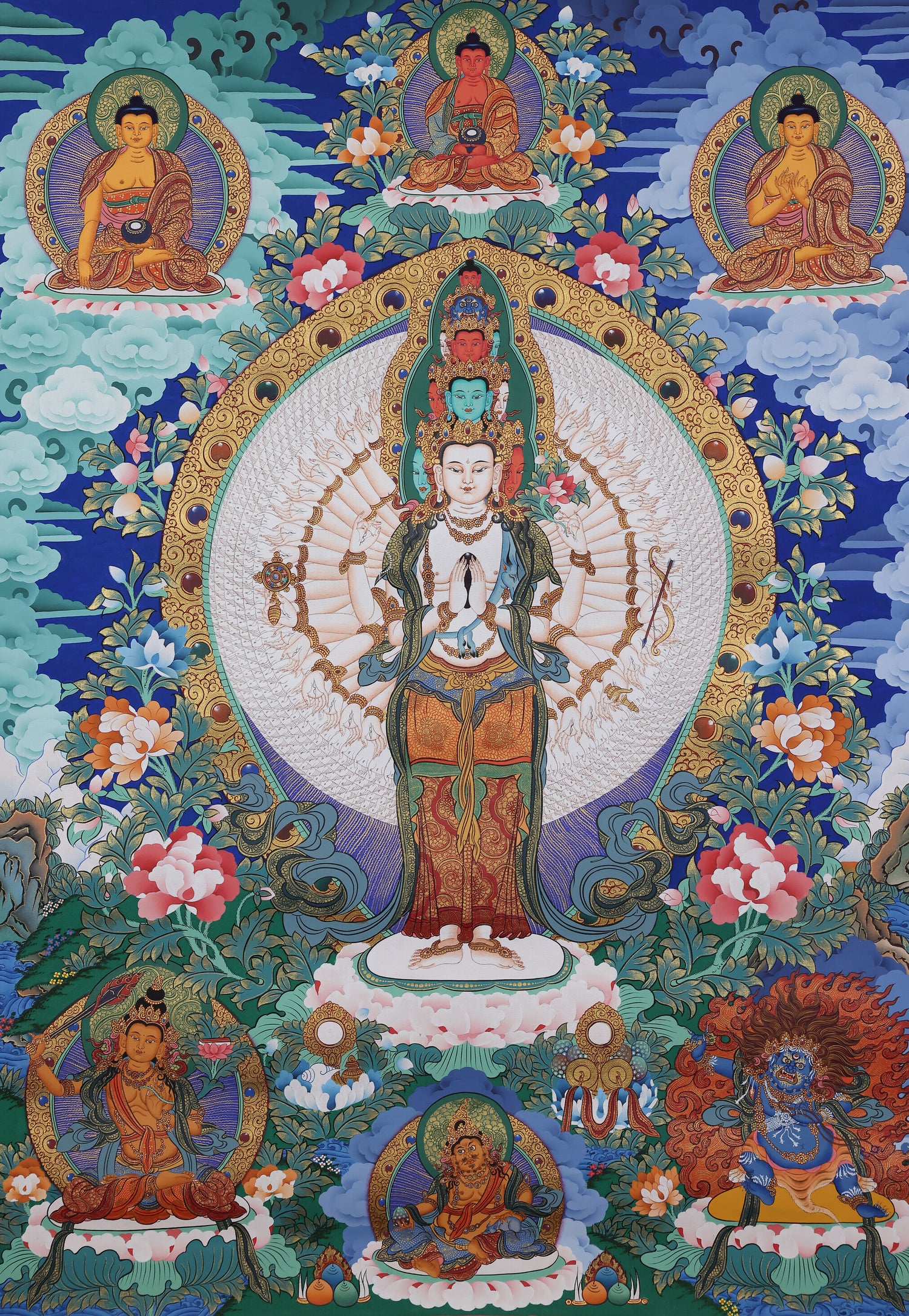
If you’ve ever been drawn to the mystical colors and solemn iconography of Tibetan Buddhist thangkas, this hand-painted Nepalese Black-Gold Five Directions Manjushri Thangka will captivate you. Measuring 50x70cm (a size ideal for home altars or portable visualization), it uses natural mineral/earth pigments and the signature "black background with gold inlay" technique to depict the "Five Directions Manjushri"—a core symbol of Tibetan Buddhist wisdom. It is a quintessential fusion of Himalayan art and Tibetan spiritual belief.
In Tibetan Buddhist cultural circles, the Five Directions Manjushri thangka is no ordinary decorative piece: it serves as a visualization tool for practicing the "Wisdom Dharma" and a devotional relic for ordinary believers seeking to overcome delusion and enhance critical thinking. Meanwhile, Nepalese "black-gold thangkas"—with their black background (symbolizing emptiness) and gold inlay (symbolizing sacred solemnity)—are a popular category of Tibetan thangkas that balance religious significance and artistic merit.
The Theme of the Five Directions Manjushri Thangka: A Spiritual Symbol of "Perfect Wisdom" in Tibetan Buddhism
In the Tibetan Buddhist system, the "Five Directions Manjushri" refers to five manifestations of Manjushri (the Bodhisattva of Wisdom), corresponding to the "Five Dharmakaya Wisdoms" of the Five Dhyani Buddhas. Its core doctrine is "Overcome the Five Poisons, Attain the Five Wisdoms"—the spiritual essence of this thangka.
The "Five Poisons" are the five fundamental afflictions that hinder sentient beings’ liberation in Tibetan Buddhism: greed, anger, delusion, pride, and doubt. The "Five Wisdoms" are the perfect wisdoms achieved after transcending these afflictions: Dharmadhatu Wisdom, Great Perfect Mirror Wisdom, Equality Wisdom, Discriminating Wisdom, and All-Accomplishing Wisdom. The iconography of the Five Directions Manjushri (varying in direction and color) is a visual expression of this doctrine:
- Central Manjushri corresponds to "delusion" and "Dharmadhatu Wisdom"
- Eastern Manjushri corresponds to "anger" and "Great Perfect Mirror Wisdom"
- Western Manjushri corresponds to "greed" and "Discriminating Wisdom"
- Southern Manjushri corresponds to "pride" and "Equality Wisdom"
- Northern Manjushri corresponds to "doubt" and "All-Accomplishing Wisdom"
For Tibetan Buddhist believers (especially those of the Gelug school), Manjushri is the "source of wisdom" (Guru Tsongkhapa is regarded as an incarnation of Manjushri). Thus, the Five Directions Manjushri thangka is not just an artwork, but a material carrier of "wisdom blessings."
Analysis of the Main Deity: Central Yellow Manjushri—The Pure Manifestation of Dharmadhatu Wisdom
The visual center of this thangka is the Central Yellow Manjushri (Child Manjushri)—the core of the Five Directions Manjushri, corresponding to the wisdom incarnation of the Central Vairocana Buddha (Great Sun Buddha), symbolizing "Dharmadhatu Wisdom" (the fundamental wisdom that transcends all distinctions).
Its iconography strictly follows the rules of the Tibetan Iconographic Measurement Sutra:
-
Body Color & Aura: The body is bright yellow (corresponding to the central dharma realm, overcoming "delusion"), with an inner bright green nimbus (symbolizing pure vitality) and an outer black background with gold inlay aura (aligning with the black-gold thangka’s base color to enhance sacredness);
-
Ornaments & Auspicious Features: Adorned with a "Five-Buddha Crown" (the five Buddhas on the crown symbolize the blessings of the Five Dhyani Buddhas), necklaces, and armlets—all patterns are outlined with 24K gold powder, intricate and detailed; the face is round and compassionate, with a clear white curl between the eyebrows (symbolizing transcendent wisdom);
-
Implements & Posture: Seated in the "Vajra Lotus Position" (a meditative posture of stability), resting on a multi-layered lotus throne (the bottom petals in red, green, and blue symbolize purity; the upper black cushion with gold patterns symbolizes solemnity); the right hand holds a "Wisdom Sword" (to cut through afflictions), while the left hand forms the "Dharma Wheel Mudra" and holds a lotus stem (the lotus supports the Prajnaparamita Sutra, representing the source of wisdom).
Attendant Deities: Directional & Wisdom Symbolism of the Four Directions Manjushri
The four corners of the thangka feature the "attendant deities" (the Four Directions Manjushri), each corresponding to a specific direction, affliction, and wisdom:
1. Top Left: Eastern Red Manjushri (Four-Armed Manjushri)
Corresponds to the Eastern Akshobhya Buddha, overcoming "anger" and manifesting "Great Perfect Mirror Wisdom":
- Body color is vermilion, with four arms: the right two hold a Wisdom Sword (to cut through anger) and a bow and arrow (to dispel detachment from Bodhicitta), while the left two hold a lotus supporting the Prajnaparamita Sutra and a bow (implements for the practice of loving-kindness).
2. Top Right: Western Blue Manjushri (Black Manjushri)
Corresponds to the Western Amitabha Buddha, overcoming "greed" and manifesting "Discriminating Wisdom":
- Body color is indigo (used in Tibetan iconography to represent black), with one face and two arms: the right hand holds a Wisdom Sword, and the left hand holds a lotus supporting the sutra; the deep hue implies "subduing greed."
3. Bottom Left: Southern White Manjushri
Corresponds to the Southern Ratnasambhava Buddha, overcoming "pride" and manifesting "Equality Wisdom":
- Body color is pure white (symbolizing non-discrimination), the right hand forms the "Wish-Granting Mudra" (to fulfill sentient beings’ good wishes), and the left hand holds a lotus supporting the sutra— the white lotus petals symbolize pure wisdom.
4. Bottom Right: Northern Lion-Riding Manjushri (Immaculate Manjushri)
Corresponds to the Northern Amoghasiddhi Buddha, overcoming "doubt" and manifesting "All-Accomplishing Wisdom":
- Body color is pale yellow, seated on a green lion (the lion symbolizes subduing afflictions and mastery of power)—it is the only one of the Five Directions Manjushri to appear with a mount, embodying the "action-oriented" nature of northern wisdom.
Techniques & Style of Nepalese Black-Gold Thangkas: Natural Mineral Pigments & Centuries of Heritage
This thangka is the work of a Nepalese Newari ethnicity artist, belonging to the "black-gold thangka" category—its techniques and style embody the heritage of Himalayan art:
1. Materials & Techniques
-
Black Background & Gold Inlay: The base is made of charcoal (or graphite powder) mixed with cow glue (symbolizing "emptiness"), then 24K gold powder (ground from gold leaf) is used with the "gold engraving technique" to outline contours and patterns— the gold glimmers against the black background, a signature feature of black-gold thangkas;
-
Natural Mineral Pigments: All colors are derived from natural materials: cinnabar (red), lapis lazuli (blue), malachite (green), chalk (white), and ochre (yellow). After manual grinding, they are mixed with cow glue for blending— the colors are rich and long-lasting, resisting fading for millennia;
-
Creation Process: Completed in traditional steps: sketching with charcoal (following Iconographic Measurement Sutra proportions) → layered dotting for color transitions → gold inlay outlining → "opening the eyes" (the artist observes precepts and chants sutras to imbue the icon with "spirituality")—the entire work takes over 3 months to finish.
2. Stylistic Features
-
Intricate Decoration: The background is filled with "auspicious clouds" (symbolizing transcendent realms), lotuses (symbolizing purity), and peonies (symbolizing prosperity)—the patterns are dense but not cluttered;
-
Soft Iconography: Compared to Tibetan local thangkas, the faces are rounder and softer, with more 舒展 limb proportions, carrying the legacy of the Indian "Gandhara style" (Nepal, as a hub of Himalayan art, blends Indian and Tibetan iconographic traditions);
-
Size & Function: The 50x70cm size is a common "altar/portable thangka" specification in Nepalese folk culture, suitable for home worship and portable visualization.
Cultural Value of the Nepalese Black-Gold Five Directions Manjushri Thangka: A Dual Carrier of Faith & Art
The value of this thangka lies in the "symbiosis of religious and artistic significance":
-
Spiritual Aspect: It is a material expression of Tibetan Buddhist "wisdom belief," conveying the doctrine of "overcoming afflictions to attain wisdom" and serving as a visualization relic for believers;
-
Artistic Aspect: It is a living sample of Nepalese traditional art—its use of natural mineral pigments, black-gold inlay techniques, and intricate soft style embody centuries of craftsmanship heritage of Newari artists.
For Tibetan cultural enthusiasts, it is a symbol of "wisdom blessings"; for art collectors, it is a tangible treasure of Himalayan aesthetics—this fusion is the core charm of thangkas.
#NepaleseBlackGoldFiveDirectionsManjushriThangka #TibetanBuddhismThangkaAnalysis #BlackGoldThangkaTechniques #FiveDirectionsManjushriSpiritualSymbolism #NepaleseTraditionalThangkaArt #NaturalMineralPigmentThangka #HandPaintedNepaleseThangka #HimalayanArtTreasures #TibetanBuddhistWisdomDeities #NaturalPigmentThangkaArt #NewariThangkaArtists #AltarThangkaForHomeWorship #GandharaStyleThangka #FiveWisdomBuddhasManjushri #BlackGoldThangkaCollection #ManjushriBodhisattvaThangka #SpiritualThangkaRelics