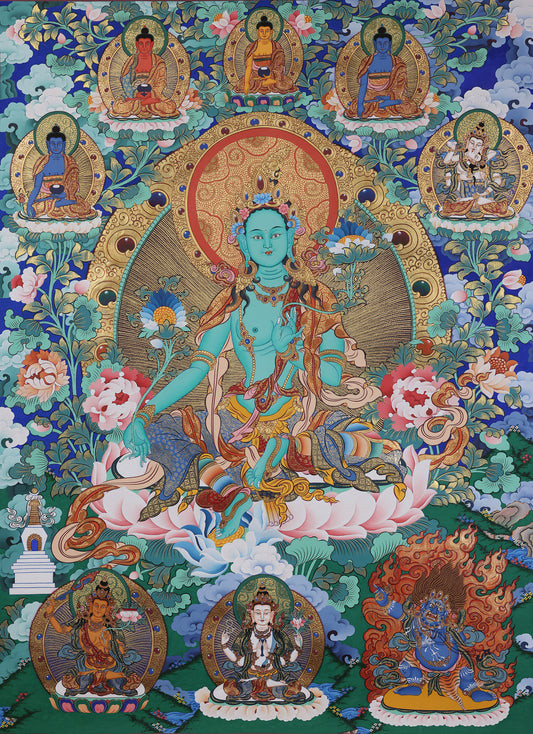
In the spiritual universe of Tibetan Buddhism, a thangka is never merely a "painting"—it is a "portable mandala" and a "visual language of doctrine." The 20×30cm hand-painted Nepalese colored thangka we explore today is precisely such a treasure: centered on the Four-Armed Avalokiteshvara, rendered with mineral and earth pigments, it is a crystallization of the Newari school’s thousand-year craft heritage.
The core theme of this thangka is the Four-Armed Avalokiteshvara, one of Tibetan Buddhism’s "Three Protectors of the Snowlands." In Tibetan context, Avalokiteshvara is not a single divine entity but the "ultimate manifestation of compassion": revered as "Chenrezig" (Protector of the Snowlands), he is venerated everywhere from herders’ tents to monastery halls.
At its essence, this theme embodies the Esoteric Great Compassion Dharma in visual form: through Avalokiteshvara’s form, mudras, and attributes, the doctrine of "saving sentient beings from samsara" is translated into tangible symbols. For practitioners, it serves as a mandala for "visualizing the 本尊"; for lay believers, it is a spiritual anchor for "praying for safety and alleviating suffering"—explaining why Four-Armed Avalokiteshvara thangkas are the most widely circulated art form in Tibetan Buddhism.
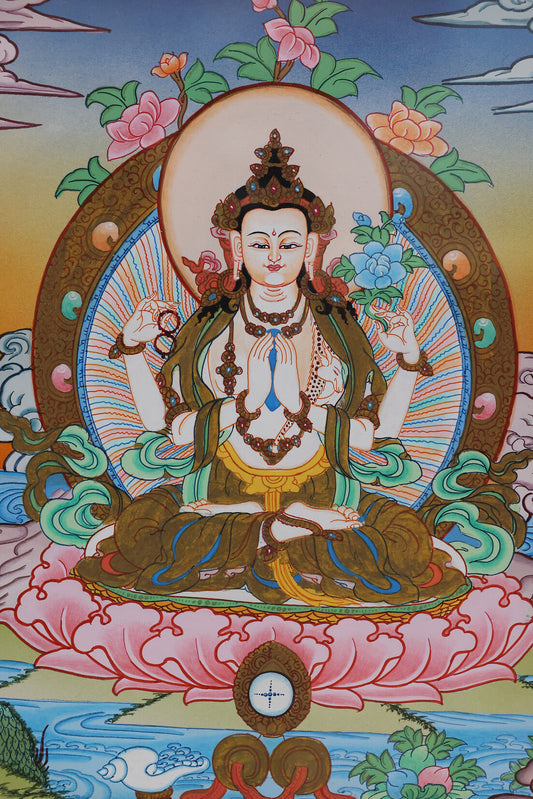
The central Four-Armed Avalokiteshvara strictly adheres to the Iconometric Canon, with every element carrying esoteric meaning:
-
Form and Adornments: His body is "white as the moon," symbolizing "innate purity"; he wears a Five-Buddha Crown (topped with Amitabha Buddha), representing "the wisdom of the Five Dhyani Buddhas integrated into the self"; the "Eight Jeweled Ornaments" (earrings, necklaces, chest chains, etc.) signify "worldly adornment as a reflection of transcendental perfection"; the deer skin draped over his left shoulder symbolizes "not abandoning sentient beings and freedom from samsara."
-
Four Arms and Attributes: His front two arms are clasped at the chest, holding a wish-fulfilling jewel (representing "the union of wisdom and skillful means, granting all good wishes"); his right rear arm holds a crystal rosary (each bead turned saves one sentient being); his left rear arm holds an eight-petaled lotus (symbolizing "purity untainted by defilement, freedom from afflictions").
-
Lotus Seat and Posture: Seated in full lotus on a pink lotus moon disc, the lotus represents "liberation from worldly defilement," while the moon disc symbolizes "cool compassion that subdues the heat of afflictions."
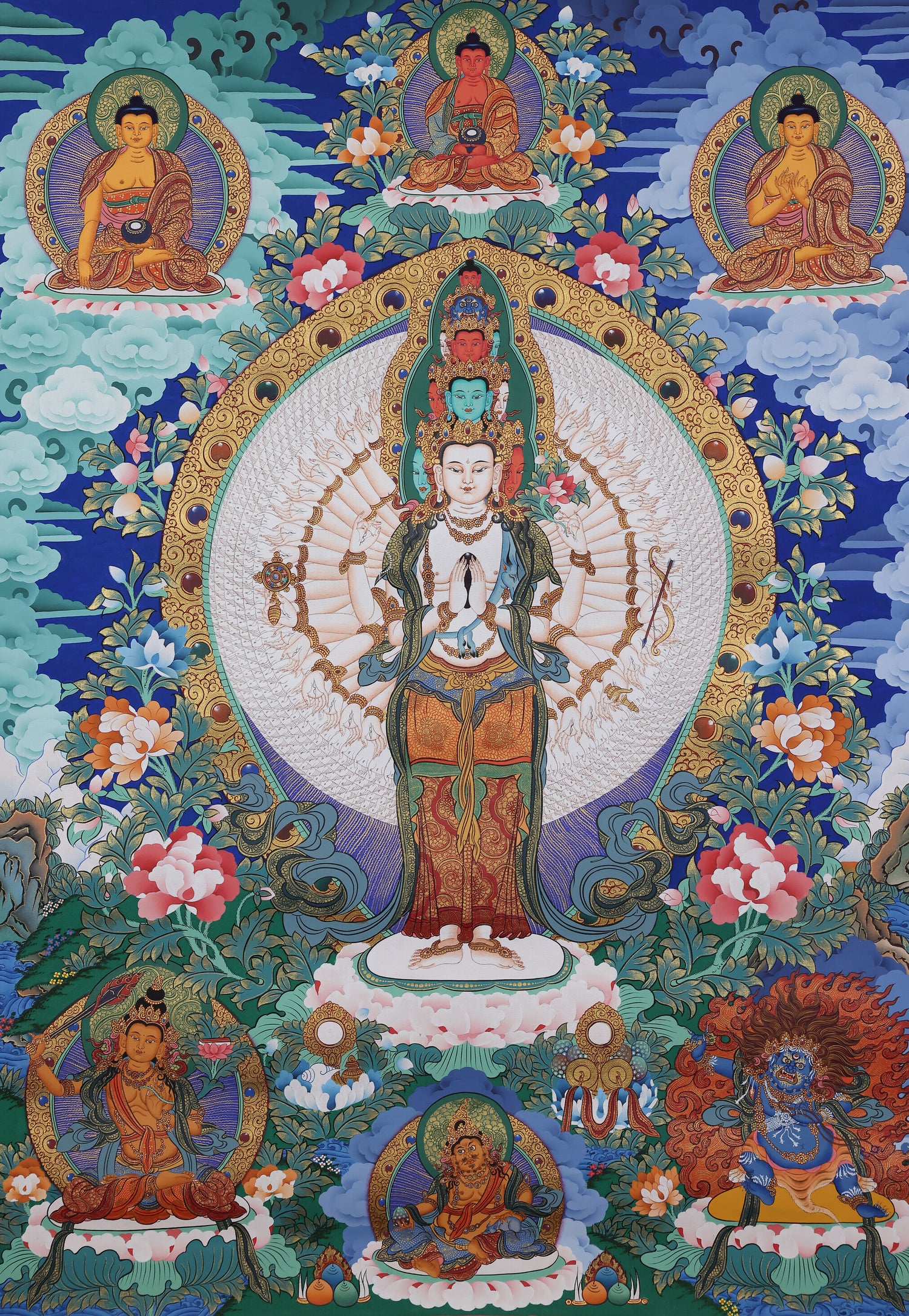
As a small 20×30cm thangka, it does not fully depict attendant deities, but symbols still allude to the esoteric mandala system of Tibetan Buddhism:
In Tibetan Buddhism, the Four-Armed Avalokiteshvara (great compassion), Manjushri (great wisdom), and Vajrapani (great power) are called the "Three Lineage Lords"—the complete protection of "compassion, wisdom, and power." The
pink lotus and blue flower in the thangka’s background are symbolic attributes of these two attendants: the lotus corresponds to Manjushri, and the jewel to Vajrapani, completing the mandala’s spiritual loop in simplified form.
This thangka is a classic example of Nepalese "hand-painted colored thangkas," with its craft and style bearing the Newari school’s heritage:
-
Craft Details: It uses a cotton-linen blend as the base, processed through traditional steps: "wolfsbane ash paste (for insect resistance) → polishing with smooth pebbles → stretching on a frame." Pigments are minerals and earth materials (cinnabar, lapis lazuli, malachite, etc.), prepared via "grinding → fine sieving → mixing with glue and alum" to achieve bright, long-lasting hues. Creation follows "ritual first": drafting adheres to the Iconometric Canon, and "opening the eyes" (painting the deity’s eyes) requires reciting mantras before brushing—endowing the thangka with "sacredness."
-
Artistic Style: It belongs to the Newari school’s "dense decorative style": the main deity occupies 70% of the frame, with the background filled with scrollwork, clouds, and flowers; the form prioritizes decoration over realism, with willow-leaf eyebrows and half-closed eyes marking the iconic Newari facial features; colors are vividly contrasted (white, red, blue dominate), accented with gold outlines—retaining the curvilinear beauty of Indian Pala art while integrating Tibetan solemnity.
For Tibetan Buddhism, a thangka is never "art" but a "carrier of faith"; for Nepalese Newari painters, it is a "millennial craft heritage." This 20×30cm Four-Armed Avalokiteshvara thangka, woven from faith and craft, is a microcosm of Tibetan Buddhist culture.
Would you like me to put together a reference list of ritual symbols in the Four-Armed Avalokiteshvara thangka for you?
#FourArmedAvalokiteshvaraThangka #NepaleseThangka #TibetanBuddhistArt #NewariSchool #MineralPigmentThangka