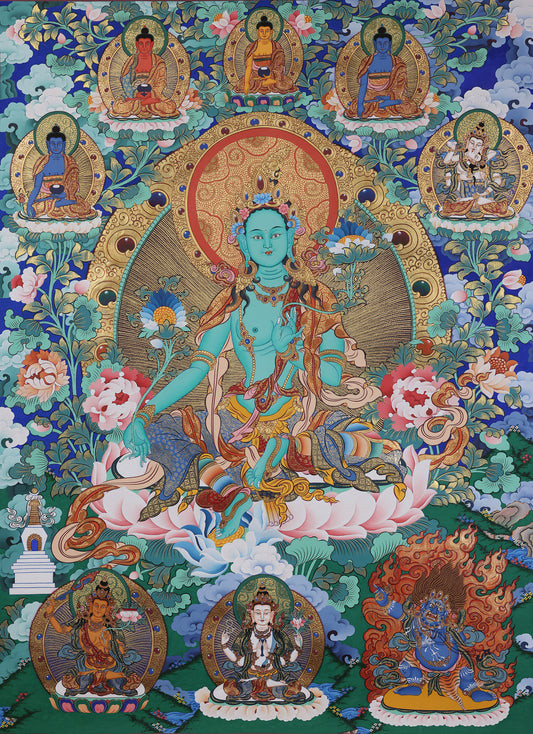
When a hand-painted Nepalese color thangka unfolds, the 45×60cm canvas is more than a mix of colors and lines—it is the coexistence of millennia of Tibetan Buddhist faith and Nepalese traditional craft. Today, we deeply dissect this Shakyamuni Buddha thangka: from its core theme to iconographic rules, from craft details to cultural context, to understand "visualized faith" in Tibetan Buddhist art.
I. Theme: The Narrative of "Enlightenment and Dharma Lineage" in Tibetan Buddhism
The core theme of this thangka is Shakyamuni Buddha’s "Victory Over Mara and Attainment of Enlightenment," but in the context of Tibetan Buddhism, it is more than the story of the Buddha’s individual awakening.
Tibetan Buddhism frames "enlightenment" as the starting point of "the Dharma abiding in the world": after defeating Mara, the Buddha turned the first Dharma wheel, opening a path for sentient beings to liberate themselves from suffering. The thangka’s compositional logic further embodies the faith in "Dharma lineage continuity"—the main deity occupies the core, surrounded by attendants, forming a sacred order of "Buddha-Disciples-Dharma Realm," echoing Tibetan believers’ spiritual reliance on "teacher-Dharma transmission."
II. The Main Deity: "Visualized Enlightenment" in The Iconometric Canon
The central Shakyamuni Buddha is a precise embodiment of Tibetan Buddhist iconographic rules:
-
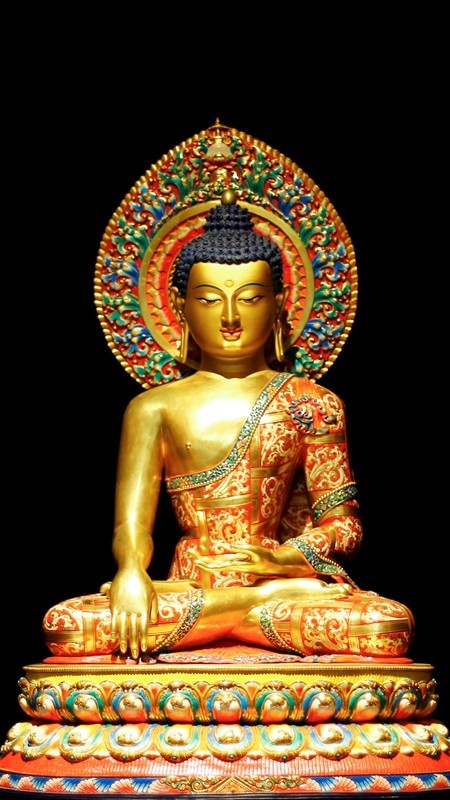
Physical Symbols: A raised cranial protuberance (symbolizing perfect wisdom), a cranial hair relic (representing transcendent awareness), long 耳垂 (signifying complete blessing and wisdom), and a "pure golden body"—a classic depiction from the Mahaparinirvana Sutra that describes the Buddha’s form as "like pure gold."
-
Mudra and Ritual Object: The right hand forms the Bhumisparsha Mudra (Earth-Touching Mudra), calling the earth to witness his victory over Mara; the left hand forms the Dhyana Mudra (Meditation Mudra) while holding a "Dharma Wheel Jewel"—the Dharma Wheel symbolizes the unceasing turning of the Dharma, and the jewel represents the perfection of Dharma nature. Together, they embody the Tibetan Buddhist doctrine of "guiding sentient beings through the Dharma."
-
Robes and Lotus Throne: The shoulder-baring monastic robe reflects the style of the Indian Sangha during the Buddha’s lifetime, adorned with Nepalese-style golden scrollwork patterns; the Buddha sits cross-legged on a thousand-petaled lotus throne—lotus flowers, which grow from mud yet remain unsoiled, correspond to the Tibetan Buddhist concept that "enlightenment transcends worldly afflictions."
III. Attendant Deities: Visual Expression of Tibetan Buddhism’s "Dharma Lineage System"
The attendants in the thangka symbolize both "Sangha transmission" and "Dharma Realm protection":
-
Attendant Disciples: Ananda and Mahakashyapa
The two standing figures at the bottom are the Buddha’s most core disciples:
- Mahakashyapa (right): Holding a khakkhara (monastic authority), dressed in a brown robe, with an aged face—he is the representative of dhuta (ascetic practice) and presided over the first Buddhist council after the Buddha’s nirvana, symbolizing "the practical foundation of Dharma transmission."
- Ananda (left): Holding a Dharma Wheel Jewel (vast knowledge of the Dharma), with a youthful face—renowned as the "foremost in hearing," he preserved most of the Buddha’s teachings through memory, representing "the textual continuity of the Dharma."
Their pairing aligns with Tibetan Buddhism’s dual foundation of "practice + scriptural study."
-
Upper Buddhas: Symbols of the Unified Dharma Realm
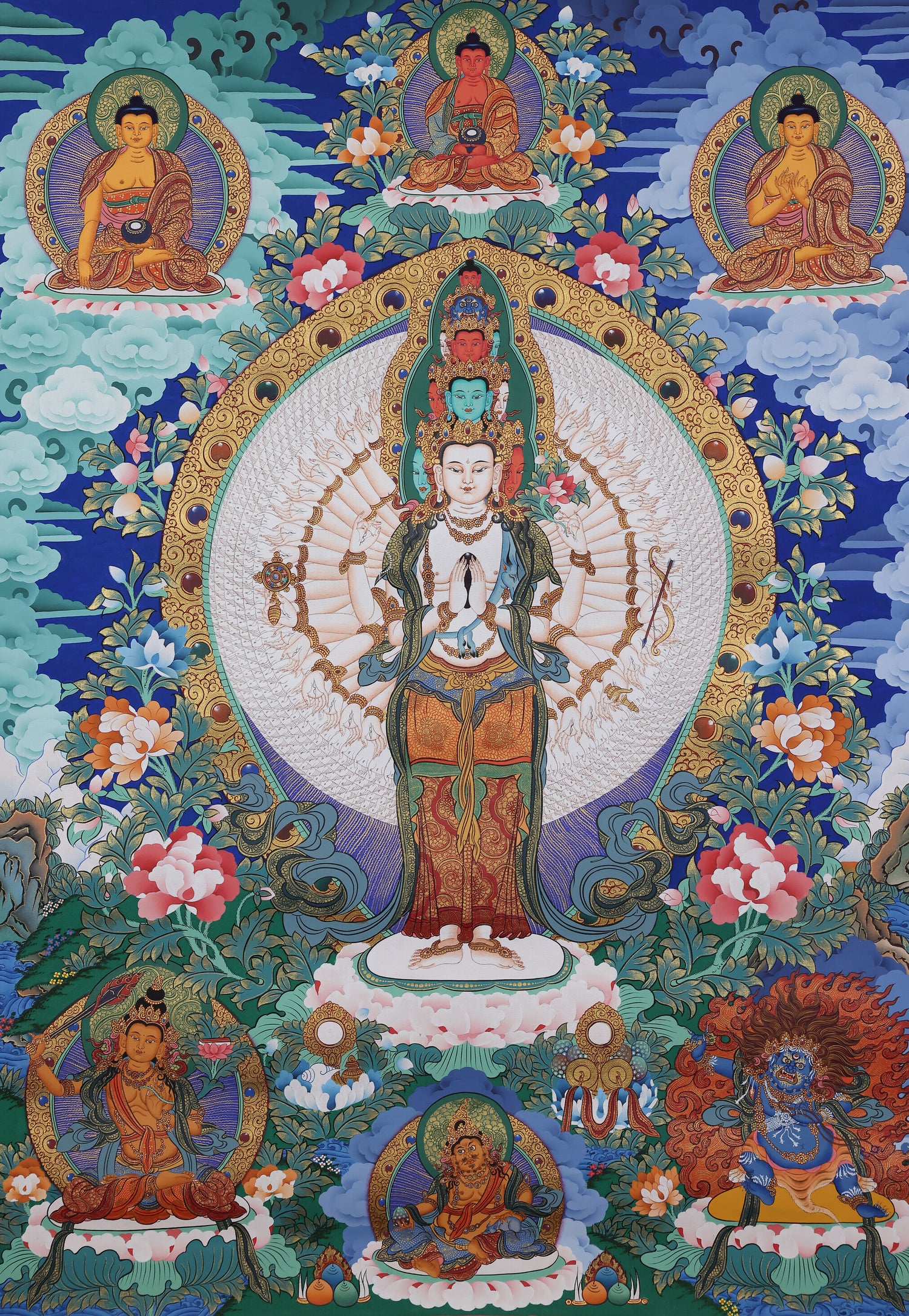
The red-bodied and blue-bodied Buddhas at the top correspond to Amitabha (red, compassion) and Akshobhya (blue, unshakable wisdom) in the Tibetan Buddhist "Five Dhyani Buddhas." This composition reinforces the idea of "all Buddhas as one in the Dharma Realm" and aligns with Tibetan practices of "worshipping Buddhas to accumulate merit and purify obstacles."
IV. Craft: "Painting the Buddha with Treasures" in the Nepalese Newari School
This thangka, hand-painted with mineral and earth pigments, is a living sample of Nepalese traditional craft:
-
Canvas Base: Made of coarse cotton cloth, coated with a mixture of cowhide glue and stone powder, then polished 5-6 times with pebbles—this creates a smooth, delicate surface while ensuring the thangka’s durability as a religious ritual object.
-
Natural Pigments: Gold is ground from 24K gold leaf, blue from Afghan lapis lazuli, red from cinnabar and coral powder, green from malachite, and white from kaolin (earth pigment). These materials are hand-ground and layered with glazes, ensuring rich, stable colors while echoing the Tibetan Buddhist concept that "painting the Buddha with treasures is the highest form of devotion."
-
Creation Process: Strictly follows the traditional steps: "sketching (proportioning per The Iconometric Canon)—outlining (vigorous, smooth ink lines with wolf hair brushes)—coloring (layered glazing, with 3-5 layers for the Buddha’s golden body)—gilding (gold lines decorating robes and halos)—opening the eyes (painting the eyes last, symbolizing the Buddha’s spiritual embodiment)." Each step unites faith and craft.
V. Style: Artistic Traits of the Nepalese Newari School
This thangka is a classic work of the Newari school, blending regional aesthetics with Tibetan Buddhist preferences:
-
Color Palette: Dominated by warm tones (red, gold, yellow)—reflecting Nepalese "warm colors as auspicious" and Tibetan "gold as a metaphor for Buddha-nature"—balanced by contrasting cool blues and greens in the background, creating a vivid yet harmonious effect.
-
Composition: Centralized and radiating, with the main deity occupying over 60% of the space (emphasizing "the Buddha as the Dharma King"), and attendants placed around it—unlike the "dense filling" of Tibetan thangkas, it retains the Newari school’s sense of openness.
-
Decorative Details: The golden scrollwork on the halo is a Newari tradition; the Tibetan-style cloud patterns, peonies (worldly prosperity), and lotuses (transcendent enlightenment) in the background fuse Nepalese, Han Chinese, and Tibetan cultures, embodying the Tibetan Buddhist idea of "uniting worldly joy and transcendent enlightenment."
VI. Cultural Value: A Microcosm of Sino-Nepalese Buddhist Art Exchange
This thangka is a living testament to Sino-Nepalese Buddhist cultural exchange: from Nepalese artisans accompanying Princess Bhrikuti to Tibet in the 7th century, to Anige (a Nepalese artist) leading the mural creation at Tibet’s Sakya Monastery in the 13th century, Nepalese art deeply influenced Tibetan Buddhist art; meanwhile, elements like the Bhumisparsha Mudra and Dharma Wheel Jewel reflect Tibetan Buddhism’s localization of the Newari school—this thangka is both a religious ritual object and a specimen of Sino-Nepalese cultural coexistence.
When we gaze at this thangka, we see more than colors and lines: we see the faith system of Tibetan Buddhism, the craft heritage of Nepal, and the cross-millennial fusion of civilizations.
#NepaleseThangka #ShakyamuniThangka #TibetanBuddhistArt #NewariSchool #HandPaintedThangka #MineralPigmentThangka #BuddhistIconography #SinoNepaleseCulturalExchange #ThangkaCraftsmanship #ThangkaAnalysis