Blog Post: A Deep Dive into a Nepalese Hand-Painted Manjushri (Samantabhadra) Thangka: The Avatamsaka Sacred Realm and Millennial Artistry of Tibetan Buddhism

$599.00 USD
Thangka name: Cai Tang Puxian Bodhisattva
size: 42cm×60cm
origin: Nepal
Eine Frage stellen

Beeil dich! Nur noch [Anzahl] auf Lager!

Geschätzte Lieferzeiten: 12–26 Tage (International), 3–6 Tage (USA).

Rückgabe innerhalb von 45 Tagen nach dem Kauf. Zölle und Steuern werden nicht erstattet.

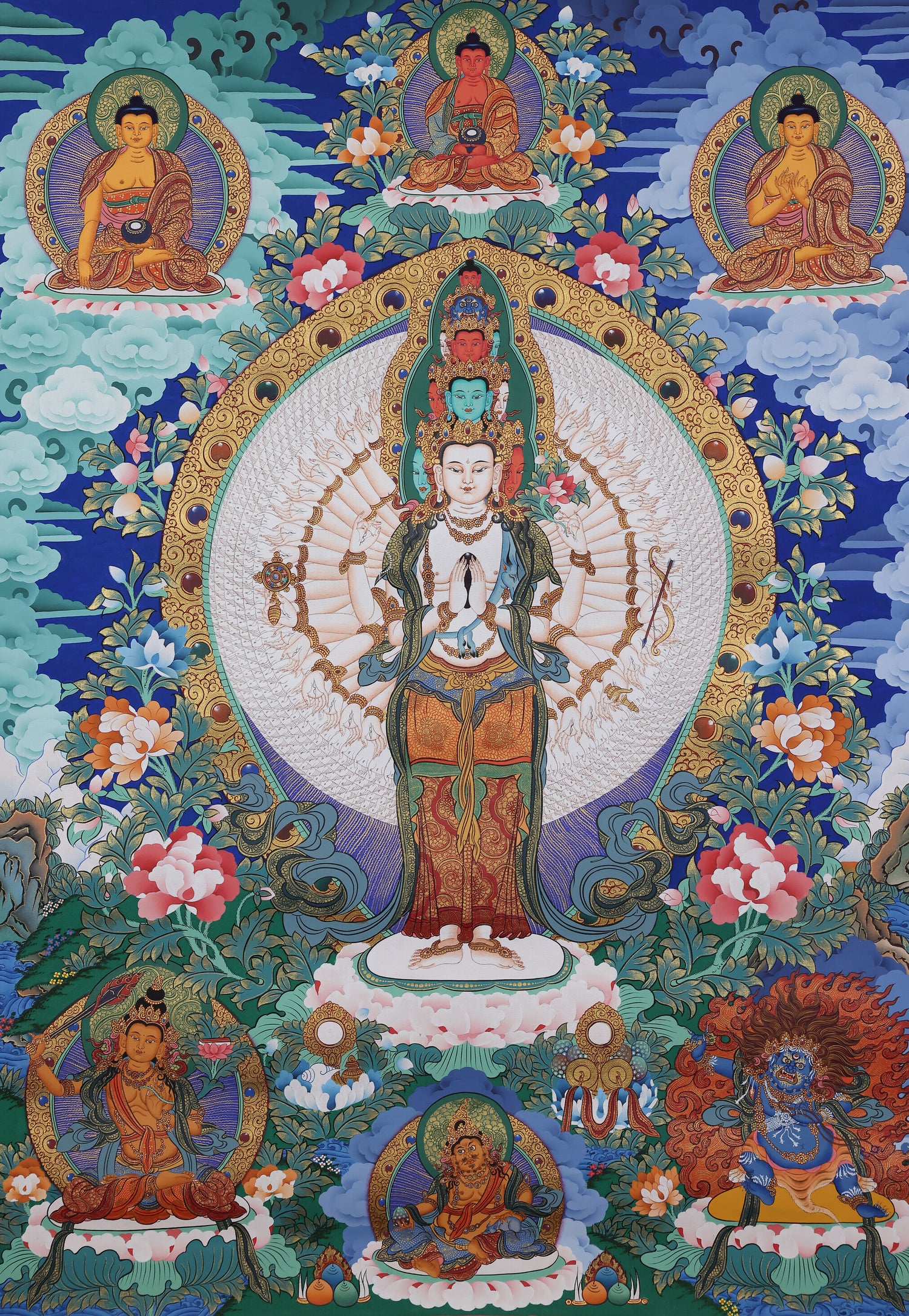
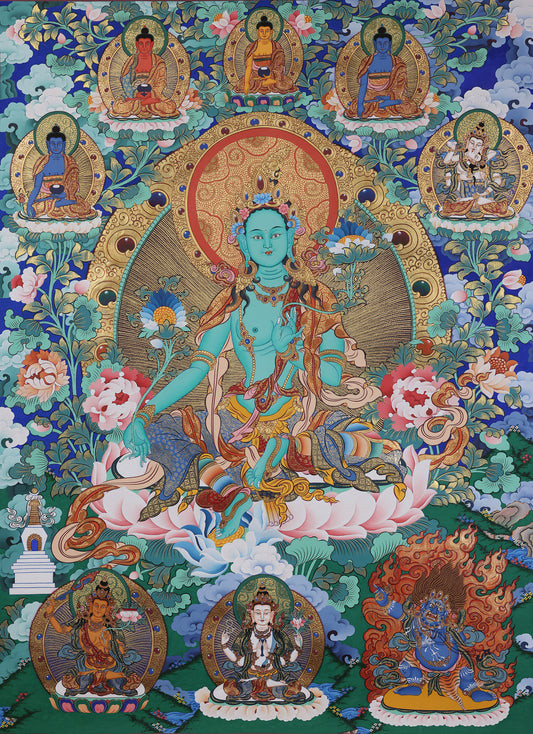
Color thangka painting of Samantabhadra Bodhisattva in Tibetan Buddhist culture, symbolizing wisdom and enlightened practice
Blog Post: A Deep Dive into a Nepalese Hand-Painted Manjushri (Samantabhadra) Thangka: The Avatamsaka Sacred Realm and Millennial Artistry of Tibetan Buddhism
$599.00 USD
When a Samantabhadra thangka painted with mineral pigments unfurls, the deep blues of azurite, emerald greens of malachite, and crimson reds of cinnabar are more than just color—they are the symbiosis of Tibetan Buddhist doctrine and Nepalese millennial craftsmanship. This 42×60cm hand-painted thangka, crafted by a Nepalese Newari school artisan, centers on the "Avatamsaka Trinity," weaving religious ritual, natural gifts, and artistic precision into a single cloth.

I. Theme: The "Virtue of Principle and Practice" in the Avatamsaka Sacred Realm

In Tibetan Buddhist context, Samantabhadra embodies the "perfection of practice"—in the Avatamsaka Sutra, he and Manjushri (perfection of wisdom) attend Vairocana Buddha, forming the core of the "Avatamsaka Trinity." This thangka’s choice of Samantabhadra as the main deity is a visual expression of the "unimpeded vows" spiritual philosophy: for Tibetan devotees, Samantabhadra’s form is an anchor for "manifesting principle through practice"; for Nepalese artisans, this theme is a classic vessel for Sino-Nepalese Buddhist cultural exchange.

Every detail aligns with doctrine: the main deity’s six-tusked white elephant mount corresponds to the "Six Perfections" (generosity, discipline, patience, diligence, meditation, wisdom); the ruyi scepter (or vase) he holds symbolizes "vows fulfilled"; even the pink peonies (not native to Tibet, but a Gandhara-influenced motif in Newari art) metaphorize "majestic merit."

II. Deity System: Balancing Ritual and Vitality

(1) The Main Deity: Samantabhadra’s Nepalese Ritual Iconography

The central Samantabhadra blends Tibetan Iconometric Canon and Newari style:

  • Form: A soft, rounded face (Newari "infant-like" feature) with high brow bones and curved eyes; milky white skin symbolizes purity. His celestial robes, layered with mineral pigments in blue and red, are edged with 24K gold leaf for pearls and coral ornaments—honoring the "adorned bodhisattva" ritual while showcasing the Newari school’s opulent "color-rich adornment."
  • Symbols: His right hand forms the gesture of granting wishes; his left holds a vase. The six-tusked white elephant mount rests in a reclining pose—its curled trunk is a Newari symbol of "auspicious tameness," and the emerald pendant on its body reflects the Newari artisan’s unique take on "jeweled majesty."
  • Aura and Lotus Seat: A reddish-orange flame nimbus (wisdom light) surrounds his head; a boat-shaped aura of blue and gold (a classic Tibetan form) frames his body. The multi-layered pink lotus seat, set against green grass and flowing water patterns, merges the doctrine of "lotus-born purity" with the Newari compositional logic of "nature enclosing the main deity."

(2) Attendant Deities: The Avatamsaka Realm’s Configuration Logic

The attendant deities at the thangka’s corners form a complete sacred system:

  • Two Buddhas Above: The red-bodied Shakyamuni (Saha World ruler) at the top left, and the blue-bodied Akshobhya (Eastern Pure Land ruler) at the top right—simplified with Newari "small form, round aura" to complement the main deity without overshadowing it.
  • Two Attendants Below: Manjushri (sword in hand) at the bottom left, and Avalokiteshvara (lotus in hand) at the bottom right—extensions of the Avatamsaka Trinity and core figures of the "Four Great Bodhisattvas," their "willow-like gentle postures" embody Newari art’s vitality.
  • Border Ornaments: Blue cloud patterns and pink peony motifs, influenced by Indian art in Newari painting, symbolize "auspicious majesty."

III. Craftsmanship: Millennial Heritage in Mineral Pigments

This thangka uses pure mineral and earth pigments, adhering to Nepal’s highest standards of manual craftsmanship:

(1) Pigments: Gifts of the Earth and Sacred Blessing

  • Core Mineral Colors: Azurite (blue) and malachite (green) are sourced from northern Nepalese mountains, processed through four steps (crush, soak, grind, settle) to layer hues (first blue, second blue), ensuring rich, fade-resistant color. Cinnabar (red) and realgar (yellow) come from Himalayan veins; white clay is local kaolin—mixed with 牛皮胶 (cowhide glue) in "weather-dependent ratios" (1:3 at 50% humidity) to balance adhesion and transparency.
  • Special Materials: 24K gold leaf is ground into powder, applied via "glue, sprinkle, polish with agate knife" to create a mirror-like luster. Coral and pearl powder detail small features (e.g., the elephant’s eyes), aligning with the religious belief that "jewels in art equal blessing."

(2) Creation Process: 40 Days of Newari Precision

As a first-grade Nepalese thangka, its creation takes 40–70 days:

  1. Cloth Preparation: Thick cotton cloth is coated 5–6 times with cowhide glue and white clay, then polished smooth with pebbles (a key Newari step: "canvas quality defines detail precision").
  2. Sketching and Outlining: After charcoal positioning, wolf hair brushes dip ink to outline with "nail-head rat-tail" and "orchid leaf" strokes—slender and fluid.
  3. Coloring and Gradation: "Background first, main deity last," using "dot-dyeing" to layer 3–5 coats (e.g., Samantabhadra’s skin tone transition) for three-dimensional gradation.
  4. Gold Outlining and Consecration: Gold powder outlines details; after monk-led chanting blessings, the seed syllables "Om Ah Hum" (symbolizing Buddha’s body, speech, mind) are written on the back—transforming the artwork into a ritual object.

IV. Style: The Fusion of Newari and Tibetan Aesthetics

This thangka is a quintessential fusion of Newari and Tibetan thangka styles:

  • Composition: The main deity occupies 60% of the space, with attendants at the corners—upholding the Tibetan "main deity supremacy" religious logic while using Newari "balanced density" aesthetics to avoid clutter.
  • Color: High-contrast "blue-red-yellow" hues, with the natural luster of minerals (e.g., azurite’s gem-like blue) enhancing sacredness—aligning with Tibetan tradition of "colors as doctrinal metaphors."
  • Form: Strictly following the Iconometric Canon proportions, yet softened by Newari "curved forms" to balance divinity and humanity, moving beyond the rigidity of Tibetan thangkas.

Conclusion: A Mobile Temple, a Cross-Cultural Treasure

This Nepalese Samantabhadra thangka is both a visual carrier of Tibetan Buddhism’s Avatamsaka doctrine and a living heritage of Newari craftsmanship. The eternal colors of mineral pigments connect the Himalayan earth to devotees’ spiritual worlds; the fused iconography witnesses millennia of Sino-Nepalese Buddhist art exchange. It is both a "mobile temple" and a cross-cultural artistic treasure.
# Nepalese Thangka #Samantabhadra Thangka #Tibetan Buddhist Art #Newari Painting School #Mineral Pigment Thangka #Avatamsaka Trinity #Hand-Painted Thangka #Buddhist Iconography Art #Thangka Craft Analysis #Religious Art Collection
Entdecken Sie das perfekte tibetisch-buddhistische Thangka, das zu Ihren Wünschen, Ihrem Lebensstil und Ihrem Raum passt. Jedes Thangka hat eine spirituelle Bedeutung und bringt Segen, wenn es richtig platziert wird.

1. Definieren Sie Ihre Absicht

Reichtum & Erfolg → Gelber Dzambhala (Gottheit des Reichtums)

Mitgefühl und Frieden → Avalokiteshvara, Grüne Tara

Weisheit & Lernen → Manjushri

Gesundheit & Heilung → Medizinbuddha

Langlebigkeit und Familienschutz → Weiße Tara

2. Wählen Sie nach Identität

Unternehmer und Geschäftsinhaber → Reichtumsgottheiten für Wohlstand.

Studenten und Gelehrte → Weisheitsgottheiten für Konzentration und Klarheit.

Heiler und Yoga-Praktizierende → Medizinbuddha für Energie und Gleichgewicht.

Familien und Hausfrauen → Tara-Gottheiten für Harmonie und Sicherheit.

Sammler und Kunstliebhaber → Seltene Mandalas oder Meisterwerk-Thangkas.

3. Passen Sie Ihren Raum an

Heimschrein / Meditationsraum → Mittlere Thangkas (60–80 cm).

Büro / Geschäftshalle → Große Thangkas für Wohlstand und Autorität.

Wohnzimmer / Arbeitszimmer → Dekorative Thangkas für Frieden und Schönheit.

4. Authentische Handwerkskunst

Jedes Thangka ist mit natürlichen Mineralpigmenten und feiner Leinwand handbemalt und spiegelt tibetische Kunstfertigkeit und spirituelle Kraft wider. Überprüfte Quellen gewährleisten Qualität und Respekt für die Tradition.

✨ Wählen Sie Ihr Thangka mit Herz – es ist nicht nur Kunst, sondern ein Segen für Ihr Leben.

Jeder Mensch hat unterschiedliche Bedürfnisse. Die Wahl des richtigen Thangkas kann spirituelle Unterstützung, Schutz, Glück und Segen bieten. Nachfolgend finden Sie Thangka-Empfehlungen für verschiedene Rollen:

1. Unternehmer

  • Bedürfnisse : Weisheit, Reichtum, Gesundheit, beruflicher Erfolg.
  • Empfohlene Thangkas :
    Manjushri : Verbessert die Entscheidungsfindung und Geschäftsweisheit.
    Gottheit des Reichtums : Bringt Reichtum und Wohlstand.
    Medizinbuddha : Unterstützt die Gesundheit und reduziert Stress.
    Mahakala : Schützt Unternehmen vor Konkurrenz und Herausforderungen.

2. Erfolgreiche Einzelpersonen

  • Bedürfnisse : Innerer Frieden, Familienharmonie, Langlebigkeit.
  • Empfohlene Thangkas :
    Amitabha Buddha : Bringt inneren Frieden und Ruhe.
    Avalokiteshvara (Guanyin) : Fördert Harmonie und Glück in der Familie.
    Amitayus (Langlebens-Buddha) : Betet für gute Gesundheit und ein langes Leben.
    Manjushri : Stärkt weiterhin die Weisheit.

3. Hausfrauen/Ehemänner

  • Bedürfnisse : Familienharmonie, Schutz, Gesundheit.
  • Empfohlene Thangkas :
    Avalokiteshvara : Steigert das Familienglück und die Harmonie.
    Schutzgottheiten : Beschützen die Familie vor äußeren Störungen.
    Weiße Tara : Segnet die Familie mit Gesundheit.

4. Studierende und Wissenschaftler

  • Bedürfnisse : Weisheit, Konzentration, akademischer Erfolg.
  • Empfohlene Thangkas :
    Manjushri : Fördert Lernfähigkeit, Gedächtnis und Weisheit.
    Shakyamuni Buddha : Hilft bei der Konzentration und spirituellen Praxis.
    Jixiang Tianmu : Bringt akademisches Glück und Prüfungserfolg.

5. Künstler und Kreativprofis

  • Bedürfnisse : Inspiration, Kreativität, künstlerische Leistung.
  • Empfohlene Thangkas :
    Manjushri : Regt kreatives Denken und Inspiration an.
    Vajrapani : Hilft, kreative Blockaden zu überwinden.
    Maitreya : Sorgt für eine entspannte und optimistische Einstellung und baut Stress ab.

6. Reisende und Abenteurer

  • Bedürfnisse : Schutz, Glück, Erfolg bei Abenteuern.
  • Empfohlene Thangkas :
    Hayagriva : Bietet starken Schutz auf Reisen und beseitigt Hindernisse.
    Mahakala : Bringt Glück und Schutz, insbesondere für Abenteurer.
    Vajrasattva : Hilft, Schwierigkeiten und Herausforderungen während der Reise zu überwinden.

7. Ältere Menschen

  • Bedürfnisse : Gesundheit, Langlebigkeit, spiritueller Frieden.
  • Empfohlene Thangkas :
    Amitayus : Betet für ein langes Leben und gute Gesundheit.
    Medizinbuddha : Fördert Heilung und körperliches Wohlbefinden.
    Avalokiteshvara : Bringt Mitgefühl und inneren Frieden in späteren Jahren.

8. Führungskräfte

  • Bedürfnisse : Führung, Weisheit, Teamarbeit und geschäftlicher Erfolg.
  • Empfohlene Thangkas :
    Manjushri : Verbessert Führungsqualitäten und Entscheidungsfindung.
    Gottheit des Reichtums : Bringt dem Unternehmen und dem Team Erfolg und Wohlstand.
    Avalokiteshvara : Fördert Harmonie und Gleichgewicht innerhalb des Teams.

9. Gesundheits- und Fitnessbegeisterte

  • Bedürfnisse : Gute Gesundheit, Vitalität, Energie.
  • Empfohlene Thangkas :
    Medizinbuddha : Verbessert die körperliche Gesundheit und Vitalität.
    Weiße Tara : Bringt Gesundheit und Verjüngung.
    Vajrasattva : Beseitigt gesundheitliche Probleme und steigert die Energie.

10. Politiker

  • Bedürfnisse : Führung, Weisheit, Frieden.
  • Empfohlene Thangkas :
    Manjushri : Verbessert Führungsqualitäten und Entscheidungsfindung.
    Vairocana Buddha : Hilft, inneren Frieden und Weisheit zu bewahren.
    Avalokiteshvara : Fördert den gesellschaftlichen Frieden und die Harmonie in der Familie.

Für alle Bestellungen über 100 USD ist der Versand kostenlos.

Rücksendungen werden bis zu 10 Tage nach Erhalt des Kaufbelegs bzw. der Sendungsnummer (bei ungetragenen Artikeln) akzeptiert. Sie als Kunde sind verpflichtet, uns vor der Rücksendung des Artikels per E-Mail zu informieren.

Andernfalls fallen die Standardversandkosten an. Weitere Informationen finden Sie in unseren Lieferbedingungen .

Rücksendungen werden bis zu 10 Tage nach Erhalt des Kaufbelegs oder der Sendungsnummer (bei ungetragenen Artikeln) akzeptiert. Sie als Kunde sind verpflichtet, uns vor der Rücksendung des Artikels per E-Mail zu informieren, nur in folgenden Fällen:

– Den falschen Artikel erhalten.
– Artikel kam nicht wie erwartet an (z. B. beschädigte Verpackung).
– Artikel hatte Mängel.
– Über die Lieferzeit hinaus.
– Der Spediteur gestattet keine Besichtigung der Ware vor der Bezahlung.

Die zurückgesendeten Produkte müssen in der Originalverpackung, sicher verpackt, unbeschädigt und ungetragen sein. Dies bedeutet, dass die Artikel zum Schutz während des Transports sicher in einem Karton verpackt sein müssen, möglichst im selben Karton, in dem sie an Sie als Kunde versendet wurden.

Kürzlich angesehen

Nicht vergessen! Die Produkte, die Sie angesehen haben, legen Sie jetzt in den Warenkorb.

Passt gut zu

Erweitern Sie Ihre Auswahl mit perfekt abgestimmtem Zubehör und ergänzenden Produkten.

Leute kauften auch

Hier sind einige unserer ähnlichsten Produkte, die die Leute kaufen. Klicken Sie hier, um den Trendstil zu entdecken.