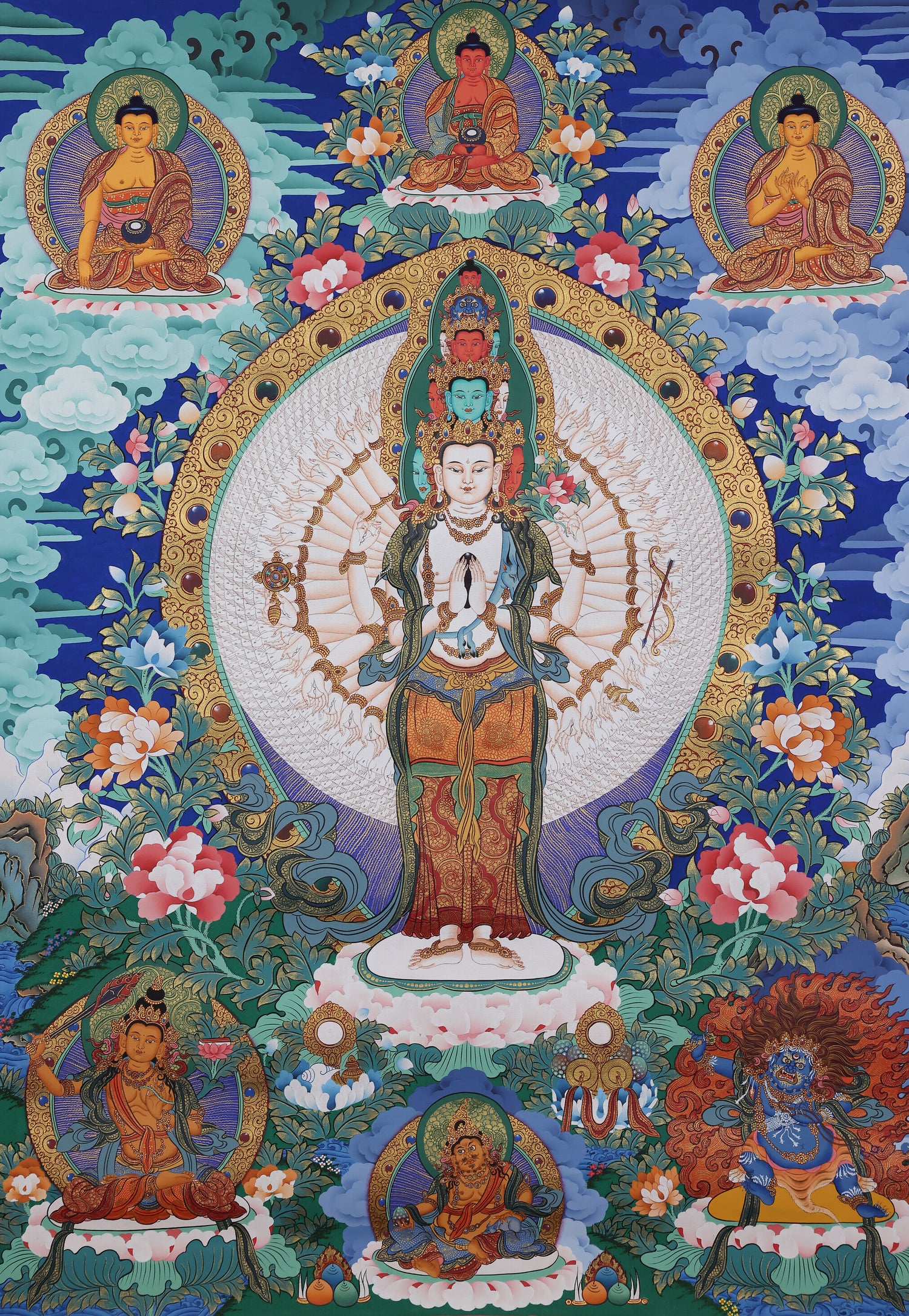
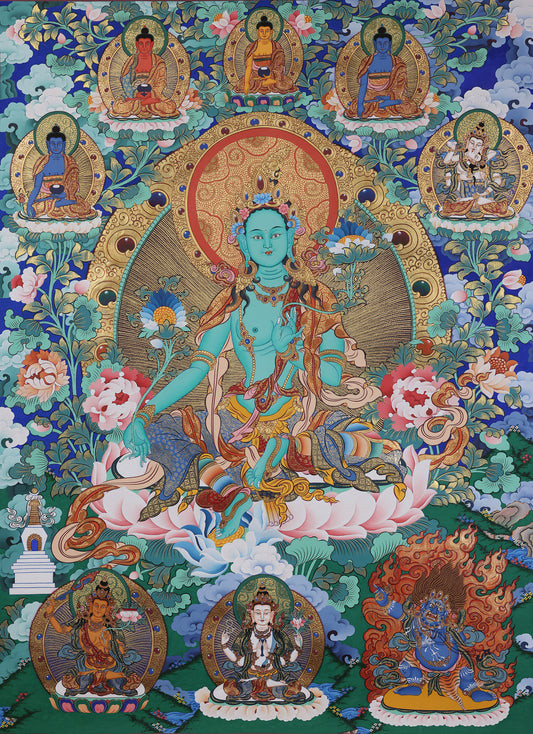
When a vivid, finely lined Nepali hand-painted White Tara thangka unfolds before you, you’re not just looking at a painting—it’s a visual vessel for the Tibetan Buddhist spirit of “compassionate salvation,” a tangible testament to Himalayan cultural fusion, and a crystallization of the Newari school’s thousand-year-old artistic heritage. Today, we use a 45×66cm mineral-pigment thangka to unlock the symbolic and artistic codes behind Tibetan Buddhist thangkas.
In the Tibetan Buddhist tradition, White Tara (Saraswati Tara) is the emanation of the right eye-tear of Avalokiteshvara (Chenrezig), and together with Green Tara, forms the “Two Principal Taras” among the 21 Taras. Her core symbolism centers on “longevity, healing, and compassionate salvation.” The theme of this Nepali thangka revolves around the “protective cosmos of White Tara”:
-
Spiritual Direction: Known as the “Seven-Eyed Mother Buddha,” White Tara’s seven eyes (on her forehead, palms, and soles) gaze upon the suffering of the six realms, echoing Tibetan Buddhism’s fundamental ethos of “all-pervading compassion”;
-
Functional Role: It serves both as a aid for practitioners to visualize and cultivate longevity, and as a “protective talisman” for household worship—aligning with the spiritual needs of Himalayan communities for “worldly stability”;
-
Cultural Link: Nepal is a key origin point of Tibetan Buddhism (Atisha Dipankara resided here before entering Tibet), so thangkas like this also carry the historical memory of Indo-Tibetan Buddhist cultural exchange.
The central White Tara in the thangka adheres strictly to the Iconometric Sutras, with each detail holding religious meaning:
-
Physical Symbolism: Her all-white form represents “purification from misfortune”; her visage (like a 16-year-old maiden) embodies “gentle compassion”; her seven eyes (the core identifier) signify “watching over the ten directions and perceiving all sentient suffering”;
-
Implements and Mudras: Her right hand forms the Varada Mudra (palm outward) to “grant blessings and ease”; her left hand holds an utpala lotus (its stem curling to her ear), symbolizing “enlightened purity” and echoing her origin as “an emanation of Avalokiteshvara’s compassion”;
-
Ornamentation: Her floral crown, necklaces, and armlets not only reflect her “celestial maiden” status but also highlight the Nepali thangka’s aesthetic of “opulent solemnity”; the double lotus throne (with upward and downward petals) represents “the pure realm beyond samsara.”
The attendant deities above and below the main figure are not randomly arranged—they follow the logic of “main deity, dharma lineage, and protection,” forming the Tibetan Buddhist practice structure of “Yidam (meditational deity), Guru, and Dharma Protector”:
-
Three Deities Above: Symbols of Dharma Lineage
The central Buddha (likely Shakyamuni or Medicine Buddha) holding a bowl represents the “source of the Dharma”; the left deity (possibly Atisha Dipankara) holding a ritual implement is the “disseminator of the Dharma”; the right guru (in monastic robes, forming a mudra) symbolizes “lineage blessings for practice”—this combination emphasizes both the authority of the Dharma and the continuity of practice.
-
Two Deities Below: Complementary Worldly Protection
The red-bodied deity on the left (likely Hayagriva or Red Dzambhala) governs “demon-subjugation and abundance”; the six-armed deity on the right (likely White Umbrella Goddess or Six-Armed White Tara) represents “warding off calamity”—together with White Tara’s “misfortune-quelling” role, they form a practical loop of “protection and benefit.”
This thangka is a masterpiece of Nepal’s Newari artistic school, whose techniques and style fuse Indian and Tibetan aesthetics with distinct regional traits:
-
Timeless Mineral Pigments
Natural materials like shell powder (white), cinnabar (red), lapis lazuli (blue), and orpiment (yellow) are mixed with animal hide glue—though labor-intensive (shell powder may be ground for years), these pigments retain vibrant, durable hues, fitting the “transgenerational” purpose of religious art; 24K gold powder, polished with an agate pen, creates a luminous sheen that defines the thangka’s opulence.
-
Artistic Traits of the Newari School
-
Color: High-contrast, saturated tones (royal blue, pink, gold) distinguish deity attributes while reflecting the local preference for “bright, vivid aesthetics”;
-
Composition: Centrally symmetrical and layered, with the main deity at the core, attendants borne on clouds, and background flowers (peonies) and landscapes drawing from Indian Pahari painting to evoke a “divine paradise”;
-
Linework: Delicate, fluid dingtou shuwei (nail-head, rat-tail) outlines lend grace and strength to robes and lotus petals—differing from the starker lines of Tibetan thangkas, embodying the “liveliness” of Newari art.
For Nepali painters, creating a thangka is a merit-building practice; for communities, it’s a visual anchor of spiritual reliance; for art history, it’s a physical example of Indo-Tibetan cultural fusion and Newari artistic 传承 —this is the thangka’s uniqueness: it is both a “vessel of faith” and an “embodiment of beauty.”
#WhiteTaraThangka #NepaliThangka #TibetanBuddhistArt #NewariArtSchool #MineralPigmentThangka #ThangkaAnalysis #TibetanBuddhistCulture #HimalayanArt #HandPaintedThangka #ReligiousArtwork