Nepalese Hand-Painted White Tara Thangka: Unpacking Its Spiritual Themes, Divine Figures, and Traditional Artistry

$599.00 USD
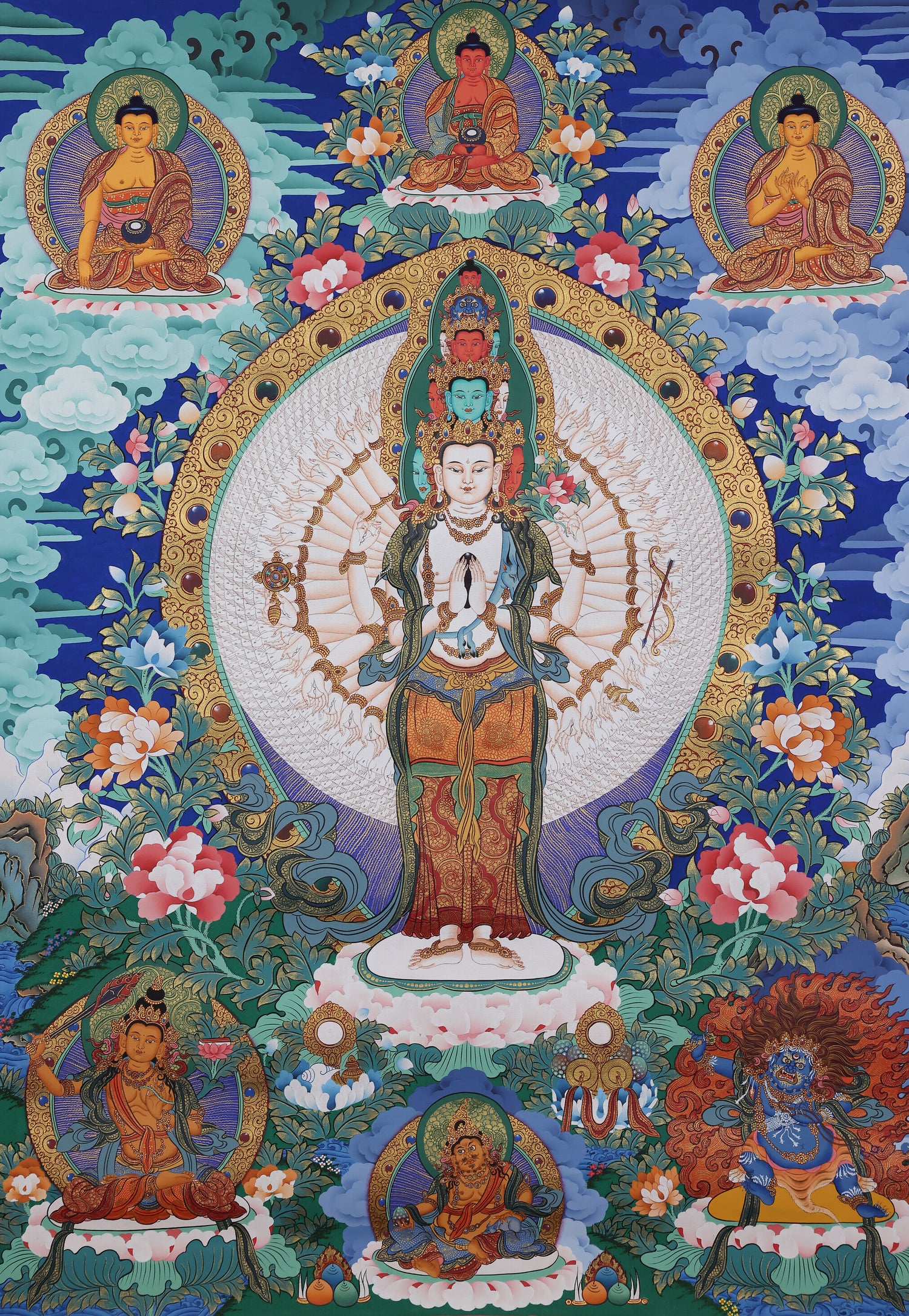
Thangka name: Rainbow White Tara
size: 48cm×66cm
origin: Nepal
Eine Frage stellen

Beeil dich! Nur noch [Anzahl] auf Lager!

Geschätzte Lieferzeiten: 12–26 Tage (International), 3–6 Tage (USA).

Rückgabe innerhalb von 45 Tagen nach dem Kauf. Zölle und Steuern werden nicht erstattet.

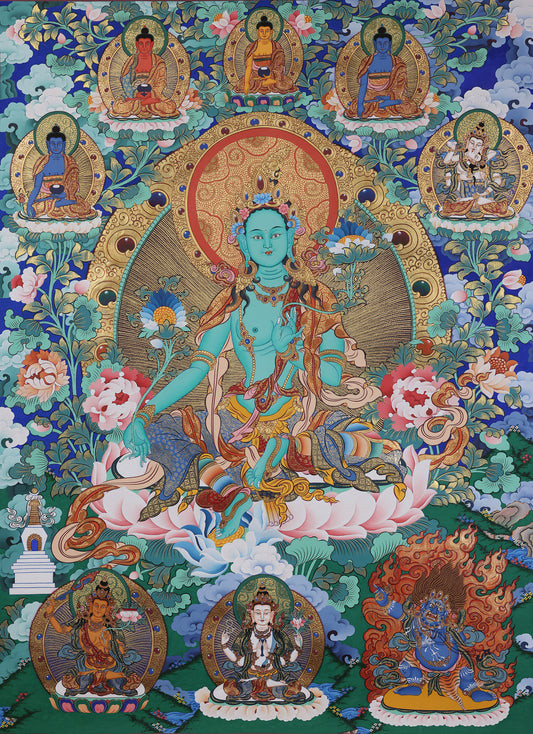
Hand-painted White Tara thangka in Tibetan Buddhist culture, symbolizing compassion and longevity blessings.
Nepalese Hand-Painted White Tara Thangka: Unpacking Its Spiritual Themes, Divine Figures, and Traditional Artistry
$599.00 USD
In Tibetan Buddhism, thangkas are often called “mobile temples”—portable, vividly rendered sacred artworks that bridge the spiritual and physical worlds. For Himalayan communities (and global art and spirituality enthusiasts), few thangkas embody this duality as beautifully as the Nepalese hand-painted White Tara thangka (48x66cm, crafted with natural mineral and earth pigments) we’re exploring today.
Rooted in Newari (Nepal’s indigenous artisan tradition) and Tibetan Buddhist iconography, this piece isn’t just a painting: it’s a visual manifesto of compassion, liberation, and timeless craftsmanship. Let’s dive into its layers—from spiritual themes to brushstroke techniques.

The Core Theme: Compassionate Liberation as a Visualized Pure Land

At its heart, this thangka depicts the pure land of White Tara (Dolma Karmo in Tibetan)—the “Buddha-Mother of Longevity and Liberation,” and the foremost of the 21 Taras (female bodhisattvas of compassion).
White Tara is believed to be an incarnation of Avalokiteshvara (the Bodhisattva of Compassion), born from his tears of grief for sentient beings’ suffering. Her thangka’s theme centers on her dual role:
  • Relieving suffering: She protects against the “Eight Great Fears” (e.g., fire, wild animals, spiritual ignorance).
  • Fulfilling blessings: She grants longevity, health, and safe childbirth (a reason she’s widely venerated by women in Himalayan cultures).
The 48x66cm medium size is intentional: it’s designed for home shrine display, making this “pure land” accessible to daily spiritual practice—turning a private space into a site of connection with Tara’s compassionate power.

The Central Deity: White Tara’s Symbolic Imagery (By the Book)

Tibetan Buddhist thangkas follow strict guidelines from the Iconometry Sutras (texts dictating sacred proportions), and this White Tara adheres to every detail—each element carries spiritual meaning:

1. The Seven Eyes: “Seeing All, Saving All”

White Tara’s most iconic feature is her seven eyes: one on her forehead (gazing at the Buddha realms) and one on each palm and sole (watching over the six realms of samsara). This isn’t decorative: it symbolizes her omniscient compassion—she sees suffering wherever it exists, and responds instantly.
Her alabaster skin aligns with her “pacifying” (shanti) spiritual role: white represents purity, clarity, and the dissolution of negative karma. Her form (modeled after a 16-year-old maiden) follows the “nine cubits” proportion rule (108 finger-widths tall), balancing divine grace with relatable human softness.

2. Posture, Handprints, and Offerings

She sits in the ardhasana (half-lotus) pose—one foot grounded on a lotus, the other folded—signaling she is not detached from the world (unlike full-lotus meditative poses) but actively engaged in liberation.
  • Her right hand forms the abhaya mudra (fearless gesture): a promise of safety and ease for all who call on her.
  • Her left hand holds a stem of the utpala (blue lotus), which blooms in three stages (bud, half-open, full) to represent the Three Jewels (Buddha, Dharma, Sangha)—the foundation of Tibetan Buddhist practice.

3. The Three-Tiered Aura (Backlight)

Her aura layers encode spiritual hierarchy:
  • Inner black radiating halo: Dispels ignorance (the root of suffering).
  • Middle turquoise scroll halo: Symbolizes life-giving purity.
  • Outer golden lotus halo: Connects her to the pure land’s abundance, separating her from the mundane world.

Attendant Deities: The Lineage and Protection Network

No thangka exists in isolation—its attendant figures anchor White Tara to a larger spiritual lineage and protective system:
  1. Top: Amitabha BuddhaThe small red Buddha above White Tara is Amitabha (the Buddha of the Western Pure Land). As Avalokiteshvara’s teacher (and White Tara’s spiritual ancestor), he represents the thangka’s lineage root—linking Tara’s compassion to the core of Buddhist enlightenment.
  2. Left Attendant: Saraswati (or Fire-Protection Tara)The pale yellow figure holding an utpala lotus is Saraswati (the bodhisattva of wisdom) or a specialized Tara form (Fire-Protection Tara). She embodies the wisdom needed to understand Tara’s teachings and avoid self-inflicted suffering.
  3. Right Attendant: Blue Yaksha GuardianThe indigo figure holding a ritual vase is a Yaksha guardian—his mild “wrathful” expression isn’t aggression, but the power to repel obstacles (illness, misfortune) that block spiritual progress.
  4. Bottom: Dharma WheelThe eight-spoked wheel at the base (resting on a lotus in flowing water) represents the Eightfold Path—Tara’s compassion is not just a feeling, but a path of ethical action to reach liberation. The water symbolizes the purification of negative karma.

Craftsmanship: Mineral Pigments and Newari Artisan Legacy

This thangka’s longevity (it can last 100+ years) and vibrancy come from Newari artisans’ unbroken, centuries-old techniques:

1. Canvas Preparation

The base is Nepalese linen (sturdier than Tibetan cotton), treated with 3 layers of cowhide glue and white clay paste—sanded smooth to create a uniform, absorbent surface for pigments.

2. Natural Mineral Pigments

Every hue comes from earth and stone (no synthetic dyes):
  • Red: Crushed cinnabar (HgS), processed in 18 steps to deepen its tone and resist fading (used for Amitabha’s robes).
  • Blue: Afghan lapis lazuli (ground to 5–20μm particles), graded by brightness (used for the Yaksha and lotuses).
  • Green: Malachite (CuCO₃・Cu (OH)₂), mixed with blue 铜矿 for depth (used for foliage).
  • Gold: 24K gold foil, hammered to 0.12μm thickness (used for halos and ornaments)—symbolizing divine light and imperishability.
Pigments are mixed with 5-year-old cowhide glue (aged to improve flexibility) in a 3:1 ratio—ensuring they bond to the linen without cracking.

3. 12-Step Painting Process

Newari artisans follow 12 strict steps:
  1. Canvas treatment
  2. Proportion sketching (per Iconometry Sutras)
  3. Pigment grinding
  4. Base color application (3–5 layers)
  5. Detail shading (with squirrel-hair brushes)
  6. Gold linework
  7. “Opening the eyes” (the final, sacred step—artisans meditate before painting the deities’ eyes to infuse them with life)

Artistic Style: The Newari Aesthetic (Nepal’s Unique Contribution)

This thangka isn’t just “Tibetan art”—it’s a product of Newari (Nepal’s Kathmandu Valley indigenous) style, which blends Tibetan iconography with Indian and local influences:
  • Vibrant, dense decoration: No blank space—clouds (curled, Newari-specific motifs), peonies (symbolizing worldly blessings), and pine trees (longevity) fill the background, creating a sense of “abundant pure land.”
  • Soft, humanized forms: Unlike the starker lines of Tibetan thangkas, Newari thangkas use “orchid leaf” brushstrokes for flowing robes and layered plant-dye shading for skin—making deities feel both divine and relatable.
  • Cultural fusion: The lotus species, cloud patterns, and guardian’s attire all reflect Nepal’s local flora and folklore—proof of Himalayan culture’s cross-border exchange.

Why This Thangka Matters

This 48x66cm White Tara thangka is more than art: it’s a living tradition. It carries the compassion of White Tara, the skill of Newari artisans, and the shared spiritual heritage of Tibet and Nepal. For practitioners, it’s a mobile temple; for art lovers, it’s a window into how Himalayan communities turn faith into tangible beauty.


#WhiteTaraThangka #NepaleseThangkaArt #TibetanBuddhistThangka #HandPaintedThangka #MineralPigmentThangka #NewariThangkaStyle #SpiritualHimalayanArt
Entdecken Sie das perfekte tibetisch-buddhistische Thangka, das zu Ihren Wünschen, Ihrem Lebensstil und Ihrem Raum passt. Jedes Thangka hat eine spirituelle Bedeutung und bringt Segen, wenn es richtig platziert wird.

1. Definieren Sie Ihre Absicht

Reichtum & Erfolg → Gelber Dzambhala (Gottheit des Reichtums)

Mitgefühl und Frieden → Avalokiteshvara, Grüne Tara

Weisheit & Lernen → Manjushri

Gesundheit & Heilung → Medizinbuddha

Langlebigkeit und Familienschutz → Weiße Tara

2. Wählen Sie nach Identität

Unternehmer und Geschäftsinhaber → Reichtumsgottheiten für Wohlstand.

Studenten und Gelehrte → Weisheitsgottheiten für Konzentration und Klarheit.

Heiler und Yoga-Praktizierende → Medizinbuddha für Energie und Gleichgewicht.

Familien und Hausfrauen → Tara-Gottheiten für Harmonie und Sicherheit.

Sammler und Kunstliebhaber → Seltene Mandalas oder Meisterwerk-Thangkas.

3. Passen Sie Ihren Raum an

Heimschrein / Meditationsraum → Mittlere Thangkas (60–80 cm).

Büro / Geschäftshalle → Große Thangkas für Wohlstand und Autorität.

Wohnzimmer / Arbeitszimmer → Dekorative Thangkas für Frieden und Schönheit.

4. Authentische Handwerkskunst

Jedes Thangka ist mit natürlichen Mineralpigmenten und feiner Leinwand handbemalt und spiegelt tibetische Kunstfertigkeit und spirituelle Kraft wider. Überprüfte Quellen gewährleisten Qualität und Respekt für die Tradition.

✨ Wählen Sie Ihr Thangka mit Herz – es ist nicht nur Kunst, sondern ein Segen für Ihr Leben.

Jeder Mensch hat unterschiedliche Bedürfnisse. Die Wahl des richtigen Thangkas kann spirituelle Unterstützung, Schutz, Glück und Segen bieten. Nachfolgend finden Sie Thangka-Empfehlungen für verschiedene Rollen:

1. Unternehmer

  • Bedürfnisse : Weisheit, Reichtum, Gesundheit, beruflicher Erfolg.
  • Empfohlene Thangkas :
    Manjushri : Verbessert die Entscheidungsfindung und Geschäftsweisheit.
    Gottheit des Reichtums : Bringt Reichtum und Wohlstand.
    Medizinbuddha : Unterstützt die Gesundheit und reduziert Stress.
    Mahakala : Schützt Unternehmen vor Konkurrenz und Herausforderungen.

2. Erfolgreiche Einzelpersonen

  • Bedürfnisse : Innerer Frieden, Familienharmonie, Langlebigkeit.
  • Empfohlene Thangkas :
    Amitabha Buddha : Bringt inneren Frieden und Ruhe.
    Avalokiteshvara (Guanyin) : Fördert Harmonie und Glück in der Familie.
    Amitayus (Langlebens-Buddha) : Betet für gute Gesundheit und ein langes Leben.
    Manjushri : Stärkt weiterhin die Weisheit.

3. Hausfrauen/Ehemänner

  • Bedürfnisse : Familienharmonie, Schutz, Gesundheit.
  • Empfohlene Thangkas :
    Avalokiteshvara : Steigert das Familienglück und die Harmonie.
    Schutzgottheiten : Beschützen die Familie vor äußeren Störungen.
    Weiße Tara : Segnet die Familie mit Gesundheit.

4. Studierende und Wissenschaftler

  • Bedürfnisse : Weisheit, Konzentration, akademischer Erfolg.
  • Empfohlene Thangkas :
    Manjushri : Fördert Lernfähigkeit, Gedächtnis und Weisheit.
    Shakyamuni Buddha : Hilft bei der Konzentration und spirituellen Praxis.
    Jixiang Tianmu : Bringt akademisches Glück und Prüfungserfolg.

5. Künstler und Kreativprofis

  • Bedürfnisse : Inspiration, Kreativität, künstlerische Leistung.
  • Empfohlene Thangkas :
    Manjushri : Regt kreatives Denken und Inspiration an.
    Vajrapani : Hilft, kreative Blockaden zu überwinden.
    Maitreya : Sorgt für eine entspannte und optimistische Einstellung und baut Stress ab.

6. Reisende und Abenteurer

  • Bedürfnisse : Schutz, Glück, Erfolg bei Abenteuern.
  • Empfohlene Thangkas :
    Hayagriva : Bietet starken Schutz auf Reisen und beseitigt Hindernisse.
    Mahakala : Bringt Glück und Schutz, insbesondere für Abenteurer.
    Vajrasattva : Hilft, Schwierigkeiten und Herausforderungen während der Reise zu überwinden.

7. Ältere Menschen

  • Bedürfnisse : Gesundheit, Langlebigkeit, spiritueller Frieden.
  • Empfohlene Thangkas :
    Amitayus : Betet für ein langes Leben und gute Gesundheit.
    Medizinbuddha : Fördert Heilung und körperliches Wohlbefinden.
    Avalokiteshvara : Bringt Mitgefühl und inneren Frieden in späteren Jahren.

8. Führungskräfte

  • Bedürfnisse : Führung, Weisheit, Teamarbeit und geschäftlicher Erfolg.
  • Empfohlene Thangkas :
    Manjushri : Verbessert Führungsqualitäten und Entscheidungsfindung.
    Gottheit des Reichtums : Bringt dem Unternehmen und dem Team Erfolg und Wohlstand.
    Avalokiteshvara : Fördert Harmonie und Gleichgewicht innerhalb des Teams.

9. Gesundheits- und Fitnessbegeisterte

  • Bedürfnisse : Gute Gesundheit, Vitalität, Energie.
  • Empfohlene Thangkas :
    Medizinbuddha : Verbessert die körperliche Gesundheit und Vitalität.
    Weiße Tara : Bringt Gesundheit und Verjüngung.
    Vajrasattva : Beseitigt gesundheitliche Probleme und steigert die Energie.

10. Politiker

  • Bedürfnisse : Führung, Weisheit, Frieden.
  • Empfohlene Thangkas :
    Manjushri : Verbessert Führungsqualitäten und Entscheidungsfindung.
    Vairocana Buddha : Hilft, inneren Frieden und Weisheit zu bewahren.
    Avalokiteshvara : Fördert den gesellschaftlichen Frieden und die Harmonie in der Familie.

Für alle Bestellungen über 100 USD ist der Versand kostenlos.

Rücksendungen werden bis zu 10 Tage nach Erhalt des Kaufbelegs bzw. der Sendungsnummer (bei ungetragenen Artikeln) akzeptiert. Sie als Kunde sind verpflichtet, uns vor der Rücksendung des Artikels per E-Mail zu informieren.

Andernfalls fallen die Standardversandkosten an. Weitere Informationen finden Sie in unseren Lieferbedingungen .

Rücksendungen werden bis zu 10 Tage nach Erhalt des Kaufbelegs oder der Sendungsnummer (bei ungetragenen Artikeln) akzeptiert. Sie als Kunde sind verpflichtet, uns vor der Rücksendung des Artikels per E-Mail zu informieren, nur in folgenden Fällen:

– Den falschen Artikel erhalten.
– Artikel kam nicht wie erwartet an (z. B. beschädigte Verpackung).
– Artikel hatte Mängel.
– Über die Lieferzeit hinaus.
– Der Spediteur gestattet keine Besichtigung der Ware vor der Bezahlung.

Die zurückgesendeten Produkte müssen in der Originalverpackung, sicher verpackt, unbeschädigt und ungetragen sein. Dies bedeutet, dass die Artikel zum Schutz während des Transports sicher in einem Karton verpackt sein müssen, möglichst im selben Karton, in dem sie an Sie als Kunde versendet wurden.

Kürzlich angesehen

Nicht vergessen! Die Produkte, die Sie angesehen haben, legen Sie jetzt in den Warenkorb.

Passt gut zu

Erweitern Sie Ihre Auswahl mit perfekt abgestimmtem Zubehör und ergänzenden Produkten.

Leute kauften auch

Hier sind einige unserer ähnlichsten Produkte, die die Leute kaufen. Klicken Sie hier, um den Trendstil zu entdecken.