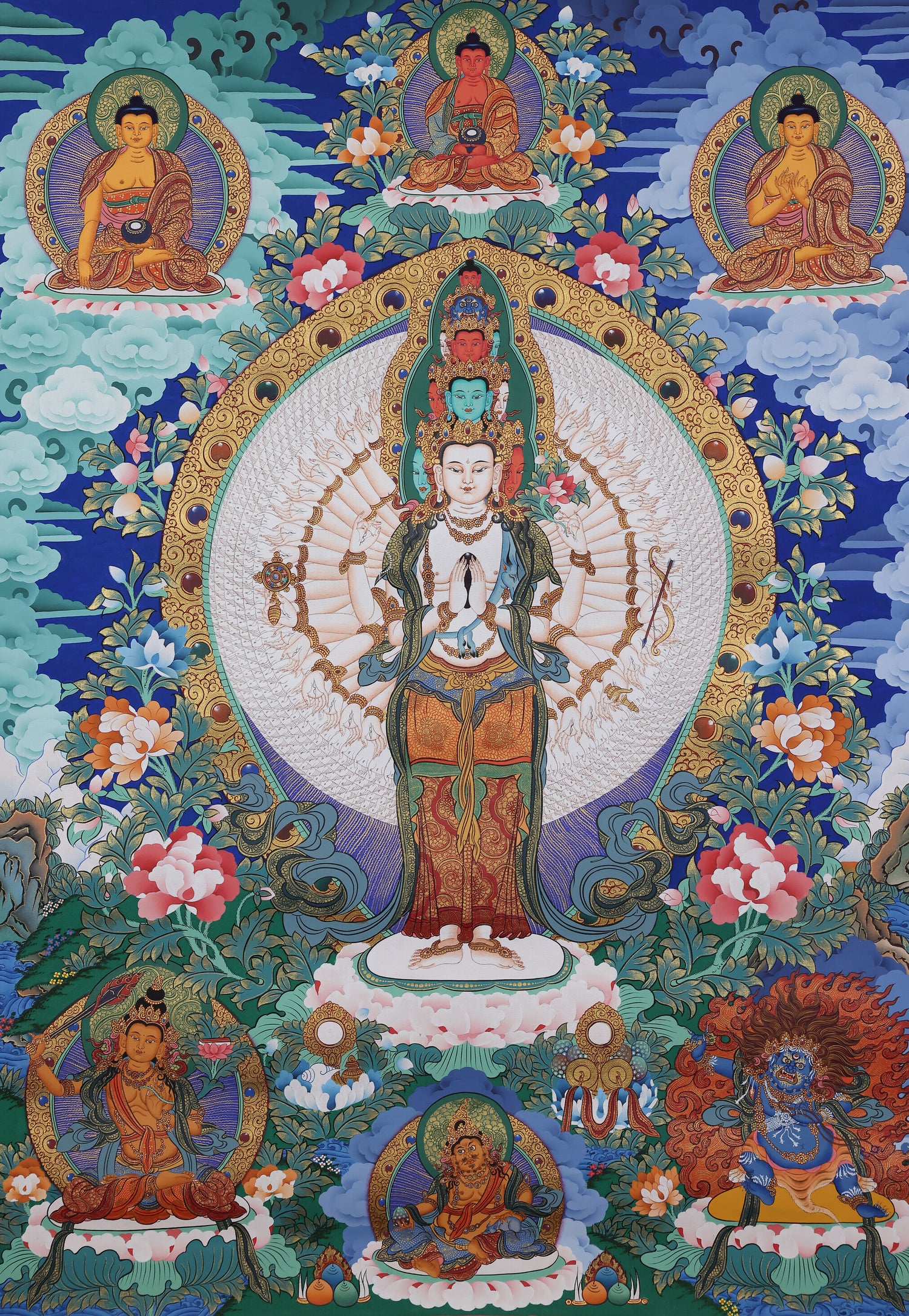
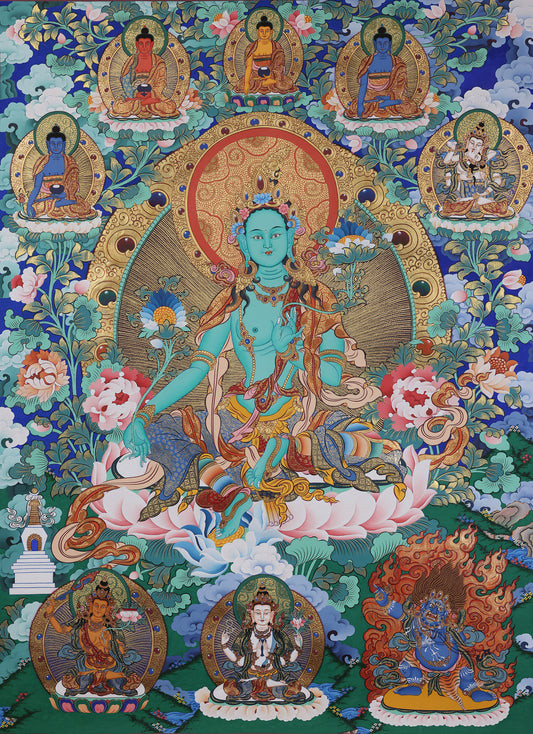
When a 45×66cm Nepalese color thangka unfolds before you, you’re not looking at ordinary art—it’s a "mobile Buddhist shrine" in the hearts of Tibetan Buddhist practitioners, a visual vessel for beliefs in compassion and longevity.
This thangka, centered on White Tara, is a handcrafted work from Nepal’s Newari painting school, created with natural mineral and earth pigments. In Tibetan Buddhist tradition, White Tara (known as "Drolma Karmo" in Tibetan) is the compassionate emanation of Avalokiteshvara. Together with Amitayus (the Longevity Buddha) and Ushnisha Vijaya (the Buddha-Mother of Victory), she forms the "Three Longevity Deities," presiding over healing, longevity, and disaster relief—serving as a spiritual link between practitioners’ "worldly well-being" and "liberation in the afterlife."
The White Tara at the center of the thangka embodies the "iconographic orthodoxy" of Tibetan Buddhist art:
-
Form: Her body is pure white like congealed fat, symbolizing "unstained compassion"; her face bears the soft, serene features of a 16-year-old girl, subtly evoking the meaning of "eternal youth" tied to longevity.
-
Seven Eyes Symbol: One eye on her forehead gazes at all Buddha-fields in the ten directions; one eye on each palm and sole of her feet watches over sentient beings in the six realms—this is a visual expression of the Tara Sutra’s verse, "Eyes like lotus petals, saving suffering everywhere," and the core symbol of White Tara’s vow of "immediate salvation."
-
Mudra and Implements: Her right hand forms the "wish-fulfilling mudra" (palm outward), promising to grant sentient beings’ prayers; her left hand twists the stem of an utpala flower (the stem wraps around her ear), where the utpala symbolizes the "Bodhicitta that transcends afflictions."
-
Lotus Throne Conventions: She sits on a double-layered lotus throne (crimson outer petals, white inner petals), fully adhering to the proportions specified in the Iconometric Sutras—the lotus, which grows from mud yet remains unstained, metaphorizes White Tara’s pure virtues.
The thangka arranges attendant deities according to the "three-realm, five-direction" cosmology, forming a complete "White Tara blessing system":
-
Upper Three Deities (Celestial Realm):
- Central Buddha (cross-legged, holding a bowl): Likely Shakyamuni Buddha, representing the "source of the Dharma" and the origin of White Tara’s vows;
- Left figure (holding a ritual implement): Likely Manjushri or Atisha, symbolizing "wisdom transmission," corresponding to the doctrine that "compassion must be guided by wisdom";
- Right figure (palms pressed together): Likely Tsongkhapa or Master Jinzhou, representing "lineage gurus," embodying the Tibetan Buddhist tradition of "guru, Dharma, and Buddha as one."
-
Lower Two Deities (Earthly Realm):
- Left red figure: Likely Red Jambhala, presiding over wealth and career, carrying practitioners’ wishes for worldly good fortune;
- Right multi-armed figure: Likely Ushnisha Vijaya, forming the "Three Longevity Deities" with White Tara and Amitayus, reinforcing the core theme of "longevity and disaster relief."
This layout is not decorative—it centers White Tara, integrating "Dharma, wisdom, wealth, and longevity" to fully cover practitioners’ spiritual and practical needs.
The thangka’s craftsmanship is a material expression of the Newari school’s centuries-old heritage:
-
Sacredness of Natural Pigments: Blue comes from lapis lazuli, green from malachite, red from cinnabar, and yellow from orpiment. These minerals are ground to 5–20μm particles and mixed with aged cow glue (stored for over 5 years) in a 3:1 ratio—mineral pigments have lightfastness of over 100 years, keeping the thangka’s colors "timeless," a metaphor for the "eternal Dharma"; white comes from chalk, its fine texture matching White Tara’s pure form.
-
Rigorous 12-Step Process: From base preparation ("glue-soaking and stretching cloth—chalk coating and sanding") to "charcoal sketching per the Iconometric Sutras," layered shading, and "outlining with weasel-hair brushes," the final step is the "eye-opening ritual" to paint the deities’ eyes—each step follows religious protocols, transforming the thangka from "art" into a "spiritual ritual implement."
-
Ritual of Gold Decoration: 24K gold powder (ground to 0.12μm thickness) is used to outline the lotus throne and halo edges, adding sacredness while aligning with the belief tradition of "offering treasures to the Buddha."
Unlike Tibetan thangkas’ "dense, full composition," this work is a classic example of the Newari school:
-
Composition: The main deity occupies over 60% of the space; attendants are arranged in "small niche-like" corners, connected by clouds, peonies, and lotuses to balance density. The background of snow-capped mountains and flowing water enriches layers while metaphorizing a "pure land sanctuary."
-
Color Palette: Warm tones dominate; White Tara’s white form contrasts with red/blue robes (cold-warm contrast), and mineral pigments transition smoothly between shades, aligning with the religious symbolism of the "five directional colors" (white = center, red = south).
-
Form: It inherits the soft curves of India’s Sarnath style while strictly adhering to the Iconometric Sutras’ proportions, balancing "softness and solemnity."
This Nepalese White Tara thangka is both a "visual object" for practitioners’ meditation and prayer and a living specimen of Sino-Nepalese cultural exchange—it carries eternal faith in mineral pigments, builds a spiritual system through the three-realm layout, and showcases regional aesthetics via the Newari style. For practitioners, it is the "incarnation of the Buddha"; for viewers, it is a visual epic of Tibetan Buddhist culture.
#Nepalese White Tara Thangka #Tibetan Buddhist Thangka Analysis #Newari Painting School #Mineral Pigment Thangka #Three Longevity Deities Thangka #Hand-Painted Color Thangka Craft #White Tara Iconography #Mobile Buddhist Shrine Thangka #Tibetan Buddhist Art #Traditional Nepalese Thangka