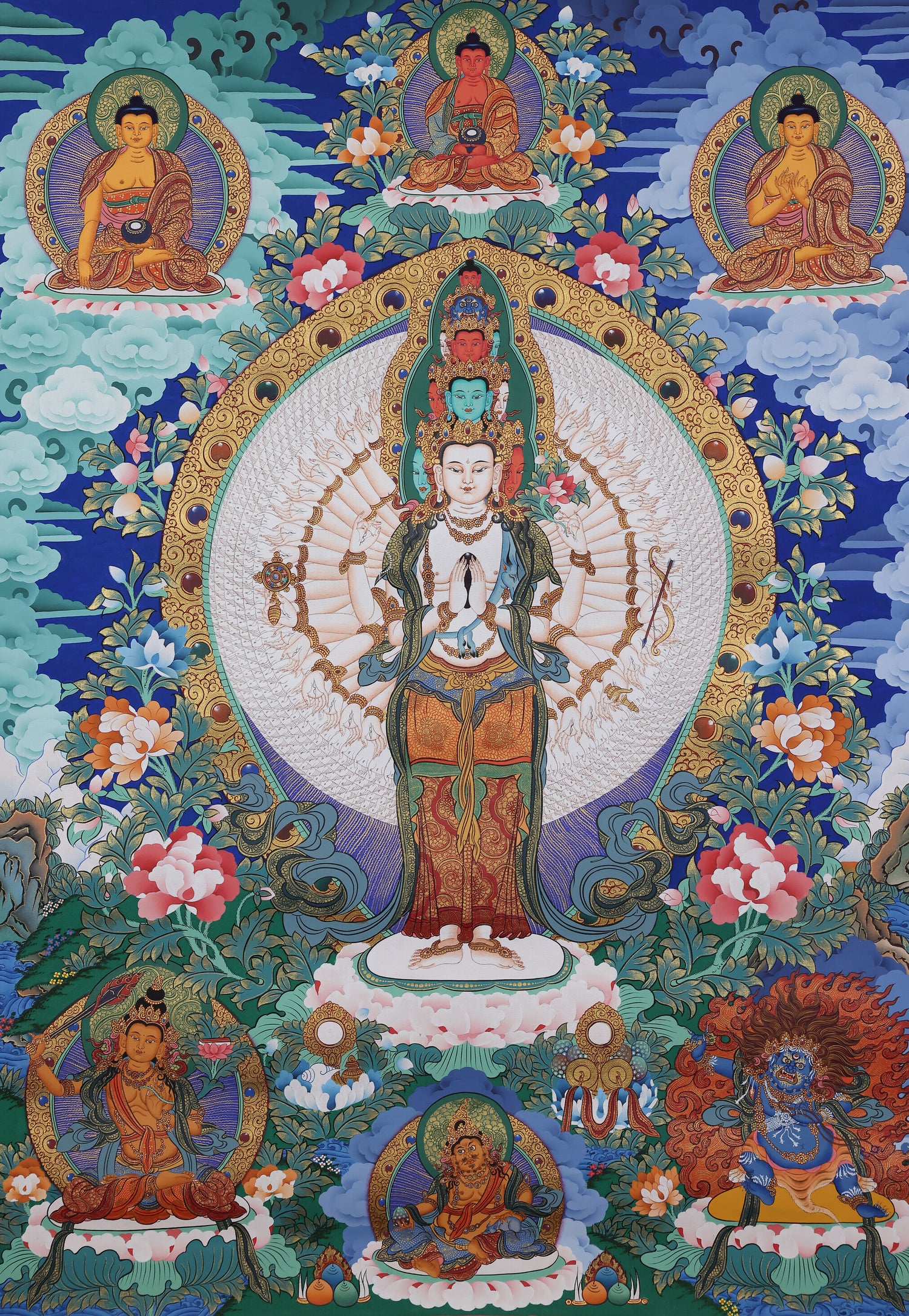
In the visual tradition of Tibetan Buddhism, a thangka is far more than a painting—it is a “map of compassion” guiding the practitioner through the spiritual realm. This hand-painted Four-Armed Avalokiteshvara Thangka is rooted in strict tantric rituals and rendered in the non-heritage craftsmanship of the Hotog (Rebgong) painting style. It transforms the core beliefs of Avalokiteshvara devotion into a sacred visual form suitable for meditation, cultural display, and spiritual practice, blending religious function, cultural symbolism, and artistic value in a single masterpiece.
I. Core Theme: The Snowy Realm’s Totem of Compassionate Protection
At the heart of this thangka lies the theme of “Four-Armed Avalokiteshvara’s Compassionate Protection.” In Tibetan Buddhism, Avalokiteshvara is revered as the protector of the Snowy Land (Tibet) and a central figure in the spiritual life of Tibetan communities.
According to Tibetan origin legends, the Tibetan people are considered descendants of a divine union between Avalokiteshvara’s enlightened influence, a sacred monkey, and a rakshasi. Thus, the Four-Armed Avalokiteshvara Thangka not only serves as a religious object but also as a symbol of ethnic and spiritual identity. Displaying or consecrating such a thangka is viewed as reconnecting with the ancestral compassion that shapes Tibetan culture.
Structurally, the thangka follows the Tibetan Buddhist Three Realms and Five Directions cosmology:
-
Upper Realm depicts the pure and holy abode of Buddhas and Bodhisattvas
-
Middle Realm presents the central deity and protective figures
-
Lower Realm symbolizes the compassionate guardianship over sentient beings in the human world
This top-to-bottom spatial hierarchy embodies the descending path of compassion, symbolizing Avalokiteshvara’s boundless vow to relieve the suffering of beings across the three realms.
II. Central Deity: Symbolism and Ritual Significance of the Four-Armed Avalokiteshvara
At the center of the painting sits the serene Four-Armed Avalokiteshvara (Chenrezig / Avalokiteshvara), meticulously drawn according to the canonical proportions outlined in the Sutra of Proportions for Sacred Images (37:25 ratio). Every detail is designed according to ritual law, ensuring the thangka functions as a legitimate tool for spiritual practice.
1. Body Features and Color
The deity’s body is pure white like the moon, symbolizing innate purity, free from defilements and afflictive obstacles. The four arms represent the Four Immeasurables—loving-kindness, compassion, joy, and equanimity—demonstrating Avalokiteshvara’s ability to save beings through multiple skillful means.
2. Mudras and Sacred Implements
-
Central hands in prayer hold a wish-fulfilling jewel, signifying the integration of wisdom and skillful means
-
Right hand holds a crystal mala, symbolizing that each recitation rescues countless beings from the cycle of suffering
-
Left hand holds an eight-petaled white lotus, representing purity and non-attachment amid worldly existence
3. Crown and Lotus Pedestal
The deity’s crown features Amitabha Buddha, signifying Avalokiteshvara as the embodiment of Amitabha’s compassion. Seated on a double-layered lotus pedestal, the lower red lotus represents liberation from defilements, while the upper moon lotus conveys cooling compassion. This design embodies the Bodhisattva ideal of “remaining in samsara without attachment, yet not detached from nirvana.”
This portrayal is not artistic improvisation but a ritually precise rendering. Deviations in proportions or implements are considered “improper” and would diminish its religious efficacy as a meditation support.
III. Attendant Deities: The Sacred Network of Protection Across Three Realms
Surrounding the central Avalokiteshvara, a carefully arranged ensemble of attendant deities creates a complete protective network, reflecting the Tibetan Buddhist hierarchy of Guru, Yidam, Dakini, and Dharma Protector.
Upper Realm Deities
At the top, Green Tara (left) and White Tara (right) manifest Avalokiteshvara’s compassion:
A central Vajrasattva figure represents karmic purification, forming the core of tantric practices focused on confession and purification.
Lower Realm Guardians
-
Yellow Jambhala (Wealth Deity) on the left symbolizes worldly prosperity and abundance
-
Blue Mahakala (Protector) on the right represents the subjugation of obstacles and protection of spiritual practice
Together, the combination of “Compassion” (Avalokiteshvara), “Mercy” (Tara), “Blessing” (Jambhala), and “Protection” (Mahakala) creates a holistic spiritual safeguard, balancing wisdom, compassion, material support, and defense in a single visual schema.
IV. Artistic Craftsmanship: Non-Heritage Techniques and Sacred Reverence
This thangka is executed in the Rebgong (Hotog) school, entirely hand-painted with meticulous attention to ritual and artistry. Its production process is itself a spiritual practice:
-
Canvas Preparation: Pure cotton cloth treated with multiple layers of aged cowhide glue and polished with crushed shells, creating a mirror-like, durable surface
-
Mineral Pigments: Lapis lazuli (blue, wisdom), malachite (green, vitality), cinnabar (red, compassion), and 24K gold powder are layered to achieve vivid, lasting colors, with lapis lazuli applied in 3–5 layers, finely ground to 5–20 μm
-
Linework and Gilding: Squirrel-hair brushes trace flowing lines with “thick center, thin ends” patterns for robes, while S-shaped arcs convey protector flames; 24K gold paint highlights divine radiance, applied with <0.3% line break rate
-
Face Opening Ritual: The final step involves drawing the deity’s face during a state of meditation and mantra recitation, infusing the painting with living spiritual energy
The Rebgong tradition emphasizes patience, precision, and devotion, where even the smallest jewelry or lotus petal may require multiple layers of shading and separate gold outlining, transforming the act of painting into a ritualized expression of faith.
V. Cultural Significance: A Living Encyclopedia of Tibetan Buddhism
This Four-Armed Avalokiteshvara Thangka is not merely an artwork—it is a microcosm of Tibetan Buddhist culture. It functions simultaneously as:
-
A spiritual tool, for visualization and meditation to receive Avalokiteshvara’s blessings
-
An educational medium, illustrating the doctrinal framework of the three realms and the interconnectedness of protective deities
-
A cultural memory, preserving Tibetan origin legends and collective spiritual identity
In contemporary terms, its use of precious mineral pigments (including scarce lapis lazuli) underscores both the heritage value and the urgency of preserving traditional techniques. The balance of ritual precision and artistic creativity demonstrates the Tibetan Buddhist principle of “expressing dharma through beauty”—faith made tangible, art made sacred.
Every brushstroke, pigment layer, and gilded line in this thangka embodies “faith realized in form”, making it a unique masterpiece that integrates spiritual practice, cultural heritage, and artistic excellence.
-
#TibetanBuddhism
-
#Avalokiteshvara
-
#FourArmedChenrezig
-
#BuddhistThangka
-
HandPaintedArt
-
#HotogArt
-
#RebgongThangka
-
#MeditationArt
-
#SpiritualArtwork
-
#TibetanHeritage
-
#SacredArt
-
#MineralPigmentArt
-
#Bodhisattva
-
#CompassionArt
-
#CulturalPreservation