— An Esoteric Symbol of Perfect Merit and Wisdom · Iconographic Canon · In-Depth Analysis of Traditional Black-Gold Craftsmanship
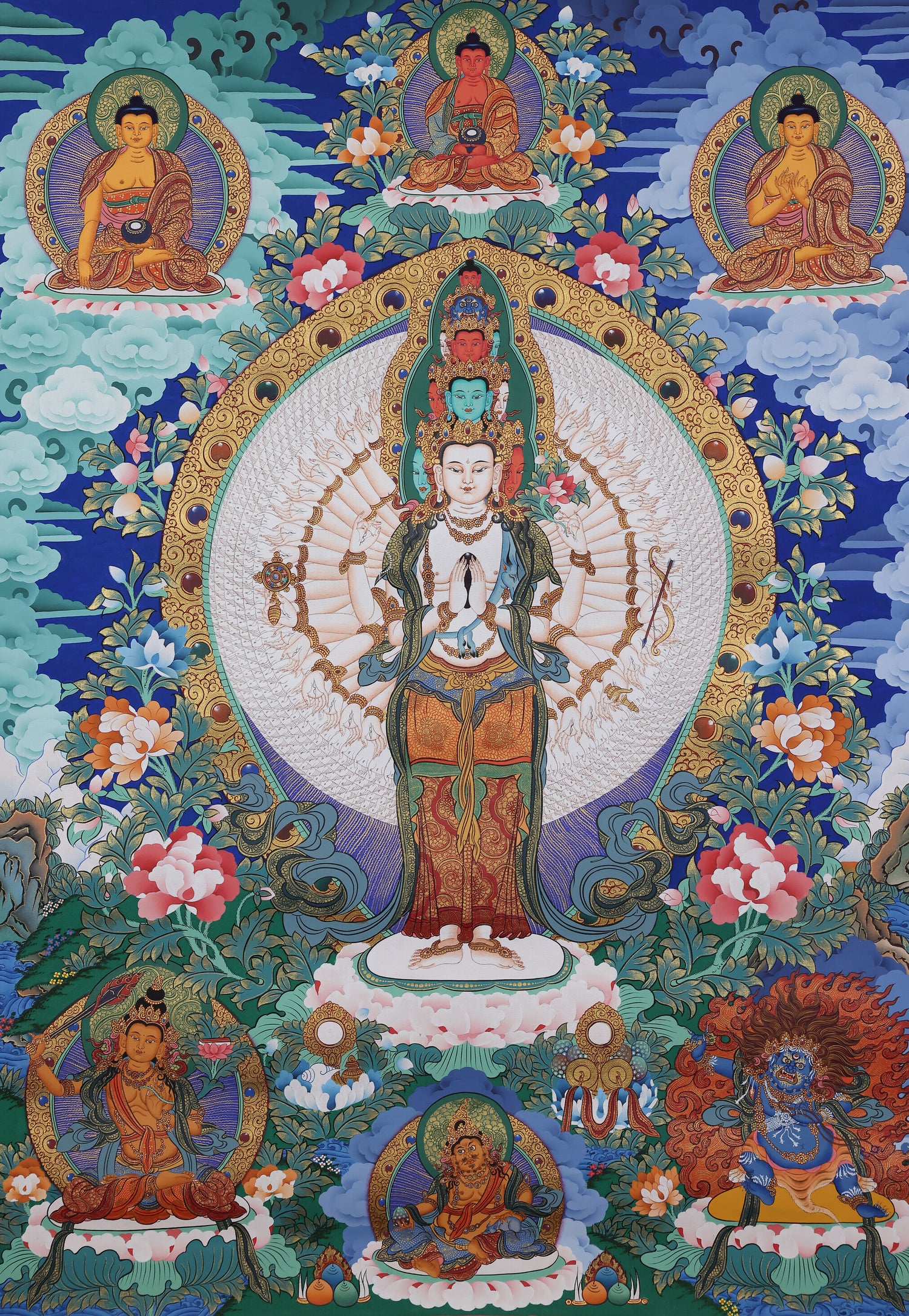
Within the artistic system of Tibetan Buddhism, a thangka is far more than a painting; it is a “visible form of the Dharma for contemplation.” It serves both as a medium through which practitioners connect with the yidam deity and as a visual expression of Tibetan philosophy, cosmology, and faith. This hand-painted black-gold Ākāśagarbha Bodhisattva thangka constructs a solemn and mysterious spiritual space through the powerful contrast of a deep black ground and radiant gold lines. In terms of doctrinal theme, iconographic discipline, and traditional craftsmanship, it exemplifies the high maturity and profound heritage of Tibetan Buddhist art.
I. Core Theme: The Treasury of Space — An Esoteric Symbol of the Union of Merit and Wisdom
This thangka enshrines Ākāśagarbha Bodhisattva (Sanskrit: Akāśagarbha) as the principal deity, one of the “Eight Great Bodhisattvas” in Tibetan Buddhism. The name “Ākāśagarbha,” meaning “Treasury of Space,” signifies that wisdom, merit, and wealth are as boundless as space itself. It symbolizes both the perfection of ultimate wisdom and the safeguarding of worldly blessings and the accumulation of spiritual resources for sentient beings.
Within Tibetan Buddhist practice systems, Ākāśagarbha Bodhisattva is revered as a guardian of precepts and wisdom. Scriptures describe him as “steadfast in discipline like Mount Sumeru, vast in wisdom like space.” He protects practitioners from violations of vows and deluded conduct, wields the sword of wisdom to sever ignorance, and grants wish-fulfilling jewels to satisfy rightful aspirations. Consequently, the practice of Ākāśagarbha has long been regarded as a supreme path in which merit and wisdom advance together.
By choosing Ākāśagarbha Bodhisattva as the central figure, this black-gold thangka visually articulates the ideal of the “union of merit and wisdom,” resonating deeply with Tibetan devotees’ aspirations for worldly stability, success in endeavors, growth in wisdom, and ultimate liberation.
II. Iconography of the Principal Deity: Strict Canon, Precise Symbolism
The depiction of Ākāśagarbha Bodhisattva in this thangka strictly follows the Iconometric Scriptures of Buddhist Images and tantric ritual prescriptions. Every detail carries explicit religious symbolism.
Body Color and Auspicious Marks
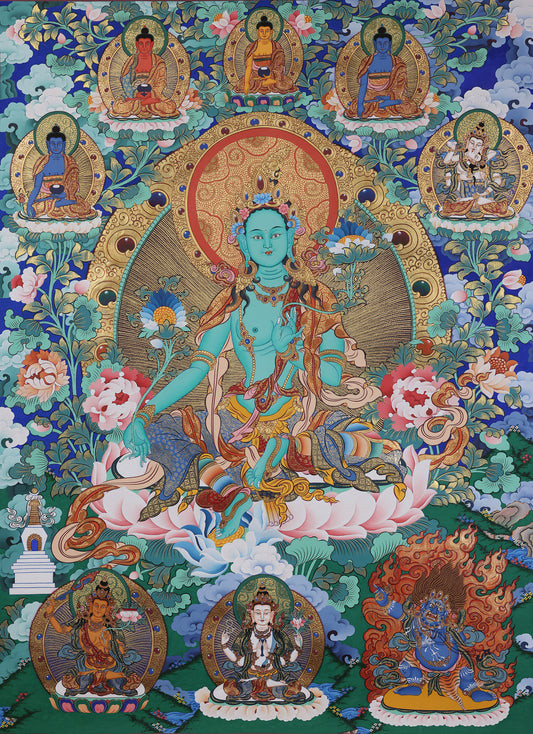
The deity’s body appears in celestial blue, the most representative color of Ākāśagarbha. In Tibetan Buddhism, blue corresponds to the “Dharma realm of space,” symbolizing wisdom that pervades all phenomena. The face is full and dignified, complete with the Thirty-Two Major Marks and Eighty Minor Signs. The white urna between the brows signifies awakened awareness and insight; the gently lowered eyes convey a serene, compassionate gaze upon all beings.
Mudrās and Attributes
The right hand holds the sword of wisdom, its blade pointing into space, symbolizing the severing of ignorance and afflictions through insight. The left hand forms the boon-granting mudrā, supporting a wish-fulfilling jewel upon a lotus. The lotus represents freedom from defilement, while the jewel signifies the fulfillment of aspirations and the accomplishment of merit—together expressing Ākāśagarbha’s essential teaching of “upholding merit through wisdom.”
Attire and Posture
The Bodhisattva wears a Five-Buddha crown, symbolizing the perfected virtues of the Five Tathāgatas. Draped in celestial garments and jeweled ornaments with the right shoulder subtly exposed, the figure embodies the classic peaceful Bodhisattva form, signifying non-attachment to appearances and direct realization of the true nature of mind. Seated in full lotus posture upon a multi-tiered lotus throne, the deity represents enlightenment that abides in the world without being stained by it.
III. Retinue and Protectors: A Blessing System Hidden Within Ornamentation
Unlike complex compositions featuring multiple explicitly depicted figures, this black-gold thangka employs an “implicit retinue” approach characteristic of esoteric expression. Attendant deities are not rendered as distinct forms but are integrated into the background patterns and symbolic system, lending the composition an inward, dignified solemnity.
Around the halo of the principal deity appear motifs of the Eight Auspicious Symbols and the Seven Royal Treasures. These are not mere decorations but signify the protective forces and accumulative resources governed by Ākāśagarbha, conveying blessings of protection, increase, and perfection. Subtly embedded in the background is the seed syllable “Hūṁ,” the core mantra syllable of Ākāśagarbha, symbolizing the subjugation of afflictions and the stabilization of right mindfulness.
Flowing wish-granting cloud motifs encircle the entire composition, representing the formless yet omnipresent protective power of the ḍākinīs and Dharma protectors, endowing the minimalist image with a complete and profound esoteric structure.
IV. Painting Technique: Black-Gold Thangka as a Form of Practice
This thangka is executed using the highly demanding Nāthang (black-gold thangka) technique, in which the act of creation itself is a form of spiritual cultivation.
Ground and Pigments
The canvas is made from high-altitude pure cotton cloth. After stretching, gluing, and repeated polishing, the surface becomes smooth as a mirror, symbolizing a purified mind. The black ground is prepared from magnetite powder, calcined deer horn ash, and natural charcoal, creating a deep, weighty tone that represents the essence of the Dharma realm. The gold lines are rendered using 24K pure gold, ground over long periods into fine powder and then prepared as pigment, symbolizing the indestructibility of the Dharma and the eternity of wisdom.
Line Work and Raised-Gold Technique
Using an extremely fine brush made from weasel or cat whiskers, the artist draws even, flowing gold lines upon the black ground. The folds of the garments are executed in the traditional “orchid-leaf line” style, following natural curves with vitality while maintaining solemnity. Certain ornamental details employ the raised-gold technique, causing the lines to stand slightly proud of the surface and reflect light differently from various angles—symbolizing wisdom manifesting according to conditions.
Facial Opening and Ritual Procedure
The painting of the face is the most sacred stage of thangka creation. The artist must purify the body, recite mantras, and complete the facial features within meditative visualization, transforming the artwork from a mere aesthetic object into a consecrated support for practice, veneration, and contemplation.
V. Cultural Value: The Integration of Faith, Art, and Contemporary Collecting
This black-gold Ākāśagarbha Bodhisattva thangka represents a living transmission of Tibetan Buddhist art. The black ground continues the ancient Bön cosmological reverence for darkness as the source of existence, while the gold lines embody the luminous wisdom of Buddhism, reflecting the profound integration of indigenous Tibetan culture and Buddhist philosophy.