In the quiet wisdom of Tibetan Buddhism, there exists a compassion that moves as swiftly as light, shines as purely as the moon, and embraces every corner of the world without bounds. This is White Tara—an emanation born from a tear of Avalokiteshvara, the Bodhisattva of Compassion. Revered as the "Seven-Eyed Mother of Buddhas," she is the supreme deity who delivers beings from suffering, bestows longevity, and grants peace. This hand-painted color thangka of the Menthang school is the complete visual manifestation of this boundless compassion. It is not merely an artistic masterpiece that embodies millennia of faith and masterful craftsmanship; it is a sacred gateway to inner tranquility and profound protective power. Invite her into your space, and let her clear light of compassion become a constant source of warmth and strength in your life.
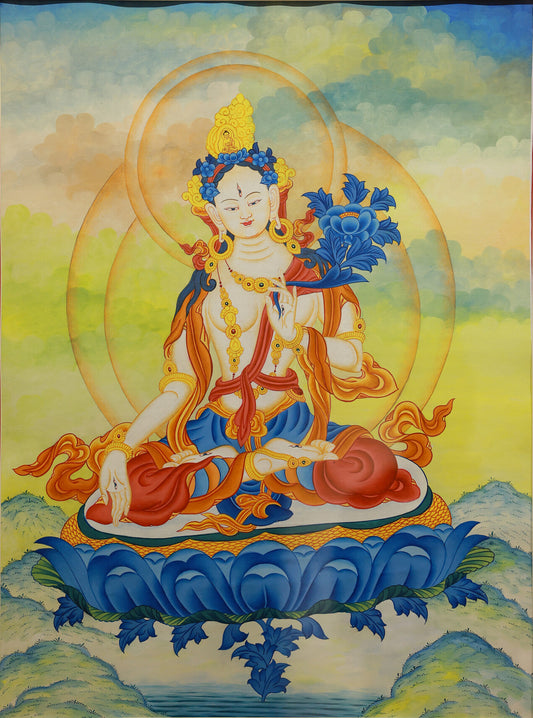
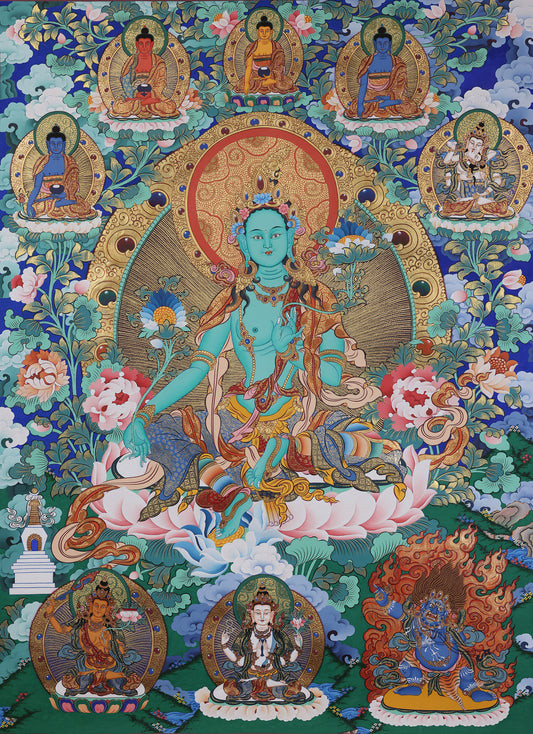
Seated at the center of the composition, White Tara manifests in a state of perfect serenity. Her form is no artist’s fancy; it is a sacred blueprint rendered strictly in accordance with the Treatise on Iconometry and Tara Ritual Texts, each brushstroke bearing profound Dharma meaning and vows.
-
Luminous Moonlike Form: Her entire body glows with a soft, radiant white, like moonlight—symbolizing her absolutely unblemished, cool, and untainted compassion. This white is not pale; it is a luminous, life-giving hue that purifies all agitation, illness, and fear.
-
Compassionate Maiden Visage: She takes the form of a sixteen-year-old celestial maiden, with eyebrows curved like crescent moons and eyes gently lowered, their gaze brimming with infinite tenderness and attentive listening. This reveals that true compassion unites the vitality of pure innocence with the wisdom of deep 包容.
-
Core Sacred Mark — The Seven Eyes: This is White Tara’s most potent symbol. Beyond her two eyes, she bears an eye on each palm, each sole, and a wisdom eye on her forehead—seven eyes in total. These represent her "all-seeing gaze upon the suffering of all beings in the three realms." No suffering, whether visible or hidden, physical or mental, escapes her omniscient, compassionate gaze. These seven eyes are the foundation of her great vow to "see in all directions and deliver swiftly," meaning her aid is comprehensive and instantaneous.
-
Right Hand in the Gesture of Granting (Abhaya Mudra): Her right hand rests naturally on her right knee, palm facing outward in a giving posture. This is the warmest of promises: to dispel all fear, anxiety, and unease in beings, and bestow deep inner calm, courage, and well-being. This symbol is especially precious amid the heavy pressures of modern life.
-
Left Hand Holding the Blue Utpala Lotus: Her left hand gently holds a blooming blue utpala lotus at her chest. The lotus, which grows from mud yet blooms pure, symbolizes that compassion can fully flourish in a world of afflictions. The stem curves gracefully over her shoulder, signifying her compassion extends like a vine to embrace all sentient beings. The small figure of Amitayus Buddha (Amitabha) in her crown is a key "identifying mark," confirming her noble identity as an emanation of Avalokiteshvara and highlighting her special merit of granting health and prolonging wisdom-filled life—echoing the deep tradition that "White Tara presides over longevity."
-
Double-Layered Blue Lotus Throne: She sits in a half-lotus posture upon a pure blue lotus throne. The layered petals, often edged in gold, symbolize that compassion and wisdom grow more magnificent amid worldly challenges. Beneath the throne, rippling green waters and mist-shrouded hills evoke a miniature vision of her pure realm: Mount Potalaka, the abode of Avalokiteshvara.
-
Warm, Radiant Aureole: Behind her is a double, perfect aureole woven from inner orange-yellow flame patterns and outer pale gold auspicious cloud patterns. This light is not scorching; it glows as warmly as a autumn sunset, representing that her light of compassion has the power to burn away obstacles, dispel the cold and darkness of life, and bring lasting hope, warmth, and good fortune.
Unlike the intricate mandala thangkas crowded with deities, this White Tara thangka uses a minimalist yet profound "single-deity" composition. This is not an omission but a subtle design that points directly to the core of Tibetan Buddhist visualization practices.
No offering goddesses or protectors are depicted, but the entire background itself is her vast retinue and pure land. The pale cyan auspicious clouds represent the eternal auspicious atmosphere and blessings surrounding the sacred being; the green waters and mountains beneath the lotus throne, drawn from the Root Tantra of Tara, depict White Tara abiding by a pure lotus pond. This masterful Menthang school technique—"using environment to represent assembly"—eliminates distractions, creating a pure, focused spiritual space that invites the viewer’s mind to settle and fully immerse in this realm of compassion.
This "empty" composition holds ultimate inclusivity in practice. It clearly reveals: you—every viewer, every worshipper—are the most important participant in this thangka’s vision. In traditional visualization, practitioners imagine themselves within this pure land, directly bathed in White Tara’s light and empowered by her. This thangka’s design removes all visual intermediaries, forging the most direct, personal sacred connection between you and the compassionate deity. This is the deepest, most practical echo of White Tara’s "swift deliverance"—deliverance occurs in every moment of your gaze.
This thangka originates from the long-standing Menthang painting school of Eastern Tibet, renowned for blending the delicate elegance of Chinese meticulous painting with the rich depth of Tibetan color. Its creation is a months-long devotional practice of purifying body, speech, and mind.
Creation begins with humble materials. Specially selected coarse cotton cloth undergoes eight complex ancient processes: soaking in custom yak-hide glue, stretching taut on a wooden frame, applying five or more layers of chalk whiting, and hand-polishing with smooth river stones hundreds of times until the surface is "as flat as a mirror, as soft as a baby’s skin." Artists view this process as a practice of "purifying the canvas of one’s own heart," reciting the Tara Mantra silently with each step to ensure both the material carrier and spiritual preparation are pure enough to bear the sacred image.
All colors are sourced from the earth’s treasures, prepared via ancient methods to carry life and spirituality:
-
White Tara’s Body Color: Made from highland chalk whiting mixed with finely ground pearl powder, yielding a soft, luminous warm white with a jade-like texture—far from pallid.
-
Blue Lotus and Pure Land: Crafted from top-grade Afghan lapis lazuli, hand-ground to a micron level, presenting a deep, tranquil, and sacred "Buddhaland blue."
-
Warm Aureole: Based on natural orpiment blended with a trace of gold powder, creating a warm, radiant, and peaceful orange-gold glow like the afterglow of the setting sun.
These mineral pigments, refined through ancient methods of "dry grinding, water levigation, and color separation," retain their soft luster and vitality for centuries—symbolizing that White Tara’s compassionate vows are eternal and ever-renewing.
-
Vibrant Linework: Using highly resilient wolf-hair brushes, artists imbue lines with distinct life based on the subject. The flowing celestial robes of White Tara use "Flowing Cloud Lines"—smooth and expansive, embodying her compassionate embrace and ease. Lotus petals and aureole outlines use "Iron-Wire Lines"—firm and strong, establishing the deity’s unshakable dignity. The critical "Seven Eyes" are outlined with "Extremely Fine Lines," each stroke focused with profound reverence for the ritual.
-
The Sacred "Opening the Face": Painting the face is the final, most inviolable step. The artist must bathe, fast, and maintain purity beforehand. White Tara’s compassionate, serene face must be completed "in one breath, with one defining stroke"—no revisions allowed. Ancient Tibetan wisdom holds that only in this moment of unwavering focus can the deity’s compassionate vows be fully and flawlessly "invited" into the painting. Later, key areas (the Amitayus Buddha in the crown, lotus throne edges) are outlined with 24K pure gold leaf. The gold glows brightly but not harshly, like supreme wisdom naturally radiating from boundless compassion.
Acquiring and consecrating this White Tara thangka gifts you a multi-dimensional treasure for life.
As a masterpiece of the Menthang school, it perfectly embodies the pinnacle of "Chinese style, Tibetan essence, and spiritual fusion": the flowing drapery lines draw from millennia of Chinese meticulous painting; the symbolic color system and majestic composition are rooted in Tibetan Buddhist core; the overall serene atmosphere is a unique spiritual creation. Its artistic and craft value make it a family heirloom to pass down, or a museum-quality piece to adorn a home with distinction.
Whether placed in a home shrine, bedroom, meditation study, or hung in a yoga studio, meditation center, clinic, counseling room, or executive office, the field of tranquility, compassion, and protection she emanates calms environmental restlessness and infuses stability and peace. She is especially revered as:
-
Guardian of Mothers and Children: Bringing safety, smooth childbirth, and healthy nourishment to pregnant women and newborns.
-
Protective Light for Travelers: Safeguarding those on journeys with safe passage, free from obstacles and sudden hardships.
-
Salve for Modern Anxiety: Her understanding gaze gently yet powerfully dissolves deep-seated fear, stress, and loneliness.
Daily communion with her is a simple yet profound inner practice:
- Gaze at her "Seven Eyes" to cultivate broader, more perceptive awareness and empathy.
- Feel her "Abhaya Mudra" to let go of unnecessary worry and cultivate calm courage to face challenges.
- Immerse yourself in the "pure land atmosphere" to preserve an inner sanctuary of coolness amid the busy city.
She does not promise effortless miracles, but offers steady, sustained spiritual nourishment and healing—guiding you to awaken the inherent peace, strength, and boundless compassion within your own life.
This White Tara thangka is a ray of moonlight shining into the mundane world, an echo of compassion that transcends time. She teaches us that the highest wisdom and deepest compassion are not distant theories—they can, through such dignified and beautiful forms, integrate into our homes, guard our days and nights, and warm our lives.
May all who behold this sacred image have minds as calm as a moonlit lake, unruffled by waves;May all who worship this sacred image have bodies protected and hearts anchored;May all who recall her merits walk without fear, their steps blooming into lotuses.
#WhiteTaraThangka #TibetanBuddhistArt #MenthangSchool #HandPaintedThangka #SevenEyedTara #CompassionateDeity #SacredArt #MineralPigmentArt #GoldLeafThangka #SpiritualDecor #BuddhistAltar #HeirloomArt #MindfulLiving #LongevityBlessings #PureLandThangka