When a Nepalese hand-painted thangka, with gem-like vivid colors and intricate details where every strand of ornament glows with mineral luster, is laid out before you, it is never just an ordinary decorative painting—it is a mobile temple of Tibetan Buddhism’s "entering the path through worldly wealth," and a condensed carrier of the Himalayas’ millennial craftsmanship and cultural memory.
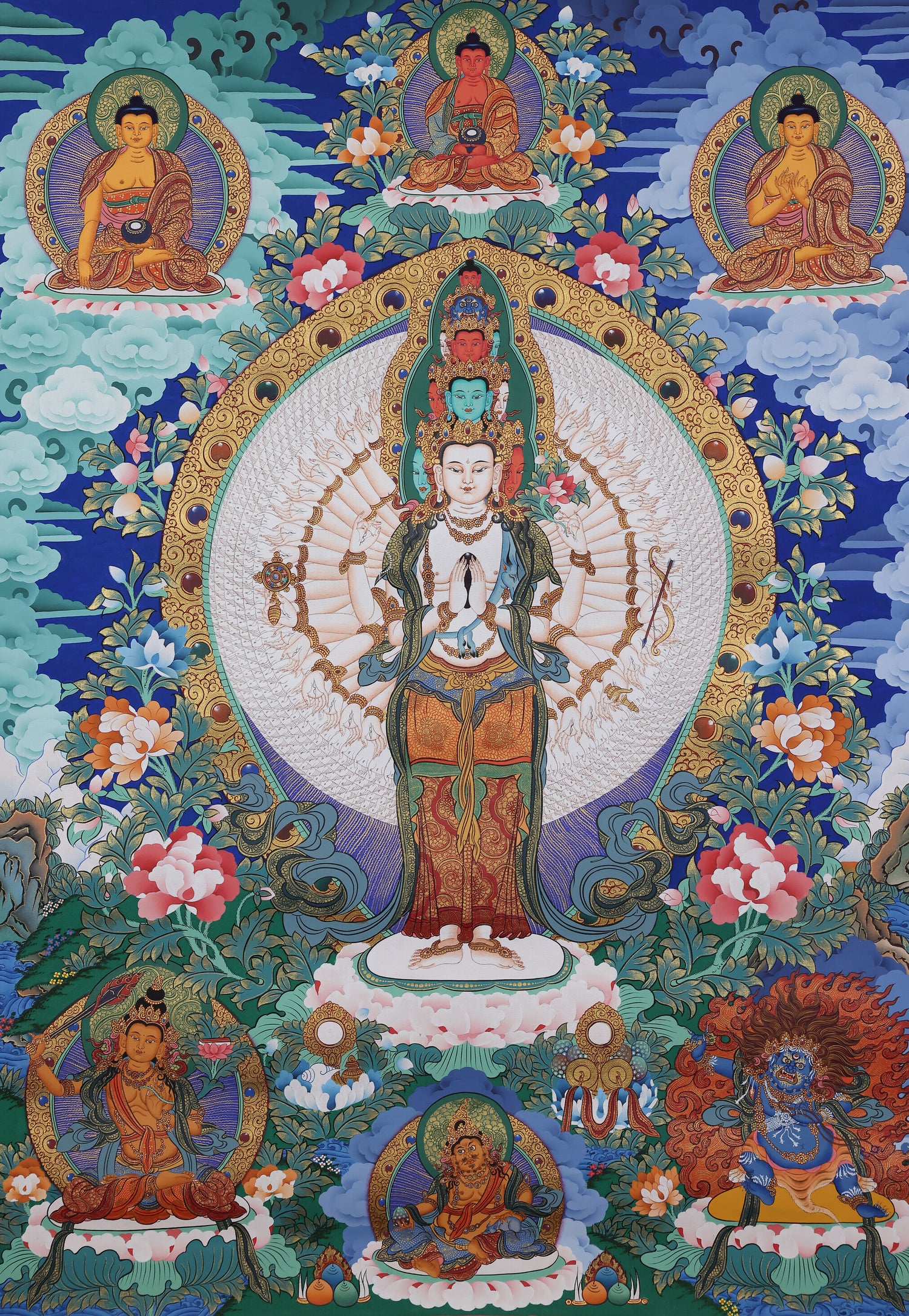
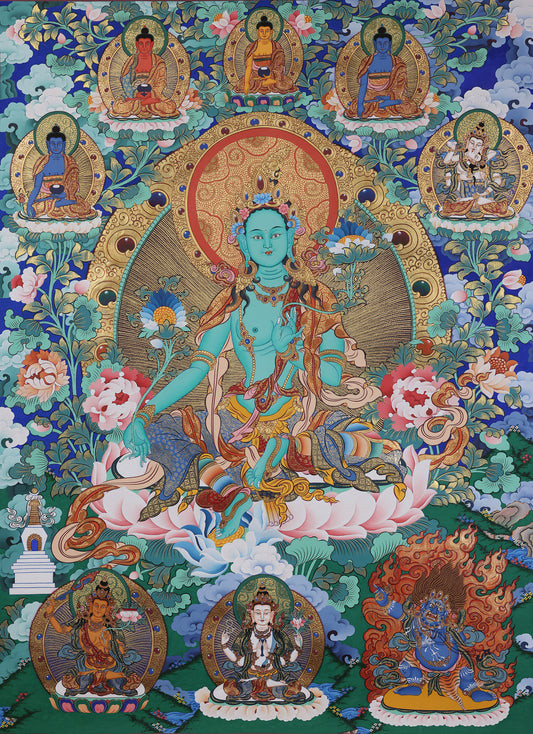
Today, we focus on this 45×64cm Nepalese "Color Thangka: Yellow Jambhala as the Main Deity with Five Wealth Gods" hand-painted thangka, dissecting the dual core of Tibetan wealth beliefs and art from its theme, deities, craftsmanship to style.
I. Theme: Five Wealth Gods Assembly—The Cosmic View of "Perfect Good Fortune" in Tibetan Esotericism
The core theme of this thangka is the assembly of the Five Wealth Gods (Five-Clan Wealth Gods), corresponding to the combination system of "Yellow, White, Red, Green, Black" wealth gods in Tibetan Buddhism. Behind it lies the cosmic logic of "five directions and five elements" and the spiritual wisdom of "entering the path through worldly wealth."
In Tibetan Buddhist doctrine, the Five Wealth Gods are not mere "luck-attracting symbols"—they are compassionate manifestations of the Five Dhyani Buddhas/Bodhisattvas to liberate sentient beings from the "karmic obstacle of poverty": Yellow Jambhala corresponds to Ratnasambhava Buddha (Central), White Jambhala to Avalokiteshvara (Bodhisattva), Red Jambhala to Amitabha Buddha (Western), Green Jambhala to Amoghasiddhi Buddha (Northern), and Black Jambhala to Akshobhya Buddha (Eastern).
This combination follows the balance of the five elements (Yellow for Earth, White for Metal, Red for Fire, Green for Wood, Black for Water) and embodies a core Tibetan esoteric insight: material wealth is a "favorable condition for practice"—eliminating the obstacle of poverty allows sentient beings to focus on cultivation; wealth, in essence, is the fruit of good karma, not a target of greed.
II. Main Deity: Yellow Jambhala—The Most Venerated "Embodiment of Merit and Resources" in Tibet
The central figure of the thangka is Yellow Jambhala (Zambhala in Tibetan), the leader of the Five Wealth Gods. Its iconography strictly adheres to the Iconometric Sutras, with every detail symbolizing "compassion and wealth":
-
Color and Form: Its golden-yellow body resembles the earth, symbolizing stable and vast wealth; the exposed chest and belly are not a sign of gluttony, but a manifestation of compassion that embraces all poor sentient beings; it wears a five-Buddha crown, representing the wisdom blessings of the Five Dhyani Buddhas.
-
Symbolism of Implements: The right hand holds a wish-fulfilling gem (Cintāmaṇi) (granting sentient beings’ reasonable wishes), while the left arm cradles a treasure-vomiting rat (Nure) (filled with jewels in its mouth, symbolizing "generosity as the source of wealth"); the right foot rests on a white conch, symbolizing "mastery of the laws of wealth, as smooth as retrieving treasures from the sea."
-
Religious Identity: Yellow Jambhala originated from Kubera, the wealth god of ancient Indian Brahmanism, and is also an incarnation of Vaiśravaṇa (one of the Four Heavenly Kings) in Buddhism. Tibetan esotericism deifies it as "Vasudhara Vajra"—in charge of "merit and resources," bestowing both material wealth and longevity/wisdom needed for practice. It is the most widely worshipped wealth protector in Tibetan households and businesses.
III. Attendant Deities: The Four Wealth Gods—Complementary "Guardians of Good Fortune"
The four deities around the main figure are the remaining four of the Five Wealth Gods, with their positions and forms strictly aligned with the logic of "five-direction protection":
-
Top Left: Red Jambhala
- Form: Crimson body like flame, holding a wish-fulfilling gem and treasure-vomiting rat; an embodiment of Amitabha Buddha’s compassion.
- Function: Governs "interpersonal connections and wealth luck," corresponding to the Fire element—symbolizing actively attracting favorable career opportunities.
-
Top Right: Green Jambhala
- Form: Emerald-green body like vegetation, holding a wish-fulfilling scepter and trident; an embodiment of Amoghasiddhi Buddha.
- Function: Governs "career and health," corresponding to the Wood element—symbolizing "growing wealth" such as agriculture, animal husbandry, and business.
-
Bottom Left: White Jambhala
- Form: Snow-white body like moonlight, riding a ferocious dragon (symbolizing "retrieving treasures from the sea"), holding a victory banner and treasure-vomiting rat; an embodiment of Avalokiteshvara.
- Function: Governs "wisdom and obstacle pacification," corresponding to the Metal element—symbolizing "pure, untainted wealth."
-
Bottom Right: Black Jambhala
- Form: Jet-black body like obsidian, holding an axe and treasure-vomiting rat, treading on a wealth-bearing deity; a wrathful embodiment of Akshobhya Buddha.
- Function: Governs "subduing wealth-leaking karmic obstacles," corresponding to the Water element—the fastest-acting wealth god among the five.
IV. Craftsmanship: Mineral Pigments + Hand-Painting—The "Eternal Beauty" That Does Not Fade for Millennia
This thangka adopts traditional Nepalese hand-painting craftsmanship, using natural mineral and earth pigments from the Himalayas—a production process of "intangible cultural heritage grade":
-
Pigment System: Red is derived from cinnabar (vermilion ore), purified via the water extraction method with lightfastness exceeding 300 years; blue comes from azurite (divided into "first-grade azurite" and "second-grade azurite" by particle size); green is from malachite; yellow is a mixture of orpiment and gold powder; black is made by 窖藏 (cellaring) and fermenting jet stone and 酥油 (ghee) lamp soot. A study by Tibet University shows that such mineral pigments have a lightfastness rating of ISO 7-8, fading by only 2.3% after 300 years.
-
Production Process: From priming white cotton cloth with glue and alum water, to sketching with charcoal according to the Iconometric Sutras, to outlining with wolf-hair brushes, layering mineral colors, and finally gilding with 24K gold powder—the entire process takes 1 to 3 months. Before painting, the artist must bathe, purify themselves, and recite mantras while visualizing, ensuring every stroke complies with religious rituals.
-
Size Value: At 45×64cm, it is a "medium-sized thangka"—suitable for both altar worship and study display, serving as a practical carrier of "daily blessing" and "cultural inheritance" in Tibet.
V. Style: Nepalese Kathmandu Valley—Balance Between Magnificence and Rigor
This thangka is a typical representative of the Nepalese Kathmandu Valley style, retaining the rigor of Tibetan iconography while integrating the magnificent traits of local art:
- Difference from Tibetan Thangkas: Tibetan thangkas have restrained colors, simple compositions, and focus on "solemnity"; Nepalese thangkas feature high-saturation colors (e.g., the golden-yellow of the main deity and the crimson of Red Jambhala), intricate cloud and lotus patterns, and incorporate the "rounded forms" of Indian Pala art, making the deities more vivid and full.
- Iconographic Rigor: Despite its magnificent style, the artist strictly follows the "three sutras and one commentary"—the height proportions of the main deity and the positions of the attendants’ implements are consistent with scriptural records, embodying the religious attribute of "thangka as a mobile temple."
VI. Cultural Value: From "Luck-Attracting Symbol" to "Spiritual Wisdom"
The core value of this thangka lies in the Tibetan Buddhist wisdom of "entering the path through worldly wishes":
-
Religious Function: As an "assembly thangka," practitioners can visualize the Five Wealth Gods and recite mantras to pray for good fortune. However, doctrine emphasizes that "practice requires the Bodhicitta"—seeking wealth with greed creates karma, while using wealth to give alms and help others achieves "dual perfection in worldly and transcendental realms."
-
Artistic Value: It combines "traditional craftsmanship and cultural memory"—the use of mineral pigments inherits millennial techniques, and the Nepalese style reflects cultural integration in the Himalayas, making it a living sample of "human intangible cultural heritage."
-
Contemporary Insight: The symbol of the "treasure-vomiting rat spitting jewels outward" serves as a reminder for modern society: true abundance lies in "inner compassion and wisdom," not material hoarding.
#NepaleseYellowJambhalaThangka #TibetanBuddhistFiveWealthGods #MineralPigmentHandPaintedThangka #TibetanThangkaCulture #KathmanduValleyThangkaStyle #ColorThangka #HandPaintedTibetanThangka #NaturalMineralPigmentArt #HimalayanArtCulture #TibetanBuddhistWealthDeities