Within the visual and spiritual system of Tibetan Buddhism, thangka paintings are far more than decorative religious artworks. They are sacred vessels of doctrine, meditation aids, and visual embodiments of Buddhist philosophy. Through strict iconographic canons and symbolic language, thangkas transform abstract wisdom into a form that can be seen, contemplated, and practiced.
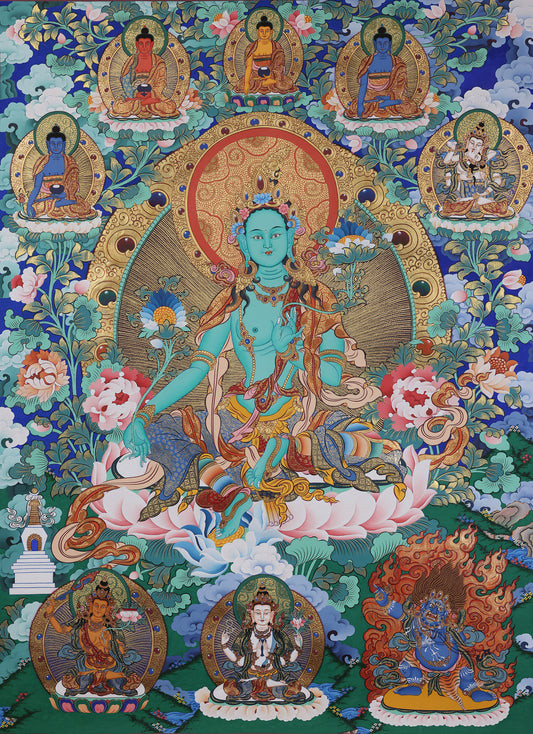
This hand-painted gold leaf Green Tara thangka is created using traditional Tibetan gilding techniques and precise ritual measurements. Radiating luminous golden light, it presents Green Tara as the embodiment of swift compassion and enlightened activity. Noble yet dynamic, opulent yet disciplined, this thangka stands as a refined union of faith, art, and cultural transmission.
I. Core Theme: The Belief in Green Tara as the “Swift and Courageous Liberator”
The spiritual core of this thangka is rooted in the Tibetan Buddhist devotion to Green Tara’s power to rescue beings from danger and fulfill virtuous aspirations.
Green Tara, known in Tibetan as Drolma, is regarded as the manifestation of Avalokiteshvara’s boundless compassion. According to The Origin of Tara, Avalokiteshvara, witnessing the unceasing suffering of sentient beings in the six realms, shed tears that fell upon the earth and transformed into a lotus. From that lotus arose Green Tara, who later manifested as the Twenty-One Taras, embodying the four enlightened activities:
Pacifying, Increasing, Magnetizing, and Subjugating.
In Tibetan culture, Green Tara is revered as the “Swift and Courageous Mother”, symbolizing immediate compassionate action without hesitation. She is believed to rescue beings from the Eight Great Dangers:
lions, elephants, fire, water, imprisonment, thieves, poisonous snakes, and harmful non-human forces. These dangers represent both external threats and internal afflictions.
From a Vajrayana perspective, Green Tara corresponds to Amoghasiddhi, the Buddha of the North, and embodies the Wisdom of Accomplishing Action (All-Accomplishing Wisdom). This wisdom transforms hesitation and doubt into decisive enlightened activity.
The use of a gold leaf background elevates this symbolism further, expressing the indestructible, timeless nature of compassion and perfectly aligning with the Tibetan Buddhist principle of the union of wisdom and compassion.
II. The Main Deity: Perfect Unity of Iconography and Symbolism
At the center of the composition, Green Tara is depicted in strict accordance with the Iconometric Scriptures, manifesting the canonical “sixteen-year-old maiden form”, which symbolizes awakened vitality, purity, and compassionate responsiveness.
1. Body Color and Hand Gestures
Her body is rendered in a luminous emerald green, signifying enlightened activity and accomplishment. She has one face and two arms:
-
The right hand extends the Gesture of Supreme Generosity (Varada Mudra), palm outward, offering fearlessness and protection.
-
The left hand holds the stem of a utpala (blue lotus) at her heart, forming the Gesture of Granting Refuge and Fulfillment of Wishes.
Her posture is the “royal ease” or “playful posture”, with the right leg extended and the left leg folded, symbolizing her readiness to rise instantly to aid sentient beings.
2. Ornaments and Crown
Green Tara wears a Five-Buddha Crown, representing the wisdoms of the Five Dhyani Buddhas and her mastery over them. Her jeweled ornaments—necklaces, armlets, and silken scarves—reflect both celestial beauty and a profound tantric truth: afflictions themselves can be transformed into enlightenment. The brilliance of jewels mirrors the innate Buddha-nature present within all beings.
3. Lotus Throne and Sacred Attributes
The utpala lotus held in her left hand bears one stem with three blossoms, symbolizing liberation across past, present, and future. She sits upon a thousand-petaled lotus supported by a moon disc, where the moon signifies purity and the lotus represents transcendence without withdrawal from the world.
III. Attendant Deities: The Ordered Structure of the Buddhist Cosmos
The surrounding deities in this thangka are not decorative elements but essential components of a hierarchical cosmic structure, expressing the Tibetan Buddhist worldview.
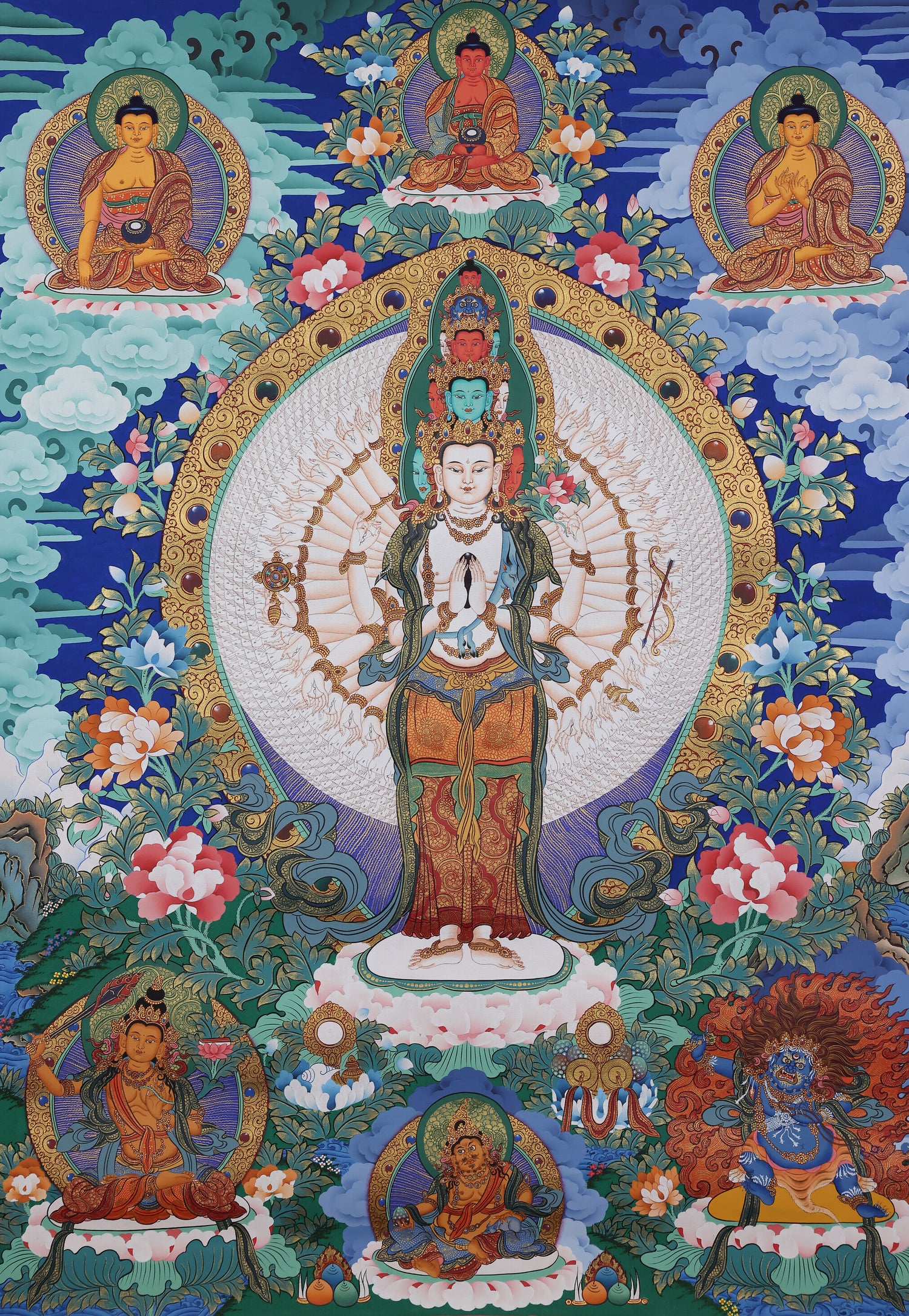
The Five Dhyani Buddhas Above: Cosmic Coordinates of Wisdom
Positioned above the main deity are the Five Dhyani Buddhas, embodying the Five Wisdoms and the universal order of enlightenment. Green Tara, as an emanation of Amoghasiddhi, functions as the bridge through which transcendent wisdom becomes effective compassionate action in the world.
Attendant Deities Below: Supportive Enlightened Functions
Below Green Tara appear two attendant deities:
-
Ushnishavijaya, the Goddess of Longevity, symbolizing purification, long life, and freedom from karmic obstacles.
-
Vajrayogini or Vajrapani, representing power, protection, and the subjugation of negative forces.
Together with Green Tara, they form a complete triad of Compassion, Longevity, and Protective Power, reflecting Tibetan Buddhism’s integrated emphasis on both worldly well-being and ultimate liberation.
IV. Artistic Craftsmanship: The Supreme Art of Gilded Engraved Thangka
This thangka is created using the most refined Tibetan technique: engraved gold leaf painting, a process that demands extraordinary patience, precision, and spiritual discipline.
The process begins with a cotton canvas prepared through multiple layers of mineral gesso. Pure gold leaf or finely ground gold powder is then applied in five to eight successive layers, each carefully dried and burnished until the surface reaches a density suitable for engraving.
The artist then drafts the sacred geometry using mineral pigments, adhering strictly to canonical proportions. With specialized agate engraving tools, intricate patterns are carved into the gold surface—clouds, robes, halos, and ornaments—creating contrasting matte and mirror-like reflections.
Finally, natural mineral pigments such as malachite green, azurite blue, and cinnabar red are applied, their permanence symbolizing the enduring nature of the Dharma.
After completion, the thangka undergoes ritual consecration by monks and is traditionally mounted in silk brocade, transforming it from an artwork into a field of merit.
A single medium-sized engraved gold thangka typically requires three to six months of focused creation, embodying the principle of “entering the path through art.”
V. Cultural Significance: A Living Union of Faith, Art, and Transmission
The value of this gold leaf Green Tara thangka extends far beyond aesthetics:
-
Spiritual Value: A powerful support for visualization practice and mantra recitation, especially the Green Tara mantra:
Om Tare Tuttare Ture Soha
-
Artistic Value: A representative masterpiece of Himalayan Buddhist painting traditions, combining symmetry, symbolism, and sacred ornamentation
-
Cultural Value: A living expression of intangible cultural heritage, preserving ancient techniques passed down through generations of master painters
Ultimately, this thangka becomes a visual embodiment of compassion, a material expression of wisdom, and a bridge between ancient spiritual traditions and modern life.
To gaze upon Green Tara radiating from golden light is to enter a silent dialogue with centuries of devotion—and to reconnect with the universal human aspiration for protection, clarity, and compassionate action.
#GreenTaraThangka
#TibetanBuddhistArt
#GoldLeafThangka
#HandPaintedThangka
#SacredBuddhistArt
#GreenTara
#SwiftCompassion
#ProtectionAndBlessings
#EnlightenedActivity
#BodhisattvaArt
#EngravedGoldThangka
#HimalayanArt
#TraditionalThangka
#IntangibleCulturalHeritage
#TibetanThangkaPainting
#BuddhistWallArt
#SpiritualHomeDecor
#MeditationArt
#SacredArtCollection