Nepalese Hand-Painted White Tara Thangka: An Artistic Vessel of Tibetan Buddhist Compassion (Full Analysis of a 48×66cm Mineral Pigment Color Thangka)

$599.00 USD
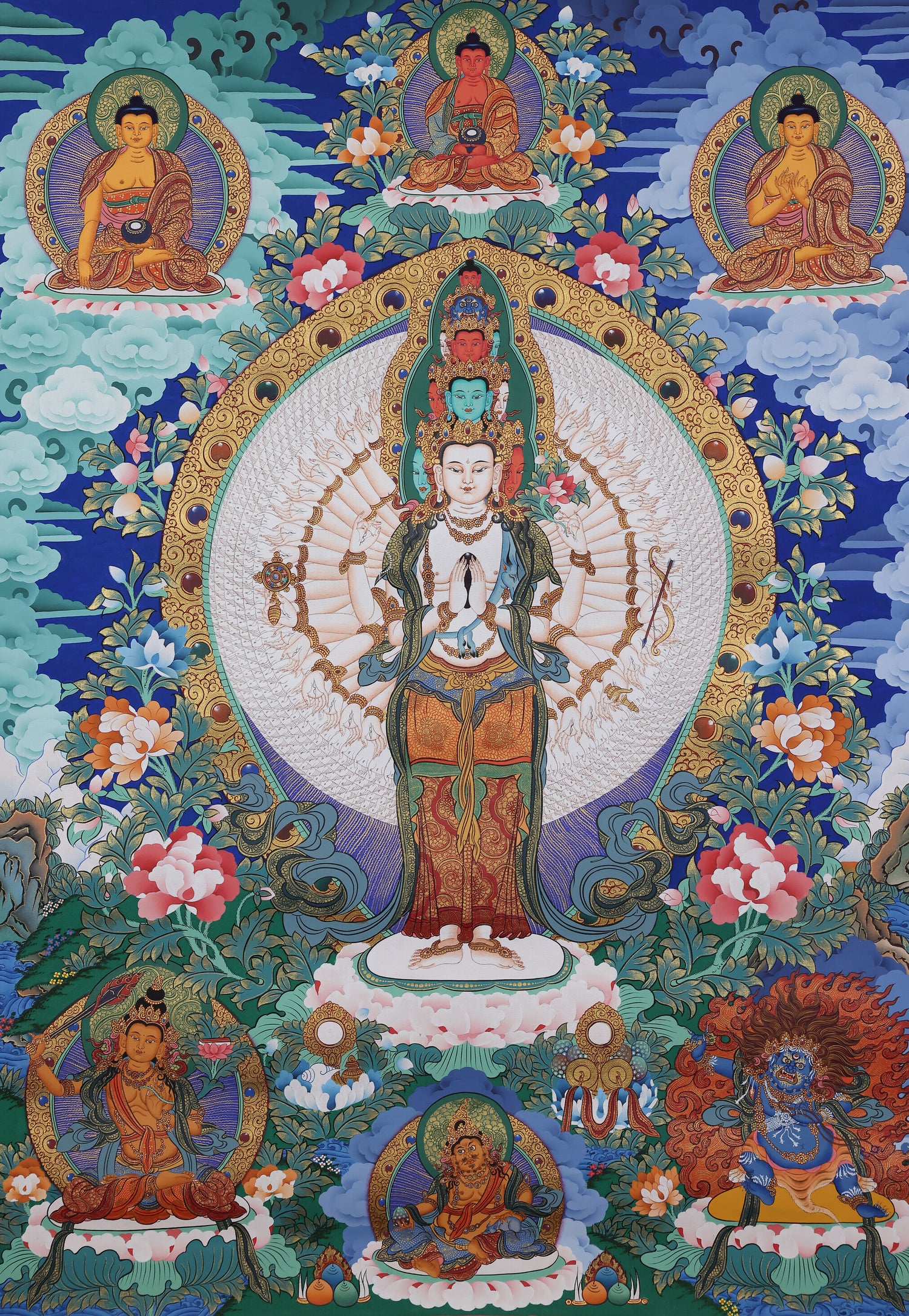
Thangka name: Colorful Tang White Tara
size: 48cm×66cm
origin: Nepal
Eine Frage stellen

Beeil dich! Nur noch [Anzahl] auf Lager!

Geschätzte Lieferzeiten: 12–26 Tage (International), 3–6 Tage (USA).

Rückgabe innerhalb von 45 Tagen nach dem Kauf. Zölle und Steuern werden nicht erstattet.

A colorful Tibetan Thangka of White Tara, symbolizing compassion and purity.
Nepalese Hand-Painted White Tara Thangka: An Artistic Vessel of Tibetan Buddhist Compassion (Full Analysis of a 48×66cm Mineral Pigment Color Thangka)
$599.00 USD
When a hand-painted Nepalese color thangka of White Tara unfurls, the 48×66cm cotton canvas bears not just hues blended from mineral pigments, but the embodied spirit of "unity of compassion and wisdom" in Tibetan Buddhism. As one of the "Three Longevity Deities" in Tibetan Buddhism, White Tara, rendered by Nepalese artisans, serves as a bridge between faith and art—and this work, painted with natural mineral pigments, is a classic example of "visualized faith" in the Himalayan cultural sphere.

I. Theme: A Visual Narrative of Tibetan Buddhist Compassionate Deliverance

The core theme of this thangka is the "Seven-Eyed Deliverance" and "Longevity Blessings" embodied by White Tara.

In the Tibetan Buddhist system, White Tara is the compassionate emanation of the left tear of Avalokiteshvara (the right tear becomes Green Tara), a central figure among the "Twenty-One Taras," and one of the "Three Longevity Deities" alongside Amitayus Buddha and Ushnisha Vijaya. Centered entirely on White Tara, this thangka conveys the most basic spiritual aspirations of Tibetan Buddhist devotees—warding off disasters, extending life, and fulfilling wishes—through the main deity’s posture, attendant configuration, and auspicious symbols.

White Tara’s "seven eyes" (on the forehead, palms, and soles) are the visual anchor of the theme: they symbolize "watching over suffering in all six realms," while elements like the lotus throne and vase implicitly align with the spiritual goal of "pure liberation." For Nepalese devotees, this thangka is not merely an object of worship, but a tangible spiritual anchor for daily prayers, making "compassion accessible."

II. Main Deity: The Symbolic Code of White Tara’s Iconographic Rules

Every detail of the thangka’s main deity strictly adheres to the Iconometric Sutras, holding the symbolic logic of Tibetan Buddhism:

1. Form: The Embodiment of Pure Compassion

  • Body Color & Countenance: Snow-white in hue, corresponding to "unstained compassionate intent and pure wisdom"; the face takes the form of a sixteen-year-old maiden, implying the longevity motif of "eternal youth," while the gentle expression conveys the 胸怀 of "unconditional great compassion."
  • Seven-Eyed Mark: The clearly visible third eye (on the brow) and palm eyes are White Tara’s signature symbols—seven eyes represent "unobstructed observation of sentient beings’ suffering," a concrete expression of her "swift deliverance."
  • Ornaments: Adorned with an Indian-style flower garland crown (distinct from Tibetan jewel crowns), paired with large earrings, necklaces, and celestial robes, it inherits Indian Buddhist iconographic traditions while using "worldly adornments" to metaphorize the doctrine of "upholding good intentions."

2. Posture & Implements: The Visualization of Aspirations

  • Seat & Lotus Throne: Seated in full lotus posture on a double lotus throne (the lower red lotus represents "rising unsoiled from mud," the upper white lotus represents "pure original mind"), the stable posture carries an undercurrent of "readiness to rise and deliver."
  • Mudra & Offerings: The right hand forms the "wish-fulfilling mudra" (palm downward), signifying "granting sentient beings’ good wishes"; the left hand holds a blue lotus (utpala), its stem curving to the ear (the bud 暗含 a vase of nectar), symbolizing "moistening afflictions with compassionate nectar."

III. Attendant Deities: Order and Function in the Sacred Space

The thangka’s attendant deities are not mere decorations, but key to constructing the "main deity-attendant-protector" system, reflecting the "clear hierarchy" of Nepalese thangka composition:

  • Left Attendant: A pale-yellow, reverently posed attendant bodhisattva (or emanation of Yellow Tara), whose function is to "assist the main deity in fulfilling wishes"; its attire echoes the main deity, enhancing the thangka’s coherence.
  • Right Protector: An indigo-blue wrathful deity (a "benevolent wrathful protector") standing with a vase—its wrathful form is not menacing, but represents "subduing obstacles with fierce power," echoing the Tibetan Buddhist tantric concept that "compassion and ferocity are non-dual."
  • Upper Emanation: A small red-bodied seated Buddha (Amitayus or Avalokiteshvara) at the top, White Tara’s "original deity," symbolizing "doctrinal lineage" and completing the faith cycle of "returning to the source."
  • Background Elements: Golden flowing cloud patterns (a signature motif of Nepalese thangkas) conceal golden dragons and birds, while stylized bodhi trees adorn the right side—these elements create an atmosphere of "sacred auspiciousness" and break the monotony of static composition with dynamic lines.

IV. Craftsmanship & Style: Tradition and Precision in Nepalese Color Thangkas

Half the value of this thangka lies in faith, the other in craftsmanship—as a hand-painted Nepalese color thangka, it carries the unique genes of regional art:

1. Materials & Pigments: The Timelessness of Natural Minerals

  • Canvas Preparation: Using white cotton as the base, simplified processes (gluing, sanding, whitening) (distinct from the multi-layered treatment of Tibetan thangkas) balance durability and paintability, suiting the practical needs of Nepalese household worship.
  • Mineral Pigments: Natural mineral pigments like lapis lazuli (blue), cinnabar (red), and ochre (yellow) yield saturated, century-resistant hues—lapis lazuli grindings produce calm blues, cinnabar blends create vibrant reds, and 24K gold powder outlines crisp, unostentatious lines, serving as a material vessel for "eternal faith."

2. Regional Style: Fusion of Indian Tradition and Himalayan Aesthetics

  • Composition Logic: Centered on the main deity with symmetrically arranged attendants, it strictly follows iconographic rules but adds dynamism with flowing clouds, distinguishing it from the "rigid symmetry" of Tibetan thangkas.
  • Lines & Colors: Soft, 舒展 figures (rounded shoulders on the main deity, natural postures of attendants) use warm tones (gold, red, orange) as the base, accented by cool tones (blue, green)—aligning with Nepalese color symbolism (red = prominence, yellow = brightness) while building a sacred atmosphere through layering.
  • Balance of Folk and Religious Qualities: Compared to the "dense detail" of Tibetan thangkas, this work has a simpler background that emphasizes the main deity—this is the practical aesthetics of Nepalese thangkas, adapted for household worship.

Conclusion: A Dual Heritage of Faith and Art

This 48×66cm Nepalese White Tara thangka is a "visual scripture" of Tibetan Buddhist compassionate faith and a living sample of Nepalese traditional craftsmanship. It carries spiritual heritage through the timelessness of mineral pigments and interprets religious rules through regional artistic characteristics—when we gaze at White Tara’s seven eyes in the painting, we see not just art, but the core spirit of Tibetan Buddhism: "watching over suffering with wisdom, practicing deliverance with compassion."

#NepaleseWhiteTaraThangka

#TibetanBuddhistThangkaAnalysis

#MineralPigmentThangkaCraft

#WhiteTaraIconographySymbolism

#NepaleseColorThangkaStyle

#TibetanBuddhistCompassionateFaith

#ThangkaAttendantDeities

#ThreeLongevityDeitiesThangka

#HimalayanArt

#ThangkaCollectionAppreciation

Entdecken Sie das perfekte tibetisch-buddhistische Thangka, das zu Ihren Wünschen, Ihrem Lebensstil und Ihrem Raum passt. Jedes Thangka hat eine spirituelle Bedeutung und bringt Segen, wenn es richtig platziert wird.

1. Definieren Sie Ihre Absicht

Reichtum & Erfolg → Gelber Dzambhala (Gottheit des Reichtums)

Mitgefühl und Frieden → Avalokiteshvara, Grüne Tara

Weisheit & Lernen → Manjushri

Gesundheit & Heilung → Medizinbuddha

Langlebigkeit und Familienschutz → Weiße Tara

2. Wählen Sie nach Identität

Unternehmer und Geschäftsinhaber → Reichtumsgottheiten für Wohlstand.

Studenten und Gelehrte → Weisheitsgottheiten für Konzentration und Klarheit.

Heiler und Yoga-Praktizierende → Medizinbuddha für Energie und Gleichgewicht.

Familien und Hausfrauen → Tara-Gottheiten für Harmonie und Sicherheit.

Sammler und Kunstliebhaber → Seltene Mandalas oder Meisterwerk-Thangkas.

3. Passen Sie Ihren Raum an

Heimschrein / Meditationsraum → Mittlere Thangkas (60–80 cm).

Büro / Geschäftshalle → Große Thangkas für Wohlstand und Autorität.

Wohnzimmer / Arbeitszimmer → Dekorative Thangkas für Frieden und Schönheit.

4. Authentische Handwerkskunst

Jedes Thangka ist mit natürlichen Mineralpigmenten und feiner Leinwand handbemalt und spiegelt tibetische Kunstfertigkeit und spirituelle Kraft wider. Überprüfte Quellen gewährleisten Qualität und Respekt für die Tradition.

✨ Wählen Sie Ihr Thangka mit Herz – es ist nicht nur Kunst, sondern ein Segen für Ihr Leben.

Jeder Mensch hat unterschiedliche Bedürfnisse. Die Wahl des richtigen Thangkas kann spirituelle Unterstützung, Schutz, Glück und Segen bieten. Nachfolgend finden Sie Thangka-Empfehlungen für verschiedene Rollen:

1. Unternehmer

  • Bedürfnisse : Weisheit, Reichtum, Gesundheit, beruflicher Erfolg.
  • Empfohlene Thangkas :
    Manjushri : Verbessert die Entscheidungsfindung und Geschäftsweisheit.
    Gottheit des Reichtums : Bringt Reichtum und Wohlstand.
    Medizinbuddha : Unterstützt die Gesundheit und reduziert Stress.
    Mahakala : Schützt Unternehmen vor Konkurrenz und Herausforderungen.

2. Erfolgreiche Einzelpersonen

  • Bedürfnisse : Innerer Frieden, Familienharmonie, Langlebigkeit.
  • Empfohlene Thangkas :
    Amitabha Buddha : Bringt inneren Frieden und Ruhe.
    Avalokiteshvara (Guanyin) : Fördert Harmonie und Glück in der Familie.
    Amitayus (Langlebens-Buddha) : Betet für gute Gesundheit und ein langes Leben.
    Manjushri : Stärkt weiterhin die Weisheit.

3. Hausfrauen/Ehemänner

  • Bedürfnisse : Familienharmonie, Schutz, Gesundheit.
  • Empfohlene Thangkas :
    Avalokiteshvara : Steigert das Familienglück und die Harmonie.
    Schutzgottheiten : Beschützen die Familie vor äußeren Störungen.
    Weiße Tara : Segnet die Familie mit Gesundheit.

4. Studierende und Wissenschaftler

  • Bedürfnisse : Weisheit, Konzentration, akademischer Erfolg.
  • Empfohlene Thangkas :
    Manjushri : Fördert Lernfähigkeit, Gedächtnis und Weisheit.
    Shakyamuni Buddha : Hilft bei der Konzentration und spirituellen Praxis.
    Jixiang Tianmu : Bringt akademisches Glück und Prüfungserfolg.

5. Künstler und Kreativprofis

  • Bedürfnisse : Inspiration, Kreativität, künstlerische Leistung.
  • Empfohlene Thangkas :
    Manjushri : Regt kreatives Denken und Inspiration an.
    Vajrapani : Hilft, kreative Blockaden zu überwinden.
    Maitreya : Sorgt für eine entspannte und optimistische Einstellung und baut Stress ab.

6. Reisende und Abenteurer

  • Bedürfnisse : Schutz, Glück, Erfolg bei Abenteuern.
  • Empfohlene Thangkas :
    Hayagriva : Bietet starken Schutz auf Reisen und beseitigt Hindernisse.
    Mahakala : Bringt Glück und Schutz, insbesondere für Abenteurer.
    Vajrasattva : Hilft, Schwierigkeiten und Herausforderungen während der Reise zu überwinden.

7. Ältere Menschen

  • Bedürfnisse : Gesundheit, Langlebigkeit, spiritueller Frieden.
  • Empfohlene Thangkas :
    Amitayus : Betet für ein langes Leben und gute Gesundheit.
    Medizinbuddha : Fördert Heilung und körperliches Wohlbefinden.
    Avalokiteshvara : Bringt Mitgefühl und inneren Frieden in späteren Jahren.

8. Führungskräfte

  • Bedürfnisse : Führung, Weisheit, Teamarbeit und geschäftlicher Erfolg.
  • Empfohlene Thangkas :
    Manjushri : Verbessert Führungsqualitäten und Entscheidungsfindung.
    Gottheit des Reichtums : Bringt dem Unternehmen und dem Team Erfolg und Wohlstand.
    Avalokiteshvara : Fördert Harmonie und Gleichgewicht innerhalb des Teams.

9. Gesundheits- und Fitnessbegeisterte

  • Bedürfnisse : Gute Gesundheit, Vitalität, Energie.
  • Empfohlene Thangkas :
    Medizinbuddha : Verbessert die körperliche Gesundheit und Vitalität.
    Weiße Tara : Bringt Gesundheit und Verjüngung.
    Vajrasattva : Beseitigt gesundheitliche Probleme und steigert die Energie.

10. Politiker

  • Bedürfnisse : Führung, Weisheit, Frieden.
  • Empfohlene Thangkas :
    Manjushri : Verbessert Führungsqualitäten und Entscheidungsfindung.
    Vairocana Buddha : Hilft, inneren Frieden und Weisheit zu bewahren.
    Avalokiteshvara : Fördert den gesellschaftlichen Frieden und die Harmonie in der Familie.

Für alle Bestellungen über 100 USD ist der Versand kostenlos.

Rücksendungen werden bis zu 10 Tage nach Erhalt des Kaufbelegs bzw. der Sendungsnummer (bei ungetragenen Artikeln) akzeptiert. Sie als Kunde sind verpflichtet, uns vor der Rücksendung des Artikels per E-Mail zu informieren.

Andernfalls fallen die Standardversandkosten an. Weitere Informationen finden Sie in unseren Lieferbedingungen .

Rücksendungen werden bis zu 10 Tage nach Erhalt des Kaufbelegs oder der Sendungsnummer (bei ungetragenen Artikeln) akzeptiert. Sie als Kunde sind verpflichtet, uns vor der Rücksendung des Artikels per E-Mail zu informieren, nur in folgenden Fällen:

– Den falschen Artikel erhalten.
– Artikel kam nicht wie erwartet an (z. B. beschädigte Verpackung).
– Artikel hatte Mängel.
– Über die Lieferzeit hinaus.
– Der Spediteur gestattet keine Besichtigung der Ware vor der Bezahlung.

Die zurückgesendeten Produkte müssen in der Originalverpackung, sicher verpackt, unbeschädigt und ungetragen sein. Dies bedeutet, dass die Artikel zum Schutz während des Transports sicher in einem Karton verpackt sein müssen, möglichst im selben Karton, in dem sie an Sie als Kunde versendet wurden.

Kürzlich angesehen

Nicht vergessen! Die Produkte, die Sie angesehen haben, legen Sie jetzt in den Warenkorb.

Passt gut zu

Erweitern Sie Ihre Auswahl mit perfekt abgestimmtem Zubehör und ergänzenden Produkten.

Leute kauften auch

Hier sind einige unserer ähnlichsten Produkte, die die Leute kaufen. Klicken Sie hier, um den Trendstil zu entdecken.