Nepalese Hand-Painted Thangka Analysis: The Faith and Art of the Tibetan Buddhist Thousand-Handed Avalokiteśvara Thangka

$599.00 USD
Thangka name: Colorful Tang Thousand-Handed Guanyin
size: 45cm×61cm
origin: Nepal
Eine Frage stellen

Beeil dich! Nur noch [Anzahl] auf Lager!

Geschätzte Lieferzeiten: 12–26 Tage (International), 3–6 Tage (USA).

Rückgabe innerhalb von 45 Tagen nach dem Kauf. Zölle und Steuern werden nicht erstattet.

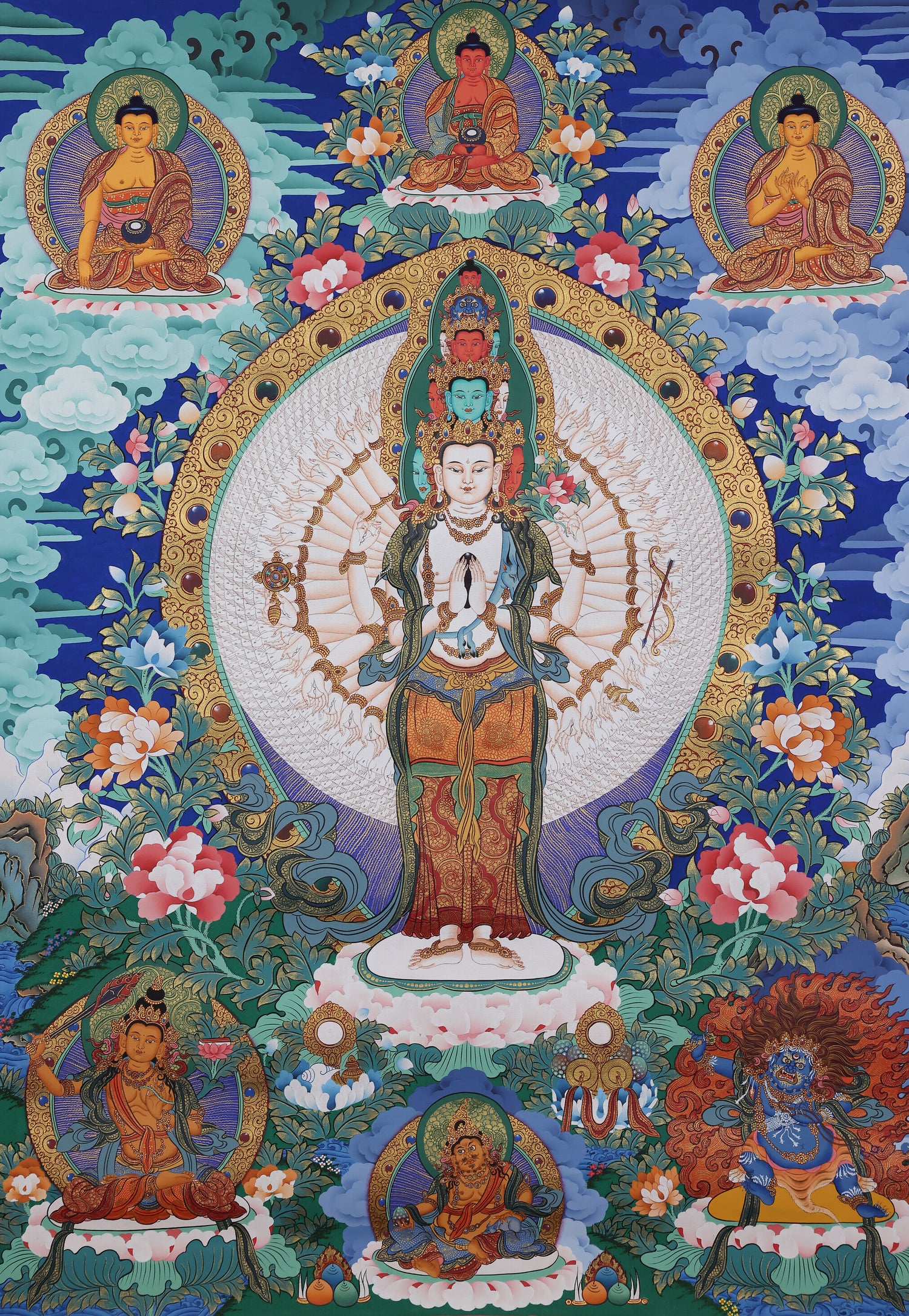
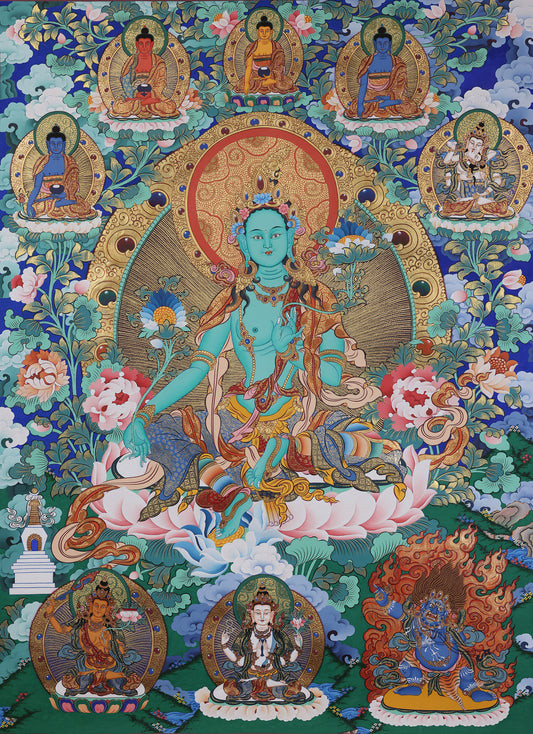
Hand-painted Tibetan Thangka showing Thousand-Armed Avalokiteshvara offering compassion and blessings
Nepalese Hand-Painted Thangka Analysis: The Faith and Art of the Tibetan Buddhist Thousand-Handed Avalokiteśvara Thangka
$599.00 USD

Nepalese Hand-Painted Thangka: The Symbiosis of Faith and Art in the Tibetan Buddhist Thousand-Handed Avalokiteśvara Thangka

When a Nepalese thangka, rich with lapis lazuli blue and malachite green, unfolds before your eyes, you’re not just seeing a vivid painting—you’re encountering a fusion of Tibetan Buddhist compassionate faith and Himalayan traditional craftsmanship. Today, we delve into a 45×61cm hand-painted Thousand-Handed Avalokiteśvara thangka from Nepal: grounded in Tibetan Buddhist culture, we decode its theme, deities, craftsmanship, and style to unlock all the secrets of this mineral-pigment thangka.

I. Theme: The Visualized Faith of "Great Compassionate Salvation" in Tibetan Buddhism

The core theme of this thangka is the Thousand-Handed, Thousand-Eyed Avalokiteśvara, a tangible expression of the "universal compassionate protection" ethos in Tibetan Buddhism.

In the Tibetan esoteric tradition, the Thousand-Handed Avalokiteśvara (Sanskrit: Sahasrabhuja-Sahasranetra Avalokiteśvara) is known as the "Great Compassion Avalokiteśvara." Its iconography originates from the Sutra of the Great Compassionate Heart Dharani of the Thousand-Handed, Thousand-Eyed Avalokiteśvara: when Avalokiteśvara vowed to "bring benefit and peace to all sentient beings," he instantly manifested a thousand hands (to protect) and a thousand eyes (to observe)—the thousand hands symbolize "boundless spiritual power encompassing the world," while the thousand eyes represent "witnessing all sentient beings’ suffering," together embodying the spiritual core of "saving beings with great compassion."

For Nepal, this thangka inherits the Tibetan Buddhist belief that "Avalokiteśvara is the Protector of the Snowy Lands" (Tibetans regard Avalokiteśvara as the ancestor of the Tibetan people) while integrating Newari cultural aesthetics: it transforms abstract "compassion" into an artistic vessel that balances religious solemnity and visual splendor, making faith tangible.

II. The Main Deity: The Esoteric Symbol System of the Eleven-Faced Thousand-Handed Avalokiteśvara

The central deity in the painting is the Eleven-Faced Thousand-Handed Avalokiteśvara, which adheres strictly to the Canon of Buddhist Iconometry while carrying the softened warmth of Nepalese style:

  • The Hierarchical Meaning of the Eleven Faces: The deity’s head displays eleven faces arranged in a five-tiered "pagoda shape," corresponding to the esoteric logic of Tibetan Buddhism’s "Five Buddha Families" and "Three Kayas":
    • Lower three faces (compassionate): Align with the "Ratna Family," guiding sentient beings with good karma;
    • Middle three faces (wrathful): Align with the "Vajra Family," subduing negative karmic obstacles;
    • Upper three faces (serene): Align with the "Padma Family," symbolizing the pure bodhicitta;
    • Top wrathful face: Align with the "Karma Family," dispelling ignorance and afflictions;
    • Highest face (Amitābha): Align with the "Buddha Family," indicating Avalokiteśvara is an emanation of Amitābha, culminating in perfect Buddhahood.
  • Simplified Expression of Thousand Hands and Eyes: In esotericism, "forty-two hands symbolize a thousand hands" (corresponding to 42 types of great compassion), each holding ritual implements (e.g., a vase, dharma wheel, lotus), with an eye painted on the palm—this symbolizes both "witnessing all suffering" and the esoteric philosophy that "each hand embodies the power of a Buddha." The deity stands on a double lotus throne with plump, graceful petals, a classic feature of Nepalese thangkas’ "soft lotus thrones."

III. Attendant Deities: Balancing Ritual and Secular Needs

The arrangement of attendant deities is no accident—it combines the Tibetan Buddhist "main deity-attendant-protector" system with Nepalese folk aspirations:

  • Upper Deities: At the top center is Amitābha (the dharmakāya origin of Avalokiteśvara), flanked by White Tara and Green Tara: White Tara symbolizes longevity and health, while Green Tara represents rescue and career success. They are the most revered female deities in Tibetan Buddhism, aligning with Nepal’s tradition of "female deity worship."
  • Lower Attendants:
    1. Left: Manjushri (holding a sword and scripture scroll): Represents wisdom; together with Avalokiteśvara (compassion) and Vajrapāṇi (power), he forms the "Three Roots," embodying the spiritual core of "uniting compassion and wisdom."
    2. Center: Yellow Jambhala (holding a wish-fulfilling jewel and treasure-spitting rat): Symbolizes wealth and abundance, the most popular protector deity in Nepalese folk culture, echoing believers’ desire for "worldly well-being."
    3. Right: Wrathful Protector (e.g., Six-Armed Mahākāla): With a flaming nimbus to signify power, it is responsible for subduing demons and removing obstacles.

This configuration adheres to Tibetan Buddhist ritual logic while catering to Nepalese believers’ practical needs, a subtle balance between religiousity and secularity.

IV. Craftsmanship: The Craftsmanship of Mineral Pigments in Nepalese Hand-Painting

This thangka is painted with natural mineral and earth pigments, a microcosm of traditional Nepalese craftsmanship:

  1. Canvas Preparation: Nepalese coarse cotton cloth is used, processed through "gluing-priming-sanding": a mixture of cowhide glue and chalk powder is applied to the cloth, air-dried, then sanded 5-6 times with pebbles. This ensures the surface is smooth and opaque while retaining fabric softness, suitable for the portability of small thangkas (often used as personal devotional objects).
  2. Pigment Preparation: Blue comes from lapis lazuli, green from malachite, red from cinnabar and red coral, yellow from orpiment, and white from pearl powder—these pigments undergo "grinding-sieving-gluing" (mixed with saffron glue or bone glue) to ensure colorfastness for centuries. The granular texture of mineral pigments is visible in the painting, a core marker of a "hand-painted masterpiece."
  3. Painting Process: First, willow charcoal is used to sketch the outline per the Canon of Buddhist Iconometry (Nepalese artists soften the lines of wrathful faces); then, colors are applied in layers with flat brushing and gradient shading; finally, wolf-hair brushes are used for linework, and 24K gold powder is used for gilding—gold lines create a magnificent luster on the nimbus and lotus petals, balancing solemnity and opulence.

V. Style: Fusion of Newari and Tibetan Elements

This thangka belongs to the Nepalese Newari-style painted thangka, integrating ritual features of Tibetan thangkas:

  • Composition: Symmetrical center + layered layout, with the main deity prominent, attendants distributed at the four corners, and cloud and landscape backgrounds—this follows the Tibetan thangka principle of "central main deity" while retaining the Nepalese painting characteristic of "balanced density" to avoid a cluttered 画面.
  • Form and Color: The deity has a round face (the Newari "baby face" feature) and soft, flowing garment folds (distinguishing it from the sharp lines of Tibetan thangkas); the core colors are red, green, and blue (corresponding to Tibetan "Three Roots" symbolism), enhanced with extensive gold gilding—high-saturation colors are tempered by the texture of minerals, resulting in a "splendid yet solemn" effect.
  • Difference from Tibetan Thangkas: Tibetan thangkas prioritize ritual rigor, while this Nepalese thangka emphasizes visual appeal and secular accessibility: the deity is softer, colors are brighter, making it suitable for both spiritual practice and cultural dissemination.

Conclusion: A Symbiosis of Faith and Art

This 45×61cm Nepalese Thousand-Handed Avalokiteśvara thangka is both a material vessel for Tibetan Buddhist "great compassionate salvation" faith and a living sample of traditional Nepalese craftsmanship. It infuses "compassion" with the warmth of color and line, and preserves Himalayan artistic heritage in mineral pigments—for believers, it is a spiritual anchor; for viewers, it is a dual gift of culture and beauty.

#Nepalese Thangka #ThousandHandedAvalokiteśvaraThangka #TibetanBuddhistArt #HandPaintedThangka #MineralPigmentThangka #NewariStyle #ThangkaAnalysis #ThousandHandedAvalokiteśvaraFaith #NepaleseTraditionalCraft #TibetanEsotericThangka
Entdecken Sie das perfekte tibetisch-buddhistische Thangka, das zu Ihren Wünschen, Ihrem Lebensstil und Ihrem Raum passt. Jedes Thangka hat eine spirituelle Bedeutung und bringt Segen, wenn es richtig platziert wird.

1. Definieren Sie Ihre Absicht

Reichtum & Erfolg → Gelber Dzambhala (Gottheit des Reichtums)

Mitgefühl und Frieden → Avalokiteshvara, Grüne Tara

Weisheit & Lernen → Manjushri

Gesundheit & Heilung → Medizinbuddha

Langlebigkeit und Familienschutz → Weiße Tara

2. Wählen Sie nach Identität

Unternehmer und Geschäftsinhaber → Reichtumsgottheiten für Wohlstand.

Studenten und Gelehrte → Weisheitsgottheiten für Konzentration und Klarheit.

Heiler und Yoga-Praktizierende → Medizinbuddha für Energie und Gleichgewicht.

Familien und Hausfrauen → Tara-Gottheiten für Harmonie und Sicherheit.

Sammler und Kunstliebhaber → Seltene Mandalas oder Meisterwerk-Thangkas.

3. Passen Sie Ihren Raum an

Heimschrein / Meditationsraum → Mittlere Thangkas (60–80 cm).

Büro / Geschäftshalle → Große Thangkas für Wohlstand und Autorität.

Wohnzimmer / Arbeitszimmer → Dekorative Thangkas für Frieden und Schönheit.

4. Authentische Handwerkskunst

Jedes Thangka ist mit natürlichen Mineralpigmenten und feiner Leinwand handbemalt und spiegelt tibetische Kunstfertigkeit und spirituelle Kraft wider. Überprüfte Quellen gewährleisten Qualität und Respekt für die Tradition.

✨ Wählen Sie Ihr Thangka mit Herz – es ist nicht nur Kunst, sondern ein Segen für Ihr Leben.

Jeder Mensch hat unterschiedliche Bedürfnisse. Die Wahl des richtigen Thangkas kann spirituelle Unterstützung, Schutz, Glück und Segen bieten. Nachfolgend finden Sie Thangka-Empfehlungen für verschiedene Rollen:

1. Unternehmer

  • Bedürfnisse : Weisheit, Reichtum, Gesundheit, beruflicher Erfolg.
  • Empfohlene Thangkas :
    Manjushri : Verbessert die Entscheidungsfindung und Geschäftsweisheit.
    Gottheit des Reichtums : Bringt Reichtum und Wohlstand.
    Medizinbuddha : Unterstützt die Gesundheit und reduziert Stress.
    Mahakala : Schützt Unternehmen vor Konkurrenz und Herausforderungen.

2. Erfolgreiche Einzelpersonen

  • Bedürfnisse : Innerer Frieden, Familienharmonie, Langlebigkeit.
  • Empfohlene Thangkas :
    Amitabha Buddha : Bringt inneren Frieden und Ruhe.
    Avalokiteshvara (Guanyin) : Fördert Harmonie und Glück in der Familie.
    Amitayus (Langlebens-Buddha) : Betet für gute Gesundheit und ein langes Leben.
    Manjushri : Stärkt weiterhin die Weisheit.

3. Hausfrauen/Ehemänner

  • Bedürfnisse : Familienharmonie, Schutz, Gesundheit.
  • Empfohlene Thangkas :
    Avalokiteshvara : Steigert das Familienglück und die Harmonie.
    Schutzgottheiten : Beschützen die Familie vor äußeren Störungen.
    Weiße Tara : Segnet die Familie mit Gesundheit.

4. Studierende und Wissenschaftler

  • Bedürfnisse : Weisheit, Konzentration, akademischer Erfolg.
  • Empfohlene Thangkas :
    Manjushri : Fördert Lernfähigkeit, Gedächtnis und Weisheit.
    Shakyamuni Buddha : Hilft bei der Konzentration und spirituellen Praxis.
    Jixiang Tianmu : Bringt akademisches Glück und Prüfungserfolg.

5. Künstler und Kreativprofis

  • Bedürfnisse : Inspiration, Kreativität, künstlerische Leistung.
  • Empfohlene Thangkas :
    Manjushri : Regt kreatives Denken und Inspiration an.
    Vajrapani : Hilft, kreative Blockaden zu überwinden.
    Maitreya : Sorgt für eine entspannte und optimistische Einstellung und baut Stress ab.

6. Reisende und Abenteurer

  • Bedürfnisse : Schutz, Glück, Erfolg bei Abenteuern.
  • Empfohlene Thangkas :
    Hayagriva : Bietet starken Schutz auf Reisen und beseitigt Hindernisse.
    Mahakala : Bringt Glück und Schutz, insbesondere für Abenteurer.
    Vajrasattva : Hilft, Schwierigkeiten und Herausforderungen während der Reise zu überwinden.

7. Ältere Menschen

  • Bedürfnisse : Gesundheit, Langlebigkeit, spiritueller Frieden.
  • Empfohlene Thangkas :
    Amitayus : Betet für ein langes Leben und gute Gesundheit.
    Medizinbuddha : Fördert Heilung und körperliches Wohlbefinden.
    Avalokiteshvara : Bringt Mitgefühl und inneren Frieden in späteren Jahren.

8. Führungskräfte

  • Bedürfnisse : Führung, Weisheit, Teamarbeit und geschäftlicher Erfolg.
  • Empfohlene Thangkas :
    Manjushri : Verbessert Führungsqualitäten und Entscheidungsfindung.
    Gottheit des Reichtums : Bringt dem Unternehmen und dem Team Erfolg und Wohlstand.
    Avalokiteshvara : Fördert Harmonie und Gleichgewicht innerhalb des Teams.

9. Gesundheits- und Fitnessbegeisterte

  • Bedürfnisse : Gute Gesundheit, Vitalität, Energie.
  • Empfohlene Thangkas :
    Medizinbuddha : Verbessert die körperliche Gesundheit und Vitalität.
    Weiße Tara : Bringt Gesundheit und Verjüngung.
    Vajrasattva : Beseitigt gesundheitliche Probleme und steigert die Energie.

10. Politiker

  • Bedürfnisse : Führung, Weisheit, Frieden.
  • Empfohlene Thangkas :
    Manjushri : Verbessert Führungsqualitäten und Entscheidungsfindung.
    Vairocana Buddha : Hilft, inneren Frieden und Weisheit zu bewahren.
    Avalokiteshvara : Fördert den gesellschaftlichen Frieden und die Harmonie in der Familie.

Für alle Bestellungen über 100 USD ist der Versand kostenlos.

Rücksendungen werden bis zu 10 Tage nach Erhalt des Kaufbelegs bzw. der Sendungsnummer (bei ungetragenen Artikeln) akzeptiert. Sie als Kunde sind verpflichtet, uns vor der Rücksendung des Artikels per E-Mail zu informieren.

Andernfalls fallen die Standardversandkosten an. Weitere Informationen finden Sie in unseren Lieferbedingungen .

Rücksendungen werden bis zu 10 Tage nach Erhalt des Kaufbelegs oder der Sendungsnummer (bei ungetragenen Artikeln) akzeptiert. Sie als Kunde sind verpflichtet, uns vor der Rücksendung des Artikels per E-Mail zu informieren, nur in folgenden Fällen:

– Den falschen Artikel erhalten.
– Artikel kam nicht wie erwartet an (z. B. beschädigte Verpackung).
– Artikel hatte Mängel.
– Über die Lieferzeit hinaus.
– Der Spediteur gestattet keine Besichtigung der Ware vor der Bezahlung.

Die zurückgesendeten Produkte müssen in der Originalverpackung, sicher verpackt, unbeschädigt und ungetragen sein. Dies bedeutet, dass die Artikel zum Schutz während des Transports sicher in einem Karton verpackt sein müssen, möglichst im selben Karton, in dem sie an Sie als Kunde versendet wurden.

Kürzlich angesehen

Nicht vergessen! Die Produkte, die Sie angesehen haben, legen Sie jetzt in den Warenkorb.

Passt gut zu

Erweitern Sie Ihre Auswahl mit perfekt abgestimmtem Zubehör und ergänzenden Produkten.

Leute kauften auch

Hier sind einige unserer ähnlichsten Produkte, die die Leute kaufen. Klicken Sie hier, um den Trendstil zu entdecken.