A Comprehensive Guide to Nepalese Painted Thangka of Padmasambhava: Fusion of Newari Art & Tibetan Vajrayana Buddhism

$599.00 USD
Thangka name: Padmasambhava of Caitang
size: 46cm×65cm
origin: Nepal
Eine Frage stellen

Beeil dich! Nur noch [Anzahl] auf Lager!

Geschätzte Lieferzeiten: 12–26 Tage (International), 3–6 Tage (USA).

Rückgabe innerhalb von 45 Tagen nach dem Kauf. Zölle und Steuern werden nicht erstattet.

Guru Rinpoche Vajra Master Thangka symbolizing fearlessness and spiritual realization
A Comprehensive Guide to Nepalese Painted Thangka of Padmasambhava: Fusion of Newari Art & Tibetan Vajrayana Buddhism
$599.00 USD

Brief Introduction to Nepalese Hand-Painted Padmasambhava Thangka

Today, we focus on a 46×65cm hand-painted Padmasambhava thangka from Nepal. Crafted with natural mineral and earth pigments, it adheres to Tibetan Vajrayana rituals while integrating Newari aesthetic traits, embodying the seamless fusion of Tibetan Buddhist faith and Nepalese traditional craftsmanship.

I. Theme: Manifestation of Oddiyana Pure Land – A Visual Vessel of Padmasambhava Faith

The core theme of this thangka is "The Serene Manifestation of Padmasambhava & His Attendant Protectors," corresponding to the Oddiyana Pure Land belief system of Tibetan Buddhism’s Nyingma school. Revered as the "Second Buddha of Oddiyana," Padmasambhava’s lotus-born origin and deeds (subduing Tibetan Bonpo demons, founding Samye Monastery, laying the foundation of Tibetan Vajrayana) establish him as a dual deity of "enlightener" and "demon-subduer."
Through the layout of "central main deity + surrounding attendants + pure land background," the thangka showcases Padmasambhava’s sacredness as a "Buddha incarnation" (the Buddha above his head symbolizes lineage origin) and his adaptability to sentient beings (half-lotus posture, secular-style adornments). Meanwhile, the attendants construct a complete "guru-disciple-dakini" lineage system, fulfilling a core function of Tibetan thangkas: communicating doctrine visually.

II. Main Deity: Padmasambhava’s Form – Materialization of Vajrayana Meanings

As the visual core, every detail of Padmasambhava strictly follows the Iconographic Measurement Sutra and tantric rituals, while incorporating the ornate aesthetics of Newari art:

1. Form & Attire: Fusion of Dual Identities

Padmasambhava appears in a "serene middle-aged form" with fair skin and faint facial hair, echoing his dual identity as a prince of Uddiyana and an ordained monk. His headdress is a jewel-and-feather-adorned variant of the blue pandita hat—symbolizing Indian scholarship, enhancing Vajrayana acharya majesty, and aligning with Newari ornamentation preferences.
His attire adopts a "three-layer nesting" design: an inner white monk’s robe (symbolizing monastic purity), a middle blue-based Tibetan waistcoat with gold Eight Auspicious Symbols patterns (symbolizing complete merit), and an outer dark brown brocade kasaya (with gold cloud patterns on edges, echoing the background). The blue-brown-gold color scheme, a classic Newari combination for "honored gurus," denotes emptiness wisdom, worldly steadiness, and perfect virtue respectively.

2. Ritual Tools: Symbols of Vajrayana Merit

Padmasambhava’s ritual tools embody clear tantric symbolism:
  • Khatvanga (skull staff): Leaned on his left arm, it features a trident (cutting greed, anger, delusion), three skulls (past-present-future wisdom; dharma-sambhoga-nirmana bodies), a five-pronged vajra (sum of Buddha-nature), a lotus (pure essence), and a bell-drum (wisdom and skillful means). Adhering to Padmasambhava Tantras rituals, Newari artists’ delicate carving amplifies its visual impact.
  • Kapala (skull bowl) & vase: His left hand holds a kapala containing a nectar vase—the kapala symbolizes "attaining wisdom through affliction," while the vase represents "blessing sentient beings and achieving siddhis," a core symbol of Vajrayana empowerment rituals.
  • Half-lotus posture: Unlike Buddhas’ full lotus posture, this "lifestyle posture" symbolizes adaptability to sentient beings’ capacities (not bound by monastic rules), typical of Newari thangkas’ "free deities."

3. Aura: Visual Reinforcement of Sacredness

Padmasambhava’s head aura is an orange circular halo (symbolizing wisdom light), and his body aura is a "multi-layer nested great aura": an outer golden scrollwork halo and an inner blue-black jewel-inlaid halo. The aura’s layers and ornamentation follow "Buddha-level deity" rituals while reflecting Newari art’s "vibrant and ornate" style.

III. Attendant Deities: Visual Expression of Lineage Transmission & Protective Power

The attendants are not decorative but materialize Tibetan Buddhism’s "lineage system" and "protective power":
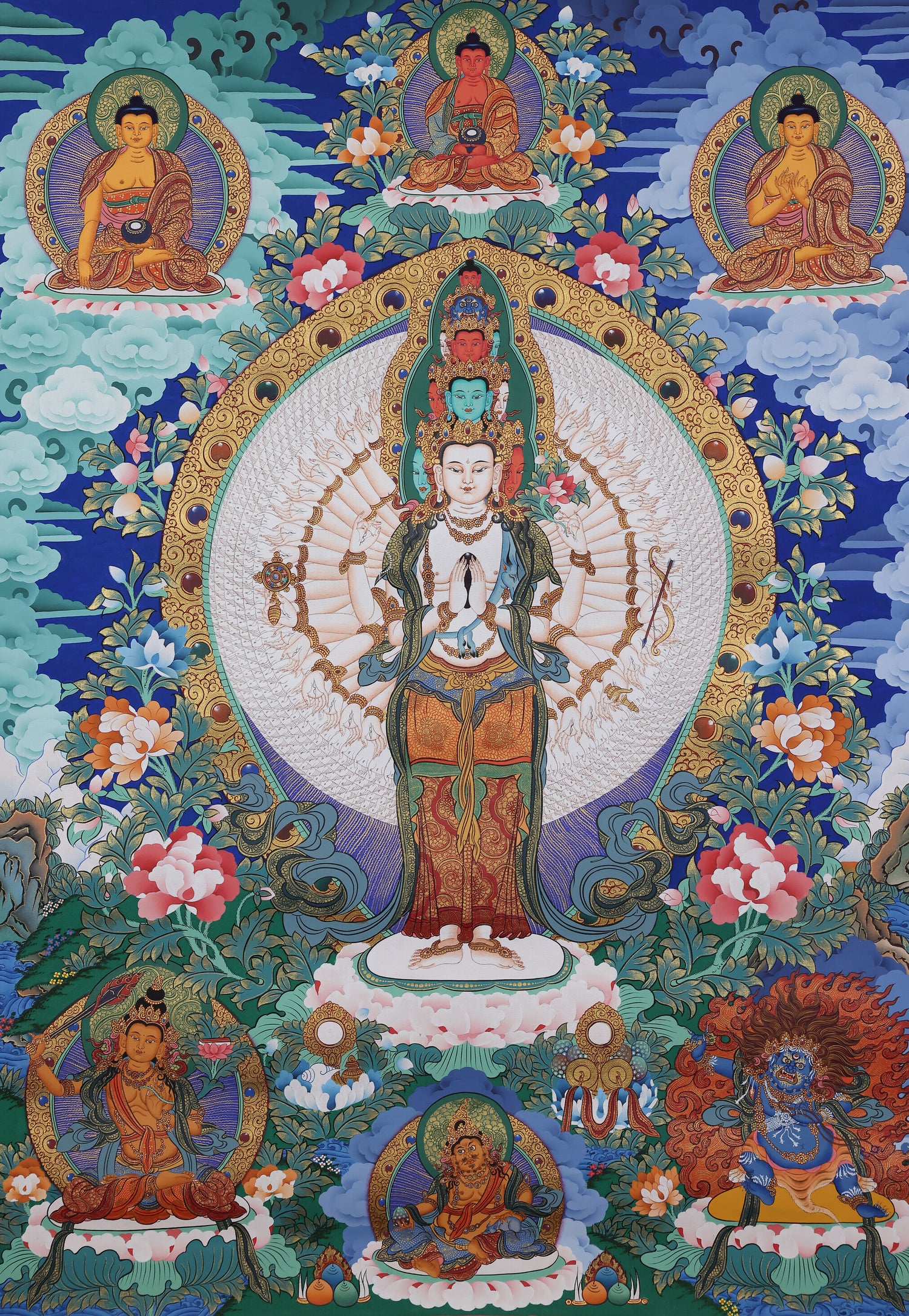
  • Upper Deity: Amitabha Buddha (red, on a lotus throne above Padmasambhava) symbolizes his lineage origin—tantras regard Padmasambhava as the "body, speech, mind incarnation of Amitabha, Avalokiteshvara, and Shakyamuni," representing dharma source and pure land aspiration.
  • Lower Left Attendant: Vairotsana (Tibet’s First Translator), in ordained monk form holding a vase, symbolizes Padmasambhava’s core Tibetan disciple and "dharma transmission and blessing sustenance."
  • Lower Right Attendant: Yeshe Tsogyal Dakini (Padmasambhava’s consort and female acharya), in serene palms-together posture, symbolizes "dakini dharma protection" and embodies Tibetan Vajrayana’s "male-female union" trait.
  • Lower Central: Nectar Vase (on a thousand-petal lotus under Padmasambhava’s throne) is an auspicious offering vessel symbolizing "blessing all sentient beings," representing his pervasive blessings.

IV. Craftsmanship & Style: The Uniqueness of Newari Art

This thangka’s techniques and style are typical of Nepal’s Newari school:

1. Natural Mineral Pigment Craftsmanship

Artists use natural mineral/earth pigments (lapis lazuli for blue, cinnabar for red, realgar for yellow) processed via crushing → grinding to 5-20μm → aging → mixing with 5+ year-old cow glue (3:1 ratio). This pigment boasts strong adhesion and centuries-long fade resistance, the core reason traditional thangkas "endure with timeless beauty."

2. Newari Artistic Style

Distinct from Tibetan local thangkas (e.g., Regong school), its stylistic traits include:
  • Colors: Saturated & Layered—3-5 pigment layers create lotus’ light pink-to-deep rose transition; warm hues evoke a sacred, serene atmosphere.
  • Ornamentation: Intricate & Detailed—"Newari scroll clouds" for cloud patterns; fine-brush outlining for garment patterns and aura jewels, reflecting Newari artists’ meticulous family-transmitted craftsmanship.
  • Composition: Dynamic Symmetry & Regional Background—incorporates "snow-capped mountains, green fields, rivers" (Nepal-Tibet border landscape), breaking Tibetan thangkas’ "abstract background" limitation and enhancing spatial depth and lifelikeness.

V. Cultural Value: Dual Identity as Religious Relic & Art Collection

Classified as a "medium worship thangka" (46×65cm), it suits both home shrine worship and monastery hall display. It is both a material vessel for Tibetan Buddhism’s "Padmasambhava faith" (meeting practitioners’ visual meditation needs) and a Newari art masterpiece (exquisite craftsmanship, unique style).
Its value lies in balancing "ritual rigor" and "artistic aesthetics": preserving Tibetan Vajrayana’s core meanings while transforming the "dharma-through-imagery" tradition into a more visually compelling form via Newari art.
#NepalesePaintedThangka #PadmasambhavaThangka #NewariThangkaCraftsmanship #TibetanBuddhistThangkaGuide #MineralPigmentHandpaintedThangka #NewariArtThangka #TibetanVajrayanaThangka #HandpaintedReligiousArt #MineralPigmentArt #OddiyanaPureLandThangka
Entdecken Sie das perfekte tibetisch-buddhistische Thangka, das zu Ihren Wünschen, Ihrem Lebensstil und Ihrem Raum passt. Jedes Thangka hat eine spirituelle Bedeutung und bringt Segen, wenn es richtig platziert wird.

1. Definieren Sie Ihre Absicht

Reichtum & Erfolg → Gelber Dzambhala (Gottheit des Reichtums)

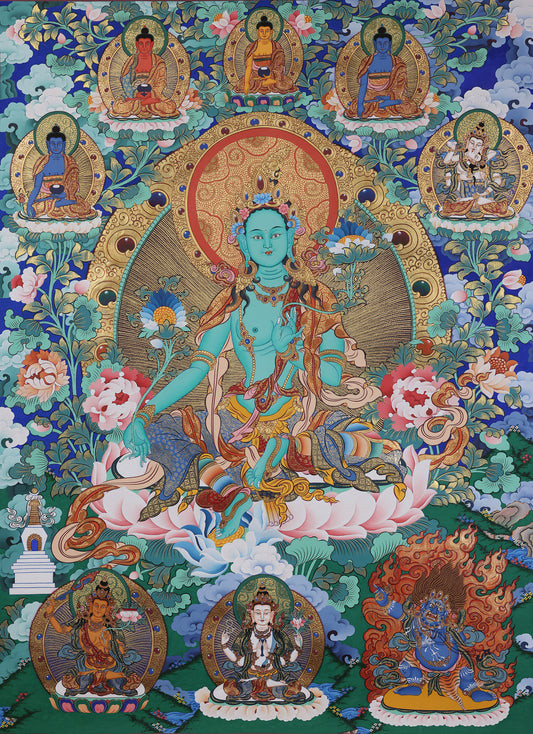
Mitgefühl und Frieden → Avalokiteshvara, Grüne Tara

Weisheit & Lernen → Manjushri

Gesundheit & Heilung → Medizinbuddha

Langlebigkeit und Familienschutz → Weiße Tara

2. Wählen Sie nach Identität

Unternehmer und Geschäftsinhaber → Reichtumsgottheiten für Wohlstand.

Studenten und Gelehrte → Weisheitsgottheiten für Konzentration und Klarheit.

Heiler und Yoga-Praktizierende → Medizinbuddha für Energie und Gleichgewicht.

Familien und Hausfrauen → Tara-Gottheiten für Harmonie und Sicherheit.

Sammler und Kunstliebhaber → Seltene Mandalas oder Meisterwerk-Thangkas.

3. Passen Sie Ihren Raum an

Heimschrein / Meditationsraum → Mittlere Thangkas (60–80 cm).

Büro / Geschäftshalle → Große Thangkas für Wohlstand und Autorität.

Wohnzimmer / Arbeitszimmer → Dekorative Thangkas für Frieden und Schönheit.

4. Authentische Handwerkskunst

Jedes Thangka ist mit natürlichen Mineralpigmenten und feiner Leinwand handbemalt und spiegelt tibetische Kunstfertigkeit und spirituelle Kraft wider. Überprüfte Quellen gewährleisten Qualität und Respekt für die Tradition.

✨ Wählen Sie Ihr Thangka mit Herz – es ist nicht nur Kunst, sondern ein Segen für Ihr Leben.

Jeder Mensch hat unterschiedliche Bedürfnisse. Die Wahl des richtigen Thangkas kann spirituelle Unterstützung, Schutz, Glück und Segen bieten. Nachfolgend finden Sie Thangka-Empfehlungen für verschiedene Rollen:

1. Unternehmer

  • Bedürfnisse : Weisheit, Reichtum, Gesundheit, beruflicher Erfolg.
  • Empfohlene Thangkas :
    Manjushri : Verbessert die Entscheidungsfindung und Geschäftsweisheit.
    Gottheit des Reichtums : Bringt Reichtum und Wohlstand.
    Medizinbuddha : Unterstützt die Gesundheit und reduziert Stress.
    Mahakala : Schützt Unternehmen vor Konkurrenz und Herausforderungen.

2. Erfolgreiche Einzelpersonen

  • Bedürfnisse : Innerer Frieden, Familienharmonie, Langlebigkeit.
  • Empfohlene Thangkas :
    Amitabha Buddha : Bringt inneren Frieden und Ruhe.
    Avalokiteshvara (Guanyin) : Fördert Harmonie und Glück in der Familie.
    Amitayus (Langlebens-Buddha) : Betet für gute Gesundheit und ein langes Leben.
    Manjushri : Stärkt weiterhin die Weisheit.

3. Hausfrauen/Ehemänner

  • Bedürfnisse : Familienharmonie, Schutz, Gesundheit.
  • Empfohlene Thangkas :
    Avalokiteshvara : Steigert das Familienglück und die Harmonie.
    Schutzgottheiten : Beschützen die Familie vor äußeren Störungen.
    Weiße Tara : Segnet die Familie mit Gesundheit.

4. Studierende und Wissenschaftler

  • Bedürfnisse : Weisheit, Konzentration, akademischer Erfolg.
  • Empfohlene Thangkas :
    Manjushri : Fördert Lernfähigkeit, Gedächtnis und Weisheit.
    Shakyamuni Buddha : Hilft bei der Konzentration und spirituellen Praxis.
    Jixiang Tianmu : Bringt akademisches Glück und Prüfungserfolg.

5. Künstler und Kreativprofis

  • Bedürfnisse : Inspiration, Kreativität, künstlerische Leistung.
  • Empfohlene Thangkas :
    Manjushri : Regt kreatives Denken und Inspiration an.
    Vajrapani : Hilft, kreative Blockaden zu überwinden.
    Maitreya : Sorgt für eine entspannte und optimistische Einstellung und baut Stress ab.

6. Reisende und Abenteurer

  • Bedürfnisse : Schutz, Glück, Erfolg bei Abenteuern.
  • Empfohlene Thangkas :
    Hayagriva : Bietet starken Schutz auf Reisen und beseitigt Hindernisse.
    Mahakala : Bringt Glück und Schutz, insbesondere für Abenteurer.
    Vajrasattva : Hilft, Schwierigkeiten und Herausforderungen während der Reise zu überwinden.

7. Ältere Menschen

  • Bedürfnisse : Gesundheit, Langlebigkeit, spiritueller Frieden.
  • Empfohlene Thangkas :
    Amitayus : Betet für ein langes Leben und gute Gesundheit.
    Medizinbuddha : Fördert Heilung und körperliches Wohlbefinden.
    Avalokiteshvara : Bringt Mitgefühl und inneren Frieden in späteren Jahren.

8. Führungskräfte

  • Bedürfnisse : Führung, Weisheit, Teamarbeit und geschäftlicher Erfolg.
  • Empfohlene Thangkas :
    Manjushri : Verbessert Führungsqualitäten und Entscheidungsfindung.
    Gottheit des Reichtums : Bringt dem Unternehmen und dem Team Erfolg und Wohlstand.
    Avalokiteshvara : Fördert Harmonie und Gleichgewicht innerhalb des Teams.

9. Gesundheits- und Fitnessbegeisterte

  • Bedürfnisse : Gute Gesundheit, Vitalität, Energie.
  • Empfohlene Thangkas :
    Medizinbuddha : Verbessert die körperliche Gesundheit und Vitalität.
    Weiße Tara : Bringt Gesundheit und Verjüngung.
    Vajrasattva : Beseitigt gesundheitliche Probleme und steigert die Energie.

10. Politiker

  • Bedürfnisse : Führung, Weisheit, Frieden.
  • Empfohlene Thangkas :
    Manjushri : Verbessert Führungsqualitäten und Entscheidungsfindung.
    Vairocana Buddha : Hilft, inneren Frieden und Weisheit zu bewahren.
    Avalokiteshvara : Fördert den gesellschaftlichen Frieden und die Harmonie in der Familie.

Für alle Bestellungen über 100 USD ist der Versand kostenlos.

Rücksendungen werden bis zu 10 Tage nach Erhalt des Kaufbelegs bzw. der Sendungsnummer (bei ungetragenen Artikeln) akzeptiert. Sie als Kunde sind verpflichtet, uns vor der Rücksendung des Artikels per E-Mail zu informieren.

Andernfalls fallen die Standardversandkosten an. Weitere Informationen finden Sie in unseren Lieferbedingungen .

Rücksendungen werden bis zu 10 Tage nach Erhalt des Kaufbelegs oder der Sendungsnummer (bei ungetragenen Artikeln) akzeptiert. Sie als Kunde sind verpflichtet, uns vor der Rücksendung des Artikels per E-Mail zu informieren, nur in folgenden Fällen:

– Den falschen Artikel erhalten.
– Artikel kam nicht wie erwartet an (z. B. beschädigte Verpackung).
– Artikel hatte Mängel.
– Über die Lieferzeit hinaus.
– Der Spediteur gestattet keine Besichtigung der Ware vor der Bezahlung.

Die zurückgesendeten Produkte müssen in der Originalverpackung, sicher verpackt, unbeschädigt und ungetragen sein. Dies bedeutet, dass die Artikel zum Schutz während des Transports sicher in einem Karton verpackt sein müssen, möglichst im selben Karton, in dem sie an Sie als Kunde versendet wurden.

Kürzlich angesehen

Nicht vergessen! Die Produkte, die Sie angesehen haben, legen Sie jetzt in den Warenkorb.

Passt gut zu

Erweitern Sie Ihre Auswahl mit perfekt abgestimmtem Zubehör und ergänzenden Produkten.

Leute kauften auch

Hier sind einige unserer ähnlichsten Produkte, die die Leute kaufen. Klicken Sie hier, um den Trendstil zu entdecken.