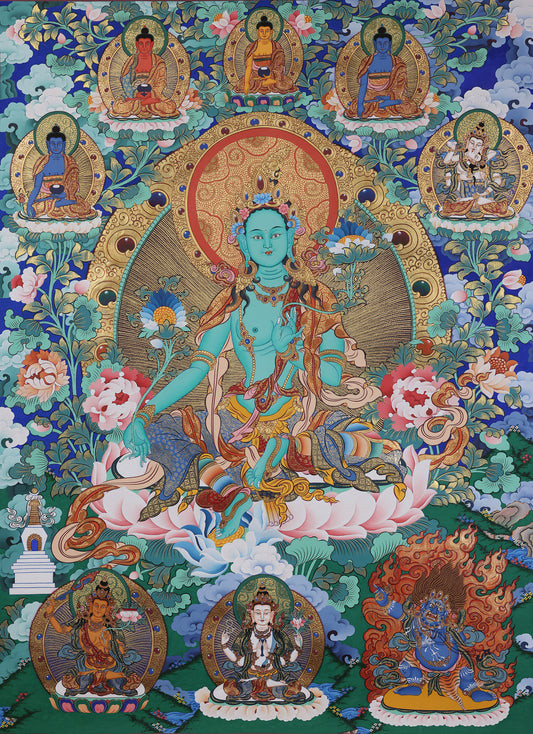
When you gaze at a 50x50cm hand-painted Kalachakra Mandala Thangka from Nepal—its layers of lapis lazuli blue, turquoise green, and 24k gold glowing against a cotton canvas—you’re not just viewing art. You’re engaging with a sacred object of Tibetan Buddhism’s Highest Yoga Tantra: a visual codex of the Kalachakra (Wheel of Time) tantra, where the structure of the universe, the architecture of human consciousness, and the path to enlightenment are woven into every line and hue. For Nepalese thangka artists, this work isn’t “creation”—it’s a spiritual practice, where precision and devotion converge to manifest a “portable pure land.”
1. Theme: The Kalachakra Mandala as a Cosmic-Life Mirror
The Kalachakra Mandala’s core purpose is to visualize the tantric union of “outer cosmos” and “inner life”—a philosophy that frames time, space, and consciousness as interconnected threads of a single reality.
At its most basic, the mandala’s “circle-within-square” structure encodes Tibetan Buddhist cosmology:
- The six outer concentric circles represent the “Six Elements” (earth, water, fire, wind, space, consciousness) that compose the physical and spiritual world. From the innermost gold ring (symbolizing pure consciousness) to the outermost black-and-red scrollwork (representing worldly delusion), these layers map the journey from mundane existence to enlightenment.
- The five nested square palaces at the mandala’s center correspond to the “Five Aspects of Enlightenment”: body, speech, mind, wisdom, and great bliss. Each palace’s walls, pillars, and gates aren’t decorative—they mark stages of tantric practice, where practitioners “enter” the mandala through visualization to align their inner state with the cosmos.
The “Wheel of Time” name itself carries dual meaning: it refers to the cyclical nature of worldly time (seasons, birth-death rebirth) and the inner cycle of karmic consciousness. The mandala’s 12 animal symbols (aligning with the lunar year), 28 lotus petals (matching the 28 lunar mansions), and 360 “day deities” (corresponding to the solar year) tie external time to internal transformation—teaching that mastering one’s mind allows control over the cycles of suffering.
2. Main Deity & Retinue: The 722-Deity Matrix of Enlightenment
Every figure in the Kalachakra Mandala is not a separate “god” but an embodiment of a quality needed for enlightenment. The 722 deities form a hierarchical matrix centered on the mandala’s heart.
The Central Deity: Kalachakra Vajra & His Consort
At the mandala’s innermost lotus (set within the fifth square palace) sits Kalachakra Vajra (the Wheel of Time Vajra) and his consort, Vishvamata (Universal Mother):
- Kalachakra Vajra is sky-blue (symbolizing unchanging enlightenment), with four faces (white, red, black, yellow—representing body, speech, mind, and wisdom) and 24 arms (holding ritual tools like the dharma wheel and vajra, signifying the power to shatter delusion). His red and white feet press down on demons of ignorance and attachment.
- Vishvamata (golden-yellow, symbolizing the fertile potential of consciousness) has four faces and eight arms, embracing Kalachakra in a “yab-yum” (father-mother) pose. This is not a depiction of worldly love: it represents the tantric union of “skillful means” (compassion) and “wisdom” (emptiness)—the dual pillars of buddhahood.
The lotus beneath them has five colored layers (green, white, red, blue, yellow), corresponding to the foundational practices of Tibetan Buddhism: renunciation, bodhichitta (the wish to enlighten all beings), emptiness, great bliss, and skillful action.
The Retinue Deities: Five Palaces of Transformation
The five square palaces surrounding the central lotus house 722 retinue deities, each tied to a stage of spiritual growth:
-
Body Enlightenment Palace (outermost square): 536 deities, including 12 animal figures (lunar year symbols) and 360 “day deities.” These link the physical body to cosmic time, teaching practitioners to align their bodily rhythms with the universe.
-
Speech Enlightenment Palace: 116 deities, dominated by 80 “yoginis” (symbolizing pure speech) and 36 “offering goddesses” (corresponding to the 36 Sanskrit letters, the building blocks of the Buddha’s teachings). This layer focuses on purifying language through mantra recitation.
-
Mind Enlightenment Palace: 72 deities, including 12 yab-yum pairs. Four corner vajras here represent the “Four Methods of Helping Beings” (generosity, kind speech, beneficial actions, and harmonious conduct).
-
Wisdom Enlightenment Palace: 16 “great bodhisattvas,” framed by 16 black pillars (symbolizing the 16 types of emptiness). Their ritual tools (swords for cutting ignorance, books for wisdom) embody the refinement of subtle consciousness.
-
Support Deities: Hidden in the mandala’s borders are figures like the 25 kings of Shambhala (the legendary land where the Kalachakra tantra was first taught) and the Five Dhyani Buddhas (representing the five wisdoms of buddhahood). These symbolize the lineage and protection of the tantric path.
3. Craftsmanship: Nepalese Thangka as a Ritual of Creation
For Nepalese thangka artists (many from Newari communities with 1,000+ years of tradition), painting a Kalachakra Mandala is a spiritual discipline, not a commercial task.
Pre-Painting Rituals
Before touching canvas, the artist undertakes days of preparation:
-
Canvas Preparation: A 50x50cm piece of Nepalese cotton is soaked in saffron and tree gum (to purify it), stretched over a wooden frame, and polished with a stone tool until it is smooth enough to hold fine lines—this is seen as “preparing the vessel for the sacred.”
-
Spiritual Purification: The artist fasts from meat, recites Kalachakra mantras, and performs a “visualization ritual” on the first day: they imagine themselves transforming into Kalachakra Vajra, with the mandala emerging from their heart onto the canvas.
Mineral & Earth Pigments: Color as Symbol and Eternity
The thangka’s hues come exclusively from natural materials, chosen for their symbolism and longevity:
-
Mineral Pigments: Lapis lazuli (blue, unchanging enlightenment), turquoise (green, purity), cinnabar (red, compassion), and malachite (teal, wisdom) are ground by hand, mixed with cow bone glue, and layered to create depth. These pigments fade minimally over centuries—a metaphor for the mandala’s eternal blessing.
-
Earth Pigments: Local Nepalese clay (yellow, black) represents the “earth element,” linking the artwork to the land’s spiritual energy.
-
24k Gold: Used for linework and deity ornaments, gold symbolizes the light of buddhahood. Each brushstroke of gold is accompanied by a mantra, framing the act as an offering.
The Painting Process: Months of Precision
A 50x50cm Kalachakra Mandala takes 3–6 months to complete:
-
Layout: The artist uses compasses and rulers to draw the mandala’s geometry, with errors limited to 1mm—tantric tradition holds that imprecision breaks the mandala’s ability to connect with the deities.
-
Layering: Colors are applied from light to dark, with each layer drying completely before the next. Newari artists use a “gradation technique” to give deities and palaces a subtle 3D effect.
-
Detail Work: Fine wolf-hair brushes are used to paint deity faces, ritual tools, and lotus petals—every line is intentional, as practitioners use these details to focus their visualization during meditation.
4. Artistic Style: Newari Art Meets Tibetan Mandala Orthodoxy
This thangka blends two traditions: Newari (Nepalese) artistic aesthetics and Tibetan mandala ritual strictness.
-
Newari Influences: Vibrant, saturated colors; rounded, youthful deity faces; and intricate scrollwork (seen in the mandala’s outer borders) are hallmarks of Newari painting, which emphasizes beauty as a gateway to devotion.
-
Tibetan Orthodoxy: The mandala’s structure, deity count, and color symbolism follow the Kalachakra Tantra Commentary: The Stainless Light—unlike Tibetan thangkas (which sometimes incorporate regional flourishes), Nepalese Kalachakra mandalas prioritize ritual accuracy.
-
Border Motifs: The outer borders feature “Eight Auspicious Symbols” (dharma wheel, lotus, etc.) and vajra patterns—these are not decorative, but protective symbols that “seal” the mandala’s spiritual energy.
Conclusion: More Than Art—A Portable Path to Enlightenment
This 50x50cm Nepalese Kalachakra Mandala Thangka is a testament to how art and spirituality can be one. It is a map (for practitioners to visualize enlightenment), a philosophy (encoding the Kalachakra’s view of time and consciousness), and a ritual object (blessed through its creation). For anyone engaging with it—whether as a practitioner or an admirer—it offers a window into Tibetan Buddhism’s belief that the path to enlightenment is not abstract: it is a structure, a color, a line, waiting to be seen and embodied.
#KalachakraMandalaThangka #NepaleseHandPaintedThangka #TibetanBuddhistArt #TraditionalThangkaCraftsmanship #MineralPigmentThangka #NewariPaintingStyle #TantricBuddhismArt #PortablePureLandThangka #HandPaintedKalachakraThangka #SacredTibetanBuddhistArt #TraditionalNepaleseThangkaCraft #KalachakraTantraArtwork #50x50cmMandalaThangka #NaturalMineralPigmentThangka #SpiritualMeditationThangka #TantricMandalaPainting #NewariTibetanThangkaFusion