Decoding Nepal’s Yellow Dzambhala Thangka: Tibetan Buddhism’s Wealth Protector, Newar School Craft, and Sacred Significance

$1,100.00 USD
Thangka name: Yellow Jambhala's Six-Syllable Mantra
size: 50cm×50cm
origin: Nepal
Eine Frage stellen

Beeil dich! Nur noch [Anzahl] auf Lager!

Geschätzte Lieferzeiten: 12–26 Tage (International), 3–6 Tage (USA).

Rückgabe innerhalb von 45 Tagen nach dem Kauf. Zölle und Steuern werden nicht erstattet.

Tibetan Buddhist Yellow Jambhala Thangka depicting the Six Syllable Mantra for wealth and prosperity, traditional sacred art.
Decoding Nepal’s Yellow Dzambhala Thangka: Tibetan Buddhism’s Wealth Protector, Newar School Craft, and Sacred Significance
$1,100.00 USD
Have you ever seen a hand-painted Nepalese work labeled a "Shakyamuni Thangka," only to find it depicts a golden-hued figure holding a treasure-vomiting rat? This 50x50cm thangka, painted entirely with mineral pigments, hides the deep wisdom of Tibetan Buddhism: "using secular resources to support spiritual practice." It is not an image of the Buddha, but a solitary thangka of Yellow Dzambhala—the chief of the Five Wealth Gods, and a crystallization of the Newar School’s millennium-old religious art from Nepal.

I. Correcting the Misconception: From "Shakyamuni Thangka" to Yellow Dzambhala’s Core Meaning


Many initially mistake this thangka for Shakyamuni Buddha, but its golden body and treasure-vomiting rat (per Tibetan Buddhist iconographic rules) clearly identify it as Yellow Dzambhala (Zambala Serpo in Tibetan)—the chief of the Five Wealth Gods.

The core theme of this thangka is not a story from the Buddha’s life, but the Tibetan Buddhist wisdom of "Dharma and Material Abundance": Yellow Dzambhala is a "Buddhist Protector + Wealth Deity" ordained by the Buddha himself. His role is to protect sincere practitioners, granting material resources to remove poverty as an obstacle to practice, while warning sentient beings that "wealth is a supportive condition for practice, not an object of greed."

This theme stems from Yellow Dzambhala’s canonical legend: When Shakyamuni Buddha taught the Great Prajnaparamita Sutra at Vulture Peak, demons caused landslides to disrupt the Dharma assembly. Yellow Dzambhala appeared in his golden form to quell the chaos and protect the assembly. The Buddha then enthroned him as the "Holy Lord of Yellow Treasures," tasking him with using wealth to support practitioners in achieving "both material and spiritual fulfillment."

II. Yellow Dzambhala: The Symbolic Language of Tibetan Buddhism in Iconography


This thangka strictly follows the Iconometric Canon, with every detail serving as a "symbolic language" of Tibetan Buddhism:

  • Golden Body: Corresponds to the "earth element" in Buddhist cosmology, symbolizing the stability and abundance of the earth; the golden hue also represents nobility and wealth enhancement.
  • Five-Buddha Crown: The crown worn on his head corresponds to the Five Dhyani Buddhas (Vairocana, Akshobhya, etc.), symbolizing Yellow Dzambhala’s wisdom to overcome the five poisons (greed, anger, delusion, arrogance, doubt).
  • Implements & Ritual Tools:
    • Right hand holding the "Brahma Ratna" (peach-shaped fruit/vase): Symbolizes fulfilling sentient beings’ virtuous wishes, reminding supplicants to seek desires aligned with the Dharma.
    • Left hand supporting the "Treasure-Vomiting Rat": This is a celestial treasure spirit that continuously spits out jewels, coral, and other treasures—symbolizing "wealth should circulate, not be hoarded," echoing the Buddhist teaching that "generosity is the source of wealth."

  • Royal Ease Posture + Foot on Conch: With his left leg crossed and right foot resting lightly on a white conch, this posture symbolizes freedom in samsara without being bound by greed; the conch represents both the ability to "retrieve treasures from the sea" and a warning: "Only by subduing greed can one truly possess wealth."
  • Ornaments & Belly Shape: The jewels adorning his body are not displays of luxury, but symbols of the merits of the "Six Paramitas" (generosity, morality, patience, etc.); his "large belly, small frame" is not a sign of gluttony, but compassion that embraces impoverished sentient beings—embodying the wisdom that "a broad heart brings good fortune."

III. The "Special Retinue" of Solitary Thangkas: Sacred Blessings of Circular Scripture


This 50x50cm thangka uses a solitary composition (no attendant bodhisattvas or offering goddesses). Its "retinue function" is replaced by the Tibetan scriptures written in gold powder around the main deity (typically Yellow Dzambhala’s mantra: "Om Dzambhala Zilay Zay Svaha").

In Tibetan Buddhist culture, thangkas are "mobile temples." These scriptures transform the work from mere visual art into a tool of religious ritual: when devotees recite the mantra while venerating the thangka, they align with Yellow Dzambhala’s aspirations and receive blessings for material support. The "retinue-free" layout also emphasizes the main deity, making it ideal for focused visualization during personal practice.

IV. Nepal’s Newar School: Craftsmanship and Artistry Behind the 50x50cm Thangka


This thangka is a hand-painted work of Nepal’s Newar School, whose craftsmanship and style blend religious orthodoxy with local artistic traits:

1. Rigorous Production Process


  • Pre-Painting Rituals: The artist bathes, purifies their mind, and chants prayers to ensure the purity of the creation—this is the starting point of the thangka’s "sacredness."
  • Canvas Preparation: Linen-cotton canvas is polished, coated with cow bone glue mixed with white clay, and treated with alum to prevent pigment bleeding; the 50x50cm size follows the same steps as large thangkas.
  • Coloring & Gilding: Mineral pigments (cinnabar, lapis lazuli, realgar) are layered for shading, then gold powder (ground from pure gold, mixed with glue) is used to outline scriptures and decorations—mineral pigments are hand-ground to over 2000 mesh, ensuring vivid colors that last for centuries.
  • Eye-Opening & Framing: The final step is painting the deity’s eyes (the "animation" of the thangka), performed by a qualified artist or lama; the thangka is framed with crimson silk (symbolizing the protective power of Dharma protectors in Tibetan Buddhism).

2. Artistic Traits of the Newar School


  • Vibrant Color Contrasts: The golden deity, black background, and crimson frame create a striking visual impact, aligning with Tibetan Buddhism’s aesthetic of "using bright colors to represent the sacred world."
  • Intricate Gilding: Gold powder details add opulence to the solemnity (distinguishing it from the more understated style of Tibetan thangkas).
  • Symmetrical Yet Dynamic Layout: The central deity and circular scriptures balance geometric symmetry with natural curves (e.g., flower branches), creating a composition that is both orderly and lively.

V. Dual Value of Nepal’s Yellow Dzambhala Thangka: Religious Vessel and Cultural Treasure


For Tibetan Buddhist devotees, this thangka is a "mobile temple for material support," embodying the wisdom of "Dharma and Material Abundance." For art enthusiasts, it is a microcosm of Newar School craftsmanship—its mineral pigments grant it timelessness, making it a cultural heritage spanning millennia.

Its value lies not just in visual splendor, but in the underlying Tibetan Buddhist spirit: "using wealth to serve practice, embracing sentient beings with compassion." This is the symbiosis of religion and art, and a testament to the cultural fusion of Nepal and Tibetan Buddhism.

#YellowDzambhalaThangka #NewarSchoolThangkaCraft #TibetanBuddhistThangkaMeaning #MineralPigmentHandpaintedThangka #FiveWealthGodsThangkaExplained  #NepaleseThangkaArt  #TibetanBuddhistWealthDeity  #HandmadeBuddhistThangka  #SacredThangkaIconography  #NewarBuddhistArt  #TraditionalNepaleseCraft  #ThangkaCulturalHeritage  #MineralPigmentThangka
Entdecken Sie das perfekte tibetisch-buddhistische Thangka, das zu Ihren Wünschen, Ihrem Lebensstil und Ihrem Raum passt. Jedes Thangka hat eine spirituelle Bedeutung und bringt Segen, wenn es richtig platziert wird.

1. Definieren Sie Ihre Absicht

Reichtum & Erfolg → Gelber Dzambhala (Gottheit des Reichtums)

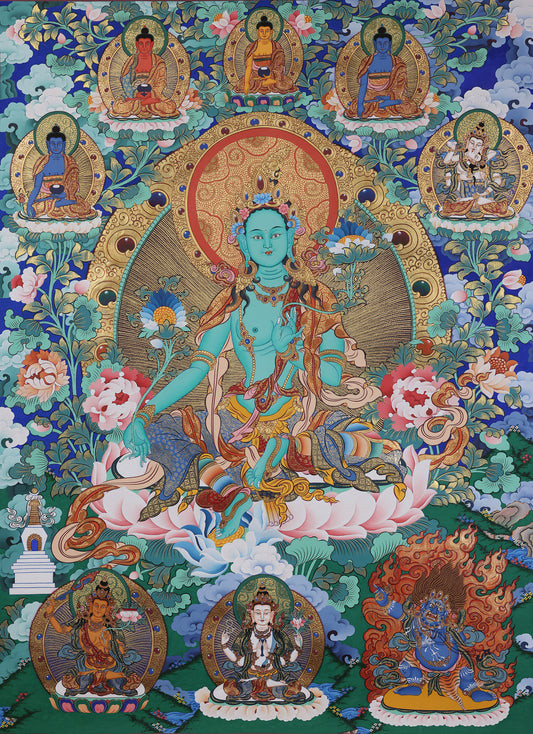
Mitgefühl und Frieden → Avalokiteshvara, Grüne Tara

Weisheit & Lernen → Manjushri

Gesundheit & Heilung → Medizinbuddha

Langlebigkeit und Familienschutz → Weiße Tara

2. Wählen Sie nach Identität

Unternehmer und Geschäftsinhaber → Reichtumsgottheiten für Wohlstand.

Studenten und Gelehrte → Weisheitsgottheiten für Konzentration und Klarheit.

Heiler und Yoga-Praktizierende → Medizinbuddha für Energie und Gleichgewicht.

Familien und Hausfrauen → Tara-Gottheiten für Harmonie und Sicherheit.

Sammler und Kunstliebhaber → Seltene Mandalas oder Meisterwerk-Thangkas.

3. Passen Sie Ihren Raum an

Heimschrein / Meditationsraum → Mittlere Thangkas (60–80 cm).

Büro / Geschäftshalle → Große Thangkas für Wohlstand und Autorität.

Wohnzimmer / Arbeitszimmer → Dekorative Thangkas für Frieden und Schönheit.

4. Authentische Handwerkskunst

Jedes Thangka ist mit natürlichen Mineralpigmenten und feiner Leinwand handbemalt und spiegelt tibetische Kunstfertigkeit und spirituelle Kraft wider. Überprüfte Quellen gewährleisten Qualität und Respekt für die Tradition.

✨ Wählen Sie Ihr Thangka mit Herz – es ist nicht nur Kunst, sondern ein Segen für Ihr Leben.

Jeder Mensch hat unterschiedliche Bedürfnisse. Die Wahl des richtigen Thangkas kann spirituelle Unterstützung, Schutz, Glück und Segen bieten. Nachfolgend finden Sie Thangka-Empfehlungen für verschiedene Rollen:

1. Unternehmer

  • Bedürfnisse : Weisheit, Reichtum, Gesundheit, beruflicher Erfolg.
  • Empfohlene Thangkas :
    Manjushri : Verbessert die Entscheidungsfindung und Geschäftsweisheit.
    Gottheit des Reichtums : Bringt Reichtum und Wohlstand.
    Medizinbuddha : Unterstützt die Gesundheit und reduziert Stress.
    Mahakala : Schützt Unternehmen vor Konkurrenz und Herausforderungen.

2. Erfolgreiche Einzelpersonen

  • Bedürfnisse : Innerer Frieden, Familienharmonie, Langlebigkeit.
  • Empfohlene Thangkas :
    Amitabha Buddha : Bringt inneren Frieden und Ruhe.
    Avalokiteshvara (Guanyin) : Fördert Harmonie und Glück in der Familie.
    Amitayus (Langlebens-Buddha) : Betet für gute Gesundheit und ein langes Leben.
    Manjushri : Stärkt weiterhin die Weisheit.

3. Hausfrauen/Ehemänner

  • Bedürfnisse : Familienharmonie, Schutz, Gesundheit.
  • Empfohlene Thangkas :
    Avalokiteshvara : Steigert das Familienglück und die Harmonie.
    Schutzgottheiten : Beschützen die Familie vor äußeren Störungen.
    Weiße Tara : Segnet die Familie mit Gesundheit.

4. Studierende und Wissenschaftler

  • Bedürfnisse : Weisheit, Konzentration, akademischer Erfolg.
  • Empfohlene Thangkas :
    Manjushri : Fördert Lernfähigkeit, Gedächtnis und Weisheit.
    Shakyamuni Buddha : Hilft bei der Konzentration und spirituellen Praxis.
    Jixiang Tianmu : Bringt akademisches Glück und Prüfungserfolg.

5. Künstler und Kreativprofis

  • Bedürfnisse : Inspiration, Kreativität, künstlerische Leistung.
  • Empfohlene Thangkas :
    Manjushri : Regt kreatives Denken und Inspiration an.
    Vajrapani : Hilft, kreative Blockaden zu überwinden.
    Maitreya : Sorgt für eine entspannte und optimistische Einstellung und baut Stress ab.

6. Reisende und Abenteurer

  • Bedürfnisse : Schutz, Glück, Erfolg bei Abenteuern.
  • Empfohlene Thangkas :
    Hayagriva : Bietet starken Schutz auf Reisen und beseitigt Hindernisse.
    Mahakala : Bringt Glück und Schutz, insbesondere für Abenteurer.
    Vajrasattva : Hilft, Schwierigkeiten und Herausforderungen während der Reise zu überwinden.

7. Ältere Menschen

  • Bedürfnisse : Gesundheit, Langlebigkeit, spiritueller Frieden.
  • Empfohlene Thangkas :
    Amitayus : Betet für ein langes Leben und gute Gesundheit.
    Medizinbuddha : Fördert Heilung und körperliches Wohlbefinden.
    Avalokiteshvara : Bringt Mitgefühl und inneren Frieden in späteren Jahren.

8. Führungskräfte

  • Bedürfnisse : Führung, Weisheit, Teamarbeit und geschäftlicher Erfolg.
  • Empfohlene Thangkas :
    Manjushri : Verbessert Führungsqualitäten und Entscheidungsfindung.
    Gottheit des Reichtums : Bringt dem Unternehmen und dem Team Erfolg und Wohlstand.
    Avalokiteshvara : Fördert Harmonie und Gleichgewicht innerhalb des Teams.

9. Gesundheits- und Fitnessbegeisterte

  • Bedürfnisse : Gute Gesundheit, Vitalität, Energie.
  • Empfohlene Thangkas :
    Medizinbuddha : Verbessert die körperliche Gesundheit und Vitalität.
    Weiße Tara : Bringt Gesundheit und Verjüngung.
    Vajrasattva : Beseitigt gesundheitliche Probleme und steigert die Energie.

10. Politiker

  • Bedürfnisse : Führung, Weisheit, Frieden.
  • Empfohlene Thangkas :
    Manjushri : Verbessert Führungsqualitäten und Entscheidungsfindung.
    Vairocana Buddha : Hilft, inneren Frieden und Weisheit zu bewahren.
    Avalokiteshvara : Fördert den gesellschaftlichen Frieden und die Harmonie in der Familie.

Für alle Bestellungen über 100 USD ist der Versand kostenlos.

Rücksendungen werden bis zu 10 Tage nach Erhalt des Kaufbelegs bzw. der Sendungsnummer (bei ungetragenen Artikeln) akzeptiert. Sie als Kunde sind verpflichtet, uns vor der Rücksendung des Artikels per E-Mail zu informieren.

Andernfalls fallen die Standardversandkosten an. Weitere Informationen finden Sie in unseren Lieferbedingungen .

Rücksendungen werden bis zu 10 Tage nach Erhalt des Kaufbelegs oder der Sendungsnummer (bei ungetragenen Artikeln) akzeptiert. Sie als Kunde sind verpflichtet, uns vor der Rücksendung des Artikels per E-Mail zu informieren, nur in folgenden Fällen:

– Den falschen Artikel erhalten.
– Artikel kam nicht wie erwartet an (z. B. beschädigte Verpackung).
– Artikel hatte Mängel.
– Über die Lieferzeit hinaus.
– Der Spediteur gestattet keine Besichtigung der Ware vor der Bezahlung.

Die zurückgesendeten Produkte müssen in der Originalverpackung, sicher verpackt, unbeschädigt und ungetragen sein. Dies bedeutet, dass die Artikel zum Schutz während des Transports sicher in einem Karton verpackt sein müssen, möglichst im selben Karton, in dem sie an Sie als Kunde versendet wurden.

Kürzlich angesehen

Nicht vergessen! Die Produkte, die Sie angesehen haben, legen Sie jetzt in den Warenkorb.

Passt gut zu

Erweitern Sie Ihre Auswahl mit perfekt abgestimmtem Zubehör und ergänzenden Produkten.

Leute kauften auch

Hier sind einige unserer ähnlichsten Produkte, die die Leute kaufen. Klicken Sie hier, um den Trendstil zu entdecken.