In the spiritual universe of Tibetan Buddhism, a Thangka is never merely a decorative painting. It is a ritual object for contemplation, a portable mandala, and a visible manifestation of enlightened qualities.
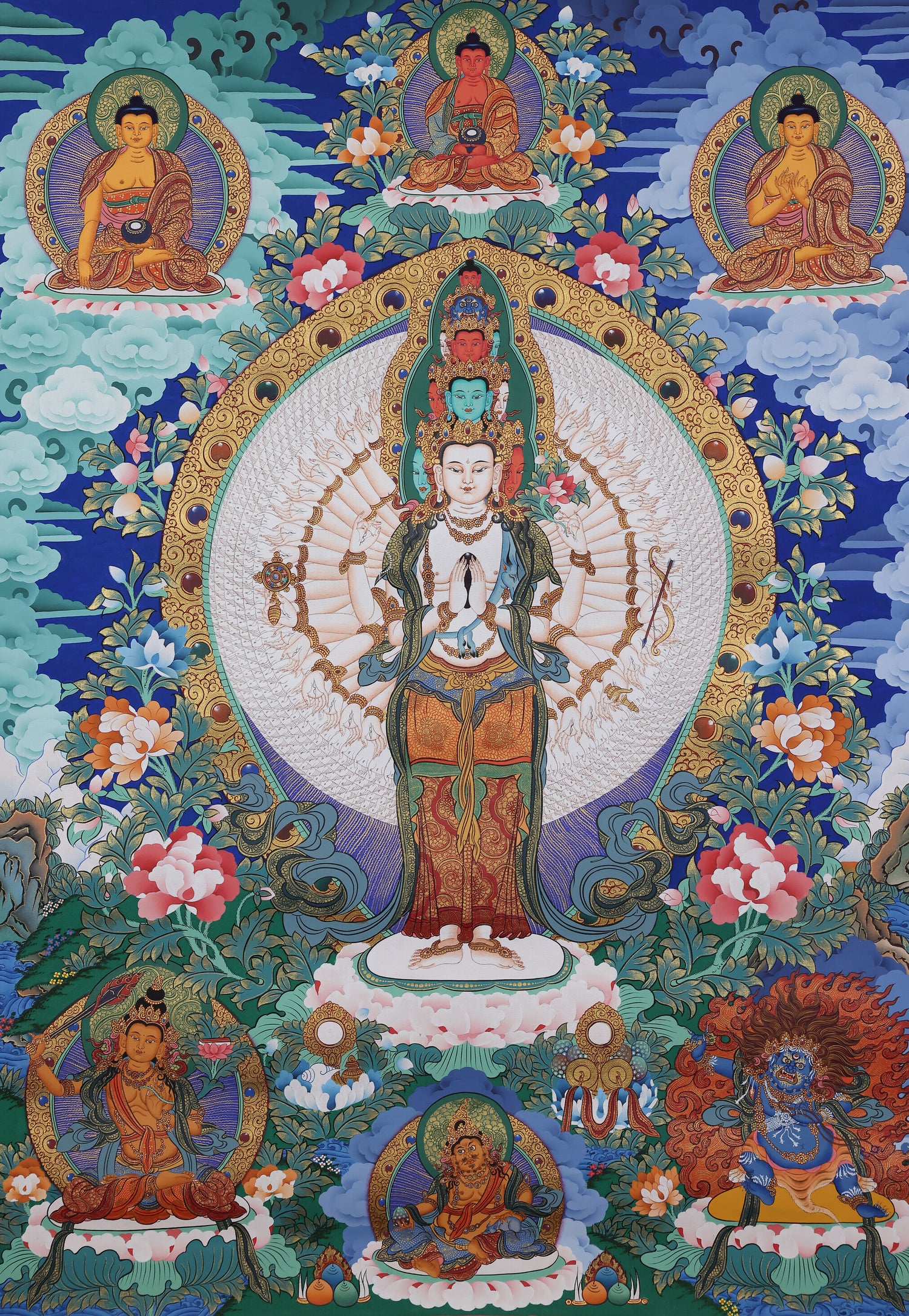
This hand-painted Thousand-Armed Thousand-Eyed Avalokiteshvara Mandala Thangka places the Bodhisattva of Compassion at its sacred center, integrating strict mandala structure with the refined techniques of the Regong (Rebkong) painting tradition. It transforms the vast vow of universal compassion and liberation of beings into a form that can be contemplated, venerated, and practiced with.
This work is both a masterpiece of Tibetan sacred art and a spiritual vessel carrying Avalokiteshvara’s boundless compassion and wisdom.
I. Core Theme: The Mandala of Thousand-Armed Avalokiteshvara
— Compassion and Wisdom as a Cosmic Order
The central theme of this Thangka is the Mandala of Thousand-Armed Thousand-Eyed Avalokiteshvara.
In Tibetan Buddhism, a mandala is not simply a geometric pattern, but a sacred cosmogram—a structured field of enlightened energy representing the universe, the path of practice, and the awakened mind itself.
-
The Thousand Arms symbolize infinite skillful means employed to liberate sentient beings.
-
The Thousand Eyes symbolize boundless wisdom that perceives the suffering and needs of all beings across the six realms.
-
The mandala structure organizes this compassion and wisdom into a harmonious and ordered spiritual universe.
The entire composition forms a complete cycle of liberation:
Primary Vow → Supportive Deities → Liberation of Beings.
It responds both to worldly aspirations—relief from suffering, protection, peace—and to spiritual cultivation, guiding practitioners toward awakening through compassion.
II. The Central Deity: Iconography of Thousand-Armed Avalokiteshvara
— Every Detail as a Code of Compassion
At the center of the mandala stands Thousand-Armed Thousand-Eyed Avalokiteshvara, depicted in strict accordance with traditional iconometric texts such as the Iconometry Sutras and Avalokiteshvara ritual manuals. Every detail carries precise symbolic meaning.
1. The Eleven-Faced Form: Gentleness and Wrath United
The Bodhisattva is shown with the classic Eleven-Faced form:
-
The central face is peaceful, embodying tenderness, patience, and solace.
-
The surrounding and upper faces appear wrathful, symbolizing the forceful wisdom needed to shatter deep-rooted afflictions.
This is not emotional contradiction, but a core Mahayana principle:
Compassion manifests in different forms according to the needs of beings.
2. Thousand Arms and Thousand Eyes: Infinite Liberation
The radiating arms represent countless methods of salvation;
the eye within each palm signifies omniscient awareness of suffering.
Together, they present a powerful visual teaching of the union of compassion and wisdom, allowing the viewer to feel reassurance, stability, and profound trust simply through contemplation.
3. Implements and Ornaments: Compassion in Action
Some hands hold sacred implements such as lotus flowers and prayer beads:
Celestial garments and jeweled ornaments express the Bodhisattva’s radiant dignity, while the golden and soft pink halo behind the figure symbolizes compassion as illuminating light, pervading all directions.
III. Attendant Deities: The Functional Network of Compassion
The surrounding deities are not decorative elements but form a systematic network of enlightened assistance.
-
Buddhas above the mandala signify that Avalokiteshvara’s compassion arises from awakened wisdom and never departs from right view.
-
Peaceful Bodhisattvas on the sides specialize in healing, longevity, and karmic purification.
-
Wrathful and protector deities remove severe obstacles and negative conditions with fierce compassion.
Together, they create a complete and effective field where compassion is not symbolic, but functional and responsive.
IV. Painting Technique: The Sacred Discipline of Regong Thangka Art
This Thangka is executed in the Regong (Rebkong) tradition, where painting itself is considered a form of spiritual practice.
1. Sacred Materials
-
Thick cotton canvas, repeatedly prepared and polished to a mirror-like surface;
-
Natural mineral pigments such as lapis lazuli, cinnabar, and malachite, symbolizing the enduring nature of compassionate wisdom;
-
24K pure gold used to illuminate halos and ritual objects, representing unchanging enlightened clarity.
2. Ritualized Technique
-
Gentle orchid-leaf lines are used for the Bodhisattva’s form, conveying softness and mercy;
-
Strong iron-wire lines are used for wrathful figures, expressing resolute wisdom;
-
Multiple translucent color layers create warmth, depth, and lifelike presence.
Throughout the process, artists maintain focused awareness and devotional discipline, allowing the Thangka to become not just an image, but a carrier of compassionate energy.