A Complete System of Compassionate Liberation, Sacred Iconography, and Black-Gold Craftsmanship
Within the artistic system of Tibetan Buddhist thangka painting, Black Gold Thangka (Tibetan: Nagthang) represents one of the most solemn and spiritually concentrated forms. Through the striking contrast of a deep black ground and radiant gold linework, this tradition is regarded as especially capable of carrying esoteric teachings and enlightened vows.
When Green Tara serves as the principal deity, the black-gold format acquires even greater significance. Known for her swift compassion and immediate responsiveness to suffering, Green Tara is among the most revered female deities in Tibetan Buddhism. A Black Gold Green Tara Thangka is therefore not merely a religious artwork, but a fully realized visual practice system—integrating doctrine, meditation, ritual, and craftsmanship into a single sacred image.
This thangka is truly meant to be contemplated, enshrined, and practiced with, functioning as a living support for devotion and inner cultivation.
I. Core Theme: Green Tara and the Vow to Liberate from the Eight Fears
The central theme of this thangka arises from one of Green Tara’s most essential practices: the liberation from the Eight Fears. Green Tara (Tibetan: Drolma) is revered as an emanation of Avalokiteśvara’s boundless compassion and is known as the deity who “responds swiftly to all who call upon her.”
According to traditional teachings, the Eight Fears include both outer dangers and inner afflictions:
On a deeper level, these dangers symbolize the inner poisons of attachment, anger, ignorance, pride, and doubt. Through visualization and devotion to Green Tara, practitioners seek not only protection from worldly adversity, but also purification of the mind and liberation from cyclic existence.
The black-gold composition adds profound Vajrayāna philosophical meaning:
-
Black represents the ultimate nature of reality (dharmadhātu), emptiness, and the primordial ground beyond form.
-
Gold symbolizes awakened wisdom and luminous clarity.
The interplay between black and gold visually expresses the Vajrayāna principle of wisdom arising within ignorance and compassion manifesting within samsara, elevating Green Tara’s protection from worldly assistance to ultimate liberation.
II. Principal Deity: Iconographic Accuracy and Sacred Symbolism
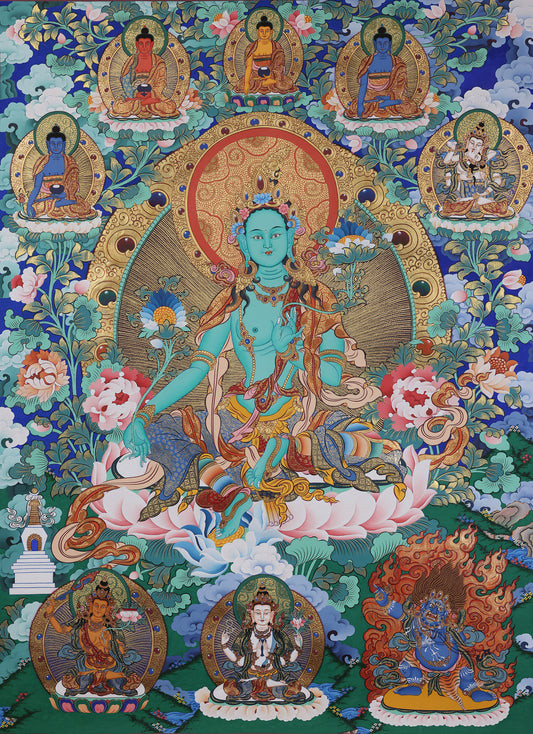
The central figure of Green Tara in this thangka strictly follows the prescriptions of the Iconometric Treatises (Pratimālakṣaṇa) and traditional Tara sādhanas. Every detail is intentional and doctrinally precise.
1. Body Color and Facial Expression
Green Tara’s body is rendered in emerald green, corresponding to the wisdom family of Amoghasiddhi, symbolizing vitality, purification, and the fulfillment of enlightened activity. Her face appears as that of a sixteen-year-old maiden—soft, radiant, and timeless—conveying both feminine grace and eternal compassion beyond worldly aging.
2. Posture and Hand Gestures
She is depicted in royal ease posture (lalitāsana): the left leg folded upon the lotus seat, the right leg extended and resting upon a small lotus. This posture signifies her readiness to rise instantly to aid beings.
-
The right hand forms the gesture of supreme generosity, granting protection and wishes.
-
The left hand, held at the heart in the Three Jewels gesture, holds the stem of a blue utpala lotus.
The lotus blooms at three stages—bud, blossom, and fruit—symbolizing Green Tara’s vow to liberate beings across the past, present, and future.
3. Adornments and Sacred Attire
Green Tara wears the Five-Buddha Crown, representing the complete integration of the Five Wisdoms. Her body is adorned with the Eight Bodhisattva Ornaments, while flowing celestial garments are rendered in the classic U-shaped folds characteristic of the Menri tradition. These details reflect both scriptural accuracy and the perfected form of a sambhogakāya deity.
III. Retinue and Symbolic Support Structure
Although the composition emphasizes the principal deity, the surrounding symbolism preserves the full ritual structure of Green Tara practice.
-
Upper Register: Often features Amitābha Buddha or Avalokiteśvara, affirming Green Tara’s origin in awakened compassion and the continuity of dharmakāya, sambhogakāya, and nirmāṇakāya.
-
Protective Forces: Wrathful guardians or Vaiśravaṇa symbolize external protection, safeguarding both Dharma and practitioner.
-
Offering Symbols: The double lotus throne, makara motifs, jewels, and ritual implements visualize offerings and aspirations for liberation from afflictions and the accumulation of merit and wisdom.
Together, these elements form a complete system of liberation, protection, and accomplishment.
IV. Black Gold Craftsmanship: Art as Spiritual Practice
This thangka belongs to the Rebgong (Amdo) Black Gold Raised-Gold tradition, where artistic creation itself is regarded as a form of Buddhist practice.
1. Ground Preparation: Purification from the Beginning
High-quality cotton or silk is stretched, sized, and polished repeatedly until smooth as a mirror. The black ground is prepared from magnetite powder blended with deer horn ash and yak-hide glue, applied in multiple thin layers. Each stage is performed with mantra recitation, symbolizing purification of mental obscurations.
2. Pure Gold Linework
Only 24K pure gold is used. Gold leaf is ground with an agate tool for over 36 hours into a fine paste. Using the raised-gold technique, the lines are subtly elevated, producing a luminous, sculptural effect that shifts with light—symbolizing wisdom dispelling darkness.
3. Mineral Pigments and Iron-Line Drawing
Green Tara’s emerald hue is created from azurite blended with pearl powder, ensuring permanence and symbolic depth. Garments, lotus petals, and ornaments are rendered using iron-line drawing, with each line precisely controlled according to iconometric standards.
A high-quality Black Gold Tara Thangka often requires months of focused, disciplined work, making the time invested itself a form of devotion and meditative alignment with the deity.
Conclusion: A Living Thangka, A Continual Response of Compassion
This Black Gold Green Tara Thangka is not a static decorative object, but a living support for spiritual practice. It transforms abstract teachings—compassion, emptiness, and enlightened activity—into a visible, approachable sacred presence.
For practitioners, it serves as the manifestation of the yidam.
For homes and sacred spaces, it offers protection and harmony.
For collectors, it represents the convergence of faith, artistry, and time-honored tradition.
Within the profound contrast of black and gold, Green Tara’s compassion arises from emptiness itself—reminding all who behold her that liberation is never distant, and compassion is always present.
#TibetanBuddhism
#GreenTaraThangka
#BlackGoldThangka
#Nagthang
#TaraBuddhism
#CompassionAndProtection
#LiberationFromEightFears
#VajrayanaBuddhism
#SacredBuddhistArt
#HandPaintedThangka
#RebgongArt
#HimalayanArt
#MeditationArt
#SpiritualPractice
#BuddhistThangka