I. Spiritual Core: The Padmasambhava Thangka as a "Visual Scripture" of Tibetan Vajrayana
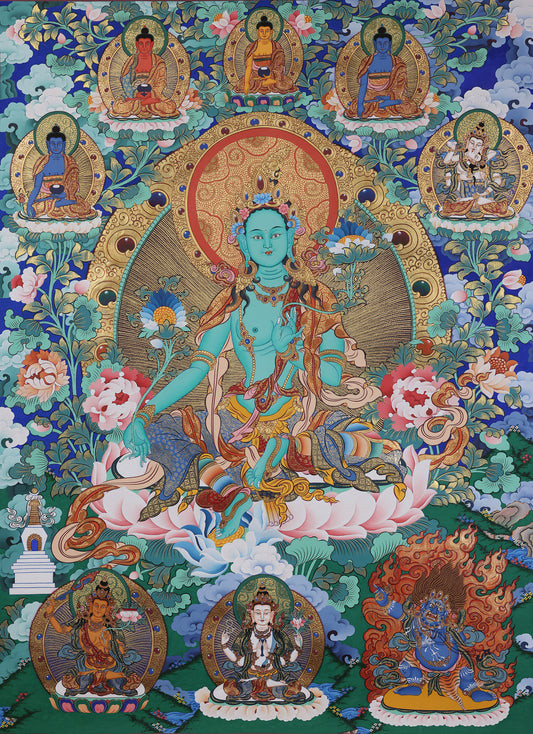
The core theme of this thangka is Padmasambhava, revered in Tibet as the "Second Buddha." As the founder of Tibetan Vajrayana, thangkas of Padmasambhava are never mere "aesthetic creations"—they are religious offerings crafted strictly according to tantric rituals. Every element of the composition corresponds to a system of "dharma transmission, protection, and practice": the main deity represents "incarnate blessings," the attendant deities symbolize "lineage continuity," and even colors and ritual implements encode the esoteric meaning of "uniting wisdom and compassion."
For Tibetan practitioners, this thangka is both an object of daily worship and a "visualization realm" for Vajrayana practice: gazing at Padmasambhava’s slightly wrathful face calls to mind his vow to subdue obstacles; noting the details of his ritual implements prompts meditation on the wisdom to overcome the three poisons (greed, anger, delusion).
II. The Main Deity and Attendant Deities: A "Cosmic System of Faith" in a Small Space
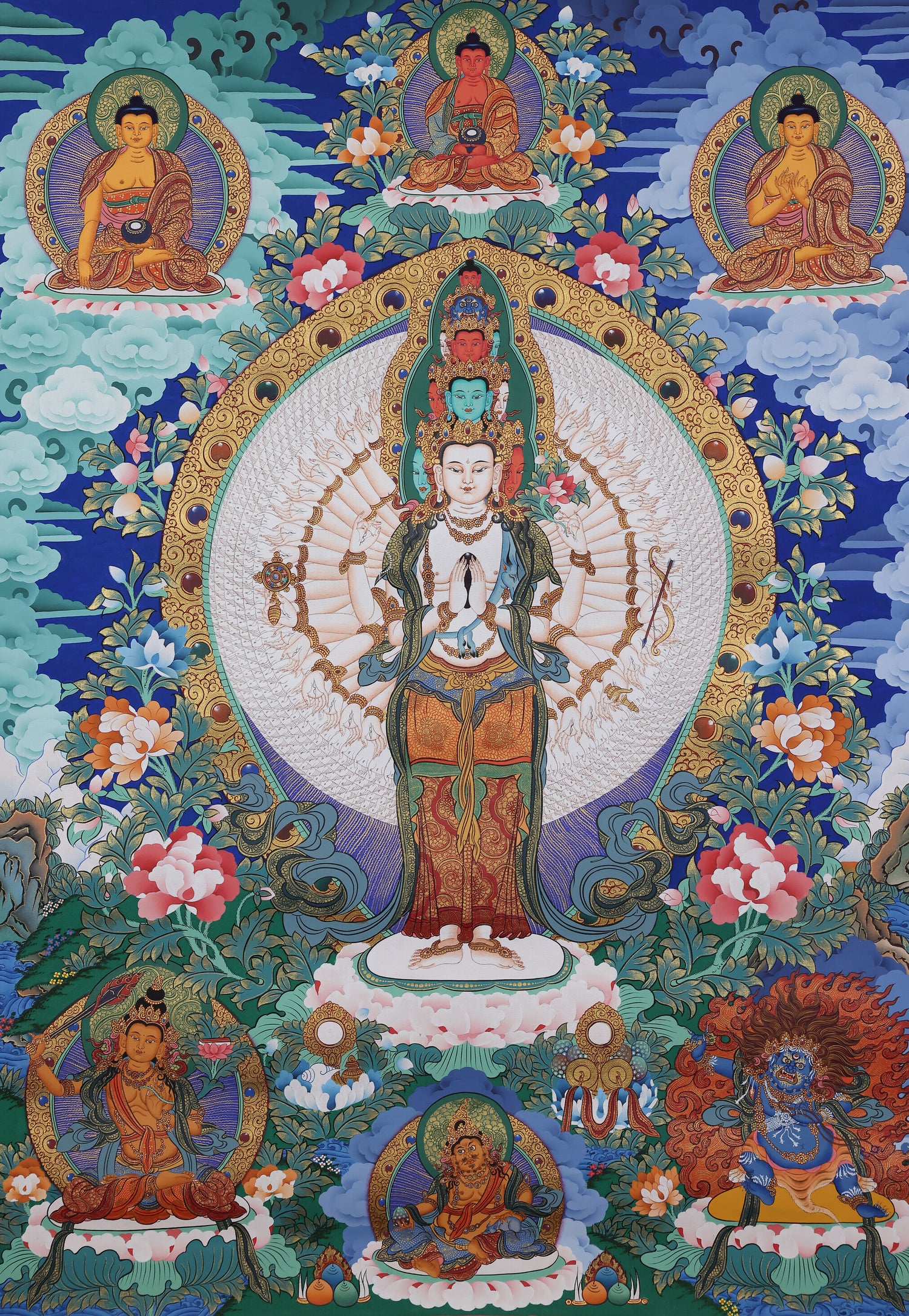
Within the 50×70cm frame, the thangka constructs a complete "deity cosmos":
-
Central Deity: The Symbolic Code of Padmasambhava
Padmasambhava wears the attire of a Sahor king, with an orange kasaya and sapphire inner robe—orange represents "wisdom fire," sapphire "emptiness water," embodying the union of wisdom and compassion. His right hand holds a vajra to shatter delusion; his left hand supports a kapala (skull bowl) holding "perfect blessings"; his left elbow rests on a khatvanga (staff) piercing three human heads, targeting the three poisons. His half-lotus posture on a lotus throne echoes the legend of his birth from a lotus—every detail aligns precisely with the
Iconographic Measurements Scripture.
-
Attendant Deities: A Layout of Transmission and Protection
Above, Amitabha (Dharmakaya) and Four-Armed Avalokiteshvara (Sambhogakaya) form the Vajrayana core of "three bodies in one" with the main deity; below, the translator Vairocana (dharma transmission) and the dakini Yeshe Tsogyal (dakini protection) complete the loop of "lineage continuity." This "central main deity, surrounding attendants" layout reflects Tibet’s "three realms, five directions" cosmology and guides practitioners along the path from faith to realization.
III. Millennium-Old Craft: The "Time Magic" of Mineral Pigments
Painted with traditional Tibetan mineral/earth pigments, this thangka’s craftsmanship is itself "living intangible heritage":
-
The Durability Code of Pigments: Cinnabar (red), azurite (blue), and malachite (green) are ground to micron levels via the "water-flotation method," with lightfastness exceeding 300 years; 24K gold leaf, hammered to 0.12μm, is mixed with aged cow glue, and layered "gradation techniques" give the gold patterns both luster and depth.
-
The "Spiritual Ritual" of Production: From preparing the linen base with 3–5 layers of polished lime-cow glue paste, to sketching with charcoal per the Iconographic Measurements Scripture, to 3–5 layers of "dark-to-light" gradation—artisans must observe precepts and meditate before painting: creation itself is a practice.
IV. Menri School Style: The Inclusive Aesthetics of Tibet
As a work of the Menri school, this thangka balances solemnity and local character:
- Scattered perspective highlights the main deity, with attendants separated by "square shrines" for balanced density;
- Strong contrasts of warm gold, cinnabar, and azurite align with Tibet’s "sacredness through color" aesthetic, while incorporating Han Chinese gongbi gradation techniques;
- Scrollwork and lotus patterns on robes blend Indian-Nepalese decorative traditions with local Tibetan kelsang flower motifs—an embodiment of inclusive art.
#TibetanThangka #Padmasambhava #MenriSchool #MineralPigmentThangka #TibetanBuddhistArt #IntangibleHeritageCraft #ThangkaAnalysis #TibetanCulture #ColorThangkaCraft #PadmasambhavaThangka