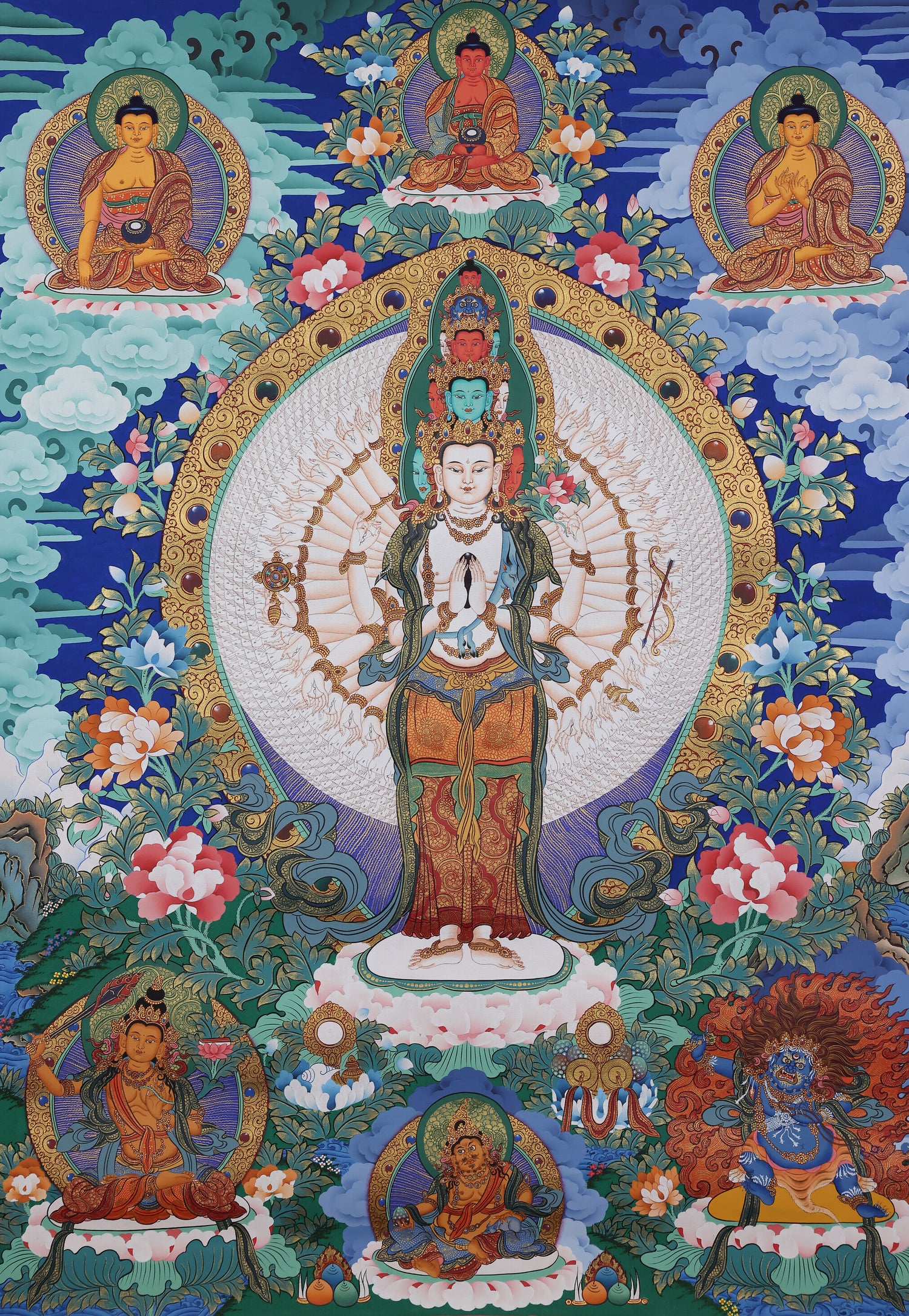
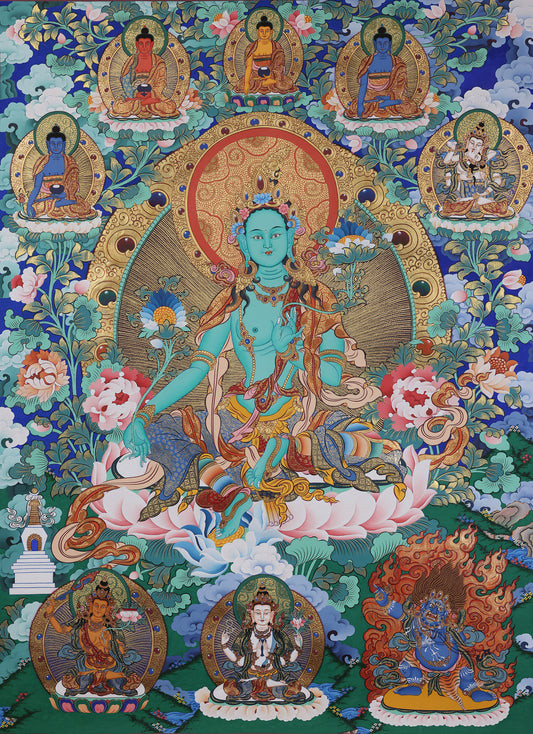
When you hold a 20×20cm hand-painted Nepalese Thangka in your palm, you’re not just grasping a decorative artwork—you’re holding the "microcosmic sacred realm" of Tibetan Buddhist cosmology. This is the Auspicious Vase Mandala Thangka we’ll dissect today: rendered in natural mineral pigments, it embodies the spiritual aspirations of Tibetan Buddhism and stands as a quintessential example of Nepal’s "exquisite micro-painting" Thangka tradition.
I. What Is a Tibetan Buddhist Mandala?
In Tibetan Buddhist culture, a mandala is far more than a pattern—it is a "gathering place of Buddhas and sacred beings." Its nested circle-square geometric structure symbolizes the cosmic order of "transcending secular suffering to reach the enlightened realm of the Buddha’s pure land":
- The outer circle represents the "all-pervading, unobstructed nature of the Dharma Realm";
- The middle square fortress (called the vijaya) symbolizes the "solid boundary of the Buddha’s pure land";
- The inner circle embodies the "pure essence of the principal deity."
Mandala Thangkas function both as "spiritual maps" for practitioners (who meditate on the patterns to merge with the Buddha’s realm) and visual carriers of Tibetan Buddhism’s "sacred space." As a key birthplace of Tibetan Thangkas, Nepal’s hand-painted mandalas balance rigorous ritual norms with a soft, artistic sensibility.
II. The Core of the Auspicious Vase Mandala: Amitayus Buddha’s Longevity Aspirations
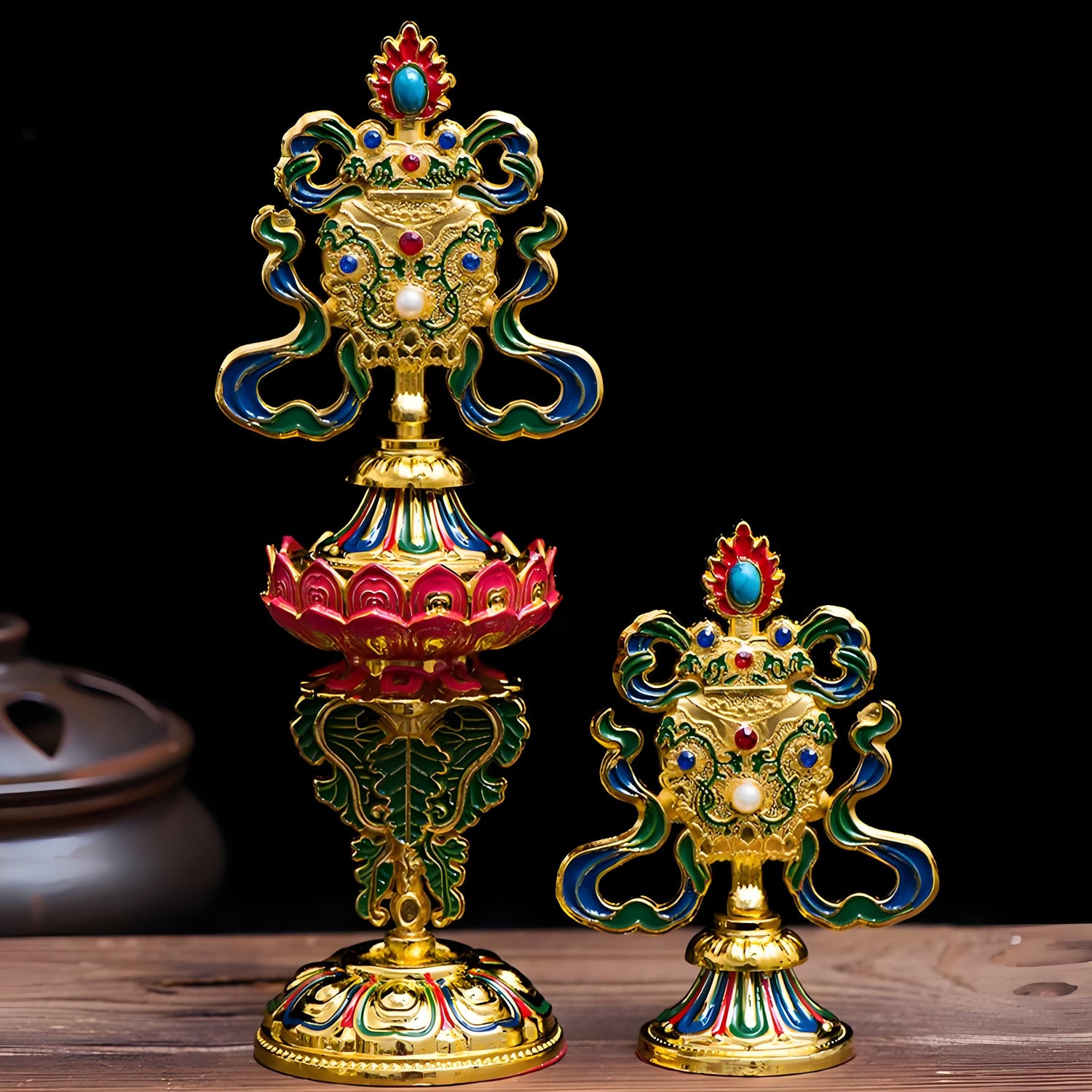
This 20×20cm Thangka centers on the theme of the "Amitayus Buddha Longevity Vase Mandala"—a ritual implement symbolic mandala (using the principal deity’s iconic ritual tool instead of a 具象 statue). The core element, the "auspicious vase," is the signature implement of Amitayus Buddha (the sambhogakaya form of Amitabha in Tibetan Buddhism).
In Tibetan Buddhism, the auspicious vase carries layered meanings:
- Filled with nectar and jewels, it symbolizes the "untainted merit and wisdom inherent in Buddha-nature";
- The red lotus surrounding the vase corresponds to Amitayus Buddha’s "enlightened realm of pure, unblemished clarity";
- The vase itself embodies Amitayus Buddha’s vow: "to free sentient beings from the fear of death and grant them ultimate peace."
For practitioners, the meditation logic of this mandala is: by focusing on the vase’s details, one gradually dissolves attachment to "birth, old age, sickness, and death," and aligns with Amitayus Buddha’s vows of longevity and the dual accumulation of merit and wisdom. This explains the popularity of small "portable mandalas" in Tibetan Buddhism: they allow practitioners to construct a "pure Buddha-land" anytime, anywhere.
III. Hidden Sacred Beings in the Mandala’s Geometry: Symbols of Attendant Deities
The mandala’s square fortress and decorative elements are not mere aesthetic flourishes—they are the symbolic gathering of attendant deities, with each motif corresponding to beings that uphold the principal deity’s vows:
-
Protection of the Three Longevity Deities: White Tara and Ushnisha Vijaya
Amitayus Buddha’s core attendants form the "Three Longevity Deities," echoed in this mandala through symbols:
- The seven-petaled lotus patterns (red petals, blue outlines) at the four fortress gates represent White Tara—her "seven eyes that see sentient beings’ suffering" correspond to the vow of "healing illness and extending life";
- The triangular "victory banner symbols" in the fortress’s geometric patterns signify Ushnisha Vijaya—she dispels all obstacles to practice, granting sentient beings a peaceful death and abundant merit.
-
Worldly Blessings: Vaishravana and the Eight Auspicious Symbols
Nepalese mandalas often balance "enlightened spiritual goals" with "worldly blessings":
- The curved fold patterns in the outer circle symbolize the "umbrella" of Vaishravana (the wealth-protecting guardian deity), representing "protection of the devotee’s resources and safety";
- The vase itself, lotus motifs, and scrollwork correspond to the "vase," "lotus," and "endless knot" among Tibetan Buddhism’s Eight Auspicious Symbols—combining secular and sacred blessings of "completeness, purity, and unobstructed Buddha-wisdom."
IV. Nepalese Hand-Painting Techniques: The Eternity in Mineral Pigments
The value of this Thangka lies in its traditional craftsmanship—and the 20×20cm size showcases the precision of Nepal’s "exquisite micro-painting" tradition:
-
Carrier and Pigments: Sacred Metaphors in Natural Materials
- The base is cotton cloth treated with four steps: washing, sun-drying, stretching, and coating with a yak-glue and gypsum layer. Its fine, smooth texture suits micro-painting and symbolizes the "stability of the Buddha’s pure land";
- All pigments are natural mineral and earth materials:
- Red (lotus petals): Sourced from local cinnabar ore in Nepal, its rich, oxidation-resistant hue symbolizes "the warmth of life and the Buddha’s compassion";
- Blue (lotus outlines): Ground from Afghan lapis lazuli, representing the "profound clarity of the Dharma Realm";
- Green (fortress patterns): Derived from malachite ore, corresponding to "the growth and continuity of merit";
- Gold (lines): Made from 24K gold powder mixed with yak glue, symbolizing "the unchanging, indestructible nature of Buddha-nature."
-
Stylistic Traits: Fusion of Tibetan Rituals and Nepalese Art
Unlike the bold lines of Tibetan Thangkas, this mandala’s scrollwork and geometric patterns feature "rounded curves"—a reflection of Nepal’s "soft aesthetic." At the same time, its proportions strictly follow the
Iconometry Sutra (the square fortress’s side length equals 1/12 of the "Buddha-body measurement"), ensuring ritual accuracy.
The 20×20cm size makes it a "portable mandala": suitable for meditation on a practitioner’s altar, or for framing and hanging in a home (in Tibetan custom, mandalas are believed to "ward off negative energy and gather blessings").
V. The Contemporary Significance of the Auspicious Vase Mandala: Value of the Microcosmic Sacred Realm
Today, this small mandala Thangka transcends its role as a "meditation tool": it is an artistic specimen of Tibetan-Nepalese cultural fusion (Tibetan ritual norms + Nepalese hand-painting techniques) and a "living heritage of traditional craftsmanship" (mineral pigments, hand-painting skills).
For collectors, it is a "tangible expression of Tibetan Buddhist cosmology"; for cultural enthusiasts, it is a visual textbook for understanding "suffering as enlightenment"—every line and pigment embodies the Tibetan wisdom of "integrating the sacred into daily life."
#NepaleseHandPaintedMandalaThangka
#AuspiciousVaseMandalaThangka
#TibetanBuddhistMandalaExplained
#AmitayusBuddhaMandala
#NepaleseThangkaMineralPigmentTechnique
#20cmPortableMandalaThangka
#TibetanBuddhistAttendantDeitySymbols
#TibetanNepaleseCulturalFusionThangka
#ThangkaCosmologyMetaphor
#HandPaintedThangkaCollection