Within the vast and refined spiritual system of Tibetan Buddhism, Green Tara (Sanskrit: Śyāmatārā, also known as The Swift Liberator) stands as one of the most compassionate and approachable deities. She embodies immediate compassionate response, fearless protection, and the perfected awakening of feminine wisdom.
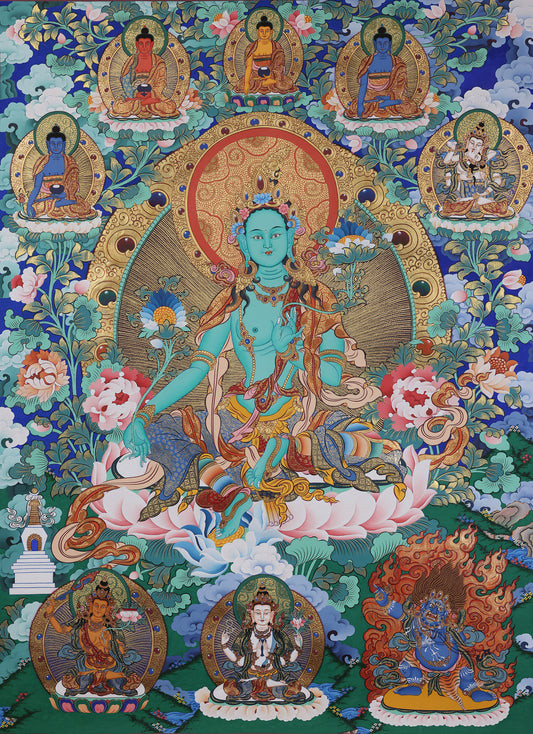
This hand-painted Tibetan Green Tara color thangka is created around that core devotion. It is not merely a religious image, but a sacred visual embodiment of tantric ritual, a spiritual anchor suitable for shrine offerings, personal meditation, household blessings, and contemporary spiritual healing.
I. The Principal Deity: Iconography and Ritual Meaning of Green Tara
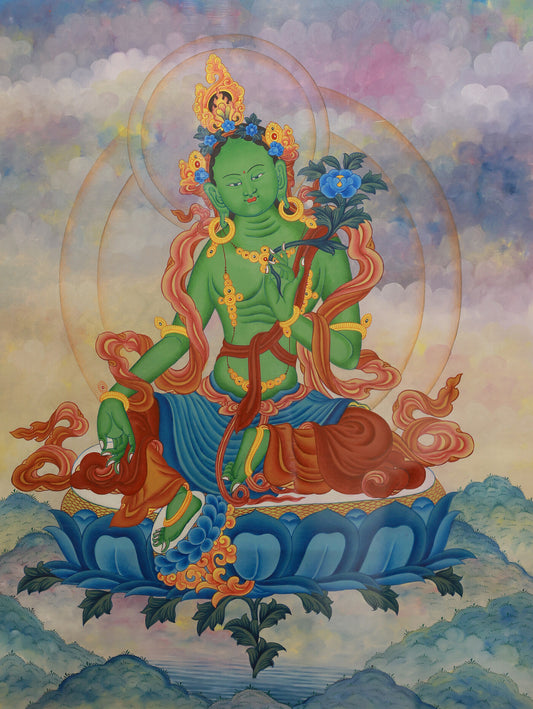
At the center of the composition sits Green Tara, rendered strictly according to the Iconometric Scriptures and traditional Tara Sadhana texts. Nothing here is arbitrary; every detail follows a precise ritual logic that serves her defining quality — swift liberation.
1. Sacred Form and Symbolic Attributes
Green Tara’s body is depicted in a vivid emerald green, symbolizing vitality, healing, and the ever-renewing force of awakened compassion. Within the Five Buddha system, green corresponds to the eastern direction and the quality of growth and increase.
Her youthful, celestial appearance — gently arched brows, downcast compassionate eyes, and a soft, serene smile — expresses both feminine grace and fearless resolve. At her crown rests Amitāyus Buddha, identifying her as an emanation of Avalokiteśvara’s boundless compassion.
She wears a utpala (blue lotus) mala at her neck, signifying discipline upheld through compassion. Her partially bare upper body is adorned with golden ornaments and jeweled garlands, symbolizing unobstructed compassion that embraces all beings without distinction.
2. Mudras and Sacred Implements
Her right hand extends gracefully over her knee in the Gesture of Supreme Generosity (Varada Mudra), palm outward, offering protection, fearlessness, and immediate aid.
Her left hand, held near the heart, gently holds the stem of a blooming utpala blue lotus, whose petals rise to her shoulder. The lotus represents purity arising within samsara, while the extending stem signifies that her compassionate activity reaches all realms without limitation.
3. Seat and Halo
Green Tara sits in a relaxed half-lotus posture upon a double-layered blue lotus throne, the lower petals accented with gold to symbolize compassion arising from suffering. Beneath the lotus lies a landscape of flowing green waters and gentle hills, evoking the pure realm described in Tara scriptures — the lotus-filled sanctuary where she abides.
Behind her form radiate dual halos: an inner ring of soft golden flame patterns symbolizing awakened power, and an outer ring of pink and violet auspicious clouds, expressing her gentle, nurturing mode of liberation.
II. The Hidden Pure Land: The Logic of the Single-Deity Thangka
This thangka adopts the traditional single-deity composition, with Green Tara as the sole figure supported by a symbolic environment. While no attendant deities are depicted, the composition subtly reveals a complete sacred cosmology.
1. Environment as Sacred Assembly
The surrounding pink-violet clouds and verdant waters are not decorative elements, but symbolic manifestations of Green Tara’s Pure Land. This approach, rooted in the Menthang School, uses sacred landscape to reveal divine presence, allowing the image to remain visually serene while spiritually complete.
2. The Viewer as Participant
In Tibetan visualization practice, the intentional openness of a single-deity thangka invites the practitioner to enter the Pure Land mentally and become one of the beings receiving liberation. The connection between deity and observer is direct and immediate — liberation is not distant or abstract, but occurs in the very moment of contemplation.
III. Painting Craftsmanship: The Compassionate Aesthetic of Menthang Color Thangka
This work represents a refined example of Menthang-style color thangka, where craftsmanship itself becomes a form of spiritual practice — an offering of body, speech, and mind.
1. Canvas Preparation
The painting is executed on hand-stretched cotton cloth, prepared through twelve traditional processes including soaking with yak-hide glue, repeated application of chalk ground, and polishing with river stones. The resulting surface is smooth, luminous, and resilient — considered a purified foundation capable of receiving the sacred image. Throughout this process, the artist recites Green Tara mantras to sanctify the support.
2. Natural Mineral Pigments
All pigments are derived from natural minerals, chosen for both symbolic and aesthetic resonance:
-
Green tones: finely ground malachite and turquoise, producing a living, botanical green that embodies healing vitality.
-
Blue lotus and throne: Afghan lapis lazuli, refined through traditional separation techniques to achieve a deep, transcendent blue associated with pure realms.
-
Gold detailing: 24K gold leaf ground into liquid gold, applied in layered gradients and burnished with agate to create a soft, radiant glow — noble yet gentle, echoing the nature of compassion itself.
3. Line Work and Consecration
Line drawing is executed with brushes made from sable hair, combining flowing “cloud lines” for garments with firm, disciplined strokes for halos and lotus petals. The deity’s subtle ritual markings, including the Seven Eyes of Tara, are rendered with extreme precision in accordance with iconographic tradition.
The final stage, known as “opening the face,” is performed after ritual purification, with each facial feature completed in a single, irrevocable stroke. Upon completion, the thangka undergoes traditional scriptural insertion, mantra sealing, and a seven-day consecration ceremony, transforming it from artwork into a living sacred object.
IV. Cultural Essence: Compassionate Liberation in Contemporary Life
This Green Tara thangka is more than a religious symbol; it is a living expression of Tibetan Buddhism’s philosophy of compassion. Her gesture dispels fear, her lotus rises unstained from suffering, and her vibrant green radiates renewal and healing — qualities deeply resonant with modern emotional and spiritual needs.
From an art historical perspective, the work reflects a harmonious integration of Chinese gongbi line refinement and Tibetan iconographic rigor, standing as a living testament to cross-cultural exchange. From a devotional standpoint, it affirms that compassion is not removed from daily life, but intimately present within it.
For expectant mothers seeking protection, women practitioners seeking spiritual guardianship, or anyone longing for calm, clarity, and inner strength, Green Tara offers a presence that is swift, gentle, and profoundly reassuring.
#GreenTara
#GreenTaraThangka
#TibetanThangka
#TibetanBuddhistArt
#BuddhistThangka#Compassion
#SpiritualProtection
#HealingEnergy
#MeditationArt
#SacredArt#HandPaintedThangka
#TraditionalThangka
#MineralPigmentArt
#MenthangStyle
#HimalayanArt#HomeAltar
#BuddhistDecor
#Mindfulness
#SpiritualHealing
#YogaMeditation