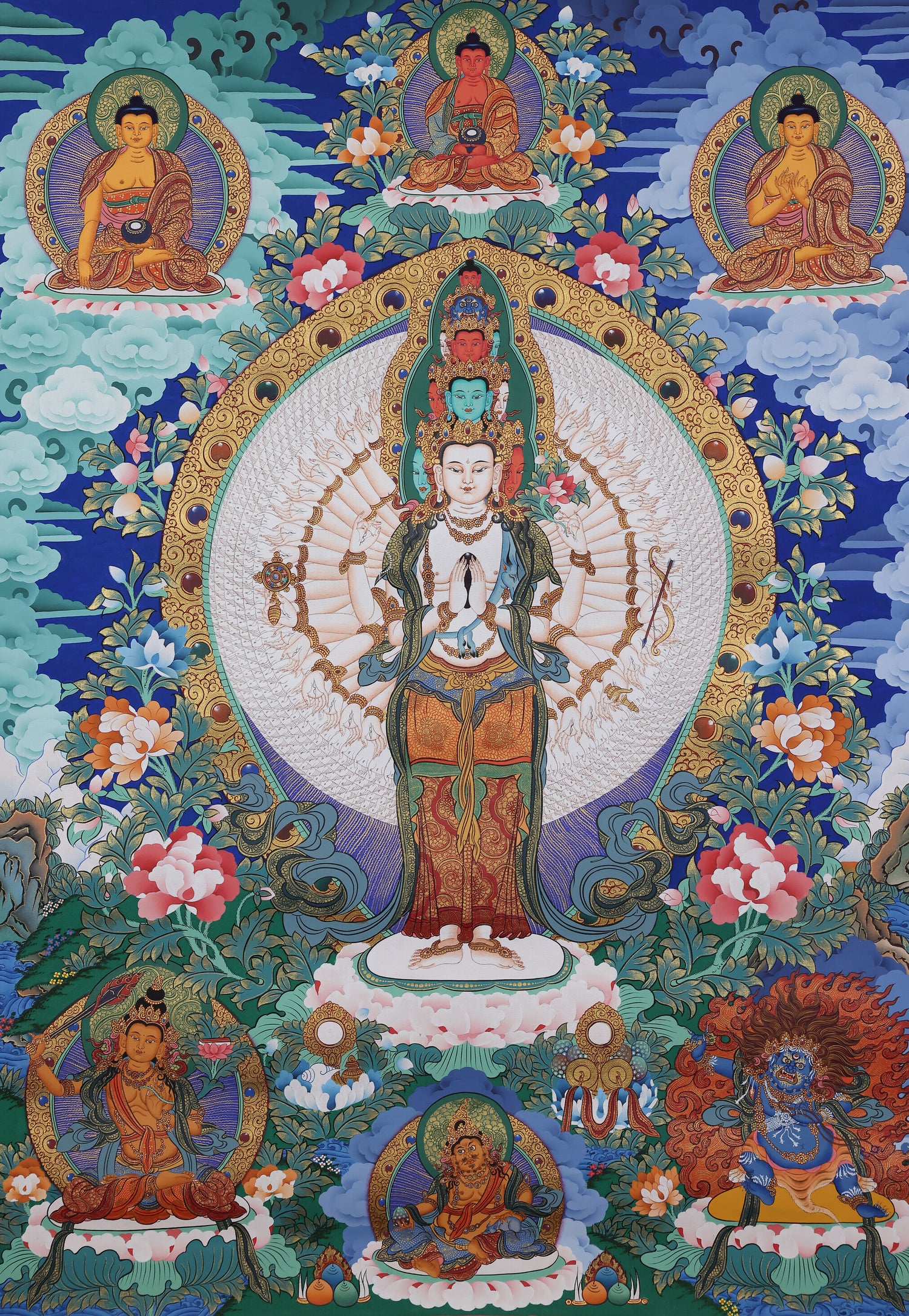
Black-Gold Ākāśagarbha Bodhisattva Thangka in Tibetan Buddhism

$699.00 USD
Thangka Name: Black Gold Akasagarbha Bodhisattva
Size: 43cm*58cm
Orgin: Nepal
Eine Frage stellen

Beeil dich! Nur noch [Anzahl] auf Lager!

Geschätzte Lieferzeiten: 12–26 Tage (International), 3–6 Tage (USA).

Rückgabe innerhalb von 45 Tagen nach dem Kauf. Zölle und Steuern werden nicht erstattet.

Hand-painted Tibetan Buddhist thangka depicting Akasagarbha Bodhisattva, symbol of wisdom and accumulated merit.
Black-Gold Ākāśagarbha Bodhisattva Thangka in Tibetan Buddhism
$699.00 USD

— An Esoteric Symbol of Perfect Merit and Wisdom · Iconographic Canon · In-Depth Analysis of Traditional Black-Gold Craftsmanship

Within the artistic system of Tibetan Buddhism, a thangka is far more than a painting; it is a “visible form of the Dharma for contemplation.” It serves both as a medium through which practitioners connect with the yidam deity and as a visual expression of Tibetan philosophy, cosmology, and faith. This hand-painted black-gold Ākāśagarbha Bodhisattva thangka constructs a solemn and mysterious spiritual space through the powerful contrast of a deep black ground and radiant gold lines. In terms of doctrinal theme, iconographic discipline, and traditional craftsmanship, it exemplifies the high maturity and profound heritage of Tibetan Buddhist art.


I. Core Theme: The Treasury of Space — An Esoteric Symbol of the Union of Merit and Wisdom

This thangka enshrines Ākāśagarbha Bodhisattva (Sanskrit: Akāśagarbha) as the principal deity, one of the “Eight Great Bodhisattvas” in Tibetan Buddhism. The name “Ākāśagarbha,” meaning “Treasury of Space,” signifies that wisdom, merit, and wealth are as boundless as space itself. It symbolizes both the perfection of ultimate wisdom and the safeguarding of worldly blessings and the accumulation of spiritual resources for sentient beings.

Within Tibetan Buddhist practice systems, Ākāśagarbha Bodhisattva is revered as a guardian of precepts and wisdom. Scriptures describe him as “steadfast in discipline like Mount Sumeru, vast in wisdom like space.” He protects practitioners from violations of vows and deluded conduct, wields the sword of wisdom to sever ignorance, and grants wish-fulfilling jewels to satisfy rightful aspirations. Consequently, the practice of Ākāśagarbha has long been regarded as a supreme path in which merit and wisdom advance together.

By choosing Ākāśagarbha Bodhisattva as the central figure, this black-gold thangka visually articulates the ideal of the “union of merit and wisdom,” resonating deeply with Tibetan devotees’ aspirations for worldly stability, success in endeavors, growth in wisdom, and ultimate liberation.


II. Iconography of the Principal Deity: Strict Canon, Precise Symbolism

The depiction of Ākāśagarbha Bodhisattva in this thangka strictly follows the Iconometric Scriptures of Buddhist Images and tantric ritual prescriptions. Every detail carries explicit religious symbolism.

Body Color and Auspicious Marks

The deity’s body appears in celestial blue, the most representative color of Ākāśagarbha. In Tibetan Buddhism, blue corresponds to the “Dharma realm of space,” symbolizing wisdom that pervades all phenomena. The face is full and dignified, complete with the Thirty-Two Major Marks and Eighty Minor Signs. The white urna between the brows signifies awakened awareness and insight; the gently lowered eyes convey a serene, compassionate gaze upon all beings.

Mudrās and Attributes

The right hand holds the sword of wisdom, its blade pointing into space, symbolizing the severing of ignorance and afflictions through insight. The left hand forms the boon-granting mudrā, supporting a wish-fulfilling jewel upon a lotus. The lotus represents freedom from defilement, while the jewel signifies the fulfillment of aspirations and the accomplishment of merit—together expressing Ākāśagarbha’s essential teaching of “upholding merit through wisdom.”

Attire and Posture

The Bodhisattva wears a Five-Buddha crown, symbolizing the perfected virtues of the Five Tathāgatas. Draped in celestial garments and jeweled ornaments with the right shoulder subtly exposed, the figure embodies the classic peaceful Bodhisattva form, signifying non-attachment to appearances and direct realization of the true nature of mind. Seated in full lotus posture upon a multi-tiered lotus throne, the deity represents enlightenment that abides in the world without being stained by it.


III. Retinue and Protectors: A Blessing System Hidden Within Ornamentation

Unlike complex compositions featuring multiple explicitly depicted figures, this black-gold thangka employs an “implicit retinue” approach characteristic of esoteric expression. Attendant deities are not rendered as distinct forms but are integrated into the background patterns and symbolic system, lending the composition an inward, dignified solemnity.

Around the halo of the principal deity appear motifs of the Eight Auspicious Symbols and the Seven Royal Treasures. These are not mere decorations but signify the protective forces and accumulative resources governed by Ākāśagarbha, conveying blessings of protection, increase, and perfection. Subtly embedded in the background is the seed syllable “Hūṁ,” the core mantra syllable of Ākāśagarbha, symbolizing the subjugation of afflictions and the stabilization of right mindfulness.

Flowing wish-granting cloud motifs encircle the entire composition, representing the formless yet omnipresent protective power of the ḍākinīs and Dharma protectors, endowing the minimalist image with a complete and profound esoteric structure.


IV. Painting Technique: Black-Gold Thangka as a Form of Practice

This thangka is executed using the highly demanding Nāthang (black-gold thangka) technique, in which the act of creation itself is a form of spiritual cultivation.

Ground and Pigments

The canvas is made from high-altitude pure cotton cloth. After stretching, gluing, and repeated polishing, the surface becomes smooth as a mirror, symbolizing a purified mind. The black ground is prepared from magnetite powder, calcined deer horn ash, and natural charcoal, creating a deep, weighty tone that represents the essence of the Dharma realm. The gold lines are rendered using 24K pure gold, ground over long periods into fine powder and then prepared as pigment, symbolizing the indestructibility of the Dharma and the eternity of wisdom.

Line Work and Raised-Gold Technique

Using an extremely fine brush made from weasel or cat whiskers, the artist draws even, flowing gold lines upon the black ground. The folds of the garments are executed in the traditional “orchid-leaf line” style, following natural curves with vitality while maintaining solemnity. Certain ornamental details employ the raised-gold technique, causing the lines to stand slightly proud of the surface and reflect light differently from various angles—symbolizing wisdom manifesting according to conditions.

Facial Opening and Ritual Procedure

The painting of the face is the most sacred stage of thangka creation. The artist must purify the body, recite mantras, and complete the facial features within meditative visualization, transforming the artwork from a mere aesthetic object into a consecrated support for practice, veneration, and contemplation.


V. Cultural Value: The Integration of Faith, Art, and Contemporary Collecting

This black-gold Ākāśagarbha Bodhisattva thangka represents a living transmission of Tibetan Buddhist art. The black ground continues the ancient Bön cosmological reverence for darkness as the source of existence, while the gold lines embody the luminous wisdom of Buddhism, reflecting the profound integration of indigenous Tibetan culture and Buddhist philosophy.

#TibetanBuddhism
#ThangkaArt
#AkashagarbhaBodhisattva
#BlackGoldThangka
#NāthangThangka
#EsotericBuddhism
#MeritAndWisdom
#SacredIconography
#BuddhistArt
#HimalayanArt
#HandPaintedThangka
#TraditionalBuddhistArt
#MeditationArt
#SpiritualHeritage

Entdecken Sie das perfekte tibetisch-buddhistische Thangka, das zu Ihren Wünschen, Ihrem Lebensstil und Ihrem Raum passt. Jedes Thangka hat eine spirituelle Bedeutung und bringt Segen, wenn es richtig platziert wird.

1. Definieren Sie Ihre Absicht

Reichtum & Erfolg → Gelber Dzambhala (Gottheit des Reichtums)

Mitgefühl und Frieden → Avalokiteshvara, Grüne Tara

Weisheit & Lernen → Manjushri

Gesundheit & Heilung → Medizinbuddha

Langlebigkeit und Familienschutz → Weiße Tara

2. Wählen Sie nach Identität

Unternehmer und Geschäftsinhaber → Reichtumsgottheiten für Wohlstand.

Studenten und Gelehrte → Weisheitsgottheiten für Konzentration und Klarheit.

Heiler und Yoga-Praktizierende → Medizinbuddha für Energie und Gleichgewicht.

Familien und Hausfrauen → Tara-Gottheiten für Harmonie und Sicherheit.

Sammler und Kunstliebhaber → Seltene Mandalas oder Meisterwerk-Thangkas.

3. Passen Sie Ihren Raum an

Heimschrein / Meditationsraum → Mittlere Thangkas (60–80 cm).

Büro / Geschäftshalle → Große Thangkas für Wohlstand und Autorität.

Wohnzimmer / Arbeitszimmer → Dekorative Thangkas für Frieden und Schönheit.

4. Authentische Handwerkskunst

Jedes Thangka ist mit natürlichen Mineralpigmenten und feiner Leinwand handbemalt und spiegelt tibetische Kunstfertigkeit und spirituelle Kraft wider. Überprüfte Quellen gewährleisten Qualität und Respekt für die Tradition.

✨ Wählen Sie Ihr Thangka mit Herz – es ist nicht nur Kunst, sondern ein Segen für Ihr Leben.

Jeder Mensch hat unterschiedliche Bedürfnisse. Die Wahl des richtigen Thangkas kann spirituelle Unterstützung, Schutz, Glück und Segen bieten. Nachfolgend finden Sie Thangka-Empfehlungen für verschiedene Rollen:

1. Unternehmer

  • Bedürfnisse : Weisheit, Reichtum, Gesundheit, beruflicher Erfolg.
  • Empfohlene Thangkas :
    Manjushri : Verbessert die Entscheidungsfindung und Geschäftsweisheit.
    Gottheit des Reichtums : Bringt Reichtum und Wohlstand.
    Medizinbuddha : Unterstützt die Gesundheit und reduziert Stress.
    Mahakala : Schützt Unternehmen vor Konkurrenz und Herausforderungen.

2. Erfolgreiche Einzelpersonen

  • Bedürfnisse : Innerer Frieden, Familienharmonie, Langlebigkeit.
  • Empfohlene Thangkas :
    Amitabha Buddha : Bringt inneren Frieden und Ruhe.
    Avalokiteshvara (Guanyin) : Fördert Harmonie und Glück in der Familie.
    Amitayus (Langlebens-Buddha) : Betet für gute Gesundheit und ein langes Leben.
    Manjushri : Stärkt weiterhin die Weisheit.

3. Hausfrauen/Ehemänner

  • Bedürfnisse : Familienharmonie, Schutz, Gesundheit.
  • Empfohlene Thangkas :
    Avalokiteshvara : Steigert das Familienglück und die Harmonie.
    Schutzgottheiten : Beschützen die Familie vor äußeren Störungen.
    Weiße Tara : Segnet die Familie mit Gesundheit.

4. Studierende und Wissenschaftler

  • Bedürfnisse : Weisheit, Konzentration, akademischer Erfolg.
  • Empfohlene Thangkas :
    Manjushri : Fördert Lernfähigkeit, Gedächtnis und Weisheit.
    Shakyamuni Buddha : Hilft bei der Konzentration und spirituellen Praxis.
    Jixiang Tianmu : Bringt akademisches Glück und Prüfungserfolg.

5. Künstler und Kreativprofis

  • Bedürfnisse : Inspiration, Kreativität, künstlerische Leistung.
  • Empfohlene Thangkas :
    Manjushri : Regt kreatives Denken und Inspiration an.
    Vajrapani : Hilft, kreative Blockaden zu überwinden.
    Maitreya : Sorgt für eine entspannte und optimistische Einstellung und baut Stress ab.

6. Reisende und Abenteurer

  • Bedürfnisse : Schutz, Glück, Erfolg bei Abenteuern.
  • Empfohlene Thangkas :
    Hayagriva : Bietet starken Schutz auf Reisen und beseitigt Hindernisse.
    Mahakala : Bringt Glück und Schutz, insbesondere für Abenteurer.
    Vajrasattva : Hilft, Schwierigkeiten und Herausforderungen während der Reise zu überwinden.

7. Ältere Menschen

  • Bedürfnisse : Gesundheit, Langlebigkeit, spiritueller Frieden.
  • Empfohlene Thangkas :
    Amitayus : Betet für ein langes Leben und gute Gesundheit.
    Medizinbuddha : Fördert Heilung und körperliches Wohlbefinden.
    Avalokiteshvara : Bringt Mitgefühl und inneren Frieden in späteren Jahren.

8. Führungskräfte

  • Bedürfnisse : Führung, Weisheit, Teamarbeit und geschäftlicher Erfolg.
  • Empfohlene Thangkas :
    Manjushri : Verbessert Führungsqualitäten und Entscheidungsfindung.
    Gottheit des Reichtums : Bringt dem Unternehmen und dem Team Erfolg und Wohlstand.
    Avalokiteshvara : Fördert Harmonie und Gleichgewicht innerhalb des Teams.

9. Gesundheits- und Fitnessbegeisterte

  • Bedürfnisse : Gute Gesundheit, Vitalität, Energie.
  • Empfohlene Thangkas :
    Medizinbuddha : Verbessert die körperliche Gesundheit und Vitalität.
    Weiße Tara : Bringt Gesundheit und Verjüngung.
    Vajrasattva : Beseitigt gesundheitliche Probleme und steigert die Energie.

10. Politiker

  • Bedürfnisse : Führung, Weisheit, Frieden.
  • Empfohlene Thangkas :
    Manjushri : Verbessert Führungsqualitäten und Entscheidungsfindung.
    Vairocana Buddha : Hilft, inneren Frieden und Weisheit zu bewahren.
    Avalokiteshvara : Fördert den gesellschaftlichen Frieden und die Harmonie in der Familie.

Für alle Bestellungen über 100 USD ist der Versand kostenlos.

Rücksendungen werden bis zu 10 Tage nach Erhalt des Kaufbelegs bzw. der Sendungsnummer (bei ungetragenen Artikeln) akzeptiert. Sie als Kunde sind verpflichtet, uns vor der Rücksendung des Artikels per E-Mail zu informieren.

Andernfalls fallen die Standardversandkosten an. Weitere Informationen finden Sie in unseren Lieferbedingungen .

Rücksendungen werden bis zu 10 Tage nach Erhalt des Kaufbelegs oder der Sendungsnummer (bei ungetragenen Artikeln) akzeptiert. Sie als Kunde sind verpflichtet, uns vor der Rücksendung des Artikels per E-Mail zu informieren, nur in folgenden Fällen:

– Den falschen Artikel erhalten.
– Artikel kam nicht wie erwartet an (z. B. beschädigte Verpackung).
– Artikel hatte Mängel.
– Über die Lieferzeit hinaus.
– Der Spediteur gestattet keine Besichtigung der Ware vor der Bezahlung.

Die zurückgesendeten Produkte müssen in der Originalverpackung, sicher verpackt, unbeschädigt und ungetragen sein. Dies bedeutet, dass die Artikel zum Schutz während des Transports sicher in einem Karton verpackt sein müssen, möglichst im selben Karton, in dem sie an Sie als Kunde versendet wurden.

Kürzlich angesehen

Nicht vergessen! Die Produkte, die Sie angesehen haben, legen Sie jetzt in den Warenkorb.

Passt gut zu

Erweitern Sie Ihre Auswahl mit perfekt abgestimmtem Zubehör und ergänzenden Produkten.

Leute kauften auch

Hier sind einige unserer ähnlichsten Produkte, die die Leute kaufen. Klicken Sie hier, um den Trendstil zu entdecken.