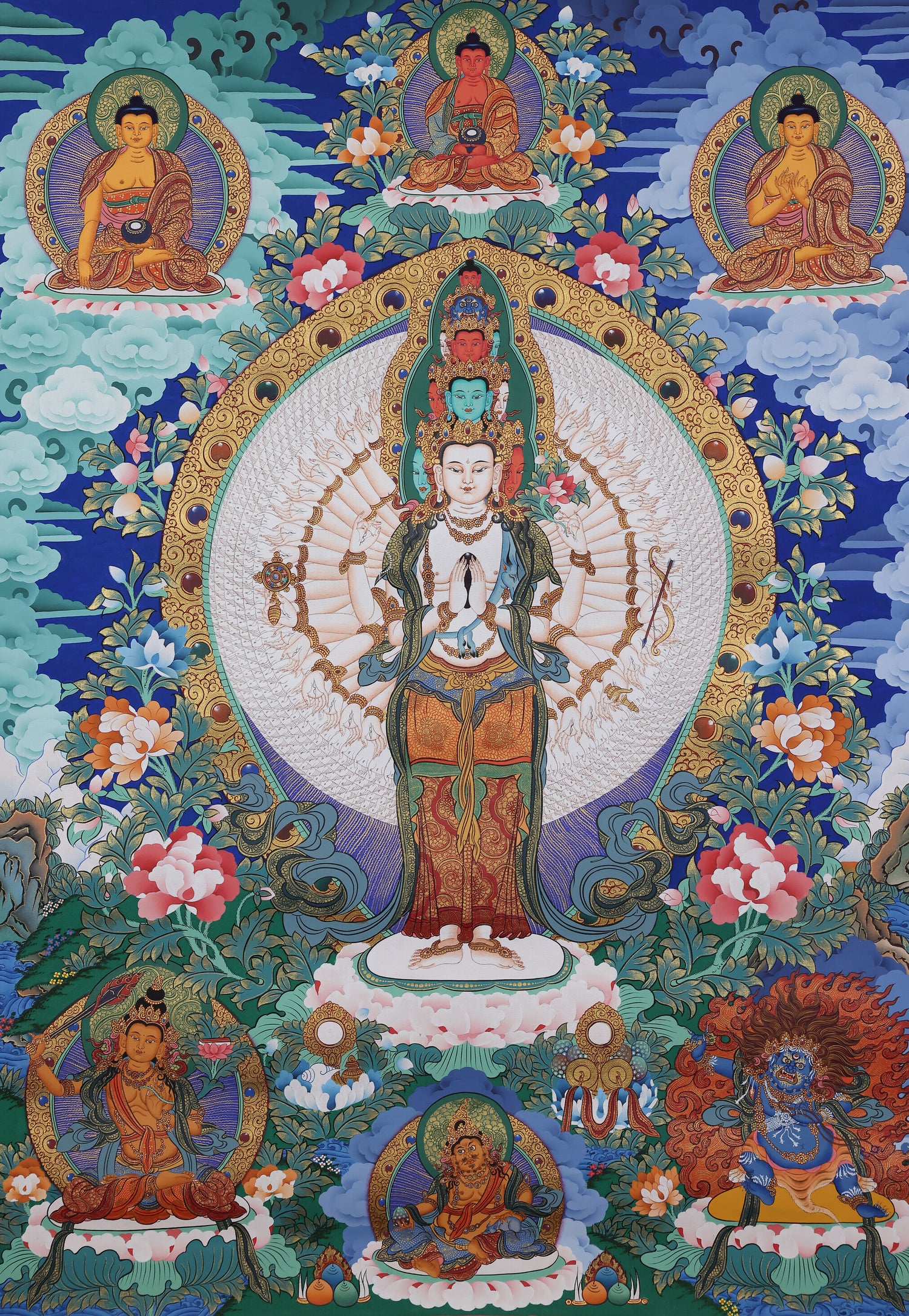
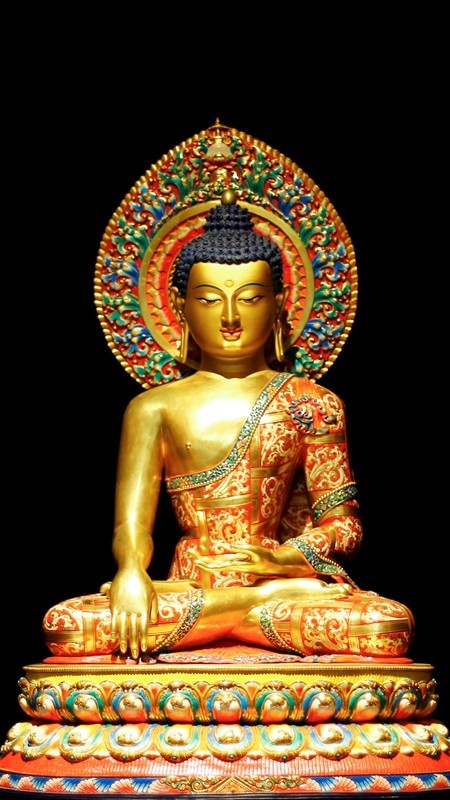
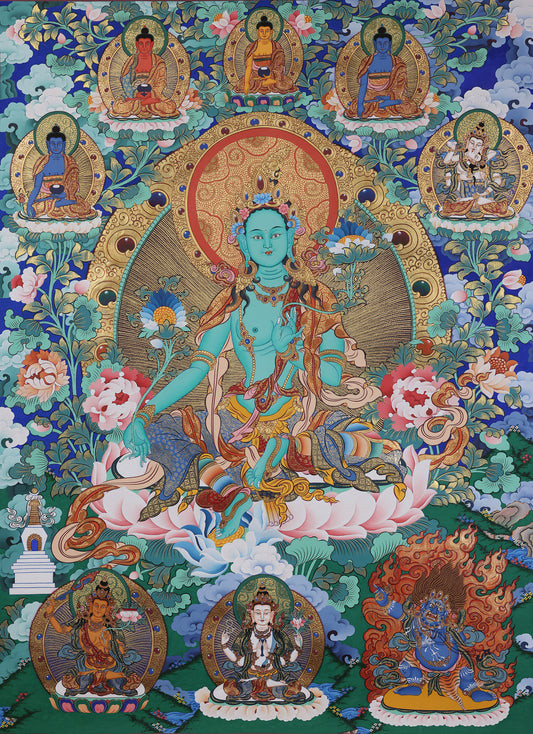
In the Tibetan Buddhist tradition, a thangka is never merely a painting. It is “visible Dharma”—a sacred support for practice, contemplation, and devotion. This hand-painted Tibetan Thangka of the Four-Faced Mahavairocana takes the supreme deity of Vajrayana Buddhism, Mahavairocana (Vairocana Buddha), as its central theme. It serves as a visual embodiment of the profound teachings of the Womb Realm and Vajra Realm Mandalas, uniting esoteric doctrine, sacred iconometry, and traditional Regong craftsmanship into a single, luminous work.
This thangka is not only an object of reverence, but also a refined cultural artifact that integrates faith, art, and philosophy into one harmonious whole.
I. Theme and Main Deity: The Manifestation of the Five Wisdoms
The central figure of this thangka is Four-Faced Mahavairocana, the primordial Buddha of Esoteric Buddhism and the embodiment of Dharmadhātu Wisdom—the ultimate nature of reality itself. Unlike historical Buddhas, Mahavairocana represents cosmic truth and awakened awareness, serving as the source from which all enlightened wisdom emanates.
1. The Meaning of the Four Faces
Mahavairocana is depicted with a pure white body, symbolizing the immaculate nature of the Dharmadhātu. He wears a Five-Buddha crown, signifying his sovereignty over the wisdoms of the Five Directions. His four serene faces gaze toward the east, south, west, and north, expressing not multiplicity of form, but the Vajrayana principle of wisdom that pervades all directions without obstruction:
-
East: Akṣobhya’s Great Mirror Wisdom, reflecting reality as it truly is
-
South: Ratnasambhava’s Wisdom of Equality, recognizing the equal worth of all beings
-
West: Amitābha’s Discriminating Wisdom, uniting compassion with insight
-
North: Amoghasiddhi’s All-Accomplishing Wisdom, fulfilling enlightened activity
These four wisdoms converge within Mahavairocana as the perfect integration of the Five Wisdoms, transforming abstract Buddhist philosophy into a form suitable for meditative visualization—an essential feature of Vajrayana practice.
2. Mudra and Seat
Mahavairocana’s hands form the Dhyāna Mudra, holding a Dharma wheel or precious vase, symbolizing unwavering meditative concentration from which wisdom flows. He sits upon an eight-petaled lotus throne, corresponding to the Eight-Petaled Court of the Womb Realm Mandala, representing the innate bodhicitta present in all sentient beings. His expression is tranquil yet majestic, embodying the silent authority of the Dharmakāya.
II. Retinue and Sacred Environment: The Mandala of the Womb Realm
Every element surrounding the main deity functions as a symbolic extension of the Womb Realm Mandala, forming a complete vision of the enlightened universe in which Mahavairocana embraces all beings.
1. Implied Retinue
Although attendant bodhisattvas are not depicted explicitly, the four faces of Mahavairocana implicitly contain the symbolism of the Four Pāramitā Bodhisattvas—Vajra, Jewel, Dharma, and Karma Pāramitā—expressing his vow to guide sentient beings through wisdom and compassionate activity.
2. Symbolic Landscape
-
Lotus and Auspicious Flowers: The lotus throne and jeweled blossoms represent the Lotus Family of the Womb Realm, symbolizing great compassion and the Vajrayana teaching that defilements themselves can become enlightenment.
-
Auspicious Clouds and Mount Meru Base: The golden clouds above and the sacred landscape below signify the Outer Vajra Court, uniting celestial deities, nature, and human realms into a vision of non-duality between the sacred and the mundane.
-
Halo and Body Radiance: The radiant golden body aura and the white-gold halo behind Mahavairocana symbolize wisdom light illuminating all directions, perfectly reflecting the meaning of “Vairocana” — the One Who Illuminates All.
III. Artistic Craftsmanship: Where Creation Becomes Practice
This thangka is executed entirely by hand using traditional Regong (Rebkong) painting techniques, a process regarded as both artistic creation and spiritual discipline.
1. Canvas Preparation
Natural linen is stretched and coated multiple times with yak-bone glue, followed by fine layers of chalk powder polished to a smooth surface. This ritualized preparation is accompanied by mantra recitation, symbolizing the purification of karmic obscurations and the readiness to receive a sacred image.
2. Natural Mineral Pigments
Only traditional mineral and botanical pigments are used, strictly following doctrinal color symbolism:
-
White: purity and ultimate reality
-
Yellow / Gold: wisdom and nobility
-
Red: compassion and vital energy
-
Green: enlightened activity and growth
Pigments are applied in multiple translucent layers, producing a luminous depth. The crystalline structure of mineral pigments resists fading, allowing the thangka’s colors to endure for centuries—an artistic reflection of the timelessness of the Dharma.
3. 24K Gold Detailing
The crown, Dharma wheel, and aura patterns are rendered with hand-ground 24K gold, mixed meticulously with natural binder. Gold symbolizes the indestructible Dharmakāya, and its application requires days of focused, meditative labor, transforming ornamentation into sacred offering.
4. Eye-Opening Ceremony
The final stage is the eye-opening ritual, performed by a qualified master using cinnabar pigment. Through mantra and concentration, the sacred presence is invoked, transforming the thangka from a painting into a consecrated object worthy of veneration.
IV. Cultural and Collectible Value: The Unity of Faith and Art
The value of this Four-Faced Mahavairocana thangka lies in its role as a living convergence of doctrine, craftsmanship, and devotion:
-
For practitioners, it is a powerful support for visualization practice and contemplation of the Five Wisdoms
-
For collectors, it exemplifies the Regong style—rich yet restrained, precise yet alive—harmonizing canonical proportions with artistic mastery
-
For cultural heritage, it stands as a testament to Tibetan Buddhism’s tradition of transmitting profound teachings through sacred art
This thangka is not an isolated artwork, but a microcosmic vision of the Buddhist cosmos. From the four faces of the main deity to the symbolism embedded in every pigment and gold line, it embodies the Tibetan cultural principle of “revealing Dharma through form, and carrying the Path through art.”
#Mahavairocana
#VairocanaBuddha
#FourFacedMahavairocana
#GreatSunBuddha
#Dharmakaya
#TibetanBuddhism
#VajrayanaBuddhism
#EsotericBuddhism
#FiveWisdoms
#MandalaArt
#TibetanThangka
#HandPaintedThangka
#RegongThangka
#SacredBuddhistArt
#24KGoldThangka
#SpiritualArtwork
#MeditationArt
#BuddhistArtCollection
#SacredArt
#HimalayanArt