In Tibetan Buddhist visual culture, a Thangka is not merely a painting.
It is a sacred spiritual map—one that connects worldly aspirations with transcendent wisdom, and devotion with daily life.
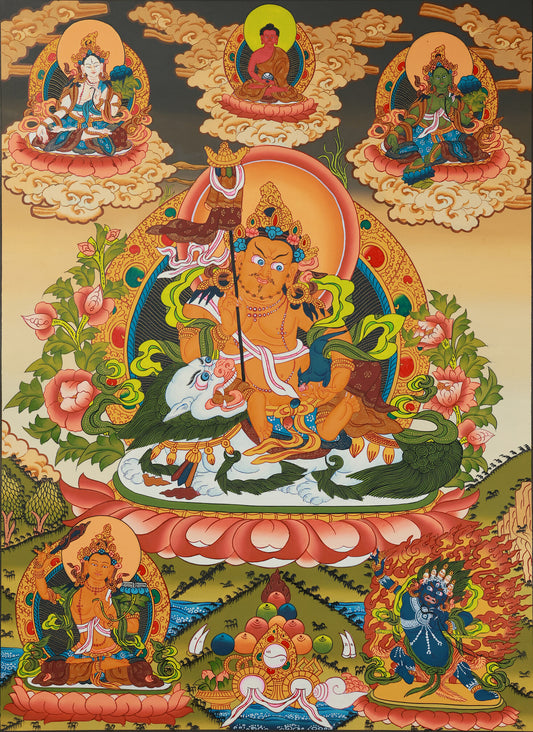
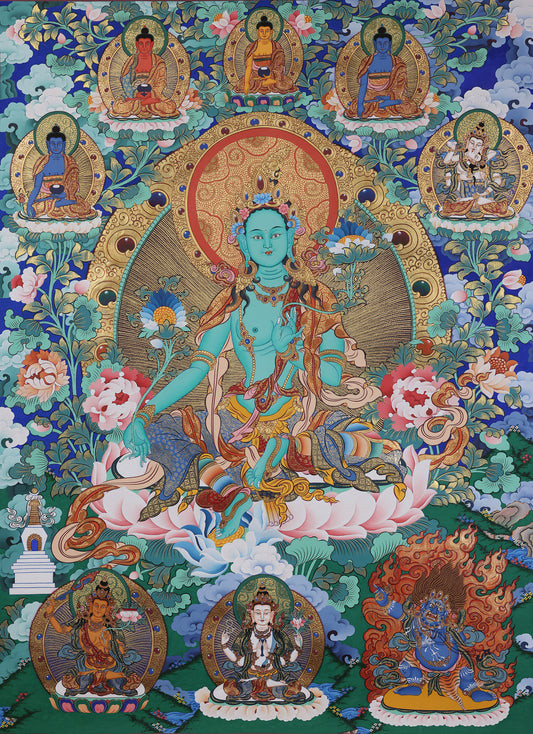
This purely hand-painted Tibetan Thangka centers on the theme of “Vaishravana Protecting the Five Directional Wealth Deities.”
Rooted in authentic Vajrayana doctrine and executed in the refined tradition of Regong Thangka painting, the work conveys prosperity without extravagance, power without aggression, and abundance guided by ethical purpose.
I. Core Theme
Wealth as Spiritual Capital, Not Worldly Indulgence
In Tibetan Buddhism, wealth is never viewed as a tool of greed.
Instead, it is regarded as spiritual capital—a necessary support for virtuous action, generosity, and the preservation of Dharma.
This Thangka embodies that philosophy:
-
Vaishravana stands at the center as the protector and distributor of wealth
-
The Five Directional Wealth Deities surround him, each governing a specific aspect of prosperity
-
Beneath and above them, protective and enlightened beings form a complete spiritual ecosystem
The composition subtly mirrors the Three Realms and Five Directions cosmology:
-
Upper Realm – Buddhas and enlightened sources of wisdom
-
Middle Realm – Vaishravana, bridging sacred wisdom and worldly life
-
Lower Realm – Wealth deities and protectors, manifesting blessings in the human world
This structure follows classical iconographic measurements prescribed in Buddhist scriptures and reflects the Vajrayana teaching:
Wisdom gives rise to merit; merit supports virtuous action.
II. The Central Deity
Vaishravana’s “Wrathful-Compassionate” Form and Symbolism
At the heart of the Thangka stands Vaishravana
(Sanskrit: Vaiśravaṇa | Tibetan: Namthöse)
He is both Guardian King of the North and the supreme wealth protector in Tibetan Buddhism.
1. Physical Appearance
Vaishravana’s body radiates golden yellow, corresponding to the jewel quality of Ratnasambhava Buddha.
His expression embodies the classic “wrathful-compassionate” form:
This reflects the Buddhist principle of protecting virtue through strength while granting blessings through compassion.
2. Attributes and Mount
-
Right Hand – Victory Banner
Symbolizes triumph over obstacles and the accumulation of merit
-
Left Hand – Treasure-Spitting Mongoose
A powerful emblem of inexhaustible wealth and generosity
-
Mount – Snow Lion
Represents mastery over fear and afflictions, and affirms his role as the Northern Guardian Deity
3. Attire and Ornaments
Vaishravana wears a Five-Buddha Crown and is adorned with pearls, coral, turquoise, and jewel ornaments.
These are not symbols of luxury, but metaphors:
Worldly treasures reflecting spiritual completeness
This aesthetic is characteristic of Regong Thangka art—opulent yet dignified, radiant yet restrained.
III. The Attendant Deities
The Five Directional Gods of Wealth and Their Functions
Surrounding Vaishravana is a complete Five Wealth Deities Mandala, each responsible for a specific form of blessing:
Upper Realm Figures
-
Central Upper Deity – Ratnasambhava Buddha
The ultimate source of wealth wisdom
-
White Tara and Green Tara
Manifestations of Avalokiteshvara, providing protection, longevity, and obstacle removal
The Five Wealth Deities
-
White Wealth Deity – Wisdom, purification, disaster relief
-
Yellow Wealth Deity – Material abundance and financial growth
-
Red Wealth Deity – Influence, attraction, noble connections
-
Green Wealth Deity – Health, vitality, career expansion
-
Black Wealth Deity – Subjugation of obstacles and negative forces
Each deity holds a treasure-spitting mongoose, reinforcing the theme of continuous prosperity and generous flow.
Lower Realm Protectors
Wrathful guardian figures at the base symbolize the removal of obstacles, ensuring that blessings can manifest smoothly in the human realm.
Together, they form a complete cycle of protection, increase, and purification.
IV. Artistic Craftsmanship
The Dual Code of Nature and Devotion in Regong Thangka
1. Natural Mineral Pigments
This Thangka is painted exclusively with traditional mineral materials:
-
24K Gold Powder – halos, crowns, sacred ornaments
-
Afghan Lapis Lazuli – sky and celestial garments
-
Malachite & Turquoise – green deities and vegetation
-
Cinnabar & Coral Powder – ornaments and floral details
-
Crushed Conch Shell – white figures and snow lions
These pigments are known to remain vivid for over 300 years, embodying the belief that sacred art should endure as long as faith itself.
2. Twelve Sacred Painting Stages
From canvas preparation to final consecration, the painting follows 12 traditional stages, including:
-
Multi-layer canvas polishing
-
Golden-ratio proportional drafting
-
Five to seven layers of color shading
-
Ultra-fine gold line detailing (as thin as 0.1 mm)
-
Final Eye-Opening Ritual, performed in meditation
This final step is not technical—it is spiritual, believed to awaken the presence within the Thangka.
3. Regong Artistic Style
-
Centralized radial composition
-
Harmonized high-saturation colors with cooling blues and greens
-
Dense yet precise detailing
Every flower, jewel, and strand of the snow lion’s mane reflects the principle:
Devotion expressed through precision
Conclusion
A Living Vessel of Faith and Blessing
This Thangka is not simply a “wealth painting.”
It is a visual embodiment of Tibetan Buddhist philosophy—where prosperity is guided by wisdom, protected by ethics, and dedicated to the benefit of all beings.
Whether placed in a home shrine, meditation space, or refined interior, it serves as:
The colors of a Thangka do not fade—
just as true faith never grows cold.
TibetanBuddhism
#WealthAndAbundance
#MeditationSpace
#HomeShrine
#BuddhistPainting
#SpiritualProtection
#SacredPainting
#ArtWithMeaning#TibetanThangka
#BuddhistArt
#Vaishravana
#WealthDeity
#RegongThangka
#HandPaintedThangka
#SacredArt
#SpiritualWealth
#BuddhistBlessings